A serious accident can change your life in seconds, but you don't have to face it alone.
If you're reading this after a refinery blast, a plant fire, or a sudden chemical release, you're probably dealing with pain, confusion, and a lot of bad advice. Some people are workers. Some are contractors. Some were just nearby when the explosion happened. Your legal path depends on which group you're in, and that's where a lot of families get steered wrong from the start.
The Texas refinery explosion injury lawyer you hire should sort out fault fast, preserve evidence, and push back when insurers try to shrink a serious case into a cheap settlement. If you were burned, inhaled smoke, lost a loved one, or were exposed near the site, you need a plan that fits your situation, not a one-size-fits-all script.
What a Refinery Explosion Really Means for You and Your Family
A refinery explosion isn't just a loud blast or a headline. It usually means a sudden failure in a high-risk industrial setting, followed by burns, smoke inhalation, falling debris, panic, and rushed decisions by everyone on scene. For families, it can mean ICU visits, missed paychecks, and long-term changes that don't show up in the first hour.
The first thing I tell people is simple. You need to know which lane you're in.
Three groups face different legal paths
If you were a direct employee, your claim may involve workers' compensation, employer fault issues, and a separate third-party investigation if someone else helped cause the blast. If you were a contractor or subcontractor, your case may turn on the refinery operator, another contractor, equipment defects, or unsafe site control. If you were a bystander, nearby resident, or motorist, you may have a negligence or toxic-exposure claim even though you never clocked in at the plant.
That distinction matters because the best recovery often comes from the responsible party outside your immediate employer. Texas law also turns on negligence and third-party fault in refinery cases, not just whether the injury happened on the job (Texas law on explosions at work).
You do not have to figure out the legal path while you're still trying to heal. Get the facts preserved first, then let the liability analysis follow.
A serious refinery case can also involve people who weren't working there at all. Nearby residents and motorists may need a different analysis if smoke, chemicals, or debris reached them. If your situation overlaps with oilfield or industrial work, this resource can also help you understand how these claims are handled in Texas, oilfield accident claims in Texas.
What to Do in the First Hours and Days After the Explosion
The first 72 hours matter more than most people realize. The decisions you make right away can protect a future claim, or wreck it.
Get medical care even if you think you're “okay.” Burn pain, inhalation injuries, and internal damage don't always feel dramatic at first. If you waited to get checked because you wanted to be tough or avoid a scene, stop doing that now. Tell the doctor exactly what happened, where you were, and what symptoms started afterward.
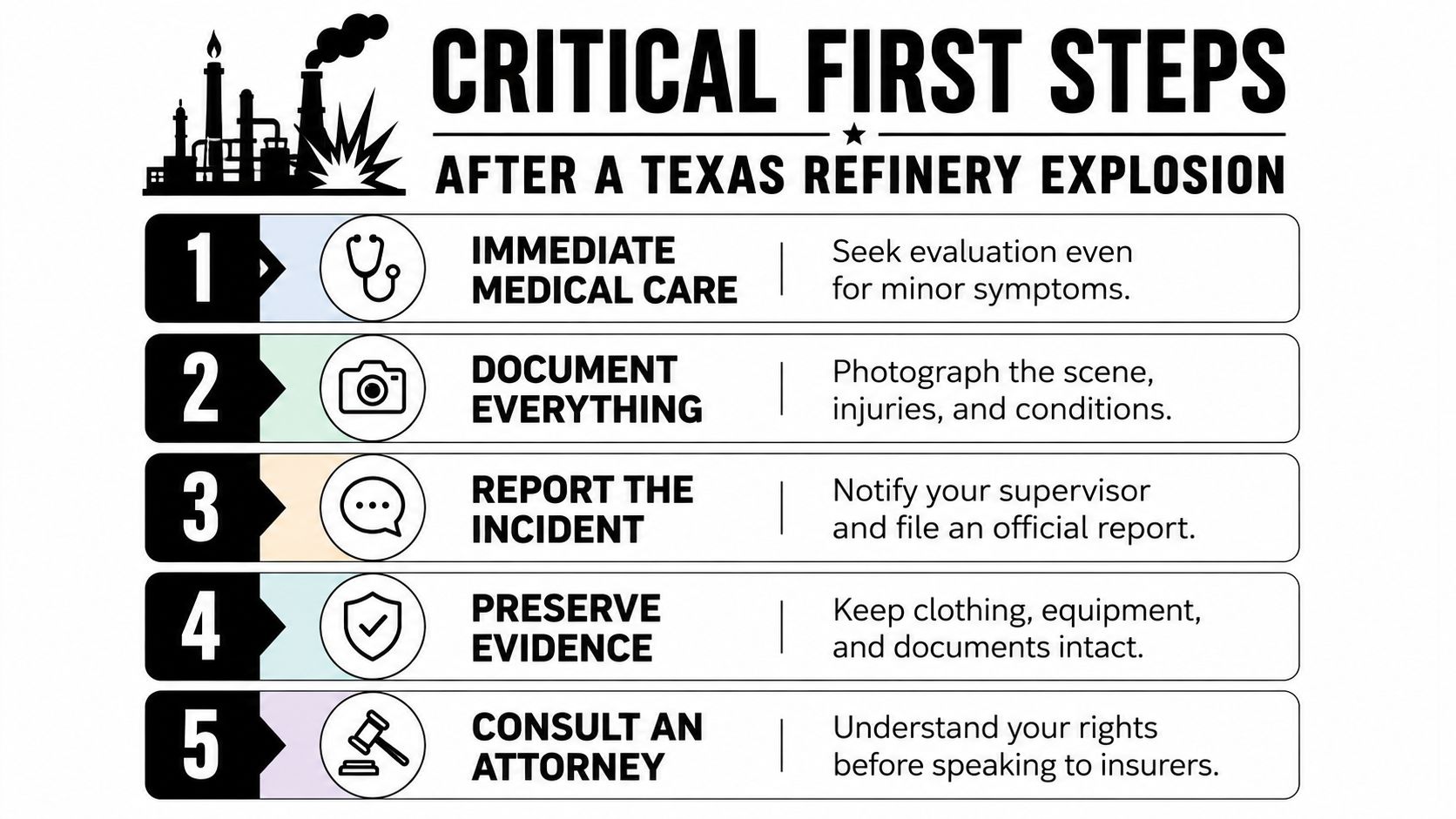
Report the incident to the appropriate supervisor, but keep your own record of what you said and when you said it. Don't guess, don't fill in gaps you're unsure about, and don't let an insurance adjuster steer the story for you. A recorded statement can be used against you later, especially if you're tired, medicated, or shaken.
Take photos of the scene, your clothing, your injuries, the equipment, warning signs, and anything else that shows conditions as they were. Get names and phone numbers for witnesses before they scatter. Save texts, work messages, and anything that shows who knew what and when.
If you're a family member helping someone through this, keep a written symptom journal. Note headaches, coughing, sleep problems, pain spikes, and every doctor visit. Also keep social media quiet. Insurers mine posts for anything they can twist into an argument that the injury wasn't serious.
Here's the short version. Treat the first days like evidence recovery, not just crisis control.
An honest medical record, clean photos, and a calm paper trail give your lawyer something real to build on. The wrong move in these first hours is often simple. You give a statement too fast, you leave the scene too quickly, or you assume somebody else already took care of the proof.
Types of Claims Available to Refinery Explosion Victims
The right claim depends on who you are and who caused the blast. That's why refinery cases are not just “injury cases.” They're usually a mix of workers' compensation, third-party negligence, wrongful death, and sometimes premises or toxic-exposure claims.
The main claim tracks in plain English
| Claim Type | Who Can File | What It Covers | Key Limitation |
|---|---|---|---|
| Workers' compensation | Injured employees | Limited medical and wage benefits | It usually doesn't pay full tort damages |
| Third-party negligence | Workers, contractors, or bystanders harmed by someone other than their direct employer | Broader damages, including pain, lost income, and future care | Must prove fault |
| Wrongful death | Families of people killed in the explosion | Funeral losses, financial loss, and family harm allowed by Texas law | Must file on time |
| Toxic-exposure or premises-liability claim | Nearby residents, motorists, or visitors exposed to smoke, fire, or unsafe site conditions | Injury and exposure damages tied to negligence or unsafe premises | Proof of exposure and causation matters |
A contractor burned in a plant fire may have more than one path at once. That person might have a workers' comp claim, a third-party claim against a negligent contractor or equipment company, and a premises claim if the refinery operator failed to keep the site safe. That's why the first legal job is to map every company on site, not just the one that paid the paycheck.
Texas also gives some cases a broader recovery path than people expect. A Car Accident Lawyer in Texas handles a different kind of injury, but the same basic principle applies, if someone else caused your losses, fault matters. The law doesn't stop at the label “work accident” or “industrial accident.”
Practical rule: If a third party helped cause the explosion, don't settle for a workers' comp-only view of the case.
Families who lost someone should also speak with a wrongful death lawyer Texas families can trust, because the value of the claim depends on both the death itself and the financial and human losses that followed. And if the injuries are severe enough to change a person's daily life forever, a truck crash lawyer Houston residents call for catastrophic crashes will understand the same kind of damage proof, even though the setting is different.
Texas Statutes of Limitations and Why Time Matters
Texas gives you a hard deadline in most refinery explosion cases. Under Texas Civil Practice and Remedies Code § 16.003, personal injury and wrongful death claims generally have a two-year statute of limitations (Texas refinery explosion deadline overview). If you miss it, your claim can die before a judge ever sees the facts.
That deadline is not just a calendar problem. It's a proof problem. Witnesses move, maintenance records get overwritten, and the scene itself changes once equipment is repaired or cleaned up.
The short notice trap is even worse in government cases
If a government entity is involved, the notice period can be as short as 180 days (Texas refinery explosion third-party timing issues). That catches a lot of people off guard, because they assume the same timeline applies everywhere. It doesn't.
The practical move is to treat the claim as live the moment you call a lawyer. That lets counsel send preservation letters, request records, and lock down witness statements before the other side controls the story.
Calling a lawyer early isn't overreacting. It's how you keep the defense from shaping the evidence first.
In refinery cases, delay hurts twice. First, it weakens your ability to prove fault. Second, it makes insurers more confident that they can push a low offer while you're still trying to understand what happened. If your injuries include burns, inhalation damage, or a long hospitalization, the paperwork can get messy fast, which is exactly why early legal help matters more than polished paperwork.
How Attorneys Investigate and Prove a Refinery Explosion Case
A refinery explosion case is usually won in the files, the equipment records, and the expert review, not in a dramatic speech. The lawyer's first job is to identify every company that touched the worksite. That includes the site operator, contractors, subcontractors, equipment vendors, maintenance crews, and anyone else who may have created or ignored the hazard.
A Gulf Coast plant walkthrough can tell the whole story
Here's how a serious investigation often unfolds. A worker is burned in a heater-unit blast at a Gulf Coast refinery. The scene gets secured, but the defense is already thinking about repairs, blame, and paperwork. The lawyer moves quickly to preserve the process-safety record, incident command notes, maintenance logs, lockout/tagout records, and witness statements before they disappear or get rewritten.
A technical review then ties the failure mode to the injury. Maybe a pressure issue led to a release. Maybe a valve position was wrong. Maybe safety instrumentation didn't work the way it should have. The medical side matters just as much, because burn depth, inhalation injury, and orthopedic trauma have to match the mechanics of the event.
That's where root-cause work matters. A good outside resource for that kind of analysis is Forge Reliability oil gas RCA, because refinery cases live or die on whether someone can explain how the system failed, not just that it failed.

The same is true for evidence preservation in ordinary injury claims. If you need a general guide on the kind of proof that supports a strong claim, what evidence is needed for an injury claim in Texas is a useful starting point.
A refinery case gets weak fast when lawyers wait around. Equipment gets repaired. Safety data gets lost. Witnesses get reassigned. The value of the claim depends less on rhetoric and more on whether the lawyer can prove who failed, how the system failed, and why that failure caused the harm.
Damages You Can Recover After a Refinery Explosion
The money question is never just about the hospital bill. A serious refinery explosion can create years of financial loss, pain, and family disruption. The law should measure the full harm, not just the emergency-room total.
The categories that matter most
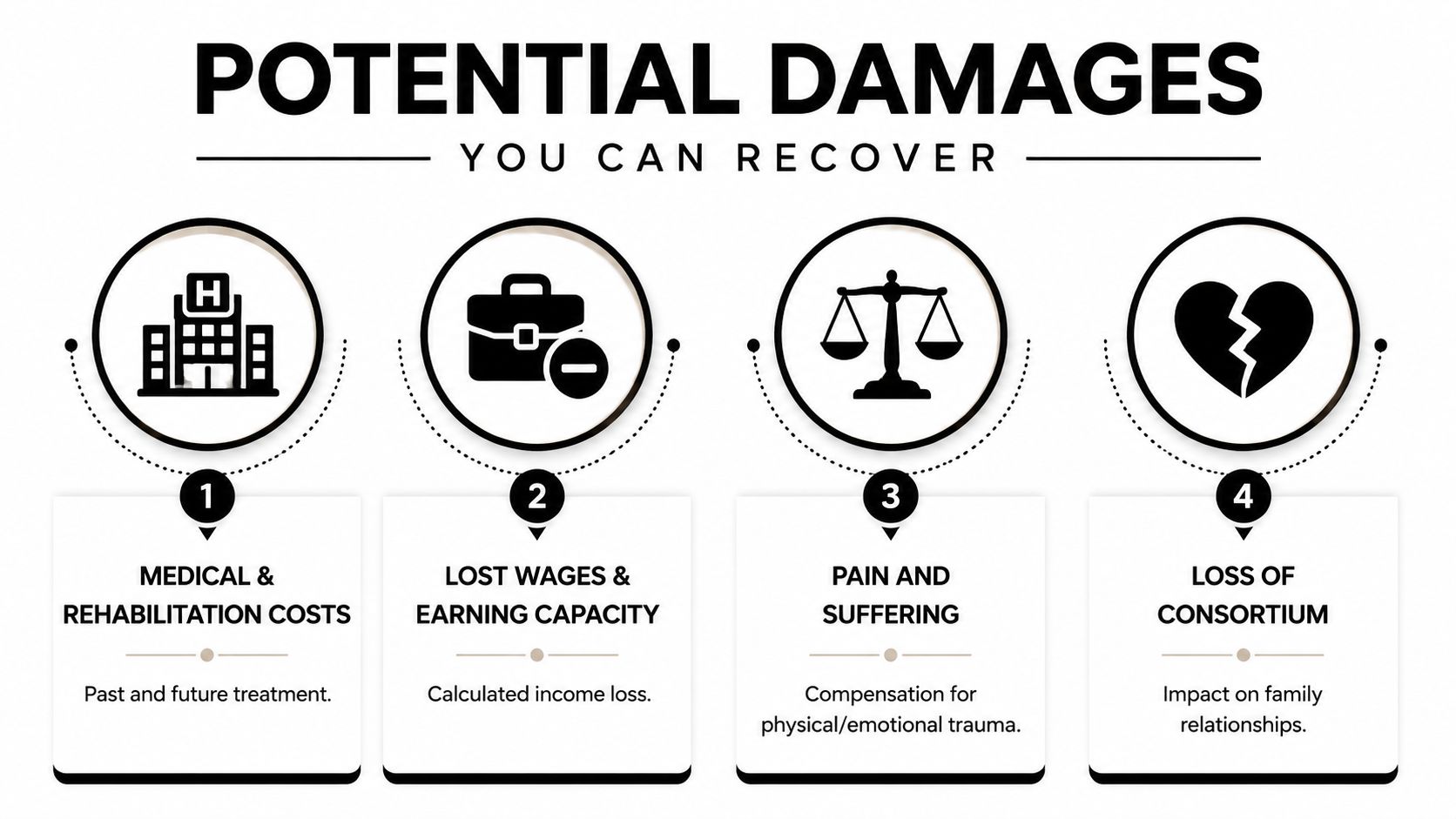
Economic losses are the easiest to document, but they're only part of the picture. They include medical bills, rehabilitation, lost wages, future earning capacity, and long-term care. If a burn injury limits movement or a lung injury changes how you work, future earnings can matter as much as current bills.
Non-economic losses are real too. Pain and suffering, disfigurement, mental distress, and loss of enjoyment of life can be major parts of a refinery claim. Families also may recover for loss of companionship and related harms where the law allows it.
Punitive damages can come into play in extreme cases where conduct was especially reckless. They're not automatic, and they're not the starting point, but they do exist when a defendant's conduct crosses a serious line.
Texas verdicts and settlements show that severe burn and explosion cases can reach very large numbers, including $15.45 million, $18.5 million, $39.7 million, and $97 million in publicly reported explosion matters (Texas explosion recoveries and trial results). Those numbers don't guarantee anything in your case, but they do show that catastrophic injuries are valued seriously when the evidence is strong.
Before you take an early settlement, get a lawyer to map out future care. That matters in refinery injuries because the first offer often ignores scars, surgeries, rehab, and the cost of being unable to work the same way again. If you want a deeper look at burn-related damages, burn injury claims in Texas is a smart place to start.
If the claim is moving through workers' comp on one track and third-party liability on another, timing can get complicated. A resource like how long workers comp takes can help families understand why one piece of the case may move slowly while the broader injury claim still needs immediate attention.
Choosing the Right Lawyer and Taking the Next Step
A refinery explosion case needs a lawyer who understands industrial injury work, not just general accident claims. That means someone who knows how to work with engineers, burn specialists, and investigators who can read plant records, maintenance logs, and incident reports without getting lost. It also means a lawyer who's willing to go to trial if the defense refuses to deal fairly.
What should matter when you choose counsel
Look for industrial-explosion experience first. These cases are technical, and the wrong lawyer can miss the fault chain entirely. You also want a team with access to engineering and medical experts, because causation in refinery cases is built on proof, not sympathy.
Trial readiness matters too. A lawyer who only talks settlement may fold too early when the defense knows the file is thin. You want someone who knows Texas courts, Texas deadlines, and how refinery companies and their insurers tend to fight these claims.
Contingency-fee representation matters because you shouldn't have to pay out of pocket just to find out whether a claim is viable. And you need a Texas-based team that understands local refineries, local juries, and the practical realities of industrial accidents across Houston, Pasadena, Port Arthur, and the rest of the Gulf Coast.
The right lawyer should also know when a case belongs in another lane, whether that's a wrongful death claim, a catastrophic injury claim, or a third-party worksite claim. The Law Office of Bryan Fagan, PLLC handles serious injury matters across Texas, and that kind of broad injury practice can matter when your case overlaps with other personal injury issues.
The best time to get legal help is before the evidence starts fading, not after the insurer has already set the tone.
You don't need to have every document, every report, or every answer before you call. You just need to start. If your family is trying to recover after a refinery explosion, a fire, or a severe burn injury, the law can still help. Recovery is possible, and the right legal help can make the next step feel manageable.
If you or your family were hurt in a refinery explosion, contact the Law Office of Bryan Fagan, PLLC for a free consultation and get straight answers about fault, deadlines, and your claim. Visit Law Office of Bryan Fagan, PLLC to talk with a Texas personal injury team that knows how to handle serious industrial injury and wrongful death cases.