A serious accident can change your life in seconds, but you don't have to face it alone. If a crane collapsed, a load fell, or a scaffold gave way on a Texas jobsite, you may be dealing with pain, missed paychecks, and a dozen unanswered questions at once. The right Texas personal injury lawyer can sort out fault, protect evidence, and push for the compensation your family needs.
Construction accidents are rarely simple. A crane incident can involve the operator, the contractor, the rigging crew, the site supervisor, or the equipment owner. A scaffold fall can involve whoever assembled it, inspected it, tied it off, or ignored a dangerous defect. That hidden web of responsibility is exactly why these claims need fast legal action and a focused investigation.
When your injuries are severe, the stakes get real fast. Medical bills start arriving, work stops, and insurance companies often move in before you've had time to understand what happened. You need clear answers, not pressure, and you need them from someone who knows how Texas construction claims work.
When a Construction Accident Changes Everything
The call usually comes in after the worst moment of someone's week, maybe their life. A husband is taken from a site after a crane strike. A daughter gets a phone call that a scaffold collapsed in Houston. A worker lies in a hospital bed wondering if he'll ever return to the trade that fed his family. Those are not abstract legal problems. They're real losses, and they deserve real answers.
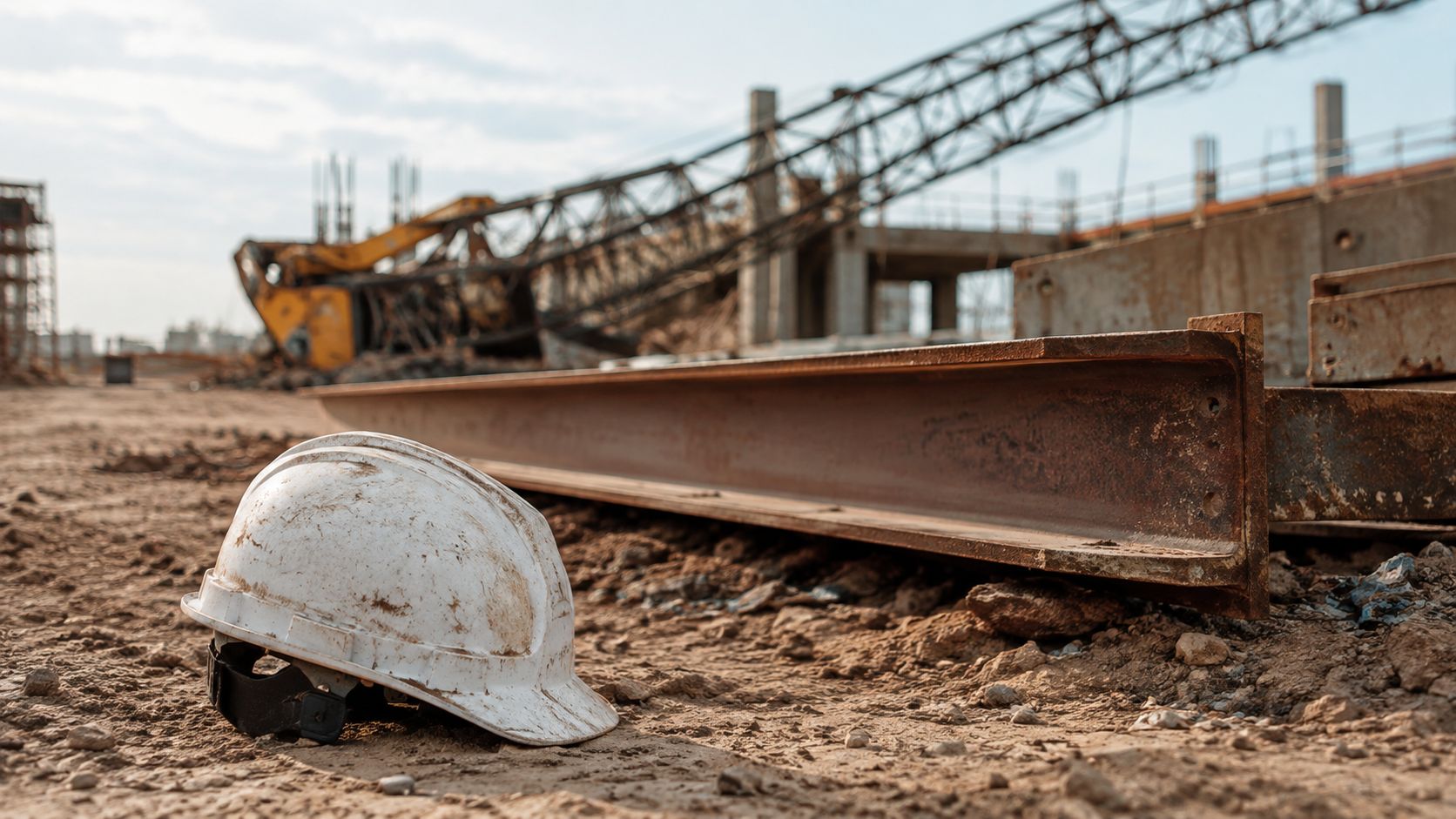
Texas has seen enough deadly jobsite tragedies to make one thing obvious, these cases are serious from day one. Federal labor data for 2011 to 2017 found 297 crane-related deaths nationwide, about 42 deaths per year, and Texas accounted for 50 of those deaths, more than the next three states combined (crane accident data). That kind of loss doesn't happen in a vacuum. It happens when a site breaks down, when safety gets ignored, or when too many people assume someone else is handling the risk.
Practical rule: if the crash, collapse, or struck-by event happened on a jobsite, treat it like a legal emergency as well as a medical one.
A Texas crane and scaffolding accident lawyer steps in to calm the chaos. That means looking past the first story the company tells and finding the true chain of events. It also means helping you understand whether your claim belongs in the workers' compensation system, a third-party claim, or a wrongful death case if you lost a loved one.
For families who are still trying to breathe after the phone call, that help matters. You don't need to guess who's responsible or how to pay for care. You need a plan, and you need someone who can build it while you focus on survival and recovery.
What a Texas Crane and Scaffolding Accident Lawyer Does
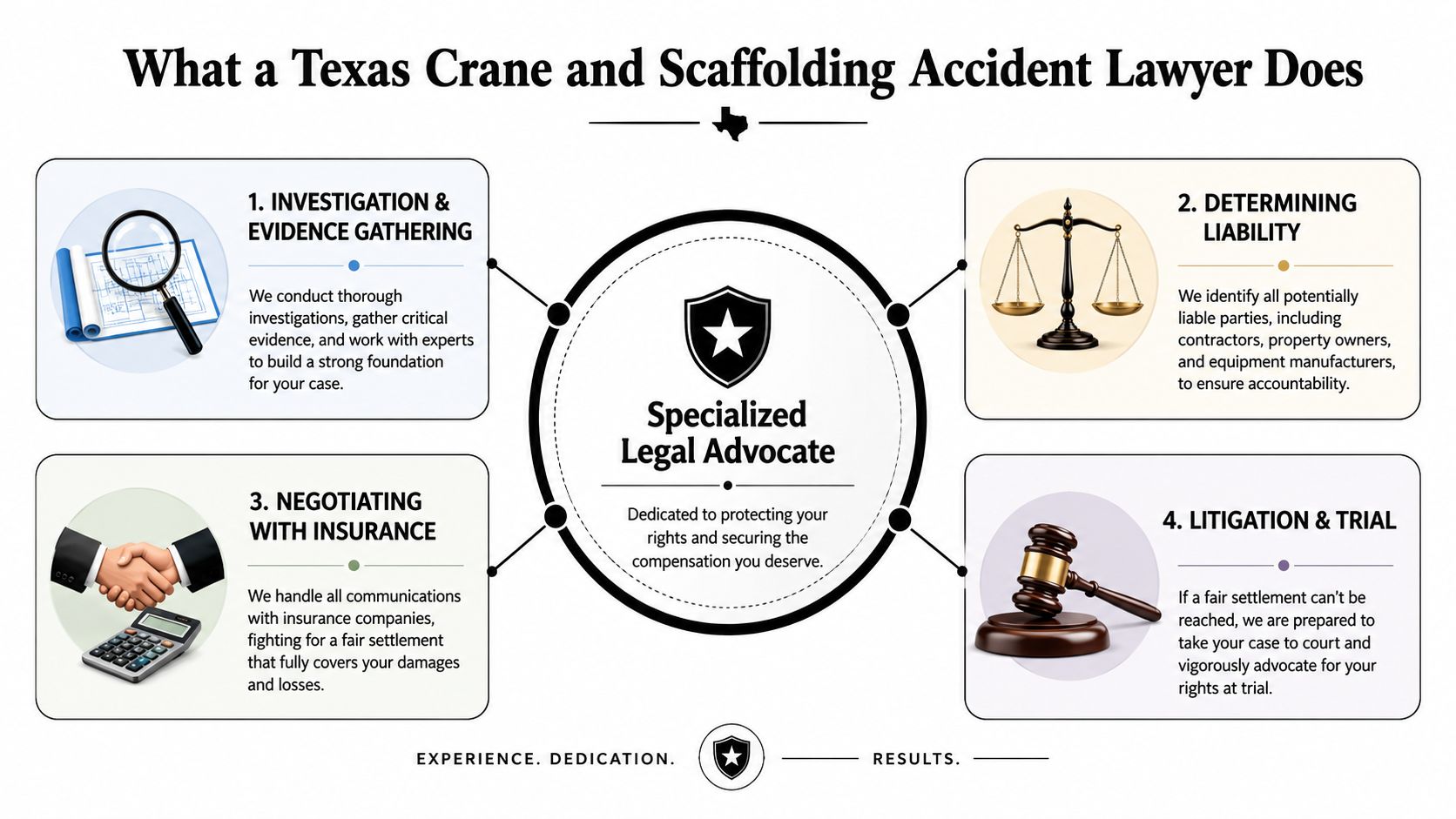
A good construction injury lawyer does much more than file paperwork. The job starts with finding out exactly what failed, who controlled the worksite, and which company's decisions created the danger. On crane and scaffold cases, that often means looking at the operator's choices, the contractor's safety practices, the equipment owner's maintenance history, and the supervisor's site instructions all at once.
Investigation comes first
These cases turn on detail. A lawyer should preserve photos, witness names, incident reports, maintenance logs, and any telemetry data before the evidence disappears. On crane claims, that can mean the Load Moment Indicator, or LMI, which may record load weight, boom angle, and operating limits at the moment of failure (crane telemetry evidence).
Liability is rarely limited to one company
Construction sites often involve several businesses working side by side. One company operates the crane, another rigs the load, another oversees the site, and another owns the equipment. That's why a lawyer has to trace the decision-making, not just the impact. If you want a plain-English look at how contractor disputes can spiral, the HireParalegals guide to contractor disputes is a useful starting point for understanding the business side of these conflicts.
Insurance companies need a different kind of response
Insurance adjusters look for gaps, not fairness. They want statements, releases, and fast closings. A strong lawyer slows that down and forces the insurer to deal with the actual evidence. That's true in construction cases and in other injury claims, including the coverage questions that come up in Uber and Lyft Accident Claims in Texas when liability is split between drivers and policy layers.
A Texas construction injury claim is not the same as a routine slip-and-fall case. If you're looking for a broader overview of jobsite claims, the firm's own construction accident lawyer Texas resource is a good place to start. The point is simple, the lawyer should be building a strong case from the first day, not waiting for the defense to define the facts.
When the case must go to court, that same lawyer should be ready to litigate. If the defense won't pay fair value, trial is part of the job, not a last resort.
Common Causes of Crane and Scaffolding Accidents in Texas
Crane and scaffold accidents are usually preventable. Families feel that truth immediately after a serious injury. A worker does not get hurt because fate singled them out. The injury usually follows a skipped inspection, a missed warning, or a decision that put production ahead of safety.
Crane cases often turn on what happened before the lift ever started. Overloaded booms can tip. Rigging can fail. A load can swing into a worker who was placed too close to the work zone. Power line contact can turn a lift into an electrocution event. Structural collapse can happen when the machine was not maintained, inspected, or used within its limits. These failures are usually traceable to the operator, the contractor, the equipment owner, or the site supervisor, and a lawyer should identify each one early.
Scaffolds fail for ordinary reasons, and that is why they are so dangerous
Scaffold claims often come down to missing guardrails, bad planking, weak tie-offs, worn bracing, or damaged feet. A platform can look stable from the ground and still fail because nobody checked the parts that hold it together. Texas scaffold guidance says employers must provide fall protection above 10 feet and also use protections like toeboards, screens, guardrails, debris nets, catch platforms, canopy structures, or barricades to protect workers from tools and falling debris (Texas scaffold guidance).
That matters because a lawsuit needs more than sympathy. It needs a safety failure tied to the injury. If a worker fell because the guardrail was missing, or a platform collapsed because a brace was bent and ignored, that is a negligence case. Good jobsites treat scaffold setup the same way they treat construction risk management Australia guidance, with planning, inspection, and clear responsibility before anyone climbs.
A safe jobsite leaves a trail. A dangerous one leaves excuses.
Texas construction sources also show why scaffold cases are taken seriously. Scaffolds are used by about 2.3 million construction workers, roughly 65% of the construction workforce, and OSHA and industry reporting estimate about 4,500 scaffolding-related injuries each year with roughly 60 fatalities annually (scaffolding injury data). That level of exposure makes sloppy assembly, poor inspection, and weak fall protection especially dangerous.
For site managers, the lesson is blunt. If you do not control access, stabilize the structure, and inspect the equipment, you are inviting a claim. For injured workers, the lesson is just as direct. Do not let anyone tell you the collapse was just bad luck.
Critical Steps to Take After a Crane or Scaffolding Accident
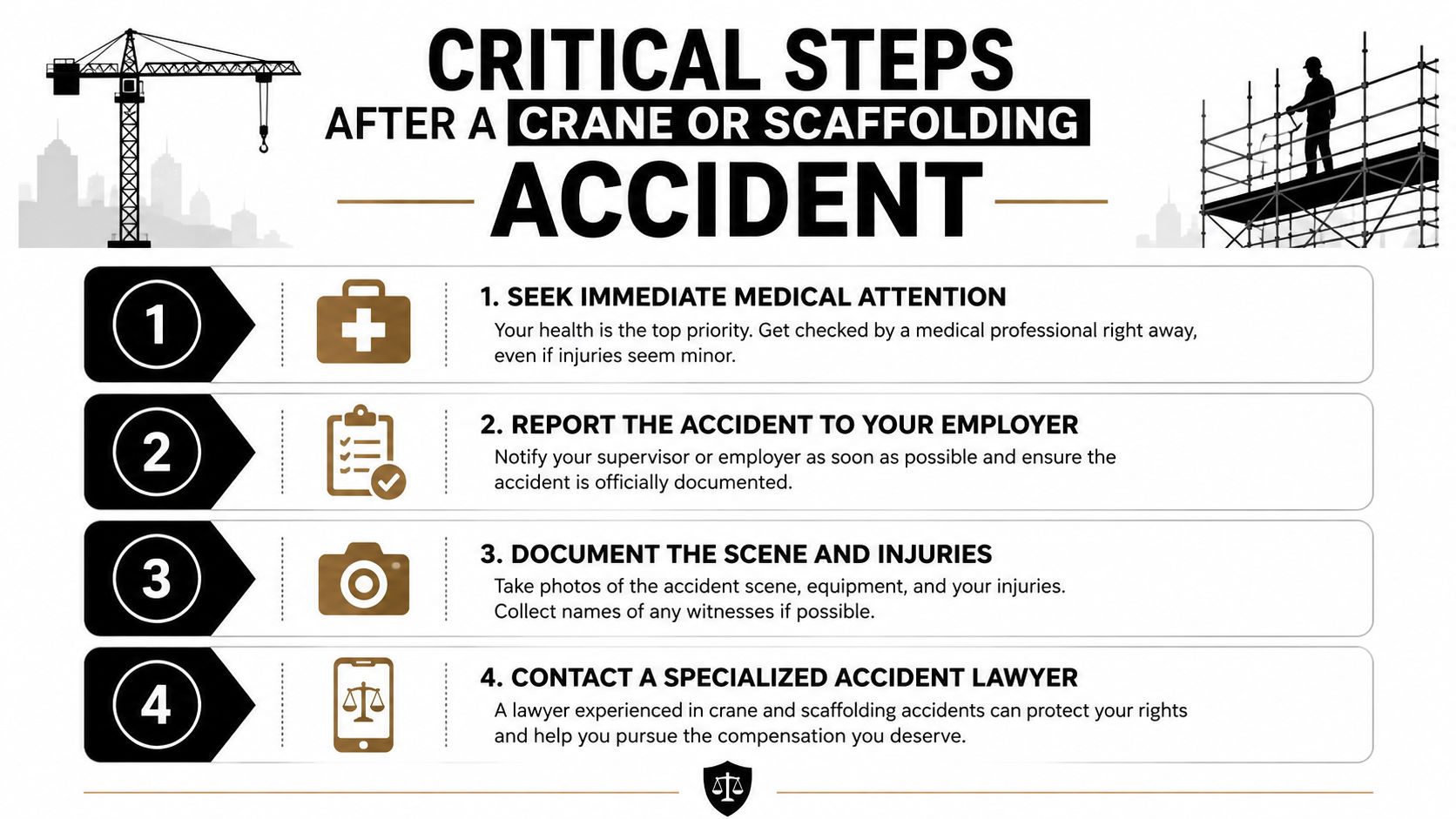
The first hours matter more than you might realize. If you can move safely, get medical attention immediately. If a coworker or family member is helping you, make sure someone calls for emergency care and reports the incident to the employer or site supervisor right away. Your health comes first, but the report also creates the paper trail that can support your claim later.
Protect the scene while it still exists
Take photos of the crane, the scaffold, the ground conditions, the broken parts, and your injuries if you're able. Get names and phone numbers for anyone who saw the accident happen. If a damaged scaffold plank, brace, hook, sling, or crane component is still on site, don't let it get tossed, repaired, or reused before it's documented.
A construction claim can get weaker fast if the evidence disappears. Crane telemetry can be overwritten, scaffolds can be dismantled, and a company can clean up the area before anyone has done a real inspection. That's why early legal help matters.
Don't let insurance control the story
Insurance adjusters often move quickly after a serious jobsite accident. They may ask for a statement or suggest a quick payment before you know the full cost of your injuries. Don't sign anything until a lawyer has reviewed it. A fast settlement can lock you into a number that doesn't come close to covering surgery, rehab, lost wages, or future impairment.
If you're unsure what to say, keep it short. Say you're hurt, you're getting medical care, and you're not ready to discuss settlement. That's enough. Everything else can wait until your attorney has looked at the facts.
Call a lawyer while the evidence is fresh
A construction case is won or lost on the first investigation. The earlier a lawyer gets involved, the better the chance of preserving digital data, physical parts, witness accounts, and maintenance records. That's especially true when a site tries to shift blame onto the worker or blame the accident on something vague like “operator error” without proof.
Your next move should be practical, not emotional. Document, preserve, and get counsel fast.
Types of Claims and Damages Available Under Texas Law
Texas law gives injured workers and grieving families more than one path to recovery, but the right path depends on who caused the harm. Some cases are workers' compensation matters. Some are third-party injury claims. Some are wrongful death claims after a fatal collapse or strike. The biggest mistake people make is assuming the first label they hear is the only one that matters.
If your employer doesn't carry workers' compensation, a third-party claim may be available against another responsible company. If a contractor, equipment owner, or another vendor caused the injury, that can open the door to a separate personal injury case. For a deeper look at how the system works, the firm's workers compensation rules Texas resource helps explain the overlap in simple terms.
Damages should match the real loss
Compensation in these cases can include medical bills, lost income, future care, pain and suffering, permanent disability, and, in fatal cases, wrongful death damages such as loss of companionship and funeral costs. That's not a wish list. It's the legal measure of what the injury took from you.
Texas also uses a modified comparative responsibility rule, often called the 51% bar. You can recover damages only if you're 50% responsible or less for the accident. If you're 51% or more at fault, recovery is barred under Texas proportionate responsibility rules (Texas negligence rules). In practical terms, fault can be divided among an operator, contractor, subcontractor, site supervisor, equipment owner, or even the injured worker. The percentage assigned changes everything.
Bottom line: if the defense can push your share of fault above 50%, they can wipe out your recovery.
Texas fatal work injury numbers show why these cases can't be handled casually. The state recorded 557 fatal occupational injuries in 2024, and construction accounted for 128 incidents, or 23% of all fatal occupational injuries in Texas (Texas fatal occupational injuries). That reality is why families should look at wrongful death, catastrophic injury, and insurance issues right away after a devastating jobsite accident.
If you've lost a loved one, this is also where a wrongful death lawyer Texas becomes essential. You need someone who can explain the claim, preserve the evidence, and press for the full range of damages the law allows.
How Evidence Is Gathered in Crane and Scaffolding Cases
Evidence decides these cases. Sympathy does not. Neither does the first incident report, or the version a company gives the day after the accident. The strongest claims are built from facts that can be checked against each other, and that starts with preserving the scene before people move equipment, clean up debris, or rewrite the story.
Crane cases are especially technical because the machine often keeps its own record. The LMI or equivalent telemetry system can preserve data on load weight, boom angle, and operating limits at the moment of failure. That record can support a claim that the crane was overloaded, that a tip-over came from unsafe operation, or that the problem was mechanical rather than operator-driven. It can also contradict a company report that tries to blame the worker without proof. In a serious case, a Texas lawyer should move fast to secure that data and pair it with the physical evidence before the site changes. A reconstruction expert witness can then help connect the telemetry, the scene, and the sequence of failure.
Physical parts matter too
Scaffold claims often turn on the hardware itself. Bent bracing, broken walk boards, deteriorated feet, missing tie-offs, and damaged connection points can show exactly how the structure failed. Those parts should be preserved, photographed, and inspected before they disappear into a dumpster or get reused on another job.
A strong attorney also looks at maintenance records, inspection logs, site photos, and witness statements. Site supervisors, contractors, equipment owners, and the people assigned to inspect the structure may all hold pieces of the answer. An accident reconstruction expert witness can help tie those pieces together and explain how the collapse, strike, or fall happened in plain English. That matters when the defense tries to muddy the waters or suggest the cause is too uncertain to prove.
Speed changes the outcome
Jobsites get cleaned up fast. Companies do not leave broken components sitting around forever. That is why waiting can cost a case. The earlier the scene is documented, the more likely it is that the key facts survive.
The first 48 hours often decide what evidence still exists. Get photos of the equipment, the scaffold, the anchors, the ground conditions, and any warning signs that were present before the incident. Ask for the names of every contractor on site, every supervisor involved, and anyone who touched the equipment after the accident. If records are at risk, a lawyer can send preservation letters and push to keep maintenance logs, inspection reports, safety meetings, and electronic data from disappearing.
If you are the injured worker, do not try to sort out liability alone. Get the evidence preserved first, then let your lawyer sort out who is responsible. In these cases, fault can reach the operator, the contractor, the equipment owner, and the site supervisor, and the proof has to show where each one failed.
Texas Filing Deadlines and What to Expect in a Free Consultation
Texas deadlines are strict, and they matter whether your case involves a collapse, a fall, or a fatal crane strike. In most personal injury and wrongful death cases, Texas generally uses a two-year limitations period. Workers' compensation claims use a separate one-year deadline (construction accident deadlines). If you wait too long, you can lose the right to recover at all.
That's why the first consultation should happen quickly. When you call, the firm should listen to what happened, ask where the accident occurred, identify the companies involved, and look for the evidence that needs to be preserved now. You should get a straight answer about whether the claim may involve workers' compensation, a third-party lawsuit, or a wrongful death case.
A good consultation also gives you a roadmap. That means talking about medical treatment, insurance contact, evidence collection, and possible next steps without pressure. It should feel like a planning session, not a sales pitch.
If you're dealing with a crane collapse, a scaffold fall, or a deadly struck-by event, don't wait for the employer or insurer to tell you what to do. Talk to a lawyer who handles construction injury claims and can explain your rights in plain English. The law office should be able to review the facts, discuss options, and move fast if evidence is at risk.
The Law Office of Bryan Fagan, PLLC can help you understand your next move after a serious construction accident, whether you're dealing with injuries, a fatal loss, or insurance questions. Recovery is possible, and legal help is available. Reach out as soon as you can so someone can protect the case while you focus on healing.
If you were hurt in a crane or scaffolding accident, the Law Office of Bryan Fagan, PLLC can help you investigate fault, preserve evidence, and pursue the compensation your family needs. Visit Law Office of Bryan Fagan, PLLC to schedule a free consultation and get clear answers about your Texas construction injury claim.