
A serious accident can change your life in seconds, but you don't have to face it alone. You may be sitting at your kitchen table with an insurance offer, a headache that won't settle, and no clear idea when you'll feel like yourself again. When ordinary tasks suddenly take more effort, deciding what your brain injury claim is worth can feel overwhelming.
A fair settlement for TBI should reflect what the injury has actually changed and what medical evidence reasonably shows you'll need going forward. You don't need to know every legal term to protect yourself. You need clear answers, reliable documentation, and time to make an informed decision.
Why a Fair TBI Settlement Is Harder to Value Than You Think
An insurance offer can look substantial beside an emergency-room bill and still leave major questions unanswered. After a crash near San Antonio, for example, you might be back home but forgetting appointments, struggling to finish work, or needing rest after routine tasks. Those problems may not show up on an early scan, and they can take time to assess.
The key question is what the injury may mean for your health and daily life over time. An early offer may be reasonable for the bills it covers, but the evidence still has to be checked against your ongoing symptoms and any care your doctors recommend.
Your Daily Function Matters
An emergency visit addresses urgent medical needs. It may not show whether you can handle a demanding job, care for children independently, or concentrate for a full workday.
The CDC describes brain-injury effects that can involve thinking, emotions, communication, behavior, and daily activities. That is why records should document cognitive and emotional changes as well as visible injuries. The CDC's information on brain injury and older-adult safety outlines these possible effects.
For the San Antonio driver, the offer might cover completed treatment while the treating team is still evaluating symptoms and work limits. A recommendation for cognitive therapy or continued restrictions can change what the evidence shows about future needs. The amount on the page should be compared with medical records, provider opinions, and employment documentation.
Practical rule: Judge an offer by what it covers, not by how impressive the total looks.
Fair Value Requires Honest Uncertainty
A lawyer cannot promise a particular recovery before reviewing liability, treatment, and available insurance. An unresolved symptom also should not be treated as certain to disappear just because its future cost is difficult to estimate.
Before deciding whether an offer is adequate, ask:
- What's included? Identify which losses the insurer has accepted and which it has not addressed.
- What remains uncertain? Ask your treating providers what needs further assessment.
- What evidence is missing? Check whether updated work restrictions, therapy records, or opinions about future care are needed.
These questions help you see whether an offer reflects the evidence available now and leaves room for symptoms that are still being evaluated. You are not being difficult by asking. You are making a decision that accounts for your health and your family's needs.
The Main Factors That Determine TBI Settlement Value
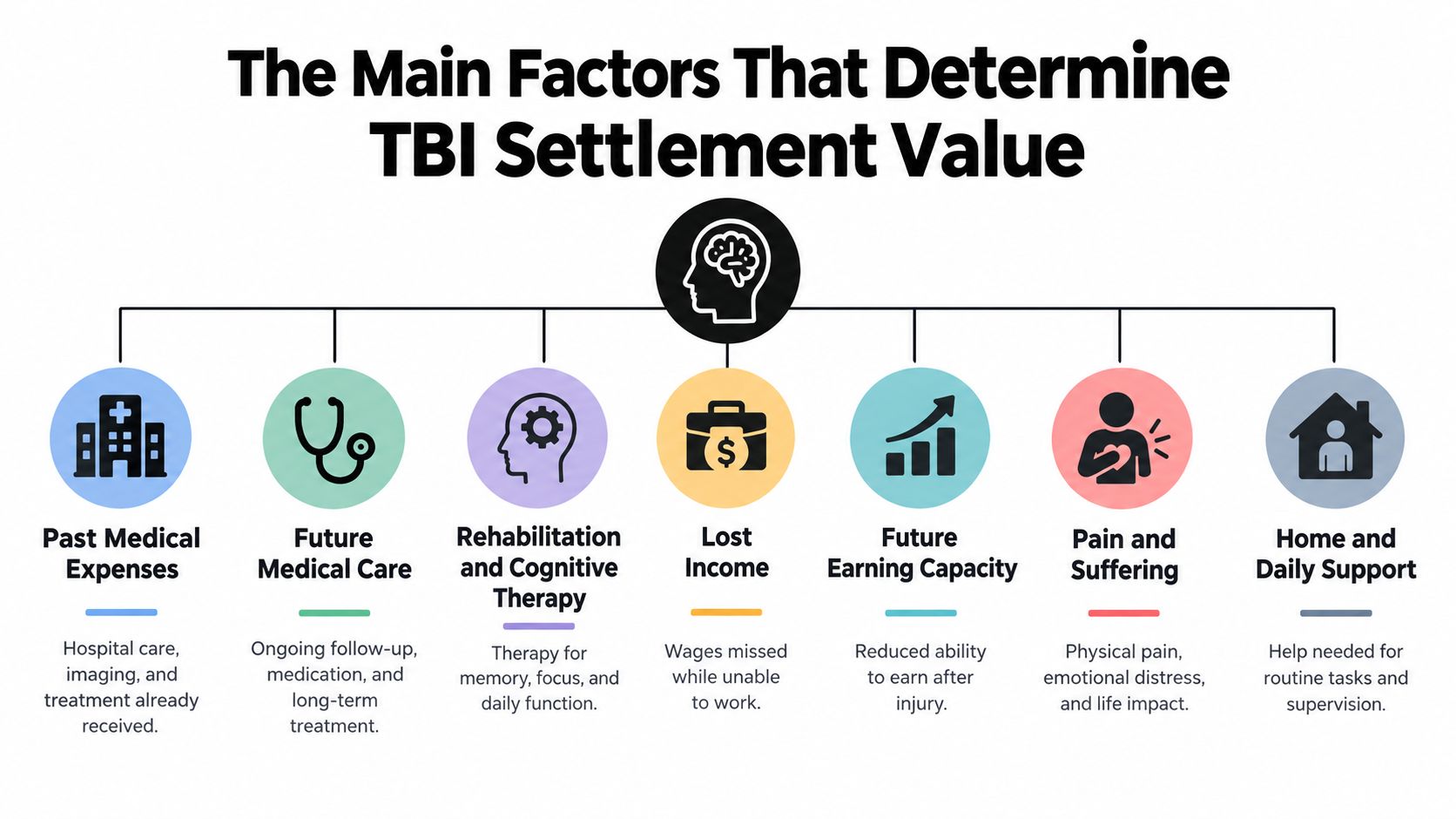
A brain injury claim becomes easier to understand when you divide it into financial losses and non-economic harm. Financial losses involve expenses and lost earning ability. Non-economic harm addresses the personal effects of the injury that don't arrive as invoices.
This overview organizes the main categories.
Medical Care and Practical Support
Your claim should distinguish completed treatment from care you're reasonably expected to need. Keeping these categories separate helps prevent omissions and avoids counting the same expense twice.
- Past medical expenses include documented hospital care, imaging, appointments, and treatment already received.
- Future medical care may include follow-up visits, medication, and ongoing treatment supported by provider opinions.
- Rehabilitation and cognitive therapy address limitations involving memory, attention, communication, and daily tasks.
- Transportation and related expenses should be tracked through receipts and appointment records.
- Home and daily support may involve supervision, personal assistance, or replacement household services.
Unpaid family help deserves careful documentation, too. Record what the person does, why assistance is necessary, and how the tasks differ from ordinary family support. Your attorney can evaluate whether and how that assistance belongs in the damages claim.
Work Loss and Personal Harm
Lost wages concern earnings you've already missed. Reduced earning capacity concerns your ability to earn going forward, even if you've returned to some form of employment.
For example, consider an Austin rideshare passenger whose treating providers recommend speech therapy and restrict demanding work. The claim should examine both the missed paychecks and whether the passenger can realistically resume the prior role. This is an illustration, not a reported settlement result.
Pain and suffering require a different kind of explanation. Persistent discomfort, frustration with memory problems, emotional changes, and reduced independence should be described through specific activities and experiences rather than broad statements that life is harder.
The CDC's moderate and severe TBI guidance explains that these injuries can cause long-term or lifelong problems and ongoing support needs. That's why substantial future-care claims may require a life-care plan rather than an estimate based only on current appointments.
The Texas Personal Injury Settlement Process describes what to expect from demand through settlement or trial. The process is easier to follow when each claimed loss has its own supporting records.
How Medical Costs and Lost Earnings Add Up Over Time
A head injury can disrupt work long after emergency treatment ends. A normal early scan or a return to the workplace may not show how fatigue, slowed thinking, or memory problems affect a person's ability to keep up over a full shift. National cost figures offer context, but medical spending averages are not settlement averages. They do not determine what an individual claim is worth or replace treatment records.
The CDC's injury economics materials report average TBI-related medical spending and associated work loss during the year following initial treatment.
Average TBI-Related Medical Spending and Work Loss by Treatment Setting
| Treatment Setting | Average Medical Spending | Average Work Loss |
|---|---|---|
| Initially treated in an emergency department | About $4,530 | About $1,500 |
| Required inpatient treatment | About $51,241 | About $6,110 |
Source note: These approximate national figures are from the CDC's injury economics report and describe the year following initial treatment. They illustrate differences between treatment settings, not a minimum or maximum recovery or a recommended insurance offer.
A Medical Projection Needs More Than a Total
A useful future-care opinion identifies the recommended treatment, explains its connection to the crash, and estimates how long it may be needed. Your attorney can review the medical support and cost information without treating every possible appointment as certain.
Ask your provider to clarify whether recommended care is ongoing, conditional, or still under consideration. That distinction helps present a credible claim while accounting for needs that current bills do not yet show. This explanation of future medical expenses and damages in Texas describes why medical support matters when estimating care ahead.
Returning to Work Isn't Always Returning to Normal
A Dallas-area warehouse worker returns to work on a shorter shift, then finds that fatigue and slowed thinking make the former pace unsustainable. The worker moves to less demanding, lower-paying duties. A paycheck may show that work resumed, while saying little about the cognitive limits behind that change.
Past pay records alone cannot explain the full loss. Compare the worker's former responsibilities and earnings with medically supported restrictions and realistic employment options. The key question is whether the injury has reduced earning ability compared with supported pre-injury capacity.
Records can make that comparison clearer:
- Income records: Pay statements, tax documents, and records of missed shifts.
- Job information: A description of the work's physical and cognitive demands.
- Medical restrictions: Written limits on duties, hours, or workplace conditions.
- Employer observations: Documented changes in performance or accommodations.
Families should not have to guess whether continuing symptoms will resolve or last. When possible, seek medically meaningful guidance before settling future losses, and protect the legal filing deadline separately.
Common Valuation Methods and Why They Fall Short
An adjuster or attorney may discuss a multiplier or a per-diem calculation when estimating damages. These methods organize a settlement discussion. They are not medical findings or guarantees of fair compensation, and their results depend on the assumptions behind the calculation.
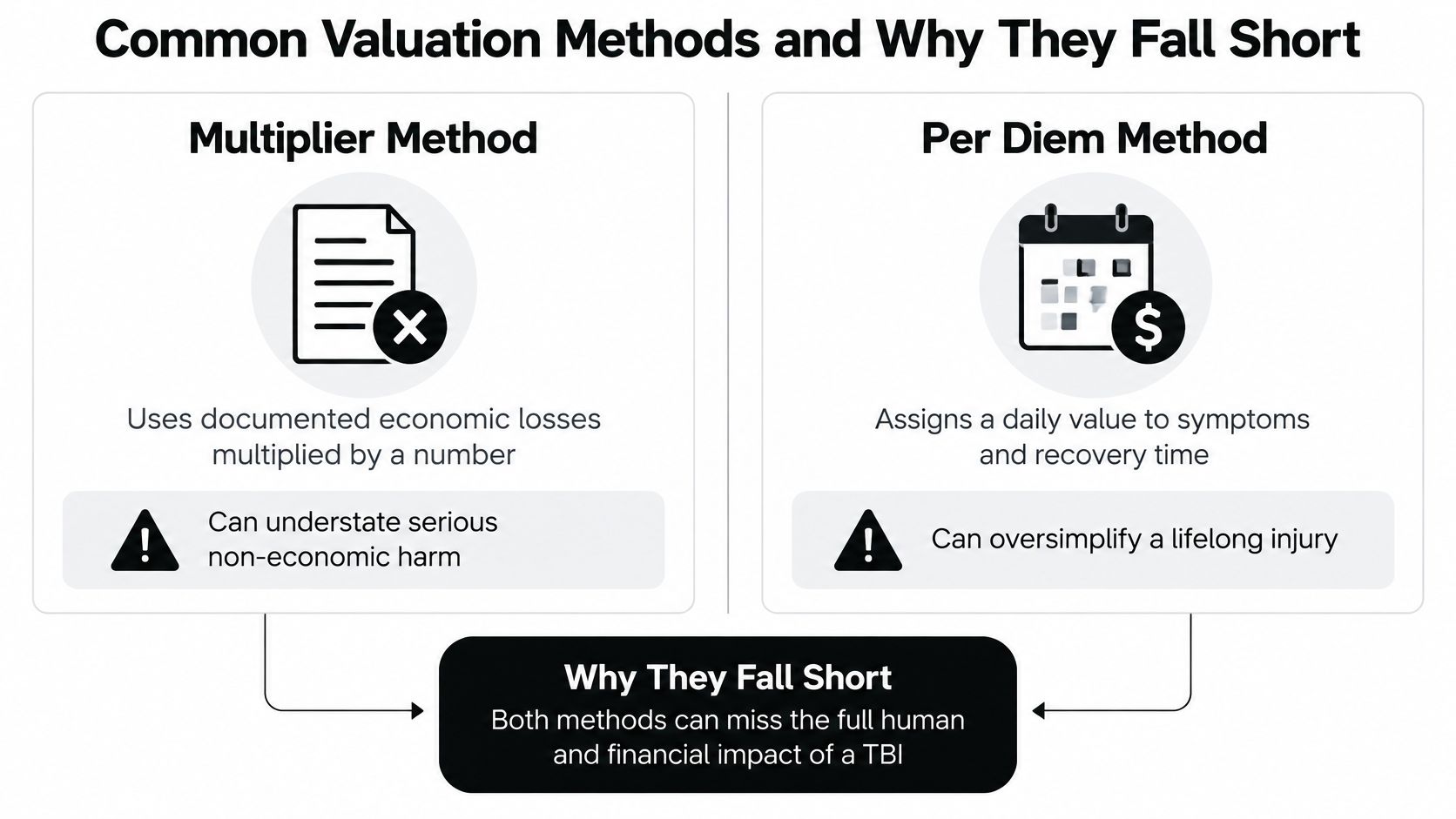
Comparing the Approaches
| Approach | How it works | Main limitation |
|---|---|---|
| Multiplier method | Applies a factor to documented economic losses as a way to discuss non-economic harm | The starting expenses and selected factor may poorly reflect functional limitations |
| Per-diem method | Assigns a daily amount to pain and suffering over a selected period | Both the daily amount and the duration require justification |
The multiplier method can miss harm when the financial starting point leaves out losses. It can also produce an inflated estimate if unsupported expenses are included before applying the factor. The calculation is only as sound as the records and reasoning behind it.
A per-diem method gives a way to discuss how long recovery may take, but symptoms can vary from day to day. A difficult day at home, an unsuccessful return to work, and a lasting need for supervision are different experiences. A single daily amount may not capture those differences.
A calculation is useful only when the assumptions behind it fit the person's injury.
Replace Shortcuts With Supported Projections
A Fort Worth resident with a moderate TBI has persistent memory and concentration problems and still cannot safely drive to familiar places. If the estimate relies only on the emergency visit, it misses the questions that shape the person's future: what care may be needed, and which activities can safely resume?
For substantial ongoing needs, a life-care plan can organize anticipated services and support. An economist's projection can translate medically supported care needs and employment assumptions into a financial analysis. Defensible numbers rest on documented treatment and expert projections.
Ask for an explanation of the proposed settlement range, not just its endpoints. You should be able to see which losses are supported by records, which projections rely on expert opinions, and which points the insurer disputes.
A strong negotiation position connects the amount sought to the available evidence. It reflects the person's documented losses and supported future needs, rather than relying on a calculator alone.
Proving Invisible and Delayed Brain Injury Symptoms
A person can leave the hospital with a normal CT scan and still struggle to remember conversations, manage familiar tasks, or regulate emotions. Imaging matters, but a normal scan does not rule out cognitive or emotional change. To understand settlement value, the evidence must show how symptoms affect everyday life, not just what appeared on an early scan.

Mayo Clinic's discussion of CT-based outcome prediction describes research into predicting how patients function after rehabilitation. A scan records important medical findings, while follow-up evaluations and observations help show changes that may emerge over time.
Describe Changes Precisely
For a family caring for someone with a TBI, a specific example is more useful than a broad statement. Record that your loved one missed a familiar appointment, needed help following a recipe, or became unusually distressed during an ordinary task. These details give providers and, if needed, a jury a clearer picture of the change.
Keep a record that connects symptoms to their practical effects:
- Symptom details: Note what happened, what activity was affected, and what helped.
- Clinical evaluation: Save treating-provider opinions and neuropsychological test results when recommended.
- Functional evidence: Keep therapy findings, work restrictions, and records of changes in household responsibilities.
- Family observations: Record specific memory lapses, mood changes, and supervision needs.
Ask relatives to describe what they observe in their own words, rather than assigning medical labels. Include improvement as well as difficulty. A balanced record is more credible and can help explain why symptoms fluctuate.
Keep Medical Certainty in Perspective
GFAP and UCH-L1 biomarker tests can support decisions about whether a CT scan is needed, but they do not independently diagnose lasting disability or determine settlement value. Clinicians assess the full picture, including examination findings, imaging, and changes documented over time.
Learning about traumatic brain injury effects years later can help families understand why follow-up matters. It does not mean every person will have the same recovery or require the same care.
Health comes first. The CDC's concussion symptoms and danger signs include worsening headache, repeated vomiting, seizures, increasing confusion, and difficulty waking. Seek emergency care if these occur, and don't delay treatment to gather claim evidence.
Building Your Texas TBI Claim and Protecting the Deadline
Your damages evidence explains what you've lost. Liability evidence explains who should be legally responsible for those losses.
In plain English, negligence means failing to use reasonable care. A Texas injury claim must connect that failure to the crash, the brain injury, and the resulting harm. Identifying a careless act isn't enough without showing that connection.
Preserve Both Sides of the Claim
Ask a family member to help organize records if symptoms make paperwork difficult.
- Crash evidence: Preserve photographs, witness information, crash reports, and available vehicle data.
- Insurance documents: Save policies, claim correspondence, offers, and requests for statements.
- Medical evidence: Keep discharge instructions, prescriptions, test results, and rehabilitation records.
- Work and care records: Collect employment documents, expense receipts, and caregiver notes.
- Expert support: Discuss whether medical, vocational, or life-care opinions are needed.
When communicating with an insurer, stick to facts you know. Don't guess about speed, accept blame to be polite, or minimize symptoms before you understand them.
Consult counsel before giving a recorded statement or signing a release. Preserve the insurer's request so your lawyer can assess what response is appropriate.
How Shared Fault Changes Recovery
Under Texas Civil Practice and Remedies Code Chapter 33, you generally cannot recover if you're more than 50 percent responsible; at or below that threshold, damages are reduced by your assigned share.
For example, after a hypothetical Houston freeway crash, $200,000 in damages reduced by 20 percent responsibility becomes $160,000, applying that same Chapter 33 rule. This illustrates the calculation, not a prediction about your case.
Fault may involve multiple people or businesses. An investigation should examine the evidence rather than assume that the first account of the collision is complete.
How Long Do You Have to File a Claim in Texas?
Texas Civil Practice and Remedies Code section 16.003 generally provides two years after accrual for personal-injury lawsuits and two years after death for wrongful-death actions. Exceptions and separate rules can affect minors, legally incapacitated people, governmental claims, survival claims, and insurance disputes.
Continuing treatment and protecting a filing deadline are separate tasks. Your attorney should address both.
Don't assume negotiations preserve your rights. Get a case-specific assessment of how long you have to file an injury claim in Texas well before the ordinary deadline approaches.
How a Texas Attorney Builds and Negotiates Your Settlement
Wage records, treating-provider opinions, and a life-care plan can help turn a Texas brain injury claim into a clear demand. A Texas personal injury lawyer connects those documents to the crash, explains how the injury affects work and daily activities, and supports the costs of future care. Each projected expense needs a reason, and each claimed limitation needs evidence.
The attorney also investigates the insurance coverage available. Ask how the available coverage affects which settlement offers are realistic. The value supported by your losses and the funds available to pay a settlement are separate parts of the evaluation.
What a Supported Demand Accomplishes
With wage records, medical opinions, and a life-care plan in the package, your lawyer can point to services an insurer left out, explain work-related effects, and show how long care may be needed. This gives the insurer specific issues to assess instead of a request to raise its offer.
Documentation does not guarantee agreement. It can clarify what remains disputed and give your lawyer evidence to use if negotiations do not resolve the claim.
Your attorney should explain:
- The insurer's position: What it disputes and the reasons it gives.
- Your options: Whether to gather more evidence, continue negotiations, or file a lawsuit.
- The proposed resolution: What the settlement and release mean before you sign.
Match the Representation to the Accident
A passenger-vehicle collision may turn on driver conduct, crash evidence, and available auto coverage. A commercial-truck case can also involve the trucking company, business records, and additional insurance questions. A wrongful-death case requires guidance for the family after a fatal loss, while a catastrophic-injury claim calls for close attention to long-term support and care.
Ask how the lawyer would investigate the specific issues in your case. Discuss expert involvement, communication, and the written fee agreement. Contingency-fee representation means no attorney fee unless the firm wins. Ask how case expenses are handled, too, so you understand the agreement before signing.
At your consultation, ask: Who will handle my file day to day, and how will I receive updates? A clear answer helps you know whom to contact while you focus on treatment and decisions about your claim.
Law Office of Bryan Fagan, PLLC offers free consultations for Texas families considering brain injury claims, insurance offers, and future care needs. Visit Law Office of Bryan Fagan, PLLC to request a consultation before signing a settlement release. Recovery and legal help are possible as you work toward greater stability and independence.