A serious accident can change your life in seconds, but you don't have to face it alone. You may be caring for someone who came home from a Houston freeway crash looking mostly normal, only to struggle months later with memory, fatigue, anger, headaches, or work. You may be that person yourself, wondering why ordinary tasks now feel exhausting and whether an insurance company will take those changes seriously.
Traumatic brain injury effects years later can be real, medically explainable, and legally important. Recovery isn't always a straight line. Some people improve substantially. Others live with lasting limitations or develop problems that become clearer as work, family, and financial demands increase.
This article explains what late symptoms can look like, how doctors evaluate them, how Texas law treats delayed damages, and what you should do now to protect your health and your claim.
When the Worst Isn't Over After the Hospital
A family member may leave the hospital after a crash able to walk, talk, and answer basic questions. The discharge papers may sound reassuring. Then, over the following months, the family notices that something has changed. The person forgets appointments, loses track of the checkbook, becomes overwhelmed in busy places, or loses patience over small problems.
That pattern doesn't mean the family is exaggerating. Brain injuries often become more visible when the survivor returns to ordinary responsibilities. A hospital can test whether someone is stable enough to go home. It usually can't measure how that person will manage a full workday, drive in traffic, organize medications, regulate emotions, or handle several conversations at once.
Practical rule: A return home is a transition in care, not proof that the injury is over.
After a Dallas truck collision, for example, a driver might resume limited work but later find that slower processing and poor stamina make the job impossible. After an Austin SUV crash, a parent might appear physically recovered while needing reminders, transportation, and supervision. These changes matter medically and financially.
What families often notice first
Late effects may involve:
- Physical changes: Headaches, dizziness, fatigue, poor balance, sleep disruption, or seizures.
- Cognitive changes: Memory lapses, slower thinking, trouble concentrating, or poor planning.
- Emotional changes: Depression, anxiety, irritability, loss of motivation, or sudden mood shifts.
- Behavioral changes: Impulsivity, aggression, social withdrawal, poor judgment, or personality changes.
Doctors can use neurological examinations, neuropsychological evaluations, imaging, employment records, and family observations to build a clearer picture. A Texas personal injury lawyer can then connect that medical evidence to lost income, future treatment, caregiving, and reduced independence.
The important point is simple. Symptoms that appear later still deserve medical attention, and they may still belong in an injury claim. The steps you take this week can protect both your recovery and your legal rights.
What Doctors Mean by Moderate and Severe TBI
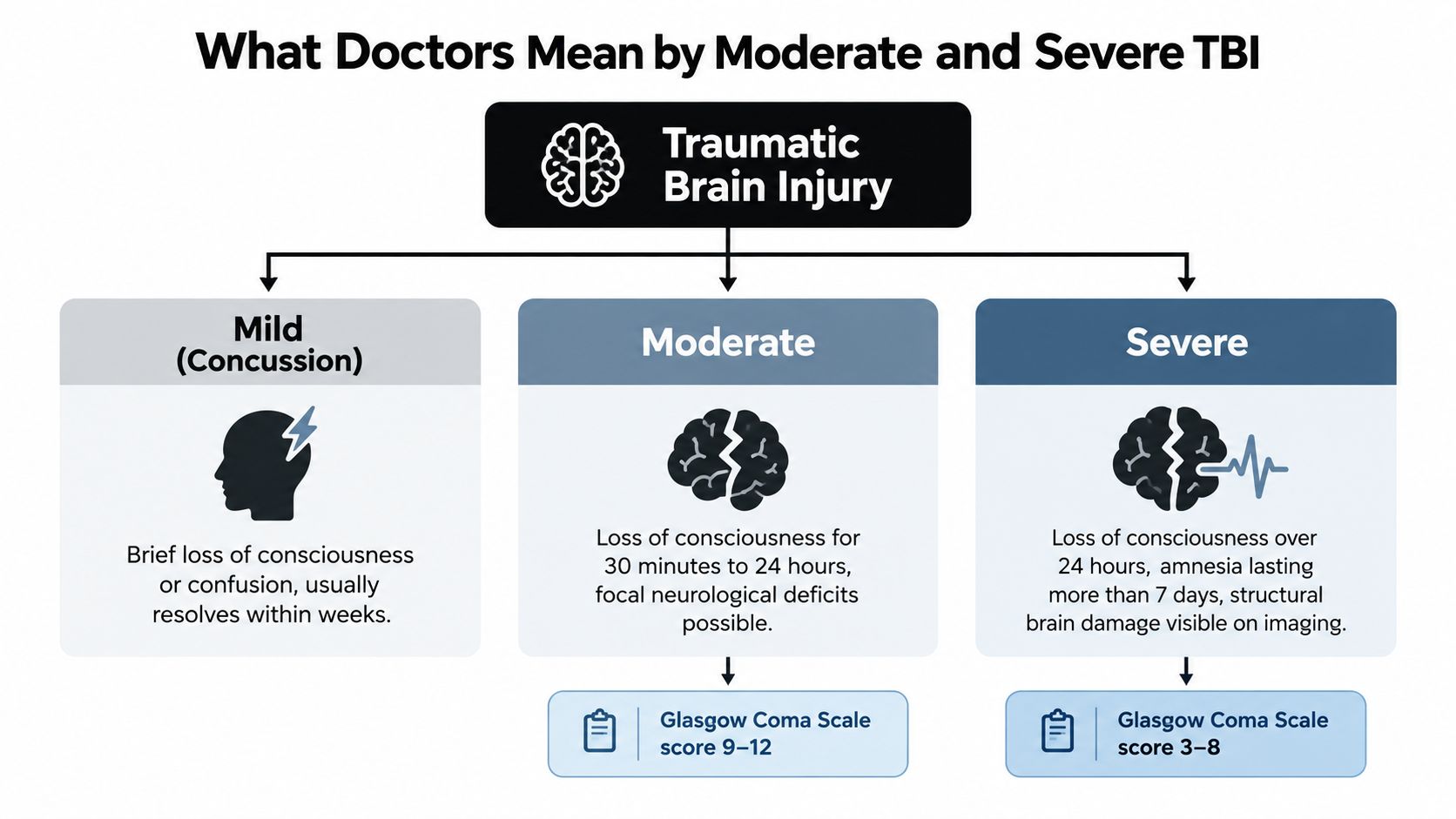
Doctors don't grade a traumatic brain injury solely by how a person looks at the crash scene. They consider loss of consciousness, post-traumatic amnesia, neurological findings, and imaging, along with the person's continuing symptoms and functional limits.
A mild TBI generally refers to a concussion. The person may have confusion, memory disruption, or a brief loss of consciousness. A moderate injury involves more substantial disruption and may produce focal neurological deficits. A severe injury can involve prolonged unconsciousness, extended amnesia, and structural damage visible on imaging.
Why the label can mislead you
“Mild” describes the initial clinical classification. It doesn't mean the injury is mild in your home, workplace, or marriage. A person can have a normal CT scan and still experience persistent headaches, visual sensitivity, slowed thinking, poor sleep, or executive-function problems.
Executive function includes planning, mental flexibility, inhibition, and self-monitoring. These abilities help a person organize a project, manage money, control an angry reaction, or recognize that fatigue is affecting judgment. They can remain impaired even when memory and processing speed improve.
A single TBI can also begin biological processes that continue for months or years, including persistent neuroinflammation, axonal injury, abnormal protein handling, and progressive neurodegeneration. Repeated head impacts may raise concern about chronic traumatic encephalopathy, or CTE, but doctors must evaluate causation carefully rather than assume it.
A study of 614 brain donors exposed to repetitive head impacts found that severe CTE pathology, stages III and IV, was associated with substantially worse cognitive and functional symptoms. Stage IV disease was 4.5 times more likely to have been associated with a dementia diagnosis than no CTE, while milder stages I and II weren't linked to dementia or measurable cognitive or functional symptoms in that analysis. The National Institutes of Health summary of severe CTE research also explains why findings from selected repetitive-impact groups shouldn't automatically be applied to every motor-vehicle injury.
The right response isn't to argue about a label. It's to document what the injury does in daily life and obtain an evaluation that addresses both symptoms and function.
The Four Categories of Effects That Show Up Later
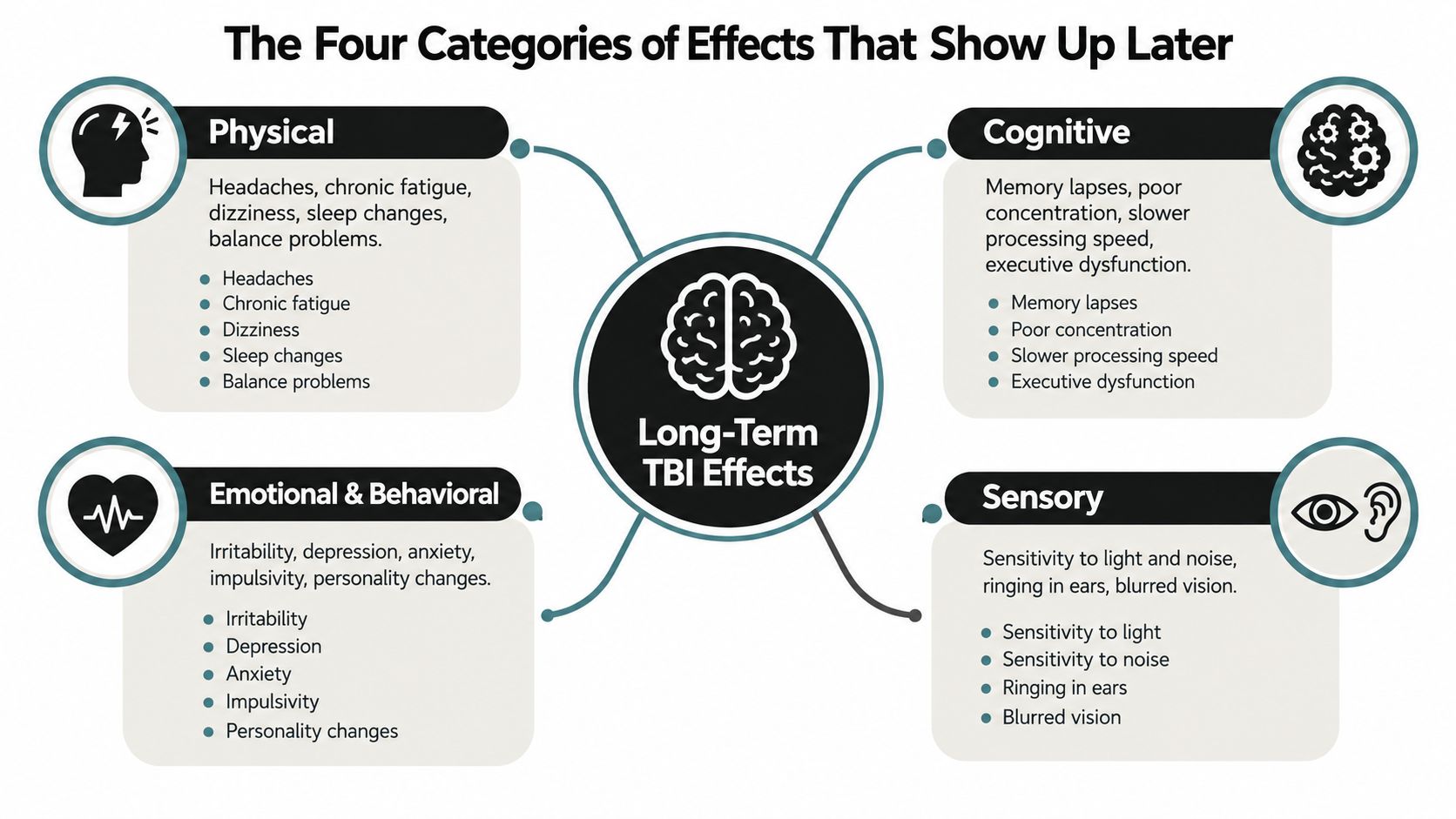
Families usually describe late TBI effects in practical terms. “He can't keep track of the checkbook.” “She gets exhausted after a short conversation.” “He isn't acting like himself.” Those observations can fit four overlapping categories.
Physical effects
Headaches, fatigue, dizziness, balance problems, sleep changes, and sensitivity to light or noise can limit nearly every activity. After a Houston car crash, a survivor may stop driving because traffic lights and highway noise trigger symptoms. A parent may need frequent rest periods and still feel depleted after ordinary household tasks.
Cognitive effects
Cognitive symptoms include memory problems, poor concentration, slower processing, word-finding difficulty, and executive dysfunction. A Fort Worth worker may understand each instruction separately but lose track when several tasks arrive together. Someone who managed household finances before the crash may now miss bills or make unsafe decisions.
The guide to understanding post concussion syndrome offers plain-language background on persistent symptoms and why they can affect daily functioning. It isn't a substitute for medical evaluation, but it can help families describe concerns more clearly at an appointment.
Emotional effects
Depression, anxiety, irritability, and loss of motivation may arise from brain changes, the emotional trauma of the crash, or the strain of living with new limitations. These causes can overlap. A neuropsychologist, neurologist, psychiatrist, or rehabilitation physician can help separate them.
A spouse may report that the survivor becomes tearful or overwhelmed in situations that never caused difficulty before. That change deserves treatment, not criticism.
Behavioral and sensory effects
Poor judgment, impulsivity, aggression, withdrawal, blurred vision, ringing in the ears, and sensitivity to light or sound can affect relationships and safety. These symptoms can be especially hard to prove because they may not appear on a standard scan.
For people seeking representation for injury victims across Texas on a no-fee-unless-we-win basis, a Texas Personal Injury Lawyer may help evaluate how documented symptoms fit a claim. The medical record should remain the foundation. Legal arguments can't replace careful diagnosis.
Two Common Long-Term Trajectories After TBI
TBI recovery usually follows one of two broad patterns, although real lives can combine elements of both.
The first is incomplete but relatively stable recovery. A survivor improves after the crash, returns home, and may even return to work. Some abilities remain limited, however. The person may function well with a quiet schedule and familiar routines but struggle with overtime, multitasking, travel, or major stress.
The second is delayed decline. A person appears to recover and later loses ground. Aging, accumulated stress, sleep problems, depression, additional injuries, or progressive neurological changes may expose limitations that were previously masked. Delayed decline doesn't automatically prove that the original crash caused every later symptom. It does mean the question deserves a careful medical analysis.
What the research shows
A 15-year prospective study of 180 TBI survivors found that 72% had a favorable functional outcome at the long-term assessment, while 53% had abilities that stayed the same or improved between early and later evaluations. At the same time, functional deterioration occurred in almost half of participants during long-term follow-up, with older age and diffuse brain injury associated with worsening neurological status. These findings are summarized by the CDC traumatic brain injury facts and statistics.
A separate very-long-term survey conducted an average of 29 years after injury found that 73% of respondents reported no problems they attributed to TBI, while 18% were totally or severely disabled. Those figures show why no lawyer should promise a result from an injury label alone. Prognosis depends on severity, age, injury pattern, treatment, health, and the person's actual functioning.
A longitudinal meta-analysis following people from 6 months to 24 years found small, statistically significant improvements in memory, processing speed, verbal ability, and visuospatial ability, with effect sizes of approximately 0.27 to 0.38. Executive functioning didn't show significant longitudinal change. The Brain Communications analysis of long-term cognitive outcomes supports a point I've seen repeatedly in claims: improvement in one area doesn't erase persistent difficulty with planning, judgment, or self-monitoring.
Future damages should match the trajectory supported by medical evidence. They may include treatment, vocational rehabilitation, lost wages, reduced earning capacity, household assistance, and pain and suffering.
What Long-Term TBI Actually Looks Like Five Years Out
Population data can't predict one person's future, but it can explain why a claim shouldn't stop at emergency bills. The CDC reports that approximately 50% of people with moderate-to-severe TBI experience further decline in daily life or die within five years of injury, and survivors have a life expectancy approximately nine years shorter than expected. The CDC report on moderate-to-severe TBI outcomes provides the underlying figures.
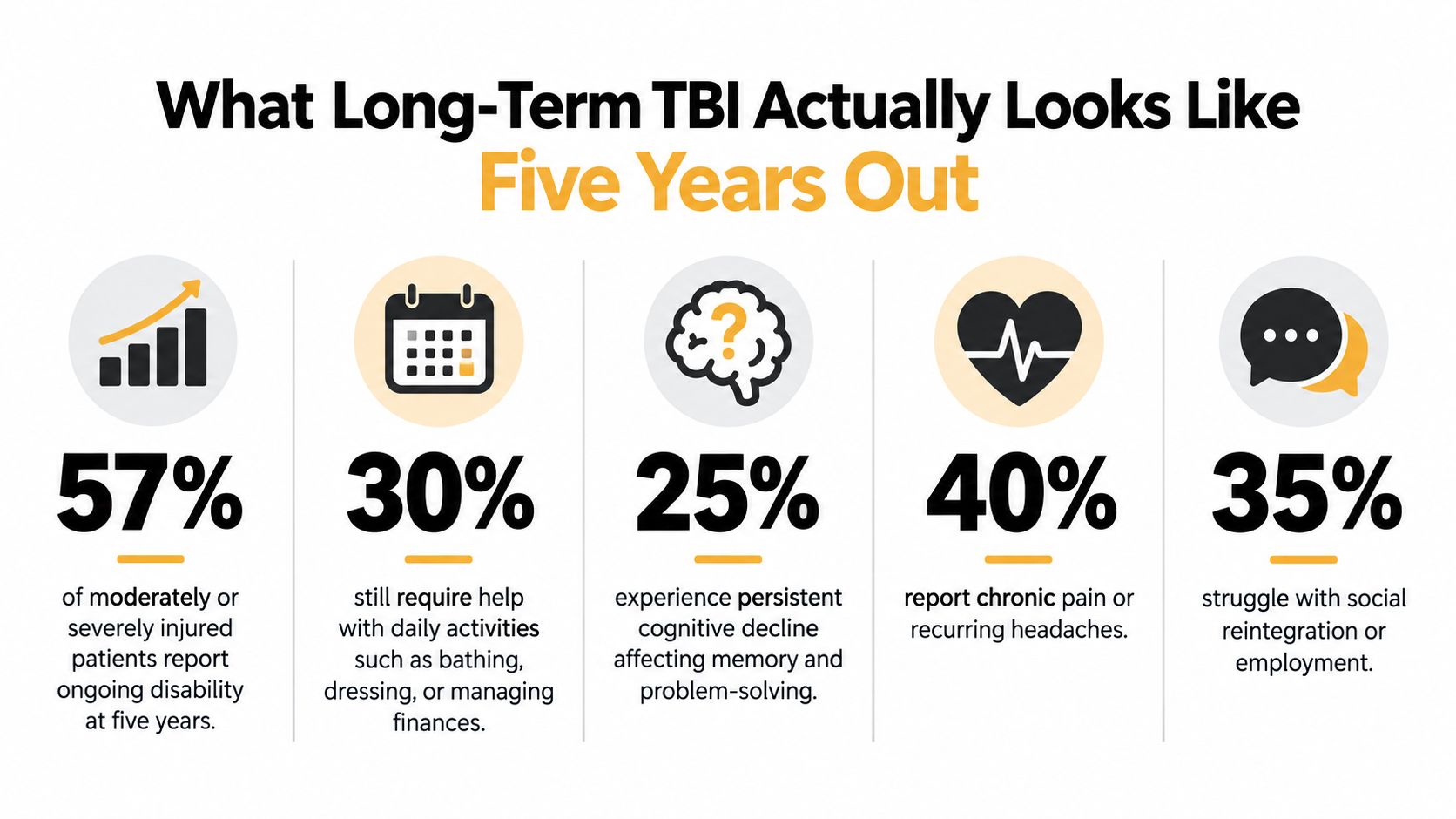
Among survivors in that data, 57% were moderately or severely disabled, 55% of people who had been working when injured were not employed, and 50% returned to a hospital at least once. 33% required help with everyday activities, which can include supervision, transportation, reminders, medication management, or assistance with household tasks.
Those outcomes translate directly into legal damages:
- Disability: Medical treatment, rehabilitation, adaptive equipment, and loss of independence.
- Unemployment: Past lost wages and reduced future earning capacity.
- Hospital returns: Future medical care and related transportation or support.
- Daily assistance: Paid care, unpaid family caregiving, and household-services losses.
- Life expectancy: Long-term planning for treatment and supervision.
The same CDC data reports 29% dissatisfaction with life, 29% alcohol or illicit-drug misuse, and 12% residence in a nursing home or another institution among the described survivors. These figures aren't predictions for your family. They show why changes in mental health, substance use, housing, and independence should be documented rather than dismissed.
A careful claim identifies the person's actual needs. Keep medical records, therapy notes, work history, tax and employment evidence, and family observations. A jury or insurer should see a specific human life before and after the crash, not a generic diagnosis.
The Hidden Long-Term Burden on Families and Caregivers
Families often provide the care that a facility would otherwise provide. They drive to appointments, organize medication, monitor safety, repeat instructions, handle finances, prepare meals, supervise children, and absorb sudden changes in personality. Because no invoice arrives, families often fail to record this work.
That's a mistake. Unpaid caregiving can represent real economic and personal harm. A life-care planner or rehabilitation professional may need to evaluate the survivor's future needs, while family records show what assistance is already occurring.
Keep a caregiving record
Use a calendar or journal to record:
- Tasks: Transportation, reminders, supervision, bathing, dressing, cooking, finances, or medication management.
- Time: The hours spent each day or week, including preparation and travel.
- Costs: Receipts for transportation, counseling, home changes, equipment, and respite care.
- Training: Instruction family members receive to manage behavior, safety, mobility, or medications.
- Employment impact: Missed shifts, reduced hours, delayed retirement, or leaving work to provide care.
- Changes over time: Improvement, new symptoms, safety concerns, or increased dependence.
Recent VA research found that family caregivers reported multiple unmet needs 10 to 15 years after injury, with emotional and practical support among the least often met. Another 2025 study reported that rehabilitation needs can persist for at least a decade. The legal significance is clear: a family may still be carrying a serious care burden long after acute rehabilitation ends.
Resources such as Velma's dementia caregiver support can help families think about stress, burnout, and support needs. The medical and legal record should also identify whether the care relates to the crash and what professionals expect in the future.
Texas law adds urgency. Most personal injury lawsuits generally must be filed within two years, but the correct deadline can depend on the claim, the injured person's circumstances, and when the injury or its legal significance could reasonably be discovered. Modified comparative responsibility also matters. A claimant generally can't recover if found more than 50% responsible, and an award is reduced by the claimant's percentage of fault when responsibility is 50% or less.
For severe injuries involving long-term assistance, families should review Texas catastrophic injury lifetime care claims with counsel before accepting an insurance payment that doesn't account for future needs.
Proving Delayed TBI Damages in a Texas Injury Claim
A person may leave the hospital, return to work, and still develop disabling memory, attention, mood, or stamina problems later. That delay does not defeat a Texas injury claim. It does require clear proof of when the symptoms appeared, what caused them, and how they changed daily function.
Start with the deadline
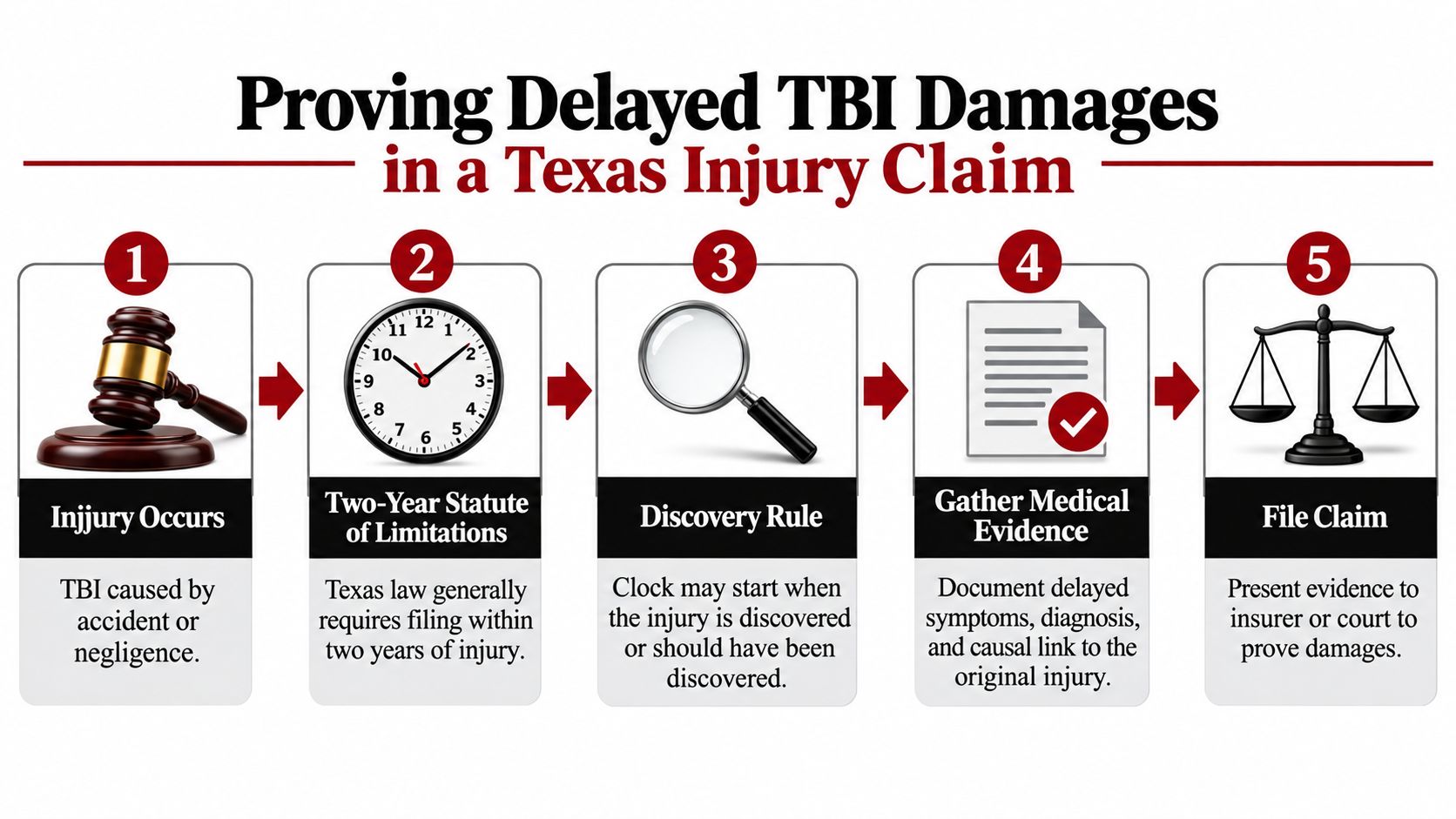
Texas generally gives an injured person a two-year statute of limitations to file a personal injury lawsuit. The ordinary period usually runs from the injury date. The discovery rule may affect that calculation when the injury could not reasonably have been discovered earlier and its significance became apparent later.
Do not assume the discovery rule will preserve a late claim. The analysis changes with the type of case, including a car crash, truck collision, wrongful death claim, childhood injury, or claim against a governmental entity. Contact a lawyer when a delayed deficit becomes medically significant. This Texas injury statute of limitations explanation explains why waiting can place a claim at risk.
Build the proof around function
A persuasive delayed-damages file should connect medical findings to specific losses:
- Pre-injury baseline: Work duties, education, driving, household responsibilities, finances, hobbies, and relationships.
- Crash records: Police reports, photographs, vehicle evidence, witnesses, emergency records, and imaging.
- Continuing medical care: Neurology, neuropsychology, psychiatry, rehabilitation, sleep, headache, and therapy records.
- Neuropsychological testing: Evaluation of memory, attention, processing speed, executive function, and emotional factors.
- Vocational analysis: Work restrictions, retraining, missed opportunities, and reduced earning capacity.
- Future-care planning: Medical and custodial needs, therapy, equipment, transportation, supervision, and family assistance. Use a Texas guide to future medical expenses damages to identify the categories that require documentation.
- Family observations: Specific examples of changes in judgment, mood, memory, stamina, and independence.
An adjuster may focus on a treatment gap or a statement that the injured person is “better.” Be precise. “I'm better than I was in the hospital” can be true while “I'm back to my pre-crash abilities” remains false.
Do not give a recorded statement or sign a broad medical release without legal advice. Do not accept a quick settlement before doctors assess future care. A Houston car accident attorney or truck crash lawyer serving Houston families should review the medical timeline, liability evidence, available insurance, and long-term damages before negotiations conclude.
Steps Texas Families Should Take Right Now
Start with health, not the claim. Schedule follow-up care with the appropriate physician, and ask whether neurology, neuropsychology, physical medicine and rehabilitation, psychiatry, sleep medicine, or vestibular therapy fits the symptoms. Treat headaches, poor sleep, depression, anxiety, and fatigue instead of trying to endure them on your own.
Then create one simple daily record. Note symptoms, activities that trigger them, missed work, appointments, medication problems, safety concerns, and caregiver hours. Preserve pre-crash work records, school records, calendars, performance reviews, tax documents, driving history, and messages that show the person's baseline.
Nutrition and daily routines may also deserve discussion with a treating clinician. Families looking for general background on metabolic needs after brain injury should use that material as general education, not as a replacement for individualized medical advice.
Protect the legal claim while treatment continues:
- Don't guess about recovery: Describe improvement and remaining limitations accurately.
- Don't give recorded statements casually: Ask a lawyer before speaking with an insurer.
- Don't sign a release too soon: Future care may not be clear yet.
- Don't wait for certainty: Consult counsel before the limitations deadline creates a crisis.
- Don't overlook family care: Record tasks, hours, costs, and employment changes.
A Texas traumatic brain injury lawyer can help preserve evidence, investigate fault, coordinate the damages analysis, and determine whether a delayed deficit may fit within Texas deadlines. A wrongful death lawyer Texas families need after a fatal crash can also evaluate survival and wrongful-death claims, depending on the facts.
Recovery may continue, even when it takes longer than anyone expected. With medical care, careful documentation, and timely legal advice, you can protect the person's future and pursue compensation for the harm the crash caused.
The Law Office of Bryan Fagan, PLLC helps Texas families investigate car and truck crashes, document delayed TBI effects, and pursue compensation for medical care, lost income, caregiving, and future needs. Schedule a free consultation through Law Office of Bryan Fagan, PLLC, with contingency-fee representation meaning you pay no fees unless the firm wins, serving Houston, Dallas–Fort Worth, Austin, San Antonio, and surrounding Texas communities.