A serious accident can change your life in seconds, but you don't have to face it alone. You may be reading this after a Houston freeway crash, a Dallas-area collision, or a frightening wreck near Austin or San Antonio. Your vehicle may be damaged, your body may hurt, and an insurance adjuster may already be asking for a recorded statement.
A semi truck tire blowout can create a violent chain of events before anyone has time to react. The right questions aren't only who was driving or who owns the truck. You also need to know why the tire failed, whether the truck should have been on the road, what records can prove the answer, and how Texas law affects your recovery.
When a Blowout Changes Everything on a Texas Freeway
You're driving home with your family when an 18-wheeler beside you suddenly produces a sharp bang. A steer tire fails. Rubber and tread scatter across the lanes. The tractor pulls hard, the driver fights for control, and the trailer begins moving toward traffic. Within seconds, your vehicle may be struck, forced into a barrier, or pushed into another lane.
After a crash like that, people often remember only fragments. You may remember the sound, the truck's movement, or the impact. You may not know whether the tire was underinflated, overloaded, worn, improperly repaired, or damaged before the truck left the terminal. That uncertainty is normal. It's also why the physical tire, maintenance records, inspection reports, cargo documents, and electronic driving data matter so much.
The federal government has identified tire problems as a significant pre-crash factor across vehicle types. In the National Motor Vehicle Crash Causation Survey, approximately 9% of estimated crashes, about 189,917 incidents, were classified as tire-related, and about 50% of tire-related crashes were single-vehicle crashes, compared with approximately 31% of other crashes. The NHTSA crash survey explains why a tire failure can cause a devastating crash even without an initial collision.
Your first job isn't to decide who is at fault. Your first job is to preserve the evidence that can answer that question.
This guide addresses what causes a blowout, how it creates rollovers and jackknifes, which parties may be responsible, and what compensation Texas law may allow. It also explains practical steps to take immediately. If the crash involved trailer damage or other equipment concerns, a resource on aluminum welding for trailers may help explain why preserving damaged trailer components matters before repairs begin.
How a Semi Truck Tire Blowout Happens
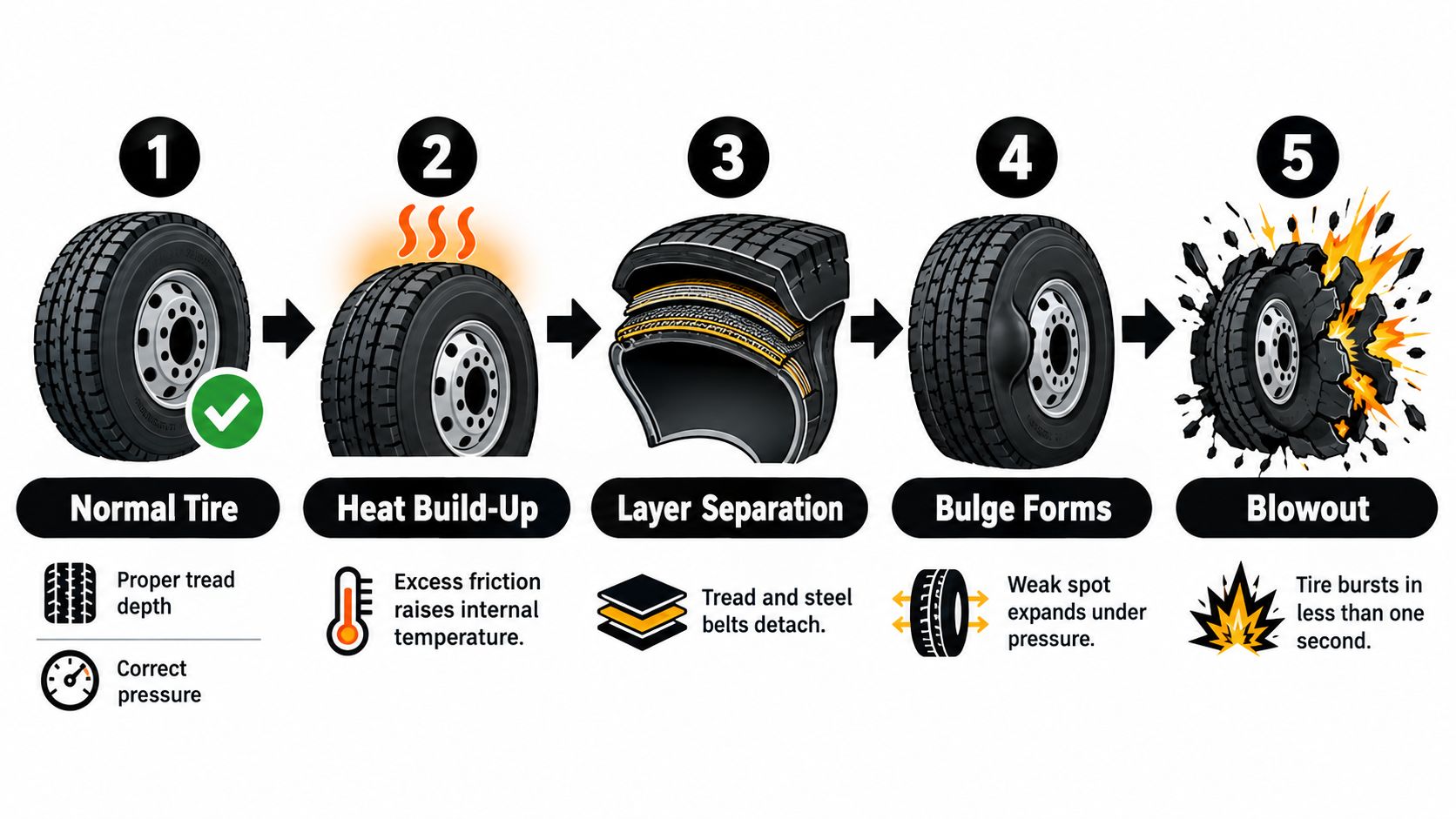
A semi truck blowout usually develops before the tire fails. It often marks the final stage of a load, inflation, and temperature cycle that steadily increases stress inside the tire.
A tire is a flexible structure carrying substantial weight through repeated rotations. If inflation pressure is too low for the axle load, the sidewall and tread flex more with each rotation. That movement creates internal friction and heat. Continued heat can weaken the rubber, steel belts, and casing until the tread separates, the casing ruptures, or the tire rapidly loses pressure.
Excess weight increases the mechanical work required from each tire. Speed and hot pavement leave less room for the tire to shed heat. Together, these conditions can turn a tire that appears acceptable during a quick inspection into a serious roadway hazard.
The failure cycle investigators look for
-
Excess load or low pressure places abnormal stress on the tire. NHTSA reports that most large-truck tire failures in the cited Michigan study were associated with vehicle overloading and/or tire underinflation. NHTSA's interpretation explains the load and inflation connection.
-
Repeated flexing produces heat. The sidewall bends whenever the wheel turns, and internal friction raises the tire's temperature.
-
Heat damages internal structure. Rubber, belts, and casing materials can weaken even when the visible tread does not immediately show the damage.
-
Separation or rupture begins. Tread may detach, a bulge may develop, or the casing may fail under continued pressure.
-
The tire loses air or bursts. The driver may have only moments to keep the tractor-trailer in its lane.
Measure pressure when the tire is cold, generally after the vehicle has been parked for roughly three hours. Releasing air from a hot tire can leave it dangerously underinflated after it cools. If a carrier does not verify pressure against the manufacturer's specified cold pressure, investigators should examine that maintenance decision.
Warning signs and useful records
Pre-trip checks should identify cuts, sidewall bulges, exposed cord, uneven wear, embedded objects, and improper repairs. The carrier should also verify axle weights and tire load ratings. When a tire fails after a heavy load, the casing, cargo records, and surrounding evidence can help distinguish among possible causes.
Tire condition affects safe movement in any context, from passenger vehicles to mobility equipment. This guide for caregivers and seniors provides background on tire replacement for mobility equipment.
A Truck Accident Lawyer in Texas may represent victims of commercial truck and 18-wheeler collisions. The legal assessment should start with the failure mechanism and the preserved evidence, not an assumption that every blowout proves negligence.
How a Blowout Turns Into a Serious or Fatal Crash
Once the tire fails, the crash sequence unfolds in seconds. The case turns on what the truck did next and how its movement affected nearby drivers.
A steer-tire failure can pull the tractor toward the damaged side and make steering difficult. An overcorrection may send the truck across its lane, into a barrier, or onto its side. A drive-tire failure can reduce traction and stability, particularly when the trailer starts pushing the tractor. The tractor and trailer may then fold across the roadway in a jackknife.
Separated tread creates another danger. A passenger vehicle can strike the debris, swerve into another lane, or lose control while avoiding it. The truck may never touch that vehicle directly, yet the blowout can still have caused the collision.
What the crash scene can reveal
A Texas crash investigator may examine:
- Yaw marks: Tire marks that help show rotation and attempted steering.
- Scrape patterns: Damage on pavement, guardrails, the trailer, or other vehicles that may show the truck's path.
- Final positions: The locations of the tractor, trailer, debris, and passenger vehicles help reconstruct movement.
- Cargo condition: Shifted or poorly distributed cargo may explain axle overload or sudden instability.
- Tire fragments: Tread, casing, rim, and sidewall pieces may indicate whether the failure began inside the tire or followed an external impact.
The federal crash-causation data indicates that tire-related crashes often involve a single vehicle. That finding matters in a semi-truck case. A truck can roll over, cross a median, or scatter debris without first striking another vehicle. Investigators should therefore treat the tire failure as a possible cause of the crash, not merely as damage discovered afterward.
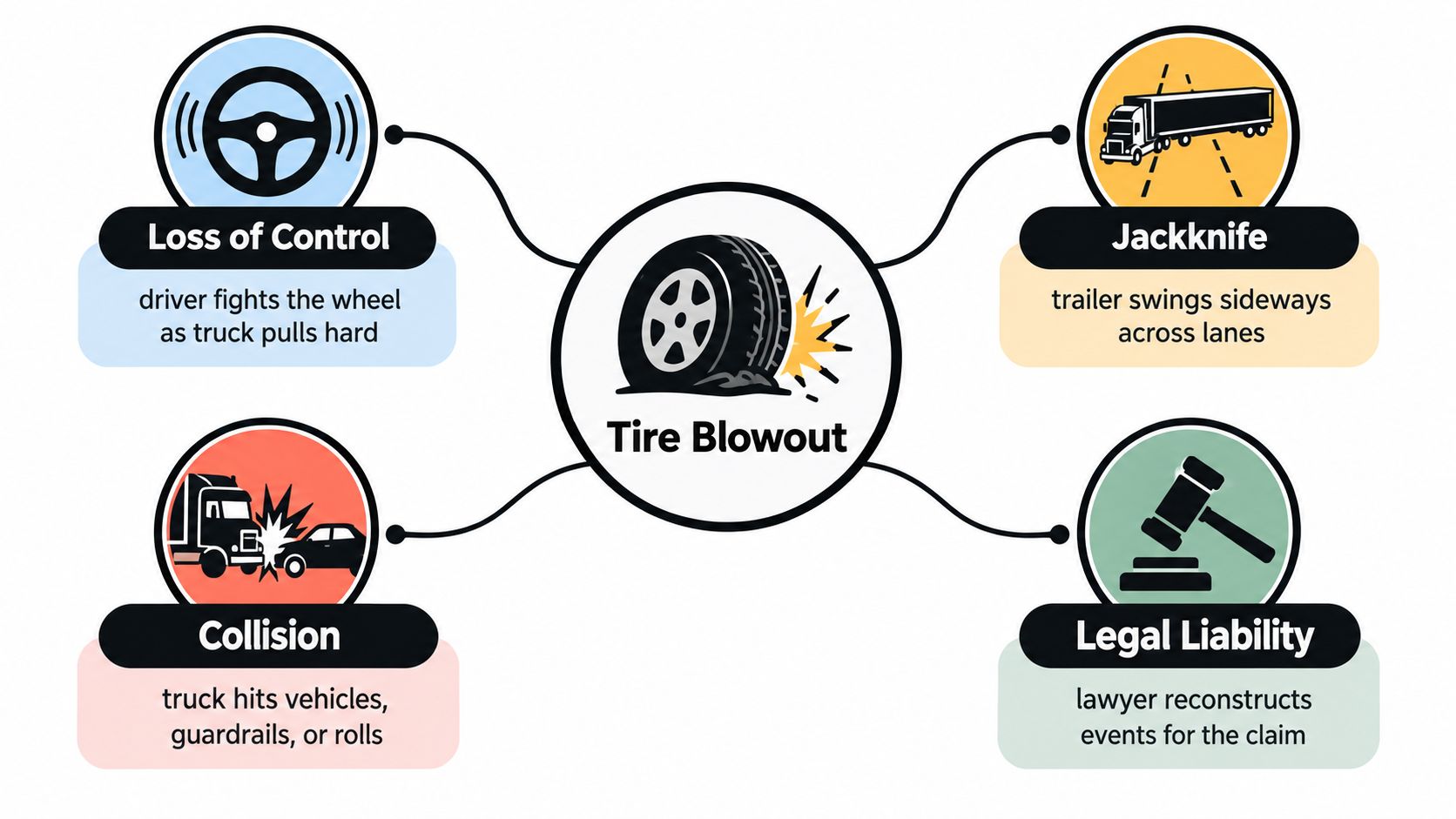
Injuries may include fractures, spinal trauma, traumatic brain injuries, burns, amputations, or fatal harm. Your claim must connect those injuries to the crash, then connect the crash to a person or company that failed to act reasonably.
Unsafe property cases follow a different legal path. The evidence principle remains useful: the condition, notice, and resulting injury must be connected. Slip and Fall / Premises Liability in Texas addresses that type of claim, while a blowout investigation focuses on tires, loading, maintenance, driver conduct, and vehicle movement.
Federal Inspection and Tire Rules as Evidence
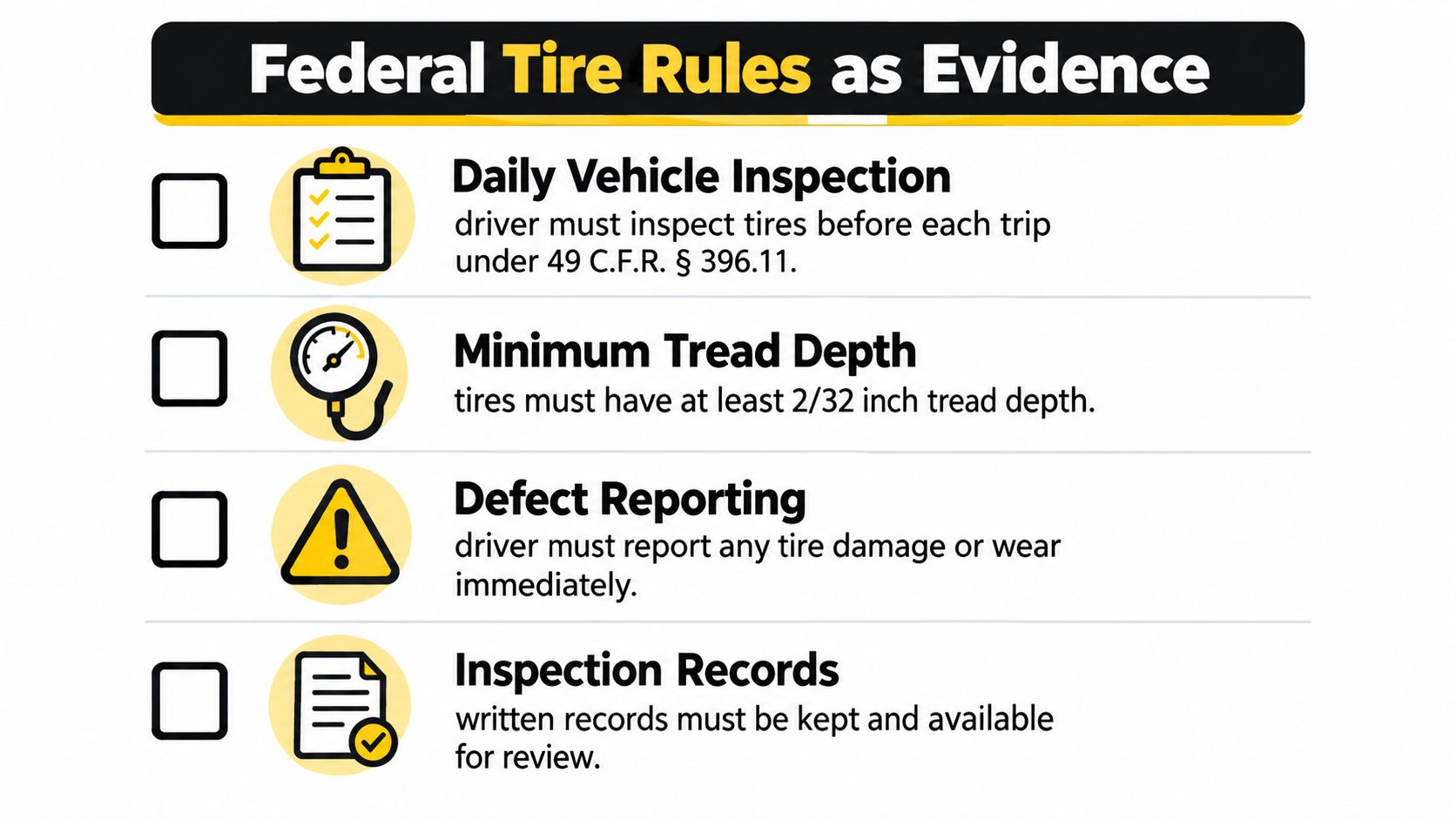
A carrier's inspection records can show whether a tire problem was visible, reported, and ignored before a truck entered a Texas roadway. Federal rules do not decide liability by themselves, but they establish specific duties for inspecting, documenting, repairing, and preserving evidence.
Under 49 C.F.R. § 396.11, commercial drivers generally must inspect their vehicles at the end of each workday and complete a written report identifying defects or deficiencies. If a reported defect could affect safe operation, the carrier must repair it or certify that repair is unnecessary before dispatching the vehicle again. The FMCSA safety guidance identifies these reports as important records in a truck maintenance investigation.
Every commercial vehicle, including each segment of a combination vehicle, must undergo a periodic inspection at least once every 12 months. The carrier must retain that inspection report for 14 months, and proof of the latest inspection must remain in the vehicle. Missing records, unexplained gaps, or paperwork that conflicts with the tire's condition can materially affect the investigation.
Tire conditions that deserve close review
Federal commercial-vehicle tire rules address load limits, inflation, tread depth, and dangerous physical defects. Under 49 C.F.R. § 393.75, the generally applicable minimum tread depth is 4/32 of an inch in a major tread groove for front tires on a truck or truck tractor and 2/32 of an inch for other tires. The rule also addresses severe cuts exposing cord or ply, bulges, improper repairs, and tires not rated for the load carried. FMCSA's tire requirements give investigators standards to compare with the failed tire.
The 2025 International Roadcheck reported 56,178 inspections, and tire-related defects produced 2,899 vehicle out-of-service violations, making tires the second-most-cited vehicle out-of-service category after brakes. The Roadcheck inspection information does not prove that a particular carrier caused a crash. It does support examining recurring maintenance problems, prior warnings, and any decision to return a truck to service with a known defect.
Request daily inspection reports, periodic-inspection reports, repair invoices, tire purchase and retread records, pressure records, dispatch documents, cargo weights, and prior out-of-service materials. Counsel can then assess whether the evidence supports a Texas negligence claim involving a federal motor-carrier safety violation and negligence per se in a Texas trucking case. Preserve the tire, photographs, electronic records, and paperwork before anyone discards or alters them.
Who Can Be Liable in Texas After a Blowout Crash
A blowout alone doesn't prove legal responsibility. Texas negligence law generally requires evidence that a responsible person or company failed to use reasonable care, that the failure caused the crash, and that the crash caused compensable harm.
The possible responsible parties depend on the evidence:
- The driver may face questions about inspection, speed, lane control, reaction, or knowingly operating an unsafe vehicle.
- The motor carrier may be responsible for maintenance, inspection systems, hiring, training, dispatch decisions, or sending the truck out with a known defect.
- A maintenance contractor may have installed, repaired, inflated, or inspected the tire improperly.
- A tire seller or retreader may be involved if the tire had a defective casing, failed retread bond, or improper repair.
- A loader or shipper may be responsible if cargo weight or distribution overloaded an axle or tire.
- A manufacturer may be considered when a manufacturing or design defect contributed to the failure.
The key is to separate the failure mechanism from the legal theory. A casing may show heat damage, impact damage, age-related deterioration, a manufacturing problem, or several contributing conditions. The person who owned the truck isn't automatically responsible, and the driver isn't automatically responsible because the driver was behind the wheel.
How comparative responsibility affects recovery
Texas Civil Practice and Remedies Code Chapter 33 uses proportionate responsibility. A claimant may not recover damages if the claimant's percentage of responsibility is greater than 50%. If recovery is allowed, a liable defendant generally owes the share corresponding to that defendant's assigned percentage. Texas Chapter 33 controls this framework.
For example, suppose a jury found a truck carrier 70% responsible for dispatching a semi with an unsafe tire and an Austin driver 30% responsible for a related driving mistake. The driver's damages could be reduced by 30%. If the driver were found 51% responsible, Chapter 33 would bar recovery under the cited rule.
A truck tire may be defective, but the claim still needs proof of how that defect caused the crash and who had a duty to prevent it.
How long do you have to file a claim in Texas?
Texas generally gives an injured person two years to file a personal injury lawsuit, and wrongful-death claims commonly carry a two-year limitations period as well. The exact deadline can change based on the facts, the identity of the defendant, governmental involvement, the injured person's age, or other legal circumstances. Don't wait until the deadline is close. Evidence such as tread fragments, electronic data, inspection files, and witness memories can disappear long before a lawsuit is filed.
What to Do in the First 48 Hours After a Texas Blowout Crash
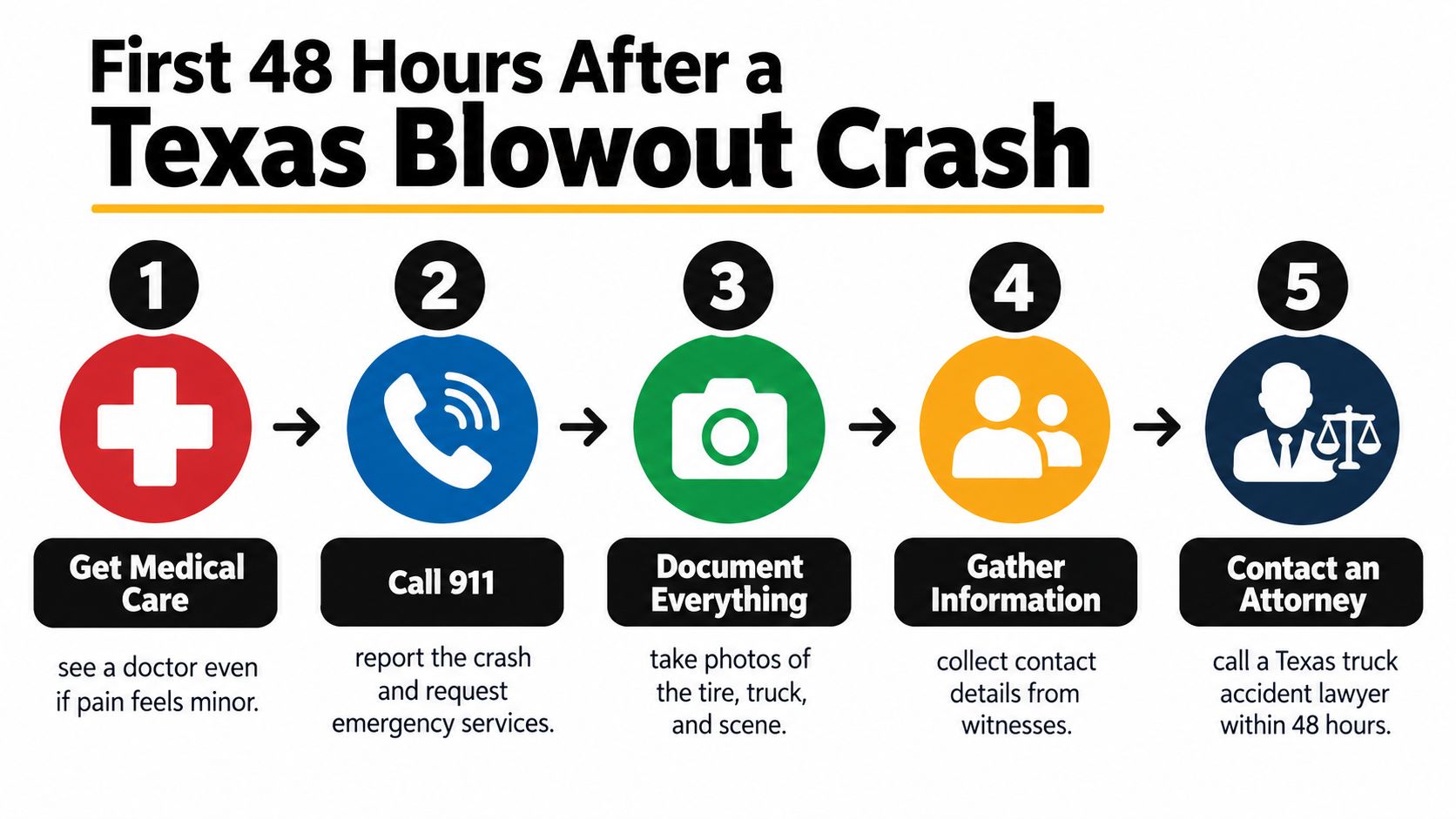
The first two days can shape your recovery and protect evidence that may disappear after the wreck. Put your health first, then take these steps as soon as you safely can.
-
Get medical care. Neck, back, head, and internal injuries may not feel severe at the scene. Follow your provider's instructions, attend recommended appointments, and keep records, prescriptions, discharge papers, and bills.
-
Call 911 and remain at the scene. Ask for emergency services and the formal crash report. Tell responders where you hurt, describe the truck's movement, and point out tire fragments, tread, or other debris. Before leaving, ask how to obtain the report and record the DPS crash report number when it becomes available.
-
Report dangerous debris. If tire pieces remain in an active lane or create another hazard, tell 911 or the agency responsible for that roadway. Do not enter traffic to collect fragments. Ask whether the debris was removed, where it was found, and which agency handled the cleanup.
-
Document the roadway. If you can do so safely, photograph the failed tire, truck, debris, lane markings, barriers, vehicle damage, skid marks, and final positions before cleanup or traffic changes the scene. Gather names and contact details from witnesses who saw the blowout, truck movement, or debris. Preserve dashcam footage and ask whether nearby businesses or traffic systems may hold video.
-
Contact a lawyer promptly. A carrier's insurer may call before you know what the maintenance, driver, or electronic records show. Do not give a recorded statement or accept a settlement before receiving legal advice.
A lawyer should send a preservation letter covering the tire, truck, trailer, cargo, maintenance files, inspection records, driver logs, dispatch records, video, and electronic control module data. Read about an ECM black-box data preservation letter in a Texas truck wreck to see why electronic evidence needs prompt attention. The request should identify the crash, demand that relevant materials not be altered or discarded, and go to the carrier and other possible record holders.
Preserve your own insurance policy, photographs, medical records, wage information, vehicle estimates, and correspondence. If you are reviewing collision and coverage, use this guide to compare auto coverage types. It can clarify policy language, but it does not replace advice about a claim against the truck driver or carrier.
What Fair Compensation Can Look Like for Texas Families
After a blowout crash, damages are more than the first hospital bill. Consider a representative Texas family whose vehicle is struck by a truck after tread separates. One parent suffers a spinal injury, cannot return to the same work, needs rehabilitation, and faces future treatment. The family may have emergency expenses, hospital and surgical bills, medication costs, rehabilitation expenses, lost wages, reduced earning capacity, and future medical needs.
The law may also recognize losses that don't come with a simple invoice:
- Physical pain and emotional distress caused by the collision and recovery.
- Disfigurement or disability that changes daily activities and independence.
- Loss of enjoyment of life when injuries prevent normal family, work, or recreational activities.
- Property damage to the vehicle and personal belongings.
- Future care needs supported by medical and vocational evidence.
If the crash kills a family member, a wrongful death lawyer in Texas can evaluate a claim for eligible surviving family members. Depending on the facts, a surviving spouse, child, or parent may seek damages connected to the relationship, financial support, mental anguish, loss of companionship, and funeral-related losses. The evidence must establish the death, the responsible conduct, and the losses recognized by Texas law.
NHTSA reports an average of nearly 11,000 tire-related motor-vehicle crashes each year, with more than 600 deaths annually in those crashes. NHTSA separately reported 511 deaths in tire-related crashes during 2024. NHTSA's tire-safety information includes all vehicle types, not only commercial trucks, but the size and momentum of a tractor-trailer can magnify the consequences.
An insurer's first offer may address immediate bills while ignoring future care, lost earning capacity, pain, or family losses. Don't sign away those claims before the medical picture and crash evidence are understood.
How a Texas Personal Injury Lawyer Can Help You Move Forward
A Texas personal injury lawyer turns the mechanical evidence into a claim that can be investigated and proved. The Law Office of Bryan Fagan, PLLC can send preservation letters, obtain inspection and maintenance records, examine tire and cargo evidence, seek telematics data, coordinate with medical providers, and prepare the case for negotiation or trial on a contingency-fee basis.
You can learn more about representation involving a semi-truck accident lawyer in Texas. The same early investigation may be necessary in Houston, Dallas-Fort Worth, Austin, San Antonio, and surrounding communities.
Recovery is possible, even when a blowout crash has changed your life. You and your family don't have to face the carrier's insurer or preserve complex evidence alone.
The Law Office of Bryan Fagan, PLLC offers free consultations for people injured in Texas semi truck tire blowout crashes and for families facing wrongful death claims. Visit Law Office of Bryan Fagan, PLLC to discuss the crash, preserve the evidence, and learn what legal options may be available to you.