Placards on trucks are required safety signs that identify hazardous cargo, and they can matter greatly for your legal rights after a crash. In federal crash data, hazardous materials were present on approximately 3% of large trucks in fatal crashes and 2% of large trucks in injury and towaway crashes; among placarded trucks in those reported crashes, material was released from 30%.
A serious accident can change your life in seconds, but you don't have to face it alone. After a Houston freeway collision, you may remember only smoke, shattered glass, emergency lights, and a square sign on the truck that struck you. That sign may help firefighters respond safely, but it can also become an important lead in a personal injury, catastrophic injury, or wrongful death claim.
What Happens When a Placarded Truck Crashes in Texas
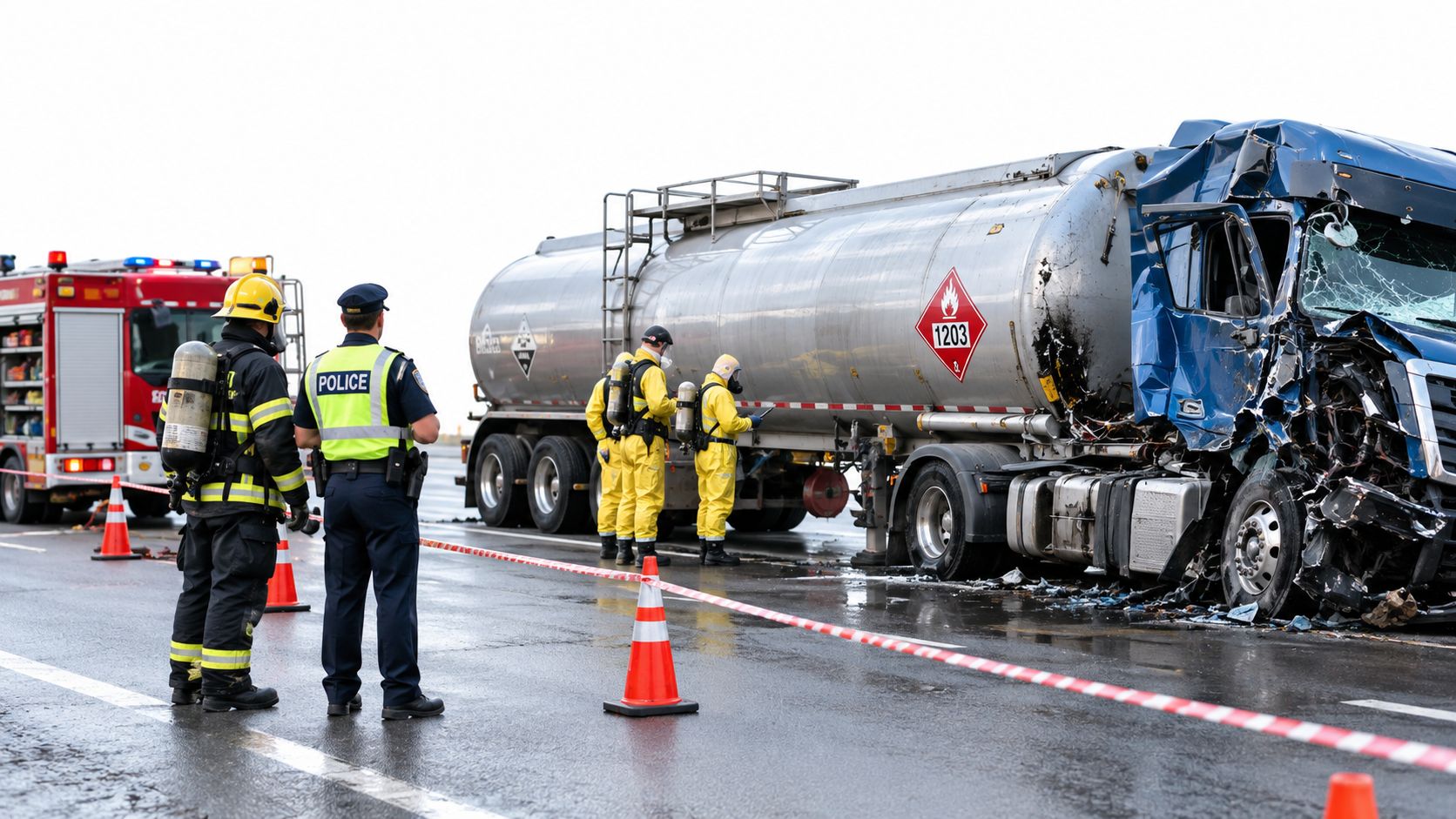
After a major Texas highway crash, ordinary drivers often see unfamiliar diamond-shaped signs on a tanker, trailer, or cargo container. Those placards on trucks identify hazard categories, such as flammable materials, corrosives, gases, or poisonous substances. They warn responders that opening a damaged compartment or approaching a leaking vehicle may create risks beyond the collision itself.
The first concern is always safety. Firefighters, police officers, and emergency medical personnel may need specialized protective equipment, altered suppression tactics, evacuation measures, or medical precautions. Federal crash records show why the warning matters. Hazardous materials appeared on approximately 3% of large trucks involved in fatal crashes and 2% of large trucks involved in injury and towaway crashes. Among placarded trucks in those reported crashes, hazardous material was released from 30%. Those figures don't mean every placarded truck crash causes a spill. They show why the sign deserves immediate attention when a tanker overturns, a trailer catches fire, or a container may be damaged. Federal Motor Carrier Safety Administration crash facts provides the underlying data.
Why the sign matters to your claim
A placard isn't proof that the truck driver caused the wreck, and it doesn't prove that hazardous material escaped. It can, however, help identify the cargo, carrier, shipper, and safety rules that applied. That information may lead investigators to bills of lading, shipping papers, loading records, inspection reports, and hazardous-material incident reports.
Practical rule: Treat the placard as a safety warning first and an investigative lead second. Never approach a leaking, smoking, overturned, or damaged truck to obtain a better photograph.
After responders secure the scene, evidence may disappear quickly. Vehicles move, cargo is transferred, and damaged placards may be removed or replaced. Collision shops and investigators may also need to understand how damaged truck components were handled. A resource such as Safety Restore for collision shops can provide context about specialized collision repair environments, although your lawyer should separately preserve the crash evidence and commercial records.
Understanding What Truck Placards Actually Show
A placard is generally a square sign positioned like a diamond. Its color, symbol, and class number provide a rapid warning about the type of hazard involved. Some placards also display a four-digit identification number that can help responders identify the specific material through official emergency-response resources.
The visual system is designed for recognition under stress. Red may signal fire-related danger, white may indicate toxic or corrosive risks, yellow may signal oxidizers or radioactive material, and orange may identify explosives. The exact meaning depends on the class and symbol, so a victim shouldn't try to interpret a damaged sign as a complete answer.
Common hazard classes you might see on a truck
| Hazard class | Typical placard color | Common examples |
|---|---|---|
| Class 1 | Orange | Explosives |
| Class 2 | Red, green, or white | Flammable, nonflammable, or poisonous gases |
| Class 3 | Red | Flammable liquids |
| Class 4 | Red and white, white over red, or blue | Flammable solids or materials dangerous when wet |
| Class 5 | Yellow or red over yellow | Oxidizers and organic peroxides |
| Class 6 | White | Toxic substances |
| Class 7 | Yellow over white | Radioactive materials |
| Class 8 | White over black | Corrosives |
| Class 9 | White with black stripes | Miscellaneous hazardous materials |
What a placard doesn't tell you by itself
The sign identifies a hazard class, not every fact needed to evaluate liability. Investigators still need to determine what was loaded, how much was transported, whether the container was damaged, whether a release occurred, and who controlled loading and transportation.
That distinction matters after an Austin or San Antonio crash. A visible placard can support a request for shipping papers and carrier records, but it doesn't automatically establish negligence, punitive damages, or an exposure-related injury. Medical causation may require toxicology, environmental medicine, occupational medicine, and a clear record of when and how exposure happened.
If you saw a number on an orange panel or diamond, write down what you remember without guessing. A blurry photograph may still help counsel compare the sign with the truck's company name, trailer number, cargo documents, and federal records.
How Federal and Texas Rules Shape Truck Placard Requirements
Placard requirements became more consistent after a major federal milestone in September 1976. The Materials Transportation Bureau, a predecessor of today's Pipeline and Hazardous Materials Safety Administration, issued final rules under Docket HM-103/112 establishing uniform vehicle-placard formats and procedures across transportation modes. Before that standardization, transportation systems could use inconsistent identification practices, which made hazardous cargo harder to recognize quickly.
Congress later expanded the federal hazardous-material framework through the Hazardous Materials Transportation Uniform Safety Act of 1990, signed on November 16, 1990. The federal hazardous-material transporter registration program began in 1992, and additional placarding changes under Docket HM-181 generally took effect on October 1, 1994, including adoption of the United Nations-recommended Class 9 placard for miscellaneous hazardous materials. Current federal placarding rules appear in 49 CFR Part 172, Subpart F. PHMSA registration information describes the federal regulatory framework.
Bulk cargo and quantity thresholds
Federal rules generally require placards for hazardous materials transported in bulk packaging. Nonbulk shipments depend on the material's hazard class, division, and quantity. Some high-consequence materials can require placarding at very small quantities, while many other materials use quantity thresholds.
For many Table 2 materials, aggregate gross weight at or above 454 kilograms, or approximately 1,001 pounds, generally requires placards. Aggregate gross weight includes the covered hazardous materials and their packaging on one transport vehicle. Table 1 materials require placarding regardless of quantity. FMCSA's hazardous-material placarding guide explains these distinctions.
Texas courts don't automatically convert a federal placarding violation into a winning injury claim. The violation may provide evidence about a carrier's safety duty, but you still need proof connecting the conduct to the collision, release, exposure, or damages. For a focused discussion of federal safety violations and Texas negligence theories, review federal motor carrier safety violations and negligence per se in Texas trucking cases.
What to Document Safely After a Truck Crash Involving Placards
A damaged hazmat truck isn't a scene to investigate by walking closer. Smoke, leaking liquid, damaged tanks, fire, and emergency operations can create risks that aren't visible from the roadway. Move to a safe location, follow police and fire instructions, and get medical attention before trying to preserve evidence.
Start with safety
If you can document anything without approaching the truck, use a phone from a safe distance. A witness in another vehicle may be able to record details while you remain in a protected area.
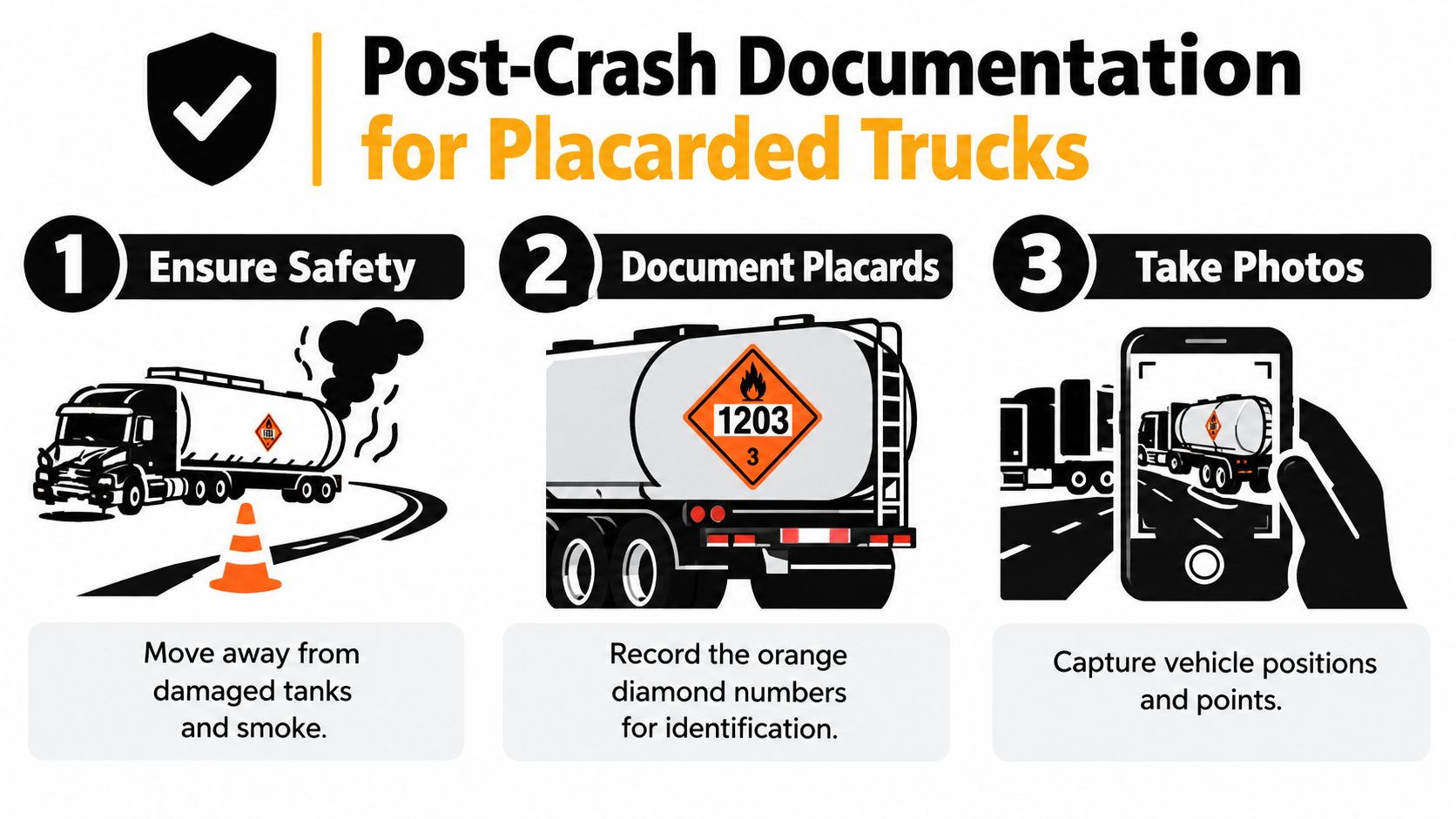
- Move away from danger. Stay clear of damaged tanks, smoke, flames, leaking cargo, and traffic lanes.
- Photograph the scene broadly. Capture vehicle positions, lane markings, road conditions, debris, and visible damage.
- Record the placard safely. Photograph each visible sign from a distance and, only if safe, obtain a closer image without entering the truck's area.
- Note identifiers. Record the tractor and trailer numbers, company name, license information, and any cargo-tank markings.
- Preserve official records. Keep the police report, medical records, insurance correspondence, and any shipping-paper information obtained through lawful or official channels.
- Don't move cargo. Never open a container, handle a damaged package, or remove a placard.
A placard may help identify the cargo, but it isn't proof that the truck caused the crash or that a release occurred. FMCSA systems track placard status and cargo release as separate facts. That distinction prevents a common mistake: treating a warning sign as conclusive proof of exposure or fault.
Commercial carriers and insurers may control important evidence immediately after a collision. Counsel may need to request dispatch records, bills of lading, shipping papers, driver logs, inspection records, electronic-control-module data, and hazardous-material incident reports. A truck electronic-control-module data preservation letter can help address that timing issue.
If you need representation for a driver or passenger injured in a Texas car accident, a Car Accident Lawyer in Texas may help preserve the ordinary collision evidence while a truck investigation develops.
Watch this safety-focused resource without returning to the truck or attempting your own inspection:
How Placards Affect Fault, Damages, and Insurance Claims in Texas
A placard can change the questions an insurer and crash investigator must ask, even when no hazardous cargo leaked. The vehicle may fall within a category that prompts closer review of carrier identification, safety records, inspections, cargo documentation, and emergency-response obligations. The sign can also help responders evaluate whether fire, toxic exposure, evacuation, or specialized medical precautions were necessary.
It still doesn't replace proof of ordinary negligence. A claim may depend on unsafe following distance, fatigue, distraction, speeding, improper loading, inadequate maintenance, or another driver's conduct. The placard gives investigators a reason to examine additional records. It doesn't decide the case.
Texas proportionate responsibility
Texas uses proportionate responsibility when multiple people or entities may have contributed to an injury. Under Texas Civil Practice and Remedies Code Chapter 33, a defendant generally pays only the percentage of damages assigned to that defendant by the fact finder. Texas generally bars recovery when the injured person's percentage of responsibility is greater than 50%.
For example, if a jury finds $200,000 in damages after a Dallas-area truck collision and assigns 20% responsibility to the injured driver, the recoverable amount would generally be reduced to $160,000, before other legal issues are considered. If the injured person were assigned 51% responsibility, Chapter 33 would generally prevent recovery. Those percentages are why investigators must examine every actor, including the driver, motor carrier, cargo loader, maintenance provider, and other motorists.
A placard doesn't automatically prove punitive damages, a regulatory violation, or chemical exposure. Medical records must connect symptoms to the crash or exposure, and the evidence must show how the conduct caused harm. If an insurer offers less than the claim warrants, careful documentation supports a reasoned response when disputing a low settlement offer, rather than an emotional decision made under financial pressure.
Insurance timing matters
Texas Department of Insurance guidance recommends notifying insurers promptly, including your own insurer even when another driver caused the crash. Keep photographs, witness information, the police-report number, repair and towing receipts, medical records, and notes of every call. An insurer must acknowledge receipt of a claim within 15 business days, according to Texas insurance claim guidance.
Don't give a recorded statement about fault or exposure before you understand the facts. Speak accurately, but avoid guessing about the placard, cargo, speed, or cause of the collision.
Working with a Texas Truck Crash Lawyer After a Placard Injury Claim
Placard cases require two investigations at once. The first asks how the collision happened. The second asks what hazardous material was present, who controlled it, whether the cargo was properly packaged and marked, and whether the response created additional harm.
An experienced Texas personal injury lawyer can help preserve both tracks before evidence disappears. That may include requesting commercial vehicle photographs, dispatch communications, bills of lading, shipping papers, driver logs, inspection records, maintenance files, electronic data, carrier safety information, and hazardous-material incident reports. The lawyer may also consult trucking-safety professionals, accident-reconstruction specialists, toxicologists, and medical experts when the facts require them.
The legal questions are broader than the placard
A careful case evaluation may examine:
- Driver conduct: Was the driver distracted, fatigued, speeding, or following too closely?
- Carrier practices: Did the motor carrier train, supervise, inspect, and maintain the vehicle appropriately?
- Cargo control: Did a shipper, broker, or loader classify, package, secure, and document the material correctly?
- Visibility and placement: Was the placard present, legible, securely attached, and unobscured?
- Medical causation: Do medical records establish injuries from the crash, possible exposure, or both?
- Damages: Do the records support medical expenses, lost income, pain and suffering, future care, or wrongful-death damages?
Federal specifications require a standard placard to measure at least 250 millimeters by 250 millimeters, approximately 9.84 inches square. It must remain securely attached, clearly visible from the direction it faces, legible, and unobscured by dirt, damage, doors, ladders, pipes, equipment, or tarpaulins. Placarding failures may support a broader inquiry into inspection, loading, maintenance, and post-crash response practices, but they don't independently establish liability. FMCSA's markings, labeling, and placarding guide provides the applicable specifications.
Claims involving catastrophic injury or death
A collision involving hazardous material may cause more than broken bones and vehicle damage. Fires, chemical contact, inhalation, and delayed symptoms can create complex medical questions. A family that loses someone may need a wrongful death lawyer in Texas to investigate the crash, identify responsible parties, and pursue damages available under Texas law.
Catastrophic injuries may require long-term treatment, rehabilitation, home modifications, transportation, or assistance with daily activities. A lawyer should build the claim around documented needs rather than assume that a placard alone increases its value. The same applies in Houston, Dallas–Fort Worth, Austin, and San Antonio, where commercial traffic, multiple carriers, and rapidly changing crash scenes can complicate evidence collection.
Insurance coverage also requires careful review. Policy questions can involve the motor carrier, shipper, owner of the truck, broker, and other entities. General information about Florida trucking liability insurance may help explain commercial coverage concepts, but a Texas claim must be analyzed under the policies, parties, and facts involved in the collision.
Many personal injury firms accept qualifying matters on a contingency-fee basis, meaning the client generally doesn't pay attorney fees upfront and the fee depends on the representation agreement and outcome. Ask about costs, medical bills, investigation expenses, communication, and settlement authority before signing anything.

When a serious collision involves a commercial vehicle, a semi-truck accident lawyer can help coordinate the crash, cargo, insurance, and medical investigations. If someone has died, involve counsel before giving a recorded statement or accepting a settlement. If you were injured, seek medical care even if symptoms appeared later, preserve your records, and don't discard damaged property before it can be documented.
The Law Office of Bryan Fagan, PLLC can investigate placarded truck crashes, commercial vehicle collisions, catastrophic injuries, and wrongful death claims across Texas through free consultations and contingency-fee representation. Visit Law Office of Bryan Fagan, PLLC to protect evidence, understand your options, and schedule a consultation. Recovery is possible, and you don't have to handle the insurance and legal process alone.