A serious accident can change your life in seconds, but you don't have to face it alone. You may be sitting in a damaged vehicle near a Houston, Dallas, or San Antonio intersection, replaying the turn in your mind and wondering whether the crash was your fault. Your injuries may already be affecting work, family responsibilities, and daily life, while an insurance adjuster is asking for your version of events.
Left turn accident fault in Texas isn't decided by one sentence, such as “the turning driver always pays.” Texas law starts with the turning driver's duty to yield, but investigators must also examine the oncoming driver's speed, signal compliance, visibility, lane use, and attention. The final result can depend on the evidence showing what each person did and how those actions contributed to the collision.
A Crash at a Texas Intersection and the Question That Follows
After a San Antonio driver begins a left turn across an intersection, an oncoming SUV appears closer than expected. The impact follows almost immediately. One vehicle may have damage to its front corner, while the other has damage along the driver's side. Both drivers may say they had the green light. Within minutes, the question becomes, “Who pays?”
That question matters because the answer can affect medical bills, lost income, vehicle damage, pain, long-term care, and the family's financial stability. It also matters because a police report may identify one contributing factor without deciding the final civil responsibility between the parties.
Left-turn crashes deserve careful attention. In the National Motor Vehicle Crash Causation Survey, researchers estimated that 2,188,969 police-reported crashes were represented by the study sample. Approximately 36%, or 787,236 crashes, were intersection-related, and a left turn was the critical pre-crash event in 22.2% of those intersection crashes, the largest share identified for any maneuver.
A left turn creates a conflict between a vehicle crossing traffic and a vehicle moving through the intersection. The investigation must examine both sides of that conflict.
The important point is that the turning driver's duty is only the beginning. A driver traveling straight may have been speeding, distracted, or running a red light. A turning driver may have entered from an improper lane or swung wide. Road design, blocked sightlines, signal timing, and vehicle data can also change the picture.
This article explains the process in plain English. You'll learn how Texas law defines the turning duty, what investigators look for, how comparative responsibility affects recovery, how to preserve evidence, and when to speak with a Texas personal injury lawyer. You deserve clarity, not a wall of legal terms, while you decide what to do next.
How Texas Law Defines the Left-Turn Duty
Texas law gives investigators a clear starting point, but it doesn't end the analysis.
The yield rule
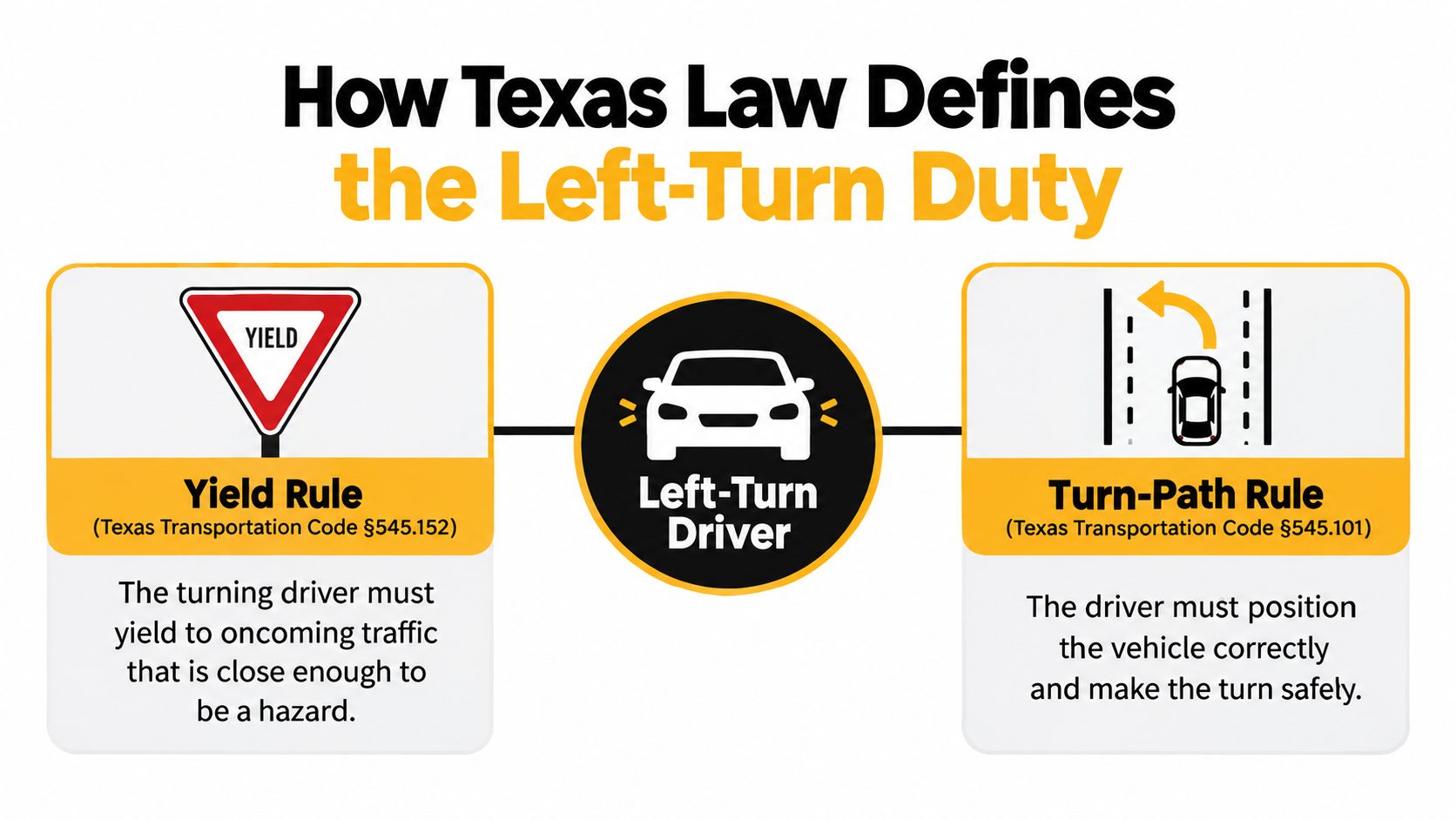
Under Texas Transportation Code §545.152, a driver turning left at an intersection, alley, private road, or driveway must yield the right-of-way to a vehicle approaching from the opposite direction when that vehicle is in the intersection or close enough to create an immediate hazard.
To start a left turn, you can't begin a left turn just because the light is green. If an oncoming vehicle is close enough that your movement would force the driver to brake sharply, swerve, or collide with you, you must wait. A permissive green light allows the turn when it's safe. It doesn't erase the duty to yield.
A protected green arrow changes the signal movement, but you still need to watch the roadway. Pedestrians, bicycles, motorcycles, and vehicles that entered unlawfully can create separate safety concerns. The exact signal phase and the position of each vehicle at the time of impact remain important.
For a practical explanation of this concept, see Texas rules on yielding the right-of-way.
The turn-path rule
Texas Transportation Code §545.101 adds another requirement. The driver approaching an intersection must use the extreme left-hand lane lawfully available and complete the turn into a lane lawfully available to traffic moving in the new direction. On a two-way roadway, the turn should be made to the left of the center of the intersection when practicable.
That means a driver can violate the law even with a green signal. For example, a Dallas SUV driver might start from the wrong lane, cut across another lane, swing too wide, or enter the opposing lane during the maneuver. Those details may support a negligence claim, but the violation still must be connected to the collision and resulting harm.
A useful way to remember the rules is:
- Look for approaching traffic.
- Yield when that traffic is in the intersection or creates an immediate hazard.
- Start from the proper lane.
- Follow the correct path into the new lane.
- Keep watching for people and vehicles throughout the turn.
Most Texas injury lawsuits must generally be filed within two years under CPRC 16.003. The Two-Year Deadline for Texas Injury Claims explains that deadline in more detail, but exceptions can exist, so delaying legal advice can create unnecessary risk.
What Investigators Actually Examine at the Scene
A crash scene tells a story, but it rarely tells the whole story through one fact. Investigators compare the law with the physical evidence, the signal sequence, and the movements of both vehicles.
Signal phase and driver movement
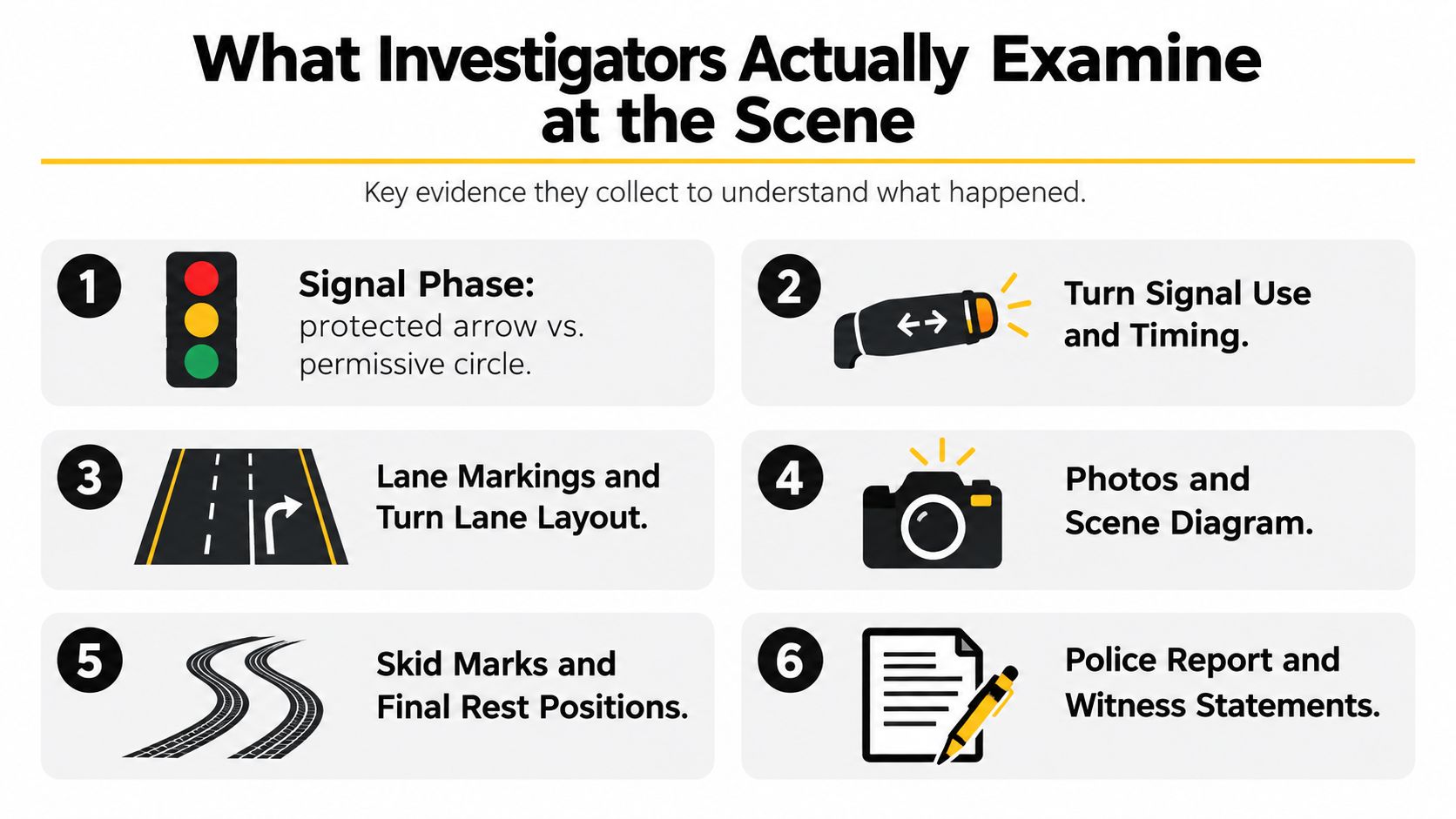
The first question may be whether the turning driver had a protected arrow or a permissive circular green. Investigators can seek signal records, traffic-camera footage, witness accounts, and video from nearby businesses. They may also examine whether a driver entered before the light changed or continued through a red signal.
Turn-signal use and timing can matter, but using a signal doesn't give a driver permission to turn into an immediate hazard. Similarly, the absence of a signal may support an argument that the other driver had less warning, but it doesn't alone establish causation.
Sight distance, speed, and reaction time
A queued truck, landscaping, construction barrier, parked vehicle, or roadway curve may block a driver's view. Investigators may measure sight distance and consider whether the approaching vehicle was visible when the turn began.
Speed matters because it affects the time available to perceive danger and react. An accident-reconstruction professional may compare skid marks, vehicle damage, final rest positions, event-data information, photographs, and vehicle paths. The analysis may ask whether either driver had enough time to avoid the crash and whether a driver's speed or distraction changed that opportunity.
Texas crash-contributing-factor data separately identifies “failed to yield right-of-way, turning left” and “turning left.” Federal intersection research also identifies left turns across oncoming traffic as a recurring severe-crash configuration, with inadequate surveillance and illegal maneuvers among important contributing factors, as described in Texas crash-records materials.
Road layout and the crash report
Road design belongs on the checklist. Investigators may examine whether the turn lane was long enough, whether markings were confusing, and whether the intersection created an obstructed or misleading path.
The police crash report is useful, but it's a starting point rather than the final civil allocation of fault. A fact finder evaluates the complete record, including testimony, photographs, video, medical evidence, and reconstruction opinions.
When the Other Driver Shares the Blame
The driver making the left turn often faces the first question about failure to yield. That doesn't mean the oncoming driver gets a free pass.
Consider a Houston intersection where the turning driver enters on a permissive green. An oncoming driver is traveling too fast to stop for a changing signal and reaches the intersection sooner than a reasonable driver would expect. The turning driver may still have had a duty to wait, but the oncoming driver's speed could have contributed to the collision by shrinking the available reaction time.
Other examples include an oncoming driver who:
- Runs a red light: A driver entering against the signal may create the immediate hazard that causes the crash.
- Drives while distracted: A driver looking at a phone may fail to brake or respond to a visible turning vehicle.
- Passes improperly: A driver using an opposing lane or passing near an intersection may appear where the turning driver didn't reasonably expect traffic.
- Changes lanes suddenly: An unsafe lane movement can place the vehicle directly in the turn path.
- Misjudges another movement: A driver may assume a vehicle will remain stopped or continue straight when it turns.
NHTSA's intersection research found that, at signalized intersections, the leading critical reason in left-turn crashes was a driver's false assumption about another driver's action, rather than a pure failure to yield. That finding doesn't decide a Texas claim, but it shows why investigators must ask what each driver expected and whether that expectation was reasonable.
The turning driver's lane position matters, too. Under Texas Transportation Code §545.101, a driver must approach from the extreme left-hand lane lawfully available and turn into a lawful lane. A green light doesn't excuse starting from an improper lane or crossing through traffic incorrectly.
Shared responsibility is a factual conclusion. It should be supported by evidence, not assumed from the direction of the turn.
After a Dallas collision, for example, photographs may show that the turning vehicle entered from a dedicated lane while the oncoming vehicle crossed a solid line to pass another car. Video may show the oncoming vehicle entered the intersection after the signal changed. Those facts can support responsibility on both sides, but the evidence must connect each action to the impact and the injury.
How Texas Comparative Responsibility Changes the Recovery
Texas uses a modified comparative-responsibility rule. An injured claimant generally can't recover damages if found more than 50% responsible. If the claimant is found 50% or less responsible, the recovery is reduced by that percentage, as provided by Texas Civil Practice and Remedies Code Chapter 33.
Here's the basic calculation using a hypothetical $100,000 in damages:
| Your Fault % | Can You Recover? | Amount You Recover |
|---|---|---|
| 20% | Yes | $80,000 |
| 50% | Yes | $50,000 |
| 60% | Generally no | $0 |
The dollar figures in this table are examples to show how the rule works, not an estimate of what your case is worth. The actual value of a claim depends on proof of medical treatment, lost income, property damage, pain, disability, future needs, and other legally recognized harm.
Why the percentage becomes the central dispute
Suppose an Austin driver turning left is accused of failing to yield. The driver says the approaching vehicle was speeding and entered the intersection after the signal changed. The other driver says the turn began suddenly and left no safe path. The dispute isn't just whether someone made a mistake. It's which conduct caused the collision and what percentage belongs to each person.
Video, event-data information, witness statements, impact locations, and scene photographs may move the responsibility analysis. A crash report can help identify an alleged contributing factor, but it doesn't control the final civil finding.
If you're reviewing coverage after a collision, a post-accident policy checklist can help you organize insurance documents and questions. For Texas-specific legal analysis, comparative negligence in Texas explains why evidence about both drivers matters.
Evidence That Protects Your Claim and How to Preserve It
The strongest evidence may disappear while you're focused on treatment and repairs. Take reasonable steps early, and ask for help when your injuries prevent you from doing it yourself.
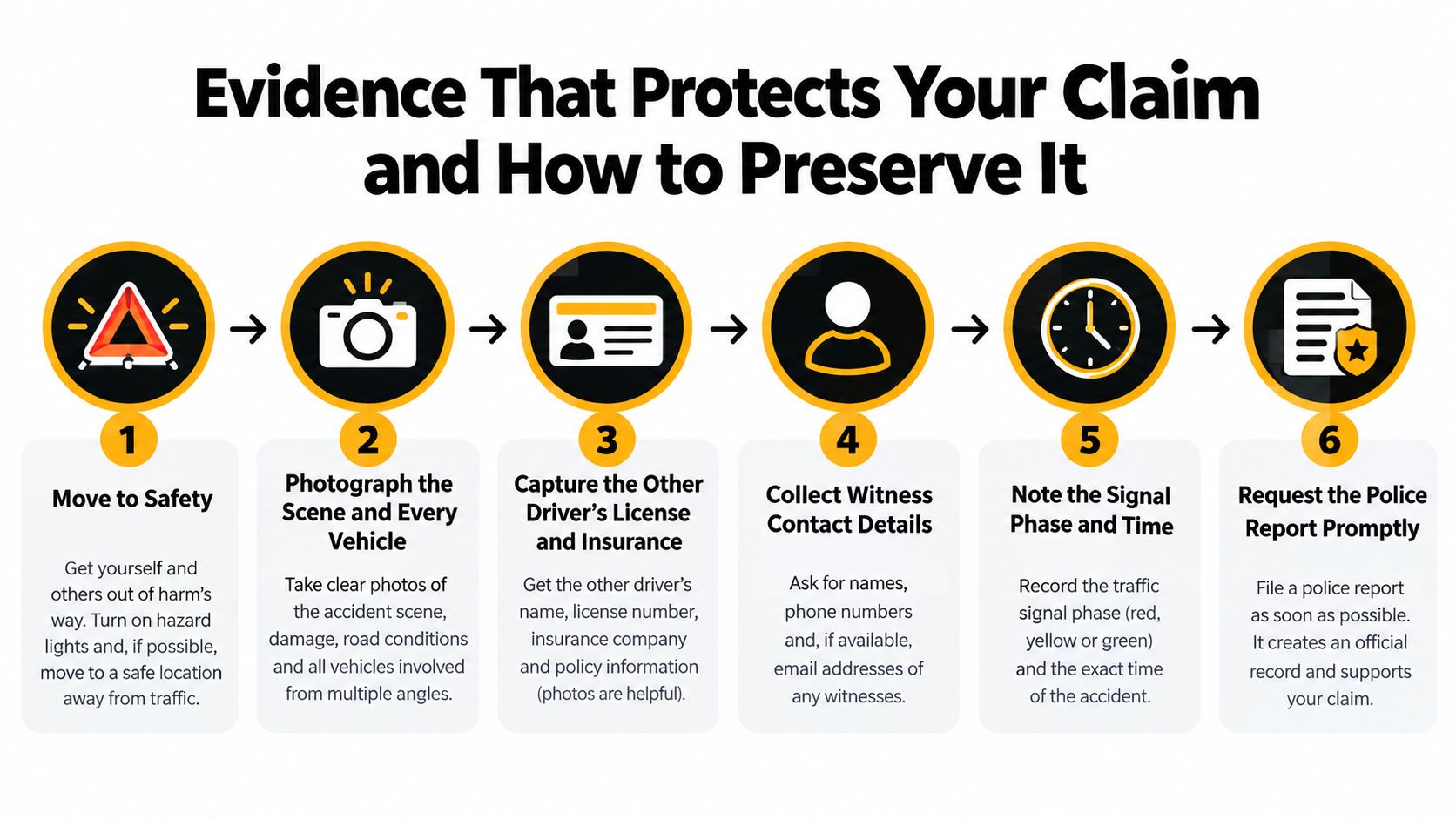
Move to safety: If possible, move the vehicle away from traffic and call emergency services for serious injuries. Don't put yourself in danger to collect photographs.
Photograph the scene and vehicles: Take pictures of each vehicle, damage from several angles, lane markings, traffic signs, signal heads, sight obstructions, debris, and objects struck. The Texas Department of Insurance recommends photographing the accident scene and every involved vehicle, along with objects such as signs, buildings, or trees.
Record the other driver's information: Photograph the other driver's insurance information, driver's license, and license plate when it's safe and lawful to do so. Save your own photographs in more than one location.
Collect witness details: Get names and contact information for people who saw the signal, vehicle movements, or impact. A witness may remember the light phase or an approaching vehicle's speed differently from the drivers.
Preserve video and digital evidence: Ask nearby businesses, residences, and traffic authorities about surveillance footage. Save dash-camera files and relevant phone footage immediately. Commercial video may be overwritten quickly, and vehicle-event information can be lost or changed once a vehicle is repaired.
Request the crash report and keep records: Contact law enforcement for the report, and retain medical bills, repair estimates, receipts, wage records, insurance correspondence, and treatment instructions. Keep a personal record of symptoms and how the injury affects ordinary activities.
The Texas Department of Insurance also recommends keeping receipts and records connected to the claim, as explained in its guidance on filing an insurance claim after an accident.
This video offers a general visual reminder of practical post-crash steps:
Don't post detailed opinions about fault or your injuries online. Also, don't give a recorded statement or sign a release before you understand your medical condition and legal rights. An accident reconstruction expert witness may help when the drivers disagree about speed, visibility, signal timing, or the point of impact.
Better evidence won't guarantee a particular result, but it gives the fault analysis a stronger foundation and can help prevent a rushed or unsupported percentage assignment.
Road Design and Emerging Technology Can Shift the Fault Picture
Some left-turn claims involve more than two drivers. A dangerous intersection layout, inadequate turn storage, confusing markings, or limited sight distance may have contributed to the crash. That possibility deserves investigation, especially when repeated collisions occur at the same location or the roadway design made a safe turn unusually difficult.
Research from the Texas A&M Transportation Institute reports that adding a left-turn lane at a three-leg stop-controlled intersection is predicted to reduce total crashes by 44%. Earlier research summarized by the institute found that left-turn lanes could reduce left-turn-related crashes by 37% to 90% in some settings, as reported in its discussion of intersection turn lanes.
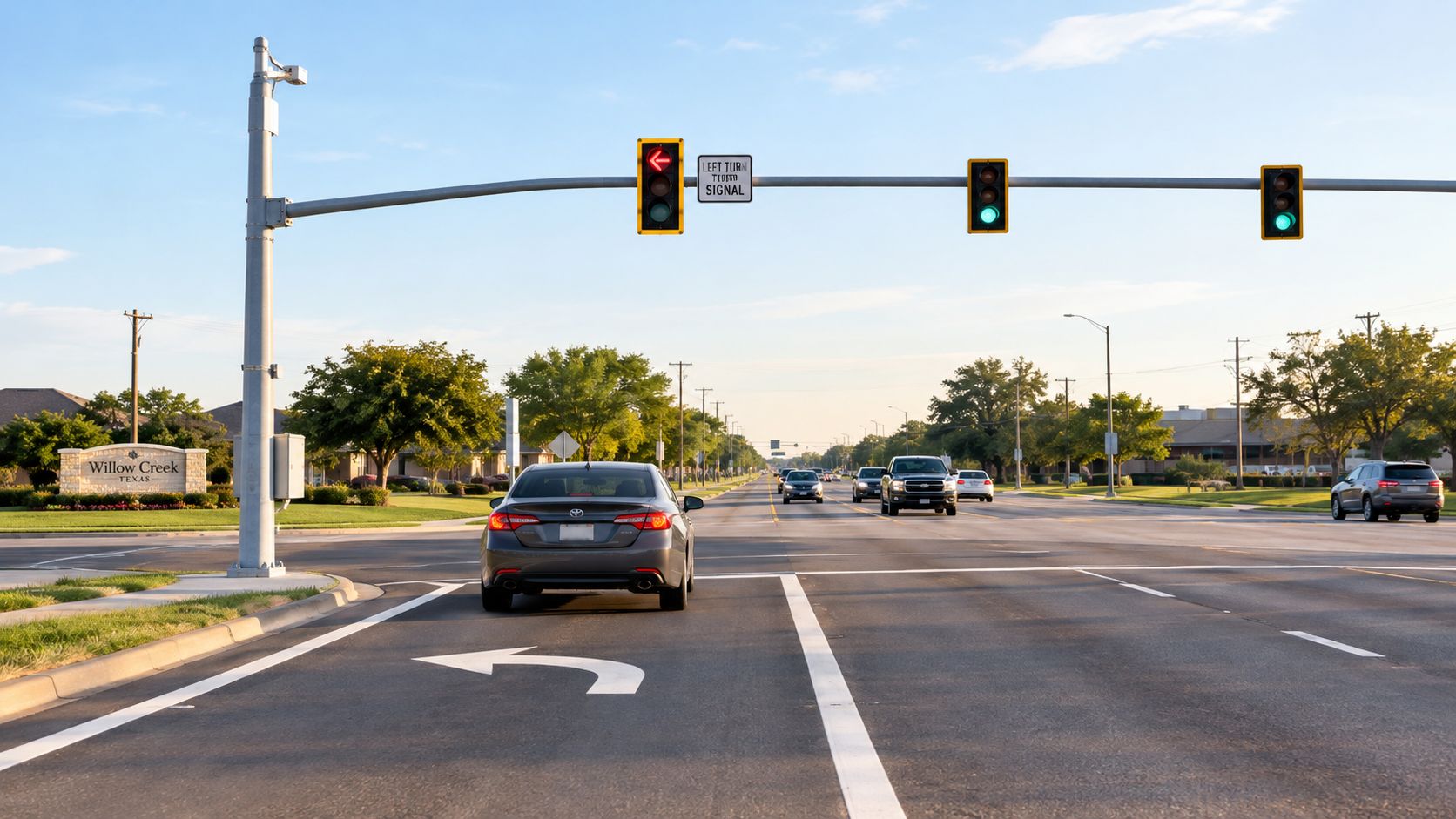
Those findings don't prove that a road agency caused a particular crash. They do show why an investigation may need to examine the physical intersection, signal design, turn-lane configuration, maintenance history, sightlines, and prior safety concerns.
Vehicle technology creates another developing question. In 2025, NHTSA reported identifying six Tesla reports in which vehicles operating with Full Self-Driving engaged entered intersections against red lights and crashed. That information doesn't establish fault in every automated-driving collision, but it shows why attorneys and insurers may need vehicle-system logs, camera data, software status, and manufacturer records.
In a fatal collision or a commercial-vehicle case, potentially responsible parties may include a road agency, vehicle manufacturer, employer, or technology provider. A truck crash lawyer in Houston may also examine company policies, driver records, maintenance, and electronic vehicle information when a commercial vehicle is involved. The police report may name a primary driver, but it isn't necessarily the end of the investigation.
Your Next Steps and How Our Firm Can Help
Start with your health. Seek medical care, follow the treatment plan, and keep records of symptoms, appointments, bills, medication, lost work, and changes in daily life. Then preserve the evidence that can show the signal phase, vehicle paths, impact location, visibility, and conduct of each driver.
Report the crash to your insurer, but be careful with recorded statements and settlement paperwork. An early offer may not reflect the full effect of an injury that has not yet been diagnosed or treated. A Houston car accident attorney can review the evidence and insurance coverage before you accept an offer or sign a release.
The same careful review matters in cases involving commercial trucks, catastrophic injuries, or a death. Families may need a wrongful death lawyer in Texas after a fatal crash, while someone facing permanent impairment may need help pursuing damages for long-term care. A car accident lawyer can also help investigate ordinary passenger-vehicle collisions, uninsured drivers, and disputed comparative responsibility.
The Law Office of Bryan Fagan, PLLC offers free consultations and contingency-fee representation, which means clients don't pay attorney fees unless the firm wins. The firm serves people in Houston, Dallas, Austin, San Antonio, and surrounding Texas communities, with a focus on investigating crashes, gathering evidence, communicating with insurers, and pursuing compensation for serious injuries and families who have lost loved ones.
Recovery may take time, but you don't have to manage every legal and insurance decision by yourself. The right information, preserved evidence, and timely advice can help you move forward with greater confidence.
The Law Office of Bryan Fagan, PLLC can review your left-turn crash, explain how Texas fault rules may apply, and help preserve evidence before it disappears. Schedule a free consultation to discuss your injuries, insurance concerns, and options for seeking recovery, with no attorney fee unless the firm wins.