A serious accident can change your life in seconds, but you don't have to face it alone. You may have finally received a settlement offer after a Houston crash, only to learn that your employer health plan wants repayment for medical bills it covered. That demand can feel like another loss after weeks or months of pain, treatment, missed work, and uncertainty.
An ERISA plan subrogation reduction in a Texas injury settlement starts with careful document review, not automatic acceptance of the plan's first demand. Federal law may give an eligible plan strong recovery rights, but the amount claimed, the plan's funding structure, the connection between treatment and the accident, and the wording of the reimbursement clause all matter.
Facing a Health Plan Lien After a Texas Accident
You settle a car wreck claim, sign the release, and expect to use the money for medical balances, lost income, household expenses, and recovery. Then a plan administrator or recovery vendor sends a demand for reimbursement. The amount may look close to the total medical care in your file, even though some charges may have nothing to do with the collision.
That situation is common in injury settlements. A health plan may have paid providers after a crash and then seek repayment from money recovered from the at-fault driver. The plan's claim is separate from your negligence case. The driver's insurance pays because another person may have caused the harm, while the plan seeks repayment because its contract says it can recover accident-related benefits.
Why the first demand isn't the final answer
A demand letter may not show how the administrator calculated its figure. It may omit reversed claims, duplicate payments, unrelated treatment, discounts, or services that occurred before the accident. It may also rely on a summary description without providing the full plan language that controls reimbursement.
That's why you shouldn't treat the demand as an invoice that must be paid immediately. Request the complete plan document, summary plan description, amendments, reimbursement provision, payment ledger, and written explanation of the claimed amount. Preserve the settlement proceeds while the accounting is reviewed.
Practical rule: Never distribute settlement money until known health-plan claims have been identified, challenged where appropriate, and addressed in writing.
A Houston car accident attorney can also determine whether the plan is self-funded or fully insured, whether Texas law applies, and whether the claim reaches the type of recovery you received. The same analysis matters after a Dallas truck collision, an Austin motorcycle crash, a pedestrian injury, or a wrongful-death settlement.
You still have options. A lawyer may challenge charges unrelated to the accident, question the plan's interpretation, seek a negotiated reduction, and document why the gross settlement doesn't represent full compensation for your losses. The earlier that work begins, the more control you have over the final distribution.
How ERISA Subrogation Affects Your Recovery
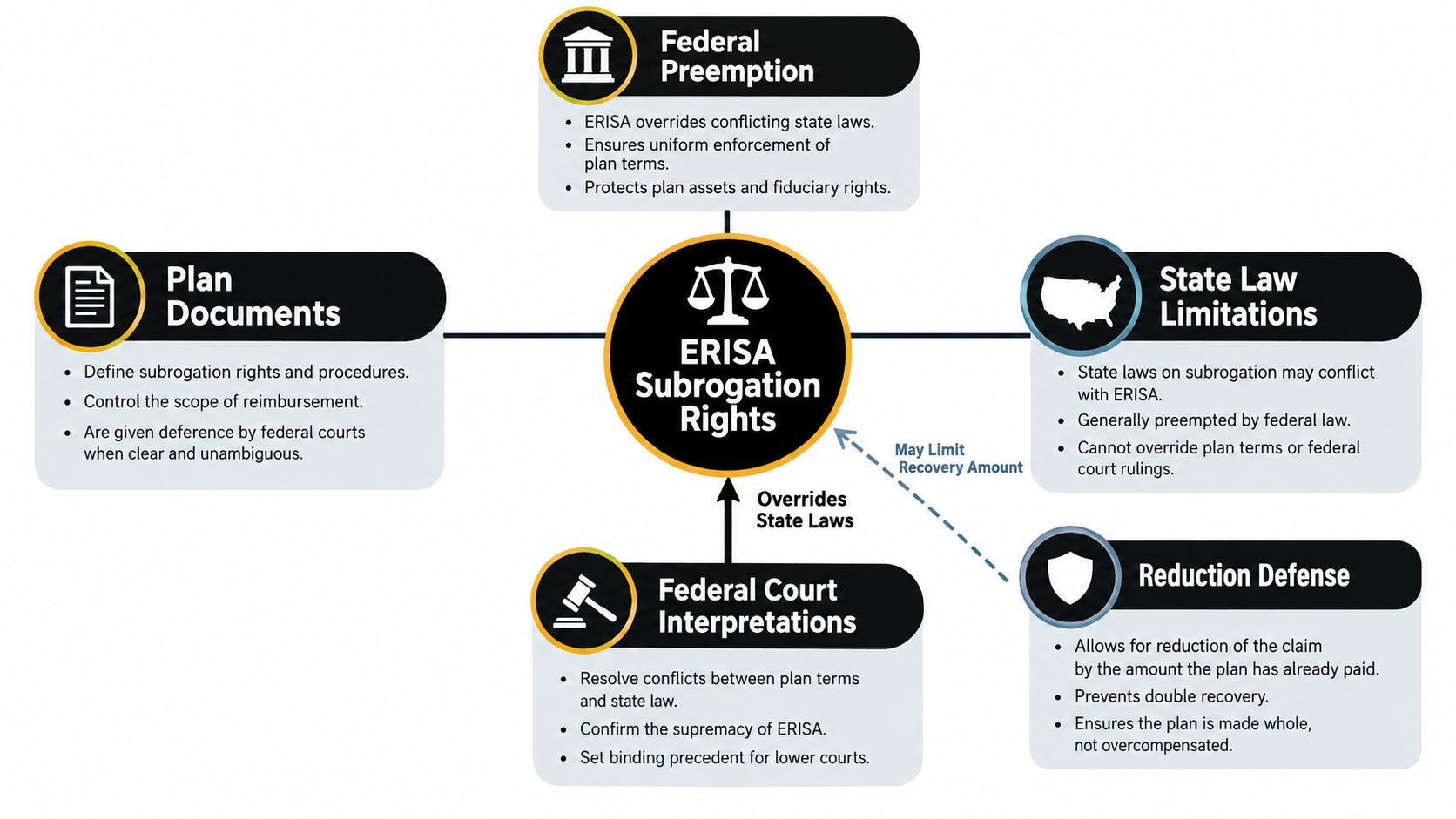
The Supreme Court's decision in US Airways, Inc. v. McCutchen, decided on April 16, 2013, is central to ERISA reimbursement disputes. The Court held that an ERISA plan administrator may seek equitable relief under ERISA §502(a)(3), codified at 29 U.S.C. §1132(a)(3), to enforce a reimbursement provision when a beneficiary recovers money from a third party. The decision is available in the Supreme Court opinion in US Airways v. McCutchen.
The Court rejected the idea that a judge may automatically reduce a plan's demand under the common-fund doctrine or merely because full repayment feels unfair. The plan's actual language controls. That doesn't mean every demand is correct. It means the first question is contractual and documentary, rather than based only on broad fairness principles.
What an equitable lien by agreement means
The earlier decision in Sereboff v. Mid Atlantic Medical Services, Inc., 547 U.S. 356 (2006), recognized that a reimbursement provision can create an enforceable equitable lien by agreement. In practical terms, a plan may claim a defined share of settlement funds when its documents identify the recovery and the portion it seeks.
The plan still must connect its demand to the governing documents and the accident-related benefits it paid. A payment ledger is therefore critical. It allows counsel to separate treatment caused by the collision from unrelated care and to identify duplicate, reversed, or incorrectly attributed claims.
Why “fairness” alone usually doesn't work
A general letter claiming the demand is unfair rarely offers sufficient legal weight against a plan with clear reimbursement language. Stronger negotiations rely on specific proof:
- Plan language: Does the document require repayment of gross benefits, accident-related payments, or a different amount?
- Payment connection: Did each listed medical payment arise from the accident?
- Recovery limits: Did disputed liability, comparative responsibility, insurance limits, or limited damages reduce the settlement?
- Procurement costs: Does the plan address attorney fees and litigation expenses?
- Fund identification: Are the settlement funds still separately identifiable?
The plan's written terms can also address offsets, reductions, attorney fees, and costs. A claim can differ materially from the total medical bills because the relevant question is usually which covered payments relate to the injury and what the plan authorizes.
The Supreme Court has also confirmed that reimbursement is not merely an informal request. When the statutory and equitable requirements are satisfied, an ERISA fiduciary may seek enforcement in federal court. That's why a Texas personal injury lawyer should review the plan before funds are distributed, rather than waiting until the recovery has already been spent.
For a practical discussion of Texas lien review, see subrogation and personal injury claims in Texas. The goal isn't to promise that every lien disappears. The goal is to make sure you pay only what the plan can support and to negotiate from the actual facts.
Self-Funded vs Fully Insured ERISA Plans
The insurance card in your wallet doesn't answer the most important question. A familiar insurance-company name may appear on the card even when the employer plan is self-funded and the carrier only administers claims.
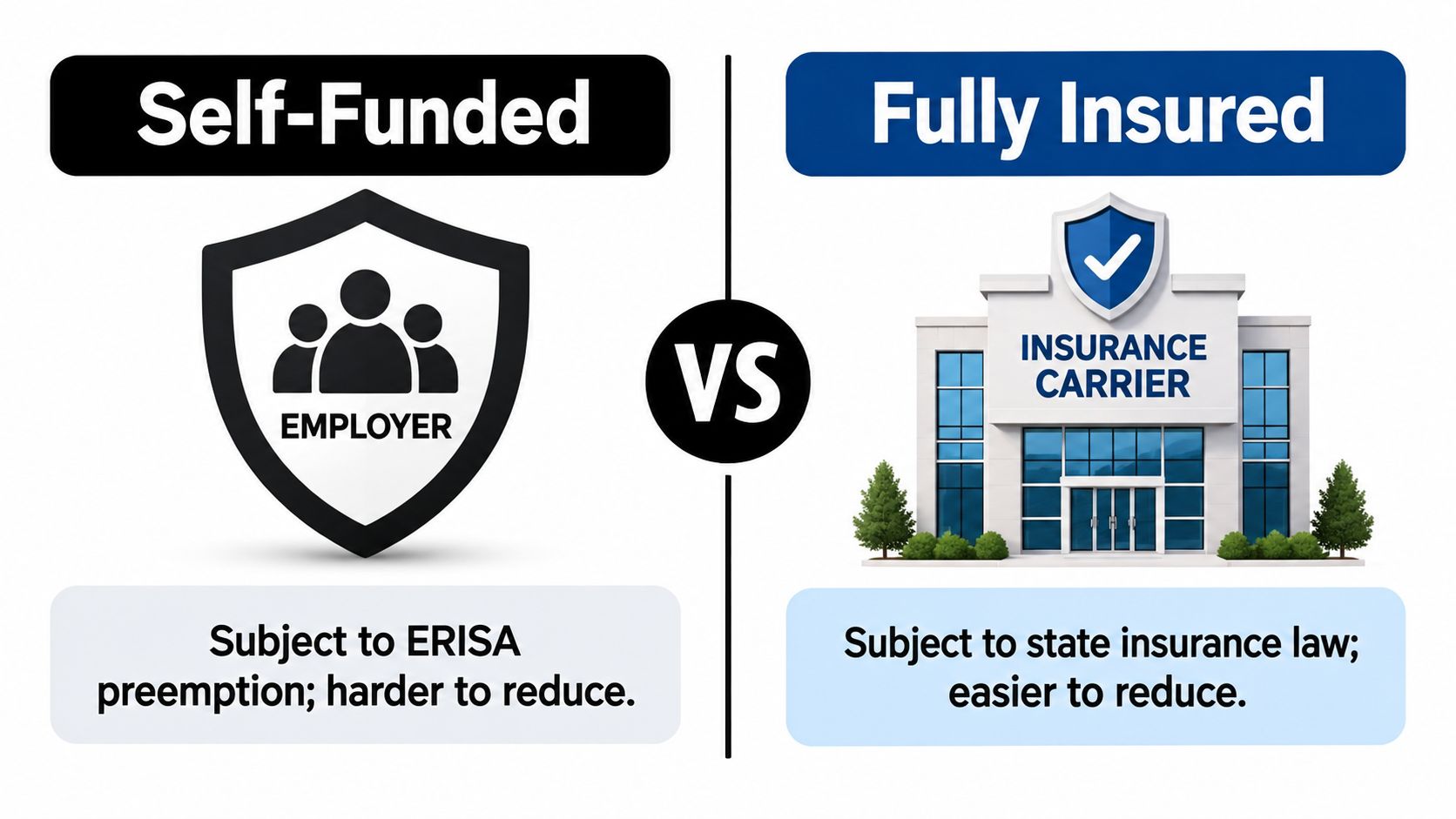
A self-funded ERISA plan generally pays benefits from employer plan assets or another plan funding arrangement. Its reimbursement rights may be governed primarily by ERISA and the written plan document, with federal preemption limiting the effect of Texas rules. A fully insured arrangement transfers the risk of paying covered benefits to an insurance carrier through premiums. State insurance regulation may apply differently to that arrangement.
The documents reveal the plan type
Ask the plan administrator or employer's benefits department for:
- The complete plan document.
- The summary plan description.
- Any amendments affecting reimbursement.
- Funding information or a description of who bears the payment risk.
- The administrator's claims-payment ledger.
- The exact subrogation and reimbursement clause.
The administrator's identity alone isn't enough. An insurance carrier may process claims for a self-funded employer plan. That distinction can affect whether Texas Chapter 140 protections apply or whether federal law and the plan's language control more directly. Texas Chapter 140 addresses contractual health-plan subrogation and reimbursement, including limits connected to the injured person's recovery, benefits paid, and procurement costs. Read the Texas statutory provisions governing health-plan subrogation alongside the plan documents.
Why the distinction changes negotiations
| Plan arrangement | Primary issue | Practical negotiation focus |
|---|---|---|
| Self-funded ERISA plan | Federal law and plan language may control | Audit the documents, challenge unrelated payments, and negotiate using the settlement facts |
| Fully insured arrangement | State regulation may remain relevant | Analyze Texas protections, policy language, benefits paid, and procurement costs |
Neither category guarantees a reduction. A self-funded plan may have strong enforcement rights, but that doesn't establish that every listed charge is valid. A fully insured plan may be subject to Texas rules, but the policy still requires close review.
This distinction also matters when the recovery includes first-party insurance. If the at-fault driver lacks adequate coverage, Uninsured and Underinsured Motorist Claims in Texas addresses how to recover when the at-fault driver lacks adequate insurance. The plan's clause should be examined to determine whether it reaches that source and under what conditions.
Proven Strategies to Negotiate a Lien Reduction
A reduction request works best when it is supported by an accounting and a clear explanation of why the client's actual recovery is limited. A request based only on hardship may be ignored. A request that identifies incorrect charges, litigation expenses, disputed liability, and uncompensated damages gives the plan a reason to reconsider its demand.
Start with the ledger, not the total
Request an itemized payment history. Review each entry against the medical records and accident date. Look for:
- Unrelated treatment: Services for a condition that predates the collision may not belong in an accident reimbursement claim.
- Duplicate entries: The same service may appear more than once or show a payment that was later reversed.
- Wrong dates or providers: Administrative errors can connect a claim to the accident when the records do not.
- Excluded benefits: The plan may have paid care that its own reimbursement language doesn't reach.
- Unpaid balances: A provider's remaining balance may affect the client's real recovery even if it isn't part of the plan's demand.
Send targeted objections in writing. Identify the claim number, date, provider, amount, and reason for the challenge. Ask for a corrected ledger and a written response.
Show why the gross settlement overstates the recovery
Consider a settlement of $100,000, with $40,000 in attorney fees, $10,000 in case expenses, and a $75,000 medical-payment claim. The recovery has only $50,000 remaining after attorney fees and expenses, before the plan's demand, medical balances, and the client's other damages are considered. Those figures come from the practical settlement example described in the Supreme Court certification materials concerning ERISA reimbursement.
The example doesn't automatically cancel the plan's lien. It demonstrates why the settlement's limits matter. Prepare evidence of:
- Attorney fees and litigation expenses used to obtain the recovery.
- Disputed fault and comparative-responsibility risk.
- Available insurance limits.
- Pain, lost income, future care, and other damages the plan didn't pay.
- Accident-related bills that remain unpaid.
- The client's actual net recovery after transaction costs.
A plan may have a contractual right to full reimbursement, but counsel can still ask for a negotiated compromise. The common-fund concept may support that request, especially where the plan benefited from work performed by the injury lawyer, but McCutchen means the argument cannot override clear plan language automatically.
Address first-party coverage carefully
A recovery from uninsured or underinsured motorist coverage may raise a separate interpretation issue. Don't assume that a plan can reach every insurance payment, and don't assume it cannot. Examine the definition of third-party recovery, the plan's treatment of first-party benefits, and the source of the funds.
The Texas medical-bill negotiation process after settlement should be coordinated with the ERISA review. A reduction agreement should be confirmed in writing, with the final amount, payment terms, and release of the claim clearly stated before distribution.
Procedural Steps to Protect Your Settlement Funds
Settlement money should be treated as restricted funds while the plan's claim is under review. The Supreme Court's decision in Montanile v. Board of Trustees shows why traceability matters. The Court held that an ERISA fiduciary could not use ERISA §502(a)(3) to attach a participant's general assets after the participant had dissipated the entire settlement on nontraceable items. It also recognized that an equitable lien can attach to an identifiable settlement fund.
The Supreme Court materials concerning Montanile explain the importance of an identifiable fund. This isn't a safe-spending strategy. Spending or commingling funds can create serious legal and practical problems, while a plan may pursue other remedies or rely on contract rights.
Follow a controlled process
- Request the complete file. Obtain the plan documents, funding information, reimbursement clause, payment ledger, and written demand.
- Preserve the recovery. Keep settlement proceeds in a separate, identifiable trust account. Don't mix them with ordinary household funds.
- Audit every charge. Match claimed payments to accident-related medical records and challenge unsupported entries.
- Calculate the net recovery. Account for attorney fees, litigation expenses, unpaid bills, disputed liability, and losses the plan didn't cover.
- Negotiate in writing. Present a specific reduction request with supporting documents and a proposed resolution.
- Document the release. Make sure the settlement agreement and distribution documents address the lien expressly.
- Obtain confirmation. Don't rely on a phone promise from a recovery vendor. Secure written terms and a clear statement of the remaining obligation.
Funds matter: Keeping money identifiable protects your ability to evaluate the claim. It doesn't erase a valid reimbursement right, but it avoids making the dispute harder.
A truck crash lawyer Houston victims trust should also coordinate the health-plan review with the liability claim, especially when a commercial carrier, multiple drivers, or serious injuries are involved. The Texas Personal Injury Settlement Process describes what to expect from demand through settlement or trial, while lien work continues alongside those negotiations.
This video provides another visual explanation of settlement-fund protection and plan claims:
How Texas Comparative Fault Impacts Your Net Recovery
A health-plan demand is measured against a settlement, but Texas fault rules can shrink that settlement before the lien is addressed. Texas follows modified comparative responsibility under Chapter 33 of the Civil Practice and Remedies Code. The fact finder assigns percentages of responsibility to the claimant, defendants, settling people, and properly designated responsible third parties.
A claimant whose responsibility is greater than 50 percent may not recover damages. When responsibility is 50 percent or less, damages are generally reduced in proportion to that responsibility under Texas Chapter 33 comparative-responsibility law.
A simple crash example
Suppose a jury finds that a distracted driver caused a collision but assigns the injured person 20 percent responsibility. If total damages are $100,000, the claimant's damages would ordinarily be reduced to $80,000 before separate issues such as liens or attorney fees are considered.
That calculation changes the negotiation picture. A plan may focus on the gross settlement, while the victim's lawyer must explain that comparative responsibility, fees, expenses, medical balances, and uncompensated losses reduce what the client keeps. Evidence such as photographs, vehicle data, medical records, witness accounts, cellphone evidence, and timely accident investigation can affect both fault and the net recovery.
Why fault evidence supports a reduction request
A wrongful death lawyer Texas families choose should investigate fault before treating settlement proceeds as available to satisfy a plan claim. The same is true after a Houston freeway crash involving several vehicles or a commercial truck wreck with multiple responsible parties.
The Texas explanation of how comparative fault affects a settlement can help families understand why shared fault reduces the available recovery. Texas Comparative Fault and the 51% Bar Rule also addresses how shared fault reduces or eliminates recovery under Chapter 33.
Don't speculate about fault in a recorded insurance statement or on social media. Give insurers accurate information, preserve evidence, and let counsel develop the responsibility analysis before the plan uses an inflated gross figure as its starting point.
Protecting Your Rights Before the Deadline Expires
Texas personal-injury claims require prompt action. The ordinary limitations period for a personal-injury claim is two years, and a wrongful-death claim generally also has a two-year deadline measured from the death under Texas Civil Practice and Remedies Code section 16.003.
Negotiating with an insurer or ERISA recovery vendor doesn't pause that deadline. An adjuster may continue reviewing a claim while witnesses become harder to locate, vehicle evidence disappears, medical symptoms change, and responsible parties become more difficult to identify.
Preserve the evidence that supports your claim
After a San Antonio SUV collision, gather photographs, vehicle information, insurance details, medical records, bills, wage-loss documents, and witness contact information. Seek medical care and follow the treatment plan. Tell providers about symptoms accurately, including symptoms that develop after the crash.
For a commercial truck wreck, early investigation may involve the driver, carrier, vehicle, maintenance history, and other evidence. A Houston car accident attorney can also evaluate whether uninsured or underinsured motorist coverage, comparative responsibility, or an ERISA claim affects the case.
Don't let the lien delay the liability case
The plan's reimbursement dispute is only one part of your recovery. You still may need to prove duty, breach, causation, and damages. A lawyer can investigate negligence, respond to insurers, identify the filing deadline, protect a wrongful-death claim, and preserve settlement funds while the plan's demand is reviewed.
You don't have to accept an inflated demand, and you don't have to handle federal plan administrators alone. Recovery is possible, even when an accident creates medical, financial, and legal complications. Prompt advice gives you a better chance to protect both the claim and the money needed for your future.
The Law Office of Bryan Fagan, PLLC helps Texas accident victims and families investigate injury claims, address ERISA reimbursement demands, negotiate medical balances, and protect settlement funds. Schedule a free consultation through Law Office of Bryan Fagan, PLLC to discuss your accident, your health-plan documents, and the steps available to protect your financial recovery.