A serious accident can change your life in seconds, but you don't have to face it alone. After a Houston freeway crash or Dallas car accident, the injuries may be obvious, but the full cost often appears later. Bills stack up, children need rides and supervision, meals become harder to prepare, and ordinary home repairs may go unfinished.
Many families overlook the economic value of unpaid household work. If an injury prevents you from cooking, cleaning, providing child care, driving family members, shopping, or maintaining the home, Texas law may recognize those lost services as part of your damages. If a loved one dies, surviving family members may also have a claim for the household support and services that person would probably have provided.
Understanding Household Services After a Serious Accident
A Houston mother suffers a serious injury in a freeway collision. Before the crash, she handled school pickups, prepared meals, managed appointments, cleaned the house, and coordinated repairs. After the crash, she can't drive, standing for long periods causes pain, and her medical restrictions prevent lifting. Her family may need paid help, or relatives may have to take over those responsibilities.
Those losses don't appear on a wage statement. They still have real value.

Why unpaid work matters
Household services include the practical work that keeps a family functioning:
- Child care: Supervision, school transportation, meals, homework support, and activities.
- Home care: Cleaning, laundry, cooking, shopping, maintenance, and household management.
- Transportation: Driving children or relatives to school, medical appointments, work, and errands.
- Family support: Personal assistance and other regular responsibilities performed for household members.
The U.S. Bureau of Economic Analysis explains household production as work such as meal preparation, cleaning, shopping, household management, child care, and maintenance. Its figures show that household-production hours rose from approximately 300 billion hours in 2019 to 308 billion hours in 2020, an increase of about 8 billion hours in one year. Families depend on this work whether or not anyone receives a paycheck.
Texas personal injury law recognizes that a serious injury can take away this contribution. The claim generally focuses on the reasonable value of services the injured person would have provided without the accident. It isn't limited to wages lost from employment.
Practical point: A stay-at-home parent, retired person, or family caregiver may have a meaningful household-services claim even without a recent employment history.
The same principle can apply after a fatal crash. If a parent was the person who provided child care, transportation, cooking, or home maintenance, the surviving family may lose far more than the person's income. Those services should be documented separately from lost wages, medical expenses, grief, and loss of companionship.
What Texas Law Says About Household Services Damages
Texas treats household-services damages as a distinct category of economic loss. The law looks at the reasonable value of services a person could no longer provide because of an injury, rather than asking only how much that person earned at work.
That distinction protects people whose household contributions weren't reflected in a paycheck. A parent who manages the home, a retired spouse who handles repairs, and a caregiver who supports relatives may all provide services with measurable replacement value.
The distinction between injury and death claims
In In re Rudolph Automotive, the Texas Supreme Court addressed the scope and wording of household-services damages. The record described a jury award of $150,000 for future household services and personal care, while another portion of the case included an award of $0 for past household services. The court emphasized that this category generally measures services the injured person would have provided, including caregiving, cleaning, cooking, transportation, and home maintenance. The decision is available in the Texas Supreme Court materials concerning household-services damages.
That wording matters. An injured plaintiff may seek the value of household services the plaintiff can no longer perform. In some circumstances, the legal question may instead concern services another family member must provide to the injured person. Those are different theories, and the jury question must define the services accurately.
A wrongful-death claim raises a different issue. The surviving family may seek the value of practical services the deceased would probably have provided. That loss belongs to the family members who depended on those services, rather than automatically being treated as the deceased person's lost earnings.
What makes the claim legally supportable
A strong claim connects four points:
- The person performed specific household tasks before the accident.
- The injury or death changed the ability to perform those tasks.
- The limitation lasted, or is expected to last, for a supportable period.
- Replacement services have a defensible reasonable value.
Medical restrictions, rehabilitation records, family testimony, calendars, invoices, and market rates can help establish that connection. A Texas Personal Injury Lawyer may represent injury victims across Texas on a no-fee-unless-we-win basis. For a broader explanation of how household services fit among other damages, review economic and noneconomic damages in Texas injury cases.
How Courts Calculate Household Services Value
The calculation should begin with the family's actual routine, not a guess. An economist or damages professional typically identifies the tasks performed before the accident, estimates the reduction in capacity or hours afterward, applies defensible market replacement rates, projects how long the impairment may continue, and discounts future losses to present value.
Two principal approaches can help explain the value.
Labor value and direct output
The labor-value method multiplies the hours of lost household work by an appropriate market wage rate. If an injured parent spent time providing child care, preparing meals, cleaning, and driving children, the analysis may assign separate rates that reflect the type of replacement work required.
The direct-output or retail-price method values the completed services based on what a household would pay to purchase them. A cleaning service, child-care provider, meal service, driver, or home-maintenance contractor may charge for the finished work rather than for a person's labor hours alone.
A study on household-services valuation methods found that valuing actual retail services produced estimates at least 80 percent higher than valuing only labor hours. That doesn't mean every Texas claim should use the higher figure. It shows that methodology can materially affect the result, and the method must fit the household's actual needs.
| Method | How It Works | Typical Use Case |
|---|---|---|
| Labor value | Lost hours are multiplied by appropriate market replacement rates. | A family has detailed records of recurring tasks and time spent. |
| Direct output | The completed service is valued at a retail or replacement-service price. | The household must purchase finished cleaning, child care, transportation, or maintenance services. |
Consider a homemaker who routinely handled several categories of work but can now perform only part of them. The analysis shouldn't label the entire household routine as lost without evidence. It should identify which tasks changed, how often they occurred, what the injury prevents, and whether family members or paid providers replaced the work.
Why the method needs support
Insurers often challenge broad estimates. A persuasive valuation uses medical evidence to show why the limitations exist, records to establish the pre-injury routine, and market evidence to support replacement rates. Future household services require particular care because the calculation must account for the expected duration of impairment and present value.
A family can also review special damages in Texas injury claims to understand how documented economic losses differ from other categories of compensation. The goal isn't to inflate a claim. It's to present the household's real loss in a way a jury, insurer, or opposing expert can evaluate.
Evidence You Need to Prove Household Services Claims
Household-services damages are strongest when the evidence tells a consistent before-and-after story. Start with what the injured person did before the crash, then show what changed and who performs the work now.
Build a before-and-after record
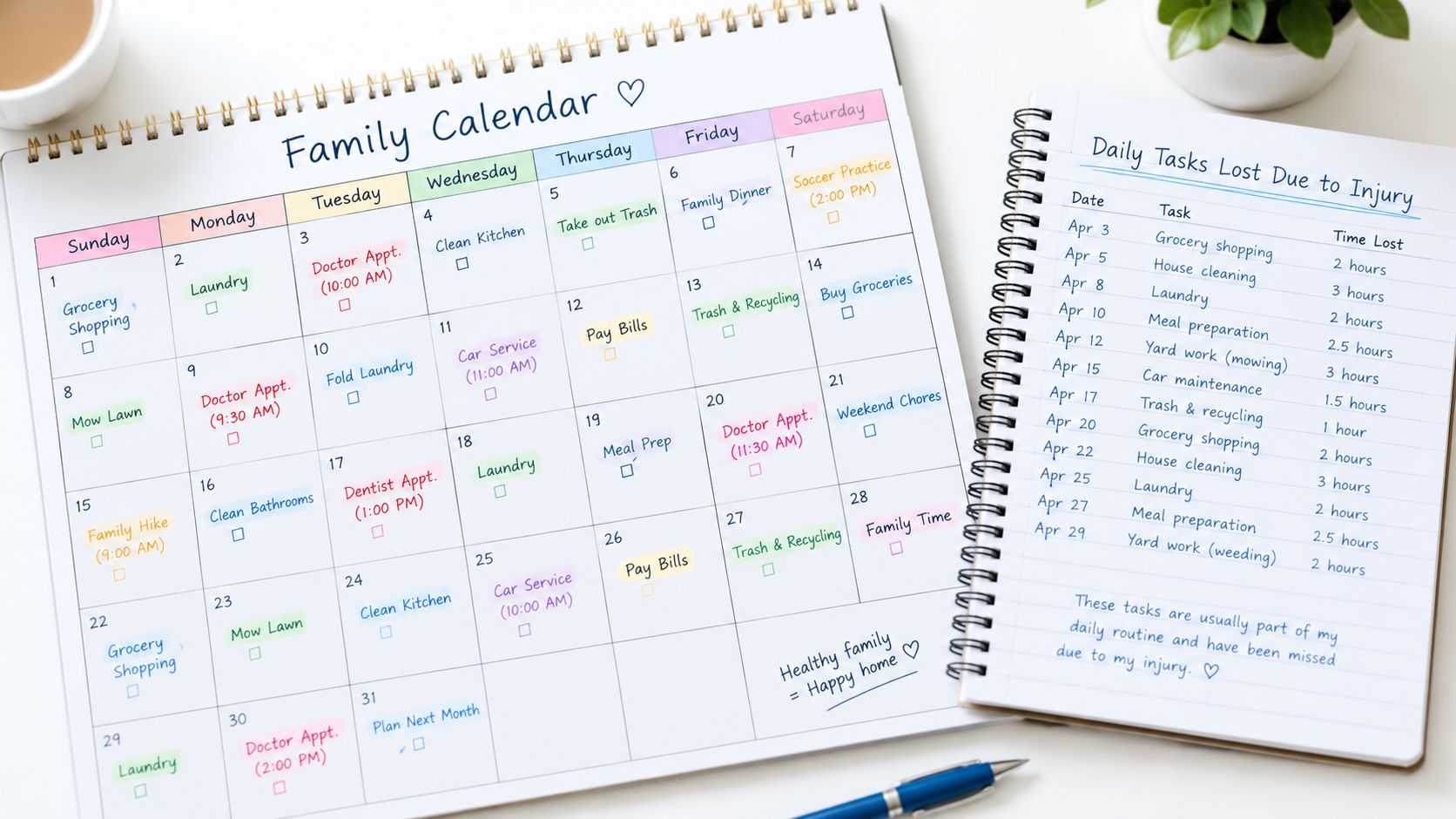
A calendar from before the accident can show school transportation, appointments, shopping, sports, home projects, and recurring family duties. A time-use diary created after the injury can record tasks that are missed, performed less often, or transferred to someone else.
Useful records include:
- Daily routines: Calendars, school schedules, appointment records, and written descriptions of normal weekly responsibilities.
- Medical limitations: Restrictions from doctors, rehabilitation records, work limitations, and notes describing lifting, standing, walking, driving, or cognitive problems.
- Replacement expenses: Child-care invoices, housekeeping receipts, repair bills, transportation costs, and records from other paid providers.
- Family testimony: Statements from relatives, neighbors, friends, and others who observed the person's normal responsibilities and post-accident limitations.
- Employment records: Leave records and schedule changes that show when a family member had to stop working or take time off to provide replacement care.
The Texas injury-claim evidence guide provides additional guidance on preserving records. Keep originals when possible, save digital copies, and organize documents by date and category.
Preserve accident and medical information
The Texas Department of Insurance recommends practical steps after a collision. Collect the other driver's identifying and insurance information, photograph the insurance card, document the scene and vehicles, obtain witness contacts, report the crash to your insurer, and preserve medical records and bills. Its collision guidance for Texas consumers also warns against guessing about fault or signing a release before understanding the claim's full value.
For a wrongful-death claim, preserve the deceased person's calendars, messages, school and child-care records, home-maintenance records, and testimony from people who saw the family's routine. The evidence should show what services the family lost, not only what income disappeared.
Evidence works best when it connects a specific task to a specific limitation and a reasonable replacement cost.
Real Texas Cases Show Household Services Damages in Action
Texas cases show why the details of the damages theory matter. In In re Rudolph Automotive, the Texas Supreme Court discussed a jury's award of $150,000 for future household services and personal care and the absence of an award for past household services in another portion of the case. The court's analysis focused on whether the services were those the injured person would have provided, rather than automatically treating every form of assistance as the same category.
That distinction can be applied to a Houston freeway crash. Suppose a mother regularly drove her children, prepared meals, handled household shopping, and managed home responsibilities before a collision. After a severe injury, she can no longer drive or safely complete those tasks. Her claim should identify each service, show the pre-crash frequency, connect the change to medical restrictions, and support replacement rates through paid assistance or qualified testimony.
The example doesn't guarantee a particular result. A jury could view the evidence differently if the family relies only on general statements such as “she did everything.” Specific calendars, school records, receipts, and testimony are more useful because they show the actual household routine.
A fatal Dallas truck collision
Consider a Dallas truck collision in which the deceased parent was the primary caregiver and handled transportation, meals, home maintenance, and daily support. A wrongful-death damages presentation would separate those lost services from the parent's earnings and from the family's emotional losses. The family may need to explain who now performs each task, whether the family purchased help, and what comparable services cost in the local market.
Texas appellate materials also illustrate why courts scrutinize the wording of the jury question and the precise services being valued. The Texas appellate decision addressing household-services damages supports the practical lesson that a damages theory should define the services carefully.
A wrongful death lawyer Texas family trusts should examine both the legal category and the evidence supporting it. Survivors shouldn't assume that unpaid caregiving disappears just because no invoice was issued.
Common Insurance Company Defenses Against Household Services Claims
Insurance adjusters may treat household work as informal help rather than an economic loss. That approach can minimize the claim, especially when a family member takes over the work without sending an invoice.
“No one paid for the services”
The fact that a spouse, relative, or neighbor helps voluntarily doesn't prove the service has no value. The relevant question is often the reasonable value of the work the injured person could no longer provide. Market rates, provider statements, testimony, and an economist's analysis can help establish that value.
“The claim is speculative”
A broad estimate with no task list is vulnerable. A documented routine is stronger. Use calendars, medical restrictions, time records, receipts, and testimony to show the difference between the person's life before the accident and the household's needs afterward.
“Family help creates no damages”
Family members frequently absorb the work because a household has no immediate alternative. That doesn't erase the lost capacity. The claim should identify the services transferred, the time required, and the reasonable replacement value rather than just asserting that relatives “helped out.”
“The damages are double-counted”
Household services should be separated from lost wages, medical expenses, personal-care costs, and noneconomic damages. Clear categories reduce confusion. For example, a person's inability to earn wages is different from the loss of cooking, transportation, or child care performed at home.
Fault can also affect the final recovery. Under Chapter 33 of the Texas Civil Practice and Remedies Code, a fact finder assigns each responsible person a percentage of responsibility stated in whole numbers. That may include the injured person, another driver, an employer, or another responsible party. An award can be reduced to reflect the claimant's share, and the statute can bar recovery when the claimant's responsibility is too great.
Don't let an adjuster's early estimate define the value of work your family depends on every day.
A truck crash may involve the driver, trucking company, maintenance providers, or other parties. A truck crash lawyer Houston families consult should investigate responsibility and the household-services evidence at the same time, rather than treating the claim as a simple medical-bill dispute.
Next Steps to Recover Household Services Damages in Texas
Start with safety and medical care. Report the collision, obtain the accident report when appropriate, gather insurance and witness information, photograph the scene and vehicles, and follow medical instructions. Tell your insurer about the crash, but don't guess about fault or sign a release before the full effect of your injuries and household losses is understood.
Create a household-services file
Keep one file for the accident, one for medical care, and one for household changes. Add calendars, task lists, childcare records, receipts, provider estimates, family testimony, employment leave records, and medical restrictions. Write down what the injured person handled before the crash and what has changed since then.
Texas law also imposes filing deadlines, and missing the applicable deadline can end an otherwise valid claim. The exact deadline may depend on the type of claim, the parties involved, and circumstances such as a government defendant or wrongful death. Contact a lawyer promptly so the correct deadline and notice requirements can be evaluated.
Early advice can also help with insurer communications, evidence preservation, liability questions, and the choice between settlement and litigation. Families may need support from a car accident attorney, truck accident attorney, wrongful death attorney, or catastrophic injury attorney, depending on the circumstances.

You don't have to calculate these losses alone. A Houston car accident attorney can help identify the services that were lost, organize the proof, and address insurance defenses. A wrongful death lawyer Texas families contact can also separate household-service losses from lost income and the personal losses that follow a fatal crash.
The Law Office of Bryan Fagan, PLLC helps injured Texans and families pursuing household-services, car, truck, catastrophic-injury, and wrongful-death claims, with free consultations and contingency-fee representation. Visit Law Office of Bryan Fagan, PLLC to discuss your accident, protect important evidence, and learn what legal options may be available. Recovery is possible, and compassionate legal help is available when you're ready to take the next step.