 Skip to content
A serious accident can change your life in seconds, but you don't have to face it alone. If you or someone you love was injured in a Texas crash involving a borrowed car, you may be wondering whether the vehicle owner can be held responsible too.
That question often leads to the phrase negligent entrustment elements Texas car accident. In plain English, negligent entrustment may apply when an owner gives someone permission to drive despite knowing, or having reason to know, that the person is unlicensed, incompetent, or reckless. The driver's negligence must still cause the crash, but the owner's decision to hand over the keys may create a separate path to recovery.
When a Wreck Involves Someone Else's Car
After a Houston-area crash, the first concern is usually survival, not legal theory. A young driver borrows his uncle's pickup after a night out. At an intersection, the pickup T-bones a minivan carrying a single parent and two children. One family member leaves in an ambulance, another misses work, and the minivan needs extensive repairs.
Then more problems appear. The driver may have no insurance, only limited coverage, or may have fled before police arrived. Even when the driver remains at the scene, he may have few assets to pay for hospital care, lost income, rehabilitation, and the family's emotional suffering.
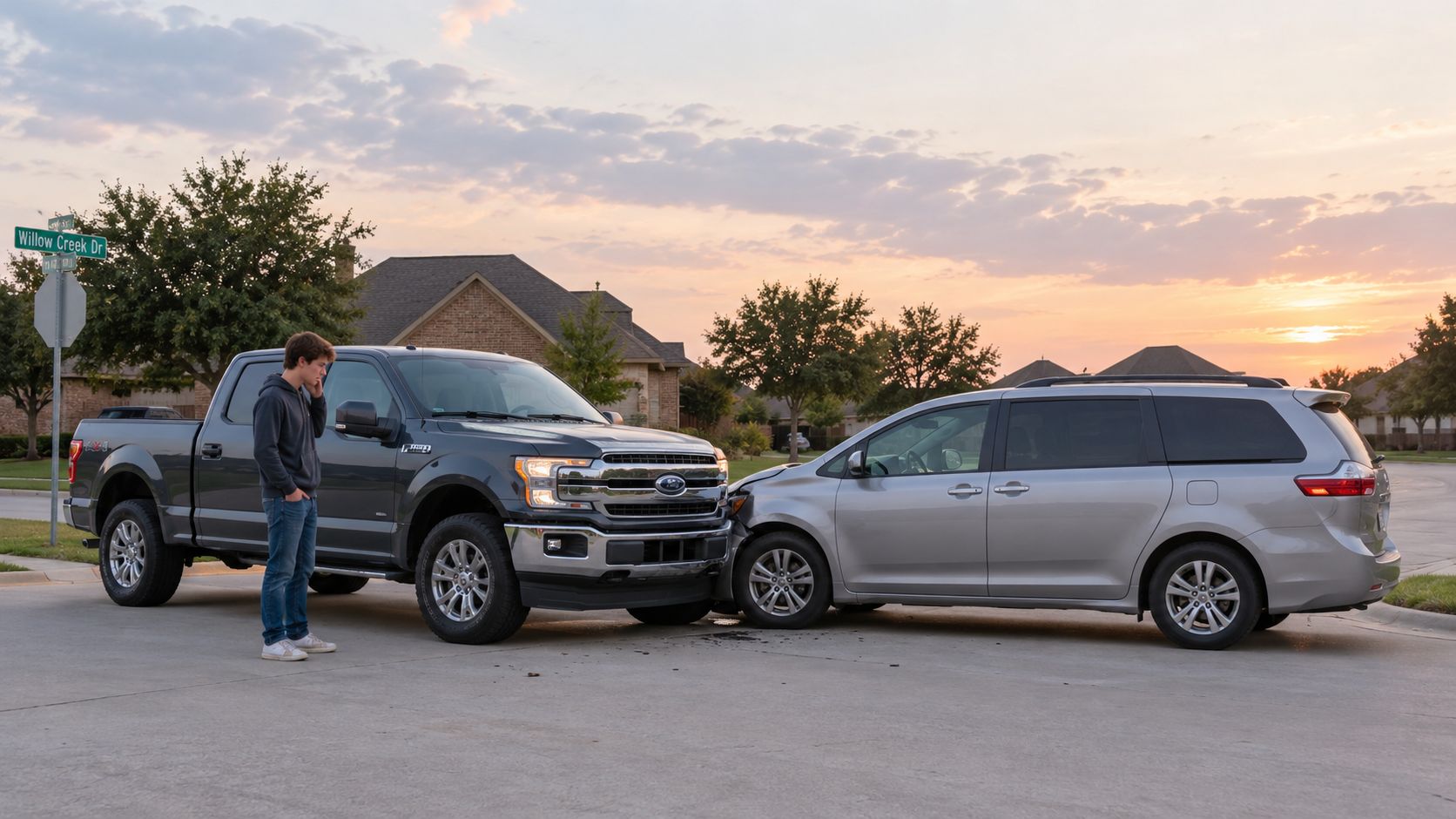
Negligent entrustment may allow an injured person to look beyond the driver and investigate the vehicle owner's conduct. The claim doesn't blame the owner merely because the owner's name appears on the title. It asks whether the owner made an unreasonable decision by allowing an unsafe driver to use the vehicle, and whether that decision helped create the chain of events that caused the collision.
That distinction matters. A parent, relative, roommate, friend, or company may have handed over the keys without being present when the crash happened. The owner may not have run the red light, crossed the center line, or driven while distracted. Still, Texas law can examine what the owner knew about the driver before permission was given.
Practical rule: The driver's fault and the owner's prior knowledge are separate questions. A strong claim must connect both.
The doctrine can be especially important in a serious injury or wrongful death case. It may identify another potentially responsible party when the at-fault driver's insurance or financial resources aren't enough. Your evidence must show more than ownership, however. Texas courts use a defined five-part framework.
The Five Elements of Negligent Entrustment in Texas
Texas courts have repeated the same five elements for decades. The framework appears in the Texas Supreme Court's decision in Williams v. Steves Industries, and a federal court has restated the elements in a more recent Texas case involving negligent entrustment.
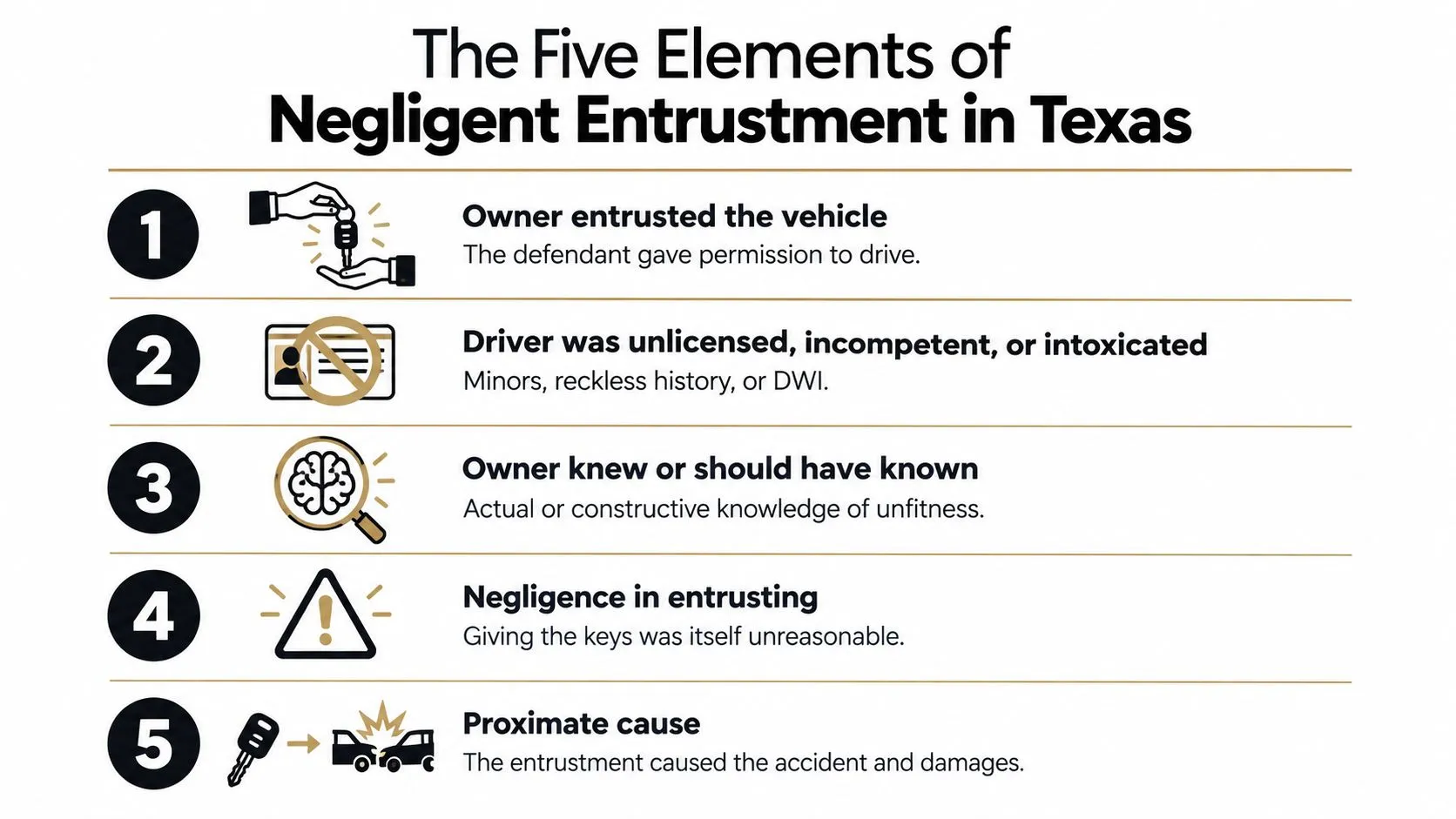
The owner entrusted the vehicle
You must show that the defendant owned, controlled, or otherwise permitted use of the vehicle. Permission may be direct, such as handing someone the keys, or may be established through the circumstances surrounding the driver's use.
For example, if an uncle gives his nephew permission to take a pickup to a gathering, the entrustment element may be straightforward. If the driver takes the vehicle without permission, the case becomes more difficult because the owner may not have entrusted the vehicle at all.
The driver was unlicensed, incompetent, or reckless
The driver must have had a condition that made the person unsafe to operate the vehicle. That condition may involve a licensing problem, a lack of driving ability, or a reckless pattern of conduct.
A suspended license, documented unsafe driving, or a history that shows serious disregard for traffic safety may be relevant. The specific evidence depends on the facts available before the crash.
The owner knew or should have known about that condition
This is often the hardest element. The question isn't only whether the owner admits knowing the driver was unsafe. It also asks whether the owner had enough information that a reasonable person should have recognized the risk when handing over the vehicle.
The timing matters. Evidence discovered after the crash may help prove what the owner knew earlier, but the key inquiry concerns the moment permission was given.
The driver was negligent in the crash
The driver must have acted negligently during the collision itself. That could involve speeding, failing to yield, distracted driving, intoxicated driving, or another failure to use reasonable care.
A driver's past record alone doesn't establish that the driver caused this particular crash. The injured person still must prove negligence on the occasion in question.
The driver's negligence proximately caused the injuries
Finally, the driver's negligence must have caused the collision and resulting harm. The evidence must tie the owner's decision to entrust the vehicle to the driver's negligent conduct and the injuries that followed.
Missing one element can defeat the negligent entrustment theory. The claim isn't, “The owner had insurance,” or, “The owner owned the car.” It's a connected proof of permission, unfitness, knowledge, negligent driving, and causation.
For context, The Two-Year Deadline for Texas Injury Claims explains why most Texas injury lawsuits must be filed within two years under CPRC 16.003.
Proving the Owner Knew or Should Have Known
The owner's knowledge is usually the battleground. An injured person may know that the driver caused the collision, yet still need to uncover what the owner knew before allowing the driver to use the vehicle.
Actual knowledge means the owner was aware of the danger. Examples may include a prior DWI conviction, a recent crash the owner discussed with the driver, an express warning from a family member, or a known license suspension. Direct messages, conversations, and admissions can make this evidence especially powerful.
Constructive knowledge, often described as “should have known,” is different. The owner may deny knowing about the driver's risk, but the available circumstances may show that a reasonably careful owner would have investigated before handing over the keys. Visible intoxication, repeated citations, erratic conduct, or an obvious licensing problem may support that argument.
A Texas Supreme Court decision explains that the owner's negligence must be connected to a foreseeable risk of injury from allowing the driver to use the vehicle. That analysis is why prior unsafe conduct matters only when it helps show the owner should have anticipated the danger.
Evidence that can reveal knowledge
A careful investigation may examine records that the owner doesn't volunteer. The following evidence can help show what the owner knew, what the owner could have discovered, and whether the owner ignored warning signs.
| Evidence Type | Typical Source | Why It Matters |
|---|---|---|
| Driving records | Texas Department of Public Safety records | May reveal license problems, citations, or driving history relevant to the owner's knowledge |
| Crash and arrest records | Police reports and court records | Can show prior collisions, DWI history, or other documented conduct |
| Digital communications | Text messages, emails, and social-media posts | May show warnings, admissions, discussions about driving privileges, or knowledge of alcohol use |
| Insurance information | Prior claim records and policy materials | Can help identify earlier incidents and the vehicle's insured owner |
| Witness accounts | Household members, friends, coworkers, and neighbors | May describe prior unsafe driving, warnings, or repeated permission |
| Video evidence | Body-camera footage, surveillance, and phone video | May document impairment, statements, or what happened before and after the crash |
The owner's knowledge is fact-intensive. A recent Texas appellate decision continued to apply the same framework and illustrates why the specific relationship between the owner, driver, and vehicle matters. The decision also reflects why a claim can't rest on a general accusation that someone was a bad driver.
A prior ticket is not automatically enough. The evidence must help show that this owner knew, or reasonably should have known, this driver posed a foreseeable risk at the time of entrustment.
The sooner you preserve evidence, the better. Texts can disappear, witnesses can forget conversations, and vehicle data may become harder to obtain. A detailed discussion of what evidence may be needed for a Texas injury claim can help you identify records to protect.
Practical Steps to Take After a Suspected Negligent Entrustment Crash
Your actions after the collision can help protect both your health and your claim. You don't need to prove negligent entrustment at the roadside, but you should preserve information that may later reveal who owned the vehicle and why the driver had access to it.
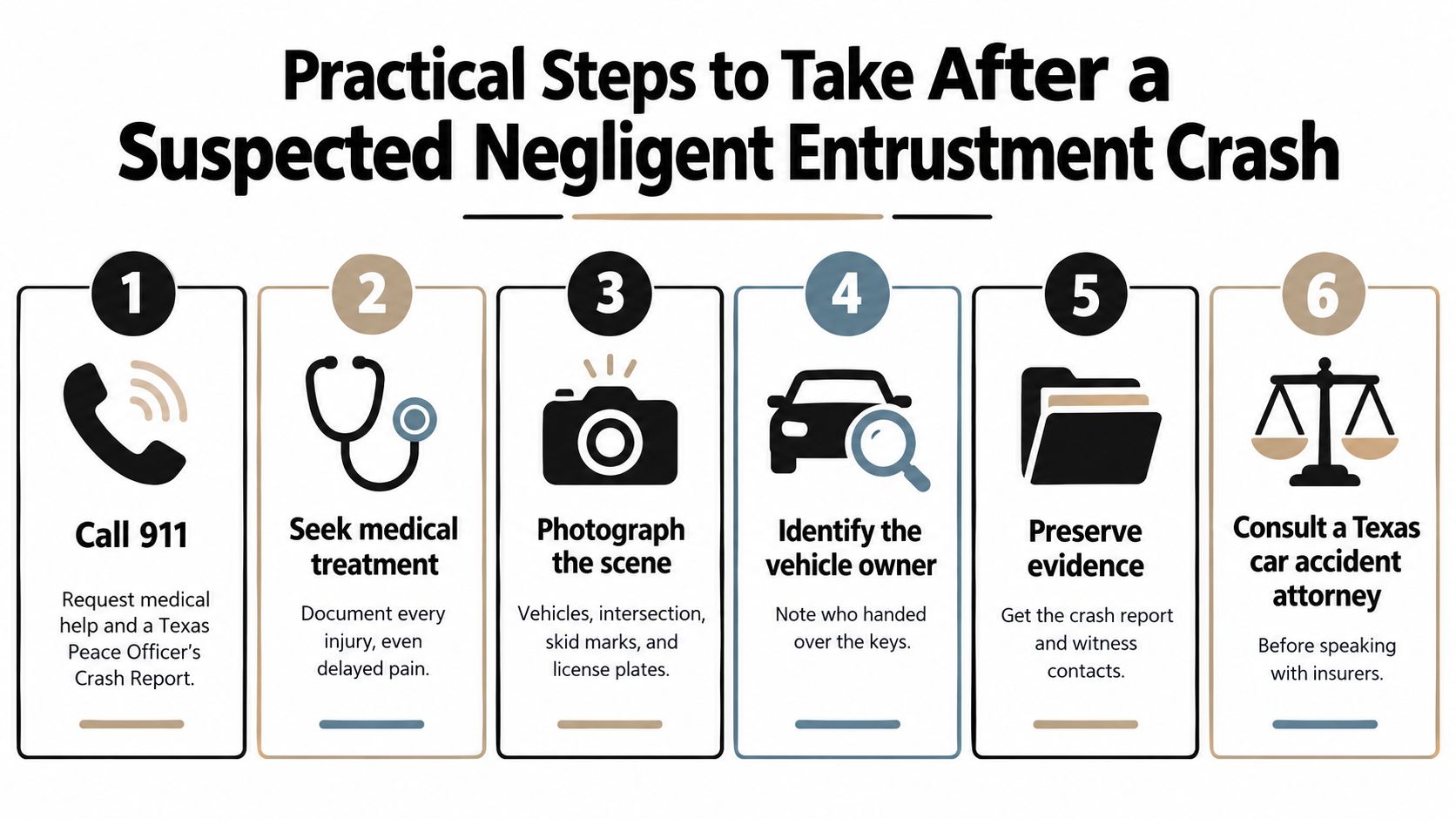
Call 911 and seek medical care. Ask for emergency help and cooperate with medical transport. Request that a Texas Peace Officer's Crash Report, Form CR-100, be completed. The report may preserve the officer's observations, driver information, and initial account of what happened.
Photograph the scene safely. Capture the vehicles, license plates, intersection, visible damage, roadway conditions, and anything suggesting impairment or unsafe operation. Don't put yourself in traffic or delay necessary treatment for photographs.
Identify the vehicle owner. Ask the responding officer for the registered owner and insurance information when available. You may also need to pursue a Texas Department of Motor Vehicles open records request, depending on what information can lawfully be released.
Collect witness information. Write down names and contact details. Ask witnesses what they observed about the crash, the driver's condition, or statements about who owned the vehicle and why the driver was using it.
Preserve documents. Keep medical records, bills, repair estimates, wage-loss documentation, photographs, and all messages with insurers. An owner's insurance declarations page may identify additional drivers, coverage conditions, or exclusions.
Be careful with insurance interviews. The other insurer may ask for a recorded statement before you understand the full extent of your injuries. You can ask to speak with a lawyer first. A step-by-step guide to what to do after a Texas car accident can help you organize the immediate response.
A free consultation can help you identify additional defendants and evidence before records disappear. Don't post detailed comments about the crash on social media, and don't guess about facts you haven't confirmed.
Here's a short visual resource that reinforces the basic response steps:
How Negligent Entrustment Fits With Negligence and Vicarious Liability
One crash can support more than one legal theory. The theories overlap, but they target different conduct and require different proof.
Ordinary negligence usually targets the driver. You must show the driver owed a duty to use reasonable care, breached that duty, caused the crash, and caused compensable harm. The driver's failure to stop, yield, maintain attention, or control the vehicle may support this claim without proving anything about the owner's prior knowledge.
Vicarious liability focuses on a relationship between the owner and driver. An owner may face responsibility when the driver was acting as an employee, agent, or authorized representative within the scope of that relationship. Permission alone doesn't automatically establish an agency relationship.
Negligent entrustment targets the owner's independent decision to provide access to the vehicle. The owner may be liable because the owner knew, or should have known, that the driver was unfit, and because the driver's negligent operation caused the injury.
| Theory | Who It Targets | Key Proof Required | Best Use |
|---|---|---|---|
| Ordinary negligence | The driver | Duty, breach, causation, and damages | Establishes the driver's direct fault |
| Vicarious liability | An employer, principal, or other responsible party | Agency or employment relationship and conduct within its scope | Applies when the driver acted for another person or business |
| Negligent entrustment | The vehicle owner or person who provided access | Permission, driver unfitness, owner knowledge, driver negligence, and proximate cause | Applies when the owner's decision to hand over the vehicle created a foreseeable risk |
These theories may be pleaded in the alternative. For example, a company may deny that a driver was acting within the scope of employment while also denying that it knew about the driver's record. Those defenses concern different questions, so the evidence should address each one separately.
Texas also uses comparative responsibility. If the evidence shows that an injured person contributed to the collision, a jury may assign responsibility among the parties under the applicable rules. That doesn't automatically erase a claim, but it can affect recovery, which is why the crash facts and medical proof must be presented carefully.
The filing deadline applies to these injury theories as well. Texas car accident guidance explains that injury and property-damage claims generally use a two-year period from the crash, while a wrongful death claim generally uses a two-year period from the date of death. Confirm the deadline for your specific claim promptly.
Common Defenses and How Texas Victims Counter Them
Owners and insurers often challenge negligent entrustment by attacking the evidence of knowledge, permission, causation, or damages. A denial alone doesn't resolve the issue. The response should match the defense.
“I didn't know the driver was unsafe.” Prior tickets, driving records, insurance files, messages, and testimony from household members may show that the owner had warnings. The owner's deposition testimony can also reveal whether the owner knew about earlier incidents or failed to ask basic questions.
“The driver wasn't allowed to take the vehicle that far.” The defense may argue that the driver exceeded the scope of permission. Evidence about the usual use of the vehicle, the owner's past conduct, the route, and the nature of the deviation can help show whether the driver's use was foreseeable.
“The injured person caused the crash.” A crash report, vehicle photographs, witness statements, event data recorder information, and accident reconstruction may clarify speed, braking, impact direction, and traffic signals. These facts can test whether the entrusted driver's conduct was the actual cause.
“The injuries are unrelated or overstated.” Consistent medical records, diagnostic testing, treatment history, and medical opinions can connect the injury to the collision. Preserve records showing symptoms from the earliest visit through later treatment.
Texas comparative responsibility can become a major issue in these disputes. Learn how comparative negligence works in Texas injury claims before accepting an insurer's description of your share of fault.
The defense doesn't need to disprove every part of your case if it creates a serious gap in one required element. That's why a lawyer should investigate the owner's knowledge and the driver's crash conduct together, rather than treating them as unrelated facts.
A Real-World Texas Example of the Doctrine at Work
Consider a composite example from a Houston suburb. A college student with a documented history of speeding tickets and a recent DWI arrest borrows his roommate's pickup. The roommate has discussed the student's driving privileges with him before, but still allows him to use the truck.
On I-45, the student runs a red light and T-bones a family SUV. The family suffers serious injuries. The student's conduct supports ordinary negligence, but the family also investigates whether the roommate's decision to provide the truck supports negligent entrustment.
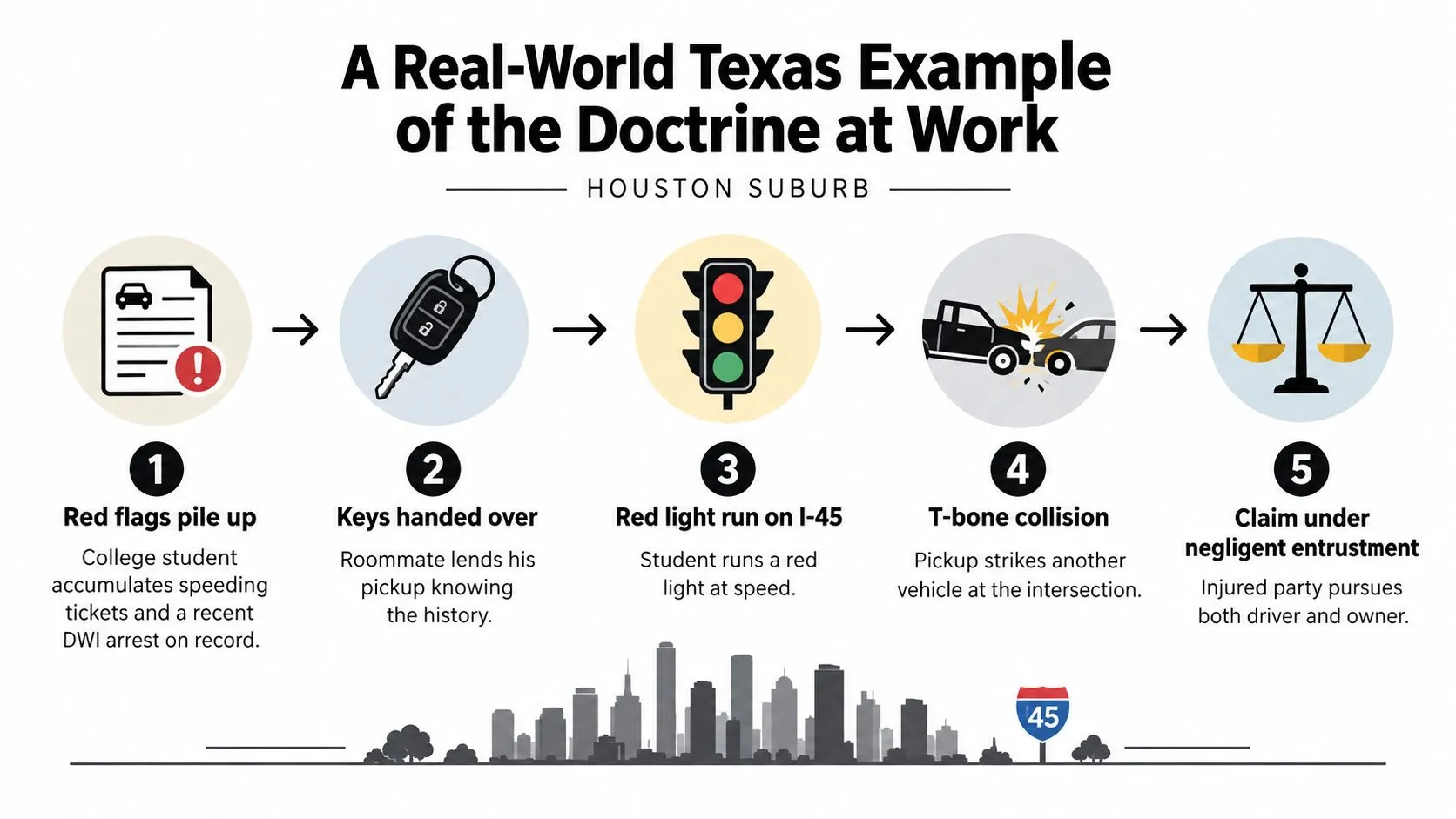
The evidence develops in stages:
- Permission: The insurance policy identifies the roommate as the vehicle owner, and messages confirm that the student was allowed to use the pickup.
- Unfitness: The speeding history and DWI arrest provide evidence of prior dangerous conduct.
- Knowledge: Phone records show messages about the DWI, while earlier conversations show the roommate knew about concerns surrounding the student's driving.
- Crash negligence: The citation and crash reconstruction report support the conclusion that the student ran the red light.
- Causation: The reconstruction connects the red-light violation to the impact with the family SUV and the resulting injuries.
In this composite scenario, the owner settles before trial, and the family recovers the available policy limits plus additional compensation. The result depends on the evidence, not merely on the fact that the vehicle belonged to someone else.
Real cases can produce different outcomes. A driver's history may be disputed, the owner may deny seeing the messages, or the reconstruction may leave room for another explanation. The practical lesson is that negligent entrustment works only when investigators gather the facts quickly and present them as one coherent chain.
How The Law Office of Bryan Fagan Can Help You
A negligent entrustment claim often requires work that an injured person can't reasonably handle while recovering. The investigation may include Texas Department of Public Safety driving records, police and court records, witness interviews, insurance materials, phone data, and vehicle evidence. In a serious crash, an accident reconstruction professional may also help explain how the collision occurred.
The legal team must connect those records to the five required elements. A prior citation matters only if it helps show the owner's knowledge. A text message matters only if it establishes permission, awareness, or another disputed fact. Medical evidence must also connect the collision to the injuries and the losses that followed.
A Texas personal injury lawyer can communicate with insurers, preserve evidence, identify available coverage, and evaluate whether the facts support claims against the driver, owner, employer, or another responsible party. If the crash killed a family member, a wrongful death lawyer Texas families trust can help identify the proper claimants and evaluate the losses caused by the death. For a commercial vehicle collision, a truck crash lawyer Houston victims contact may need to examine company records, driver qualifications, and additional insurance layers. Serious injuries may also require a catastrophic injury attorney and families may need support from a wrongful death lawyer.
The Law Office of Bryan Fagan, PLLC represents injured Texans in car, truck, wrongful death, and catastrophic injury matters. Its approach includes investigating the crash, interviewing witnesses, examining available records, communicating with insurers, and preparing cases for negotiation or trial when a fair resolution isn't offered. The firm also describes contingency-fee representation, meaning clients don't pay attorney fees unless there is a recovery.
Before speaking with the at-fault driver's insurer, preserve your photographs, medical records, repair documents, and messages. Avoid posting about the collision, and arrange a free case review early enough to protect the applicable deadline. You deserve clear answers, compassionate support, and a legal strategy built around the actual evidence.
The Law Office of Bryan Fagan, PLLC can investigate whether an owner's decision to lend a vehicle supports a negligent entrustment claim alongside ordinary negligence and other theories. Visit Law Office of Bryan Fagan, PLLC to request a free consultation and discuss your Texas car, truck, catastrophic injury, or wrongful death case. Recovery is possible, and legal help is available.


