 Skip to content
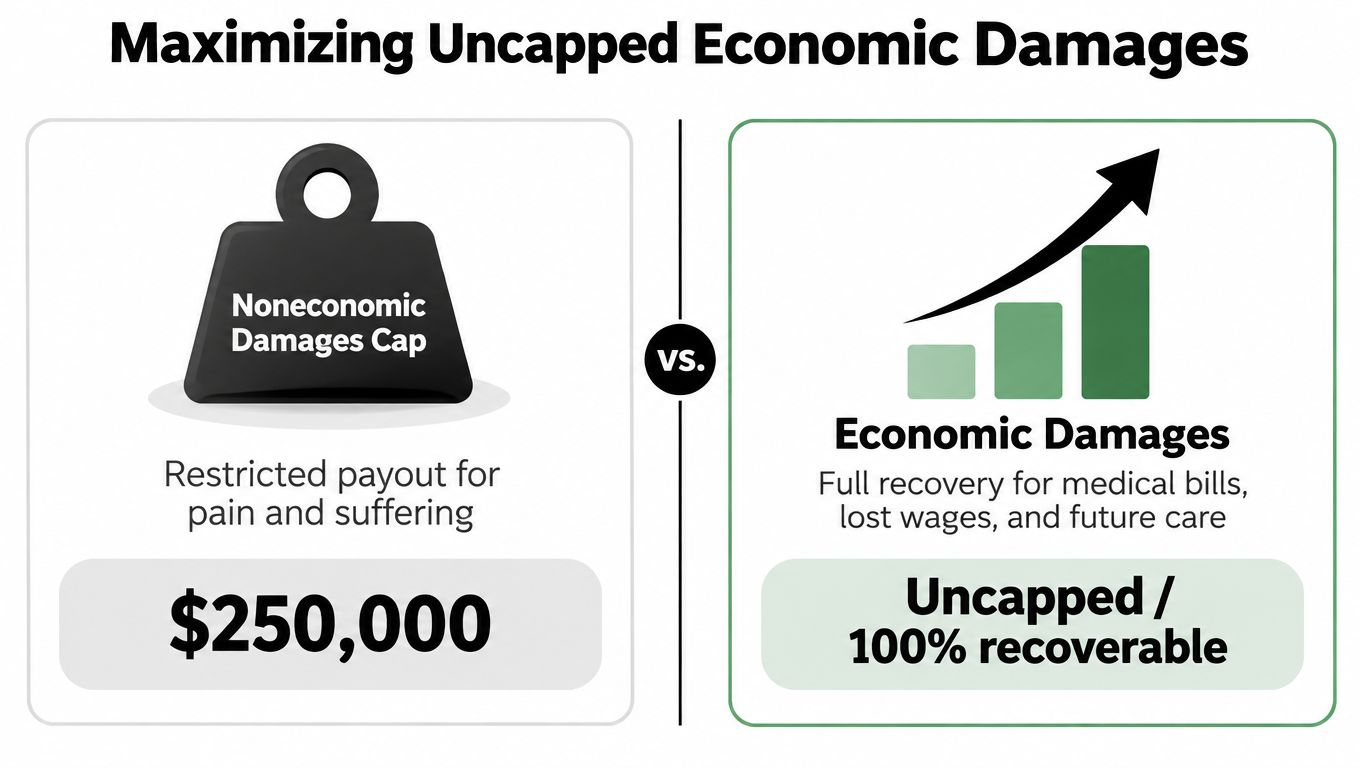
Texas limits noneconomic damages such as pain and suffering to $250,000 per claimant against doctors and other non-institution providers, and up to $500,000 per claimant against multiple health care institutions. Economic damages, including medical bills, lost wages, and future care, remain completely uncapped.
A serious medical error can leave you facing another question after the emergency ends: how much can Texas law let you recover? You may be dealing with another surgery, months of rehabilitation, missed work, or the loss of a loved one, while a hospital insurer asks you to accept a quick settlement.
The Texas medical malpractice noneconomic damages cap can limit compensation for pain, mental anguish, disfigurement, and loss of companionship. It does not place a ceiling on every loss. The strongest claims separate capped emotional harm from fully recoverable financial harm and document both categories from the beginning.
Facing a Medical Error and Understanding Your Rights
You trusted a doctor, nurse, hospital, or surgical center with your health. Instead, a delayed diagnosis, medication mistake, surgical error, or failure to monitor your condition may have changed your life. Families often leave the hospital with unanswered questions, growing bills, and a sense that no one is taking responsibility.
After a Houston hospital error, for example, a patient may need a second procedure and prolonged therapy after a preventable complication. The patient may also be unable to return to work or care for children. Texas law treats the financial consequences differently from the personal suffering. Noneconomic damages are limited, but qualifying economic losses are not.
Under Texas Civil Practice and Remedies Code Section 74.301, noneconomic damages are capped at $250,000 per claimant against a physician or other non-institution health care provider. A separate $250,000 per-claimant limit applies to a single health care institution, while the total institutional cap can reach $500,000 per claimant when more than one institution is liable.
Practical rule: A cap on pain and suffering isn't a cap on your medical bills, lost income, or future care.
That distinction matters in a catastrophic injury case. A patient who suffers permanent harm may have substantial costs for treatment, rehabilitation, assistive equipment, home care, and reduced earning capacity. Those losses require detailed proof, but they aren't reduced because Texas limits noneconomic damages.
A relatable example
Suppose a patient undergoes surgery at a hospital and suffers a serious injury after the care team fails to respond to warning signs. The patient may pursue claims against the surgeon and the hospital, but the possible noneconomic recovery depends on how the law classifies each defendant and whether liability can be established.
The patient's medical records, employment history, treatment recommendations, and future-care needs become just as important as the evidence showing what went wrong. A settlement discussion based only on current bills can leave major future losses unaddressed.
Even when your claim involves medical personnel, understanding the health care system can help you identify who may have participated in the care process. Resources about roles such as becoming a healthcare project coordinator can provide general background about how health care operations are organized, although they aren't a substitute for legal advice.
You don't need to determine the legal value of your claim alone. Start by preserving records, following your doctors' instructions, and speaking with a qualified Texas personal injury lawyer before signing a release.
How the Texas Noneconomic Damages Cap is Calculated
Many people hear “$250,000 cap” and assume Texas imposes one single limit on the entire malpractice case. That isn't how the statutory structure works. Texas creates separate categories for non-institution providers and health care institutions, and the analysis is performed per claimant.
A physician, individual surgeon, or other non-institution provider falls into one statutory bucket. The limit against those providers remains $250,000 per claimant, regardless of how many such providers are sued or how many legal theories are pleaded. Adding more doctors to the lawsuit doesn't automatically multiply that provider cap.
Hospitals, licensed facilities, and other health care institutions are treated differently. One liable institution is subject to a $250,000 per-claimant cap, while multiple liable institutions can create a combined institutional ceiling of $500,000 per claimant.
| Defendant Type | Cap Per Claimant | Key Condition |
|---|---|---|
| Physician or other non-institution provider | $250,000 | The limit applies regardless of how many covered providers are sued |
| One health care institution | $250,000 | Applies to the institutional defendant |
| Multiple health care institutions | Up to $500,000 total | More than one institution must be found liable |
The commonly discussed $750,000 combined maximum arises only when the case includes liable providers and multiple liable institutions. It isn't the default result in every malpractice claim. A case against only one doctor or only one hospital may have a substantially lower noneconomic ceiling.
Per claimant is not per incident
Texas analyzes these limits per claimant, not just per medical event. A single incident can injure more than one person or give rise to claims by several eligible claimants. Each claimant may require a separate cap analysis, particularly in wrongful death litigation or cases involving multiple injured patients.
That distinction can affect how a family evaluates a claim. A family shouldn't assume that one hospital event creates one shared noneconomic limit for every person affected. The legal claims, claimant status, defendant classifications, and applicable statutory provisions all matter.
The difference between economic and noneconomic damages in Texas injury cases is central to this calculation. Noneconomic damages address losses such as pain, mental anguish, disfigurement, and loss of companionship. Economic damages address measurable financial harm and aren't subject to this noneconomic ceiling.
For a broader description of What Damages Can You Recover in a Texas Injury Case?, victims can review the categories of compensation available in Texas injury claims. A lawyer should then apply those categories to the medical records, employment evidence, family circumstances, and future needs in the specific case.
Maximizing Uncapped Economic Damages in Your Claim
The cap makes careful economic-damage preparation essential. If a medical error leaves you with permanent limitations, the value of your claim may depend heavily on whether your legal team proves the full cost of treatment and the income you can no longer earn.
Economic damages generally include past and future medical expenses, rehabilitation, lost wages, and diminished earning capacity. They may also include other provable financial losses connected to the injury. The key is to preserve evidence before bills, employment records, and treatment details become difficult to reconstruct.
Build the financial record early
Start with a dedicated file, whether physical or digital. Keep itemized bills, pharmacy receipts, mileage records, disability paperwork, pay records, and invoices for assistance at home. Ask your providers to explain the treatment they expect you to need, not only the care you've already received.
A serious injury can create costs that don't appear on a hospital invoice. You may need transportation, modifications to your home, help with household tasks, or ongoing therapy. Your lawyer can determine which losses are legally recoverable, but you should preserve the underlying proof.
Prove future care instead of guessing
Future damages require evidence, not speculation. Treating physicians can describe the medical services you may need. Rehabilitation professionals can explain functional limitations. Life-care planning and economic analysis can help connect those medical needs to projected financial costs and lost earning capacity.
A young patient with a permanent birth injury presents a different economic picture from an adult who misses a short period of work. A child may need extensive care and support throughout life, while an adult may lose wages, benefits, professional opportunities, and the ability to perform household services.
Document the losses that continue after discharge. The end of a hospital stay doesn't mean the financial harm has ended.
Don't allow an insurer to value the case only by looking at bills already paid. A settlement that covers current treatment but ignores future surgery, therapy, medication, or reduced earning capacity may leave your family without the resources needed for recovery.
You should also maintain a personal record of how the injury affects work, mobility, sleep, family responsibilities, and daily activities. That journal can support noneconomic damages, while employment documents and medical evidence support the uncapped economic portion of the claim.
Constitutional Challenges and Wrongful Death Nuances
Texas's current cap system has a constitutional foundation. Earlier Texas limits were struck down under the state constitution, but the modern framework followed House Bill 4, related reforms effective September 1, 2003, and the ratification of Proposition 12 on September 13, 2003. Historical materials describe an earlier 1977 system that used a lower baseline cap later adjusted through consumer-price indexing, before the modern fixed structure replaced it. These historical details are summarized by the Texas Medical Association's liability reform history.
Proposition 12 amended the Texas Constitution to authorize legislative limits on noneconomic damages in health care liability actions. The constitutional text specifically permits the Legislature to limit damages and losses other than economic damages in claims involving medical or health care providers, as stated in Article III, Section 66 of the Texas Constitution.
That history changes the practical legal question. A broad argument that Texas can't have any malpractice cap faces a serious constitutional obstacle. Modern disputes more often concern how the cap is allocated, which defendants qualify as providers or institutions, and which claimants may pursue separate damages.
Wrongful death and survival claims
A fatal medical error creates profound legal and personal consequences. Surviving family members may pursue wrongful death claims for losses connected to the death, while a survival action can address claims belonging to the person who died. These claims aren't interchangeable, and separate statutory provisions can affect how they interact with the noneconomic cap.
Families should review the differences between Texas wrongful death and survival actions before accepting a settlement or assuming that one cap applies to every available claim. The identity of the claimant, the type of damages sought, and the relationship between the claims can change the analysis.
For example, after a fatal medication error, the surviving spouse and children may have distinct losses, while the deceased patient's own claim may involve a separate legal theory. A lawyer must examine the records, statutory definitions, defendant classifications, and procedural deadlines together.
This is an area where families should avoid relying on a hospital's explanation of the cap. The hospital's insurer has an interest in limiting payment. An independent review can reveal whether multiple institutional defendants, separate claimants, or distinct causes of action require further investigation.
Strategic Steps to Protect Your Right to Full Compensation
The cap is fixed, but your preparation doesn't have to be limited. A strong malpractice investigation asks two questions at the same time: who caused the harm, and what will this harm cost for the rest of the patient's life?
Start by preserving the complete medical record. Request records from every facility and provider involved, including emergency care, imaging, surgery, rehabilitation, pharmacy services, and follow-up treatment. Don't assume the hospital's chart contains every relevant document or that one provider's records will identify every entity involved.
Identify every responsible defendant
A hospital may be only one part of the care system. A physician group, surgical center, staffing company, or other institution may have a separate role. Whether a defendant is legally responsible depends on the facts, contracts, employment relationships, duties, and evidence of negligence.
That doesn't mean you should add every name appearing in a chart. It means your legal team should investigate each participant early enough to preserve evidence and evaluate the applicable cap bucket. Identifying a second institution can matter when the evidence supports liability, but a claim still requires proof rather than speculation.
Prove negligence with qualified medical evidence
Medical malpractice cases require more than showing that a bad outcome occurred. The evidence must address the accepted standard of care, the provider's breach, and the connection between that breach and the injury. Medical experts often review records and explain these issues in language a judge or jury can understand.
You should also ask the legal team how it will prove future losses. A treating specialist may address medical needs, while vocational and economic professionals may help evaluate work capacity and earning loss. The precise experts depend on the injury and the damages being claimed.
Don't confuse malpractice with ordinary negligence
Some disputes involve conduct that may fall outside a professional medical judgment claim, but the label depends on the facts and applicable law. Vicarious liability may also matter when an employer or institution is legally responsible for an employee's conduct. These theories can't be used as shortcuts around the cap without careful legal analysis.
Your lawyer should investigate the legal theory, not simply accept the hospital's label for the incident.
The same discipline applies to fault. Texas generally uses modified comparative responsibility, often called the 51% bar rule. If an injured person is 51% or more responsible, recovery is barred; if the person is less than 51% responsible, the award is reduced by that percentage, as explained in this Texas personal injury law overview. Medical causation and patient conduct should be evaluated separately, but both can affect the final result.

Navigating the Texas Medical Malpractice Claims Process
A valid claim can fail when a deadline or procedural requirement is missed. Texas malpractice cases require early action because records, witnesses, expert reviews, and financial evidence take time to assemble.
Start with the filing deadline
Texas injury claims are generally subject to a two-year statute of limitations, and victims should verify the deadline that applies to their facts through Texas's two-year deadline guidance. The date that starts the clock can depend on the circumstances, the type of claim, and statutory rules. Don't wait until the deadline is close to contact a lawyer.
Follow the claim roadmap
Get appropriate medical care. Follow treatment recommendations and ask questions about your condition. Your health comes first, and consistent treatment also creates a clearer medical record.
Preserve evidence. Keep records, bills, prescriptions, work documents, messages, and notes about what happened. Don't alter medical records or make public accusations about providers.
Obtain a legal evaluation. A lawyer can assess whether the facts support a health care liability claim, identify potential defendants, and determine which deadlines may apply.
Investigate before filing. Counsel may obtain records, consult medical professionals, and evaluate economic losses before deciding whether litigation is appropriate.
Prepare the expert report. Texas law requires a detailed expert report within 120 days after filing a health care liability lawsuit, a requirement discussed in this Chapter 74 expert report deadline guide. The report must address the applicable standard of care, the breach, and causation. Missing the requirement can place the case at serious risk.
Evaluate settlement carefully. Don't compare an offer only with the capped noneconomic amount. Review past and future medical care, wage loss, earning capacity, and the effect of a release on every claim.
A Houston car accident attorney may handle a crash claim without the same medical malpractice expert-report process, while a truck crash lawyer Houston families rely on may focus on driver, employer, and trucking evidence. Medical negligence claims require their own specialized investigation.
The following video may provide additional general context about the expert-report requirement:
Don't give a recorded statement to an insurer or sign a medical authorization without understanding its scope. An insurance adjuster may sound helpful, but the adjuster works for the insurer. Refer detailed questions to your lawyer, and keep communication factual and limited.
Get Compassionate Legal Help for Your Malpractice Claim
A medical error can affect every part of your life. You may be trying to recover physically while managing bills, helping a spouse, caring for a child, or grieving someone who didn't survive. You deserve clear information, not pressure to make a fast decision.
A careful legal review should address the cap structure, every potentially responsible provider or institution, and the complete economic impact of the injury. It should also consider whether the claim involves wrongful death, a survival action, or another related theory. The right approach depends on the records and the facts, not on a generic settlement formula.
The Law Office of Bryan Fagan, PLLC represents injured Texans and families in serious personal injury matters, including medical negligence, car crashes, truck collisions, catastrophic injuries, and wrongful death. The firm offers free consultations and contingency-fee representation, so clients don't pay attorney fees unless the firm wins.
Whether you searched for a Texas personal injury lawyer, a wrongful death lawyer Texas families can consult, or help after a catastrophic medical injury, act before evidence and deadlines create unnecessary problems. Recovery may take time, but a well-prepared claim can help protect your medical care, financial future, and family's rights.
The Law Office of Bryan Fagan, PLLC can review how the Texas medical malpractice noneconomic damages cap applies to your claim, investigate potential defendants, and document uncapped economic losses. Visit Law Office of Bryan Fagan, PLLC to schedule a free consultation and take the next step toward recovery with legal help available.


