A serious accident can change your life in seconds, but you don't have to face it alone. You may be a Houston warehouse worker who suffered a back injury while moving equipment, a construction worker hurt in a fall, or a family member trying to understand what happened after a fatal workplace accident. Then you learn your employer doesn't carry workers' compensation insurance, and the usual answers no longer seem to apply.
That discovery can feel frightening, especially when medical bills are arriving and paychecks have stopped. A nonsubscriber work injury lawsuit against a Texas employer may provide a path to pursue compensation, but it isn't an automatic recovery. You generally must prove that the employer's negligence caused your injury. The right evidence, an early coverage check, and prompt legal advice can make a meaningful difference.
When Your Texas Employer Has No Workers' Comp Coverage
Rafael worked in a Houston-area warehouse. During a shift, a loaded pallet moved unexpectedly and struck his leg. His supervisor arranged basic first aid, but Rafael later learned the company didn't carry workers' compensation insurance. He was left with medical appointments, missed work, and a difficult question: if there was no workers' comp claim, did he have any legal option?
In Texas, the answer may be yes. An employer that doesn't carry workers' compensation is generally called a nonsubscriber. Instead of receiving benefits through the workers' compensation system, an injured employee may bring a civil negligence lawsuit directly against the employer. That lawsuit can seek damages such as medical expenses, lost wages, pain and suffering, and future care needs, if the worker proves the required elements.
The situation still requires careful analysis. Your employer's lack of coverage doesn't prove that the employer caused the accident. You'll need to examine what happened, what safety duties applied, whether the company failed to act reasonably, and how that failure led to your injury.
Practical rule: Treat the absence of workers' compensation as a reason to investigate quickly, not as proof that you automatically win.
Why the first days matter
Report the accident in writing, obtain medical care, preserve photographs, and identify witnesses. Employment records, safety policies, incident reports, and medical notes may later help show what the employer knew and how the injury affected you.
You can also review the firm's explanation of Texas workers' compensation rules while gathering information. A serious injury may affect your ability to work, care for your family, and plan for the future, so don't sign an employer document or recorded statement before understanding what it does.
This guide explains how nonsubscriber status changes your legal options, what you must prove, how Texas deadlines work, and which steps can protect your claim. If a loved one died from a workplace accident, the analysis may also involve a wrongful death claim and a different set of family concerns.
What a Nonsubscriber Employer Means in Texas
You are injured at work, and your employer says it does not carry workers' compensation insurance. That fact changes the legal route available to you, but it does not decide whether you have a case. Texas is the only state that doesn't require private employers to carry workers' compensation insurance. A private company may opt out of that system and become a nonsubscriber. An injured worker may then pursue a civil claim rather than workers' compensation benefits. The Texas Tribune explains this structure in its reporting on Texas workplace injuries.

Workers' compensation functions like a structured safety net. A subscribing employer pays for coverage, and an injured employee generally seeks benefits through that system. A nonsubscriber employer has chosen a different arrangement. The worker may bring a civil lawsuit, but the injury alone does not establish that the employer caused it. The practical question is what the employer knew, what safety duty applied, and whether a failure to act reasonably contributed to the injury.
How common is nonsubscription?
Nonsubscription affects a substantial group of Texas workers, not just a handful of unusual employers. In 2024, 24% of Texas employers were nonsubscribers, and 13% of Texas employees worked for nonsubscribers, according to the Texas Tribune's analysis of state workplace data. The employee share was the lowest in a decade, but many workers remained outside the traditional system.
State reporting shows about 117,624 private-sector employers lacked coverage in 2020, employing roughly 2.1 million workers. The same Texas Department of Insurance reporting states that 25% of private-sector employers were nonsubscribers in 2022. Employers with 1 to 4 employees had the highest rate at 31%, while employers with 50 to 99 employees had the lowest at 7%, according to the Texas Department of Insurance's 2022 biennial report on workers' compensation. The report also records a decline in year-round private-sector nonsubscribers from 38% in 2004 to 29% in 2020.
Construction, transportation, warehouse, and industrial workers may encounter particular concerns because their jobs can involve heavy equipment, vehicles, falls, and changing work conditions. Your employer may provide an internal injury plan, but that plan is not automatically workers' compensation insurance. Read its reporting deadlines, medical-care rules, and benefit limits carefully.
Before filing, verify the employer's status through the state's public nonsubscriber list and preserve the result. That check can prevent a basic coverage mistake, because a lawsuit based on assumed nonsubscriber status may begin on the wrong legal foundation. For broader information about workplace claims and possible claims involving other responsible parties, see workplace injury and third-party claims in Texas.
Your Right to Sue and What You Must Prove
After a workplace injury, learning that your employer is a nonsubscriber may seem to answer the legal question. It does not. That status can permit a direct negligence lawsuit, but it does not by itself prove that the employer caused your harm.
Texas Labor Code Chapter 406 allows an injured employee of a nonsubscriber employer to sue directly. The employer also loses important common-law defenses, including contributory negligence, assumption of risk, and the fellow-servant rule, as explained by the Texas Department of Insurance. The practical proof gap remains: you must connect the employer's conduct to the accident and the accident to your losses.
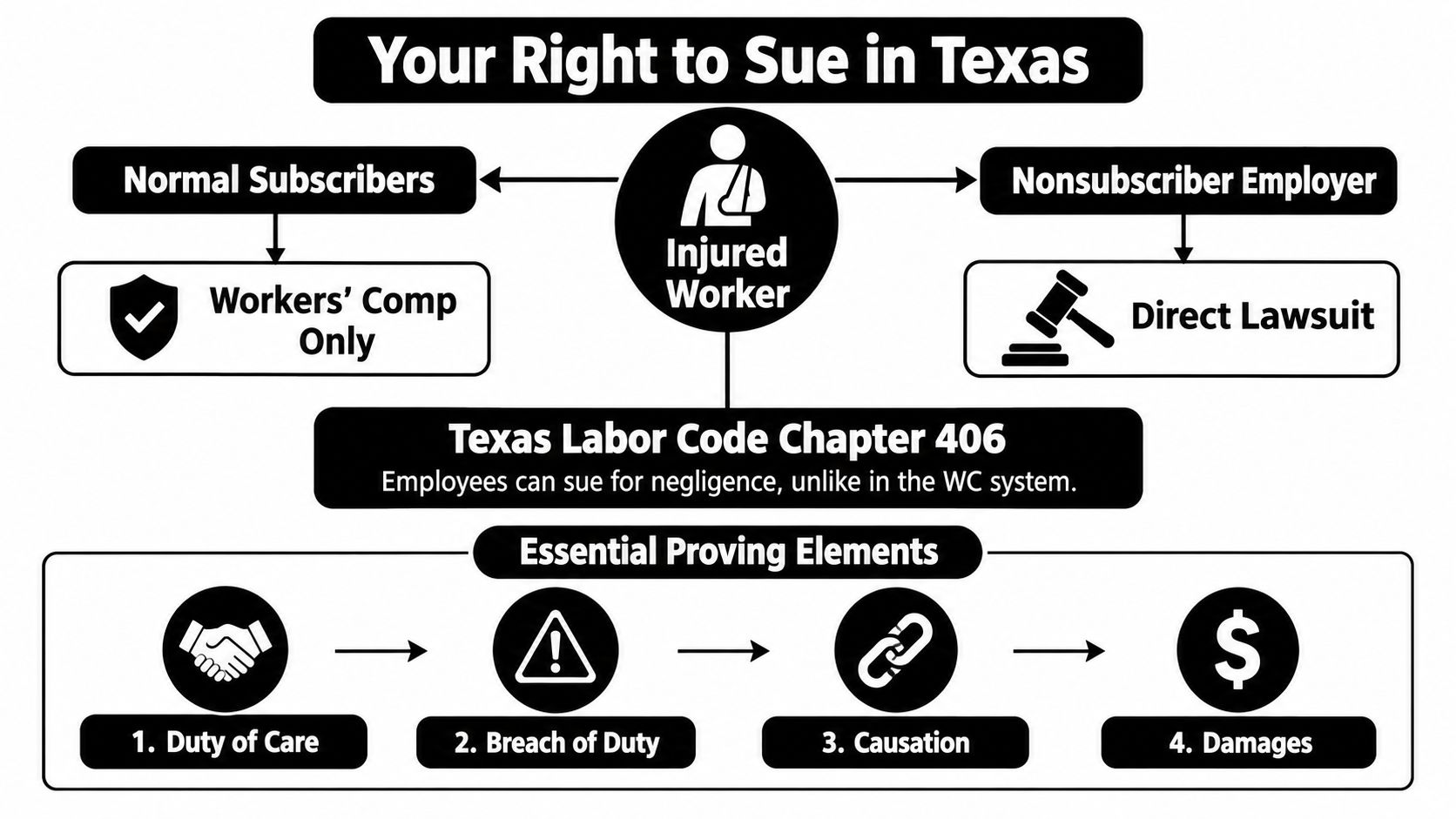
The four questions your claim must answer
Duty. Employers must take reasonable steps to provide a safe workplace. Depending on the job, that duty may include training, safe equipment, supervision, maintenance, warnings, and workable safety procedures.
Breach. Identify what the employer did wrong or failed to do. Evidence might show that the company ignored a known equipment defect, provided inadequate training for a hazardous task, or required work to continue despite an unsafe condition.
Causation. Show that the breach caused the injury. If a forklift struck you, relevant questions include who controlled it, whether the employer knew about a safety problem, and whether that problem contributed to the collision.
Damages. Prove the losses caused by the injury. Medical records, employment history, physician opinions, wage information, and testimony about daily limitations may support claims for medical expenses, lost wages, reduced earning capacity, pain and suffering, and future care.
The employer may still dispute negligence, causation, or the amount and proof of your damages. It cannot rely on the defenses listed above, but removing those defenses does not replace evidence. In particularly serious cases, a lawyer may also assess whether exemplary damages are legally available. That requires a separate, demanding analysis of the employer's conduct and the evidence.
The Texas Supreme Court's discussion of nonsubscriber claims explains that these cases seek recovery through fault-based negligence claims, rather than workers' compensation benefits. Before filing, confirm the employer's status through the state's public nonsubscriber list and preserve the result. That simple verification helps ensure the lawsuit rests on the correct coverage facts.
Common Employer Defenses and Misconceptions
The most important misconception is simple: nonsubscriber status alone doesn't create liability. If a worker is injured while performing a job, the worker still must show that the employer breached a duty of reasonable safety and that the breach caused the injury.
An employer may argue that the accident happened for a different reason. It may dispute the sequence of events, question whether a dangerous condition existed, or claim that the medical condition came from another source. It may also argue that another company, property owner, equipment manufacturer, driver, or subcontractor caused the harm.

What the employer generally can't use
Under Texas Labor Code Section 406.033, a nonsubscriber employer loses several defenses that would otherwise complicate an injured worker's case. The employer generally can't rely on:
- Contributory negligence: blaming the worker as a complete common-law defense.
- Assumption of risk: arguing that the worker accepted the danger by taking the job.
- Fellow-servant rule: shifting responsibility to a coworker's negligence.
Those protections can change settlement discussions and trial strategy. They don't excuse poor documentation, however. You still need evidence that tells a consistent story about the unsafe condition, the employer's knowledge or conduct, the accident, and the resulting harm.
Texas comparative responsibility principles can also affect how a court evaluates fault. Read the firm's explanation of comparative negligence in Texas for a broader discussion of how responsibility may be analyzed in personal injury litigation. The exact application depends on the facts and the claims involved.
A Houston example shows why details matter. Suppose a delivery worker slips on an unmarked spill in a loading area. The employer's lack of workers' compensation coverage doesn't prove that the spill caused the fall or that the employer should have known about it. Photographs, cleaning logs, witness accounts, surveillance footage, and medical records may provide the missing connection.
How Long You Have to File and What the Timeline Looks Like
If you were hurt at work months ago, you may still have time to bring a claim, but the calendar matters. Texas's general deadline for personal injury claims is two years, and that rule commonly applies to nonsubscriber work-injury claims. Our guide to the Texas personal injury statute of limitations explains how the deadline works. Evidence can weaken while you wait: records may be lost, witnesses may relocate, and memories may fade.
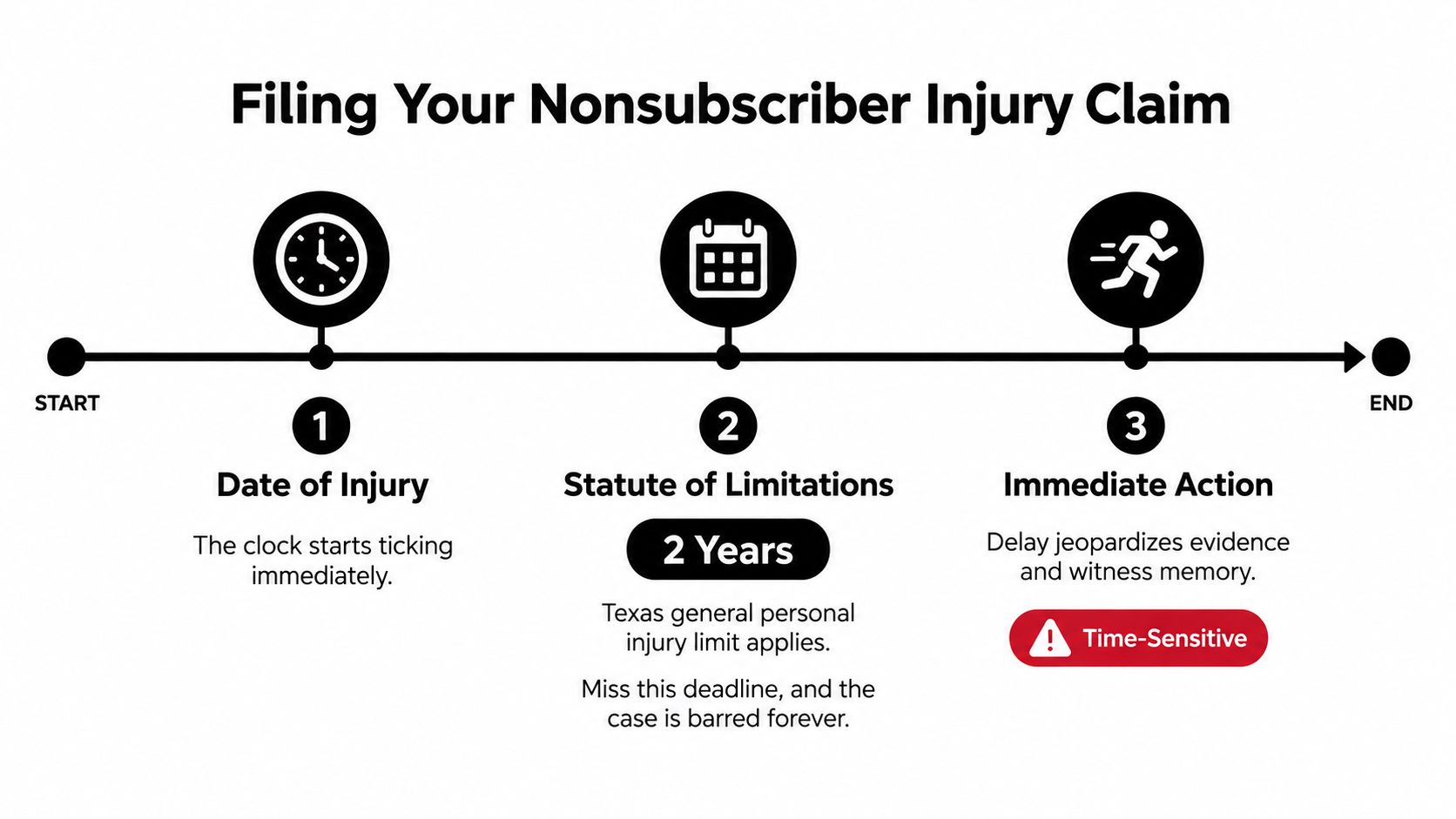
The usual path of a claim
- Report the injury. Notify your supervisor or employer in writing, and retain a copy.
- Obtain medical care. Tell each provider the injury happened at work and follow reasonable treatment instructions.
- Verify coverage and investigate the facts. Confirm whether the employer is a subscriber or nonsubscriber. Checking the state's public nonsubscriber list before filing can prevent a proof problem later. Nonsubscriber status alone does not establish that the employer caused your injury.
- Evaluate damages. Organize medical bills, wage information, work restrictions, and evidence of possible future care.
- Send a demand. Your lawyer may present the facts and claimed damages to the employer or its liability insurer.
- File suit if needed. Filing begins the formal civil process if negotiations do not resolve the claim.
- Complete discovery and resolve the case. The parties exchange information, take depositions when necessary, negotiate, and prepare for trial if no fair resolution occurs.
Certain nonsubscribing employers must report work-related injuries involving more than one day of lost time, known work-related illnesses, and fatalities through DWC Form-007, according to Texas Department of Insurance employer guidance. That report may help confirm when the accident occurred, how much work you missed, and the seriousness of the injury.
Practical Steps and Evidence That Strengthen Your Case
Your actions after a workplace accident can protect both your health and your legal position. Start with safety and medical care, then preserve information before the workplace changes.
Follow this evidence checklist
- Report in writing: Describe when, where, and how the accident happened. Avoid guessing about facts you don't know.
- Get medical treatment: Keep appointment records, bills, prescriptions, and written work restrictions.
- Photograph the scene: Capture equipment, floor conditions, missing guards, lighting, warning signs, and the surrounding area, if it's safe to do so.
- Identify witnesses: Record names and contact information for coworkers, supervisors, contractors, and anyone who saw the event or complained about the condition.
- Save employment records: Keep pay statements, schedules, job descriptions, performance records, and communications about missed work.
- Track symptoms: A short daily journal can show pain, sleep problems, mobility limits, and how the injury affects ordinary activities.
- Preserve communications: Save texts, emails, incident forms, benefit-plan documents, and messages from supervisors or insurers.
- Be cautious with statements: Don't give a recorded statement or sign a release for the employer's insurance representative before consulting a lawyer.
Verify coverage before filing
If your employer denies being a nonsubscriber, or you're unsure what coverage exists, verify it yourself. Texas employees can use the state's coverage verification process or the public non-subscriber list, a concrete pre-suit step that many guides overlook. The coverage process and related state developments are discussed in this explanation of verifying Texas nonsubscriber status.
Texas rolled out an Employer E-File tool for nonsubscriber reporting in August 2026, and the coverage-verification page was updated that month, according to the same source. Those administrative tools may make employer-status documentation easier to locate, but you should still save what you find and discuss discrepancies with counsel.
Settlement Versus Trial and Why an Experienced Lawyer Matters
A nonsubscriber claim may resolve through negotiation or proceed to trial. A settlement can provide certainty without asking a jury to decide disputed facts, but the offer must be measured against your medical needs, income losses, pain, and future limitations. A trial may provide a stronger result when the employer's offer is unfair or the evidence supports substantial liability, but it also carries uncertainty and requires preparation.
The money generally comes directly from the employer, usually through its liability insurance or available assets. That makes early investigation important. An insurer may evaluate the claim based on the records it receives, so incomplete evidence can make your injuries and future needs appear smaller than they are.
What legal representation adds
An experienced Texas personal injury lawyer can help preserve evidence, identify safety failures, examine employer records, locate additional responsible parties, and work with medical or vocational professionals when future losses require careful analysis. A lawyer can also handle communications with the employer and insurer, evaluate settlement proposals, and prepare the case for trial when negotiation doesn't produce a fair result.
The same careful approach applies in other Texas injury matters. A Houston car accident attorney may investigate a crash involving an employee vehicle, while a truck crash lawyer in Houston may examine commercial driving records and company practices. Families facing a fatal workplace or traffic incident may need a wrongful death lawyer in Texas, and survivors with permanent impairments may need guidance from a catastrophic injury team.
Recovery won't happen overnight, but a well-supported claim can help you pursue medical care, income replacement, and accountability. The Law Office of Bryan Fagan, PLLC offers free consultations and contingency-fee representation for people evaluating Texas personal injury claims, including workplace injuries and related third-party cases.
If you were hurt because a Texas employer may not carry workers' compensation, the Law Office of Bryan Fagan, PLLC can help investigate coverage, preserve evidence, and evaluate a potential negligence claim. Schedule a free consultation through Law Office of Bryan Fagan, PLLC to discuss your options, and remember that recovery is possible with informed legal support.