 Skip to content
A serious medical injury can change your life in seconds, but you don't have to face the legal process alone. Maybe a Houston hospital procedure left you with a new disability, or a loved one died after a diagnosis was missed. While you're managing pain, medical bills, and grief, you may also be trying to understand an unfamiliar rule called the Chapter 74 expert report 120-day deadline in Texas.
This deadline can decide whether a health care liability claim moves forward. The rule is strict, but it isn't impossible to manage. With prompt legal guidance, careful records, and a qualified medical expert, you can take the next step with greater confidence.
A Life-Changing Injury and a Confusing Legal Path
After a Dallas hospital procedure, a patient may expect a routine recovery. Instead, serious complications develop, additional treatment follows, and returning to work becomes impossible. Medical records may document what happened, yet they often do not explain whether the care violated a legal standard.
An Austin patient can face the same uncertainty after a delayed diagnosis. The patient reports troubling symptoms, receives treatment, and later learns that an earlier diagnosis might have changed the course of care. The family must then examine several questions: What should the provider have done? Did the care fall below accepted standards? Did that failure cause the injury?

Why the legal process feels different
Medical negligence claims follow a different path from a typical Texas car accident claim. A crash investigation may rely on photographs, witness statements, traffic-camera footage, and vehicle damage. A health care liability claim often turns on medical judgments that a patient, family member, or lawyer cannot assess without qualified expert review.
Texas law requires that review early in the case. The report must address the standard of care, breach, and causation, giving the defendant an early opportunity to assess the claim before full discovery. A serious injury, poor outcome, or troubling experience does not by itself establish medical negligence.
The timing creates another problem. The parties may still be gathering records and identifying what happened when the reporting deadline approaches. Counsel must identify every proper defendant, track each answer date, obtain complete records, and locate an expert who can evaluate the care. In a case involving several providers, each defendant may require a separate analysis. Treating the case as one broad complaint can leave an important claim unsupported.
A difficult outcome deserves a careful investigation, but that investigation must begin early enough to protect the claim.
The legal question remains whether a provider's conduct caused the harm. The fact that treatment ended badly is not enough by itself. Other Texas personal injury cases may also involve comparative responsibility when more than one person contributed to an accident, but health care claims require close attention to medical proof.
If the injury came from a Houston freeway collision rather than medical treatment, a Houston car accident attorney can evaluate negligence, insurance coverage, and available evidence. Truck collisions raise their own evidence and liability questions, and early evidence preservation matters in either type of case. When medical care is involved, contacting counsel promptly gives the legal team time to protect records, examine the providers' roles, and address the Chapter 74 requirements.
What Is a Chapter 74 Expert Report
A Chapter 74 expert report is a written report prepared by a qualified medical expert in a Texas health care liability claim. The claimant must serve the report and the expert's curriculum vitae on the affected health care provider or the provider's attorney.
The report serves as an early explanation of why the claim has a legal and medical foundation. You can think of it as a pre-game summary for the court. It isn't the full trial presentation, and it doesn't replace discovery, but it must give the defendant and judge a fair summary of the key medical opinions.
Who may be affected
The requirement can apply when a claim arises from treatment, a lack of treatment, or another alleged departure from accepted medical standards involving a health care provider. Depending on the facts, defendants may include:
- Physicians: A surgeon, emergency physician, radiologist, or other doctor may need an individual report addressing that provider's conduct.
- Hospitals and clinics: The claim may involve care delivered through an institution, requiring careful analysis of the institution's role.
- Other medical professionals: Nurses and other providers may be involved when their acts or omissions form part of the alleged negligence.
The report must address the claim against each defendant with enough detail to explain what that particular provider allegedly did wrong. A general statement that “the medical team was negligent” may not explain the conduct of each separate defendant.
What the report is meant to show
The report must address three connected questions:
- What should the provider have done?
- How did the provider depart from that standard?
- How did that departure cause the injury or death?
Those questions help distinguish a potentially actionable claim from a disagreement with treatment or an unfortunate medical result. A patient can experience a serious complication even when the provider followed the applicable standard of care. The expert report helps evaluate that distinction at the beginning of the case.
The medical injury itself may lead to questions about bills, lost income, pain, future care, or loss of companionship. For a general overview of available categories, see What Damages Can You Recover in a Texas Injury Case?. The report requirement, however, concerns the medical foundation of the claim, not the final calculation of damages.
The Critical 120-Day Deadline Explained
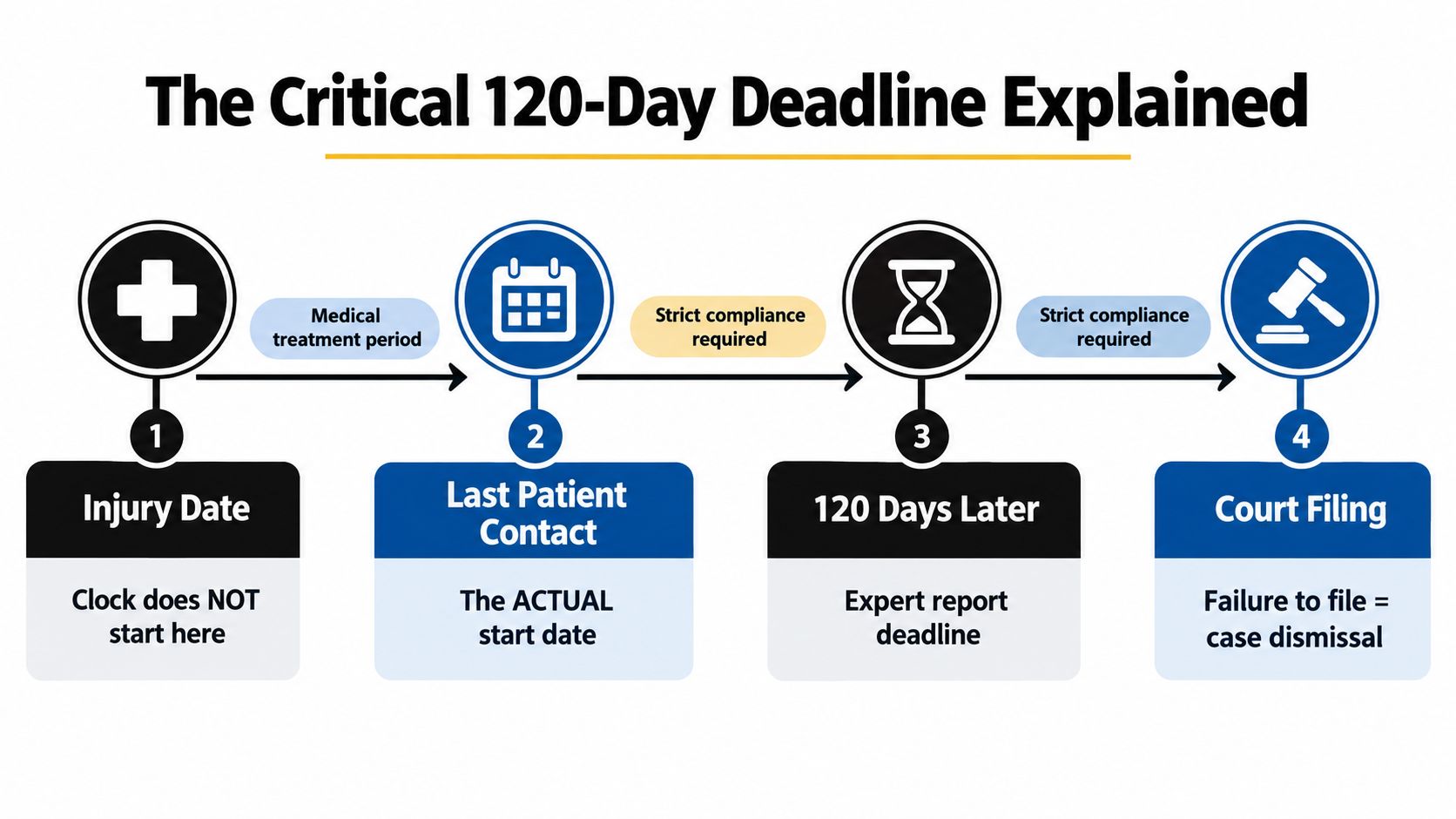
The most important timing point is simple: the clock is tied to each defendant's original answer, not to the injury date. Section 74.351 gives a claimant exactly 120 days after each defendant's original answer is filed to serve the expert report and the expert's curriculum vitae on that defendant or the defendant's attorney. Texas Civil Practice and Remedies Code Section 74.351 contains the governing rule.
That distinction matters because people often begin counting from the wrong event. The clock isn't automatically measured from the day of surgery, the date of a diagnosis, the date of an accident, or the day the family first suspected negligence.
One claim can have more than one countdown
Consider a Houston crash victim who later receives treatment from a surgeon and hospital. The patient believes the medical care worsened the injuries from the collision and files a health care liability claim against both defendants.
The surgeon may file an original answer on one date. The hospital may file its original answer later. Because the statute measures the deadline from each defendant's answer, the claimant may face separate report deadlines. A lawyer should track every answer date independently rather than place one date on a calendar and assume it controls the entire case.
| Event | Why it matters |
|---|---|
| Injury or treatment date | This is not the Chapter 74 report trigger |
| Defendant's original answer | This starts that defendant's 120-day period |
| Service of the report and CV | These must reach the affected defendant or attorney within the applicable window |
| Objection to an insufficient report | The statute provides a 21-day window that must also be monitored |
The objection deadline creates another procedural trap. Objections to an allegedly insufficient report can be waived if they aren't served within the statute's 21-day window. Multiple defendants may therefore create separate answer dates, report deadlines, and objection issues.
Extensions are limited
Texas law recognizes limited ways to extend the deadline. Under Section 74.353, if the court makes the required preliminary determination that the case is a health care liability claim, the deadline can be the later of the applicable statutory dates described in that provision, or a later date agreed to in writing by the affected parties. A written agreement may also extend the report deadline.
Don't assume an extension exists because a deadline feels unfair or because records arrived late. A lawyer should confirm the agreement in writing and calculate the date carefully. A verbal understanding may not protect you.
Texas previously used a longer period under the predecessor framework. A Texas Tech Law Review article explains that the earlier statute used 180 days, while Chapter 74 reduced the period to 120 days, a 33.3% reduction in the available time window. The Texas Tech Law Review discussion also describes changes in how the deadline was framed.
What Makes an Expert Report Adequate
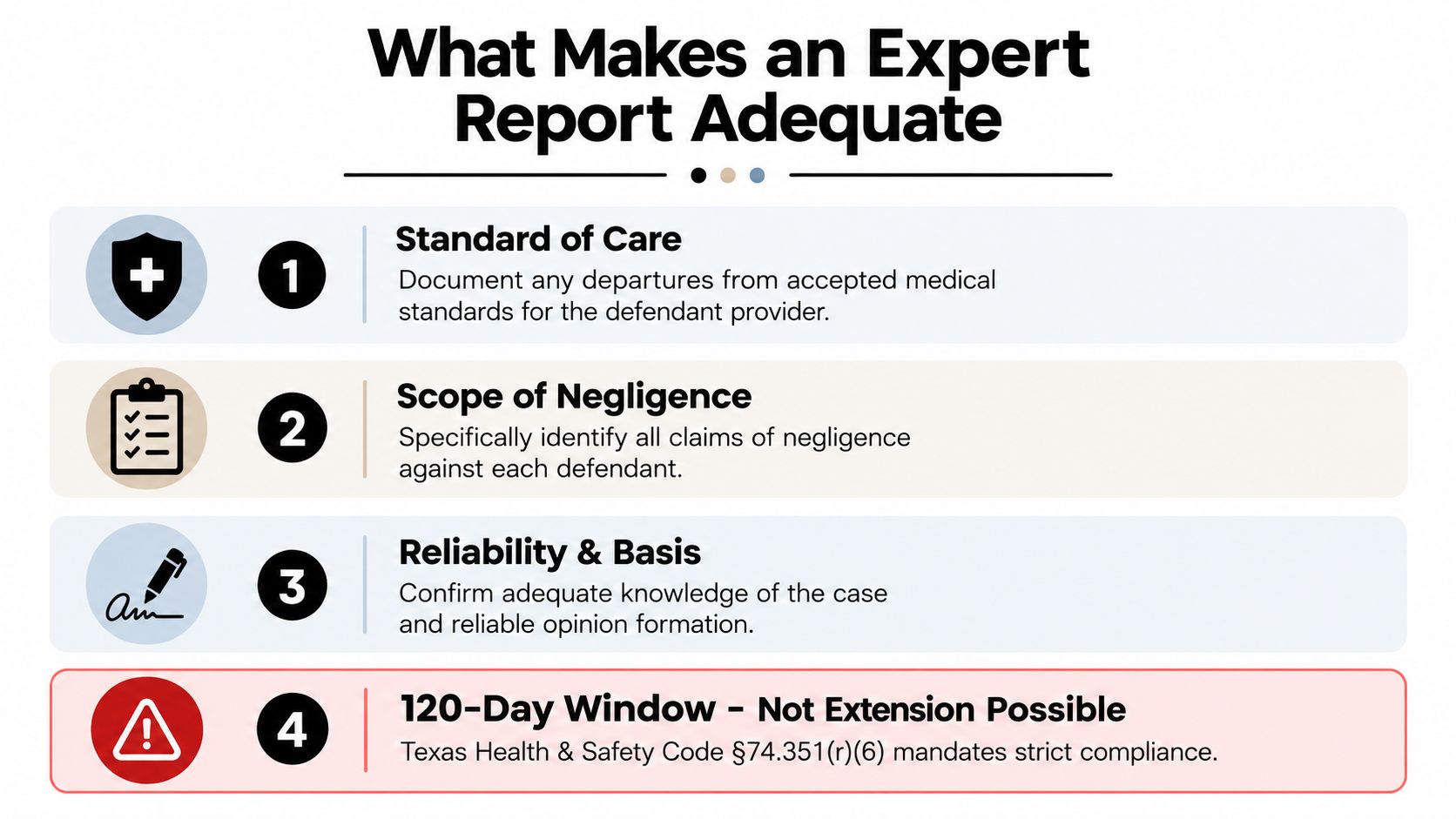
Serving something on time isn't enough. The report must provide a fair summary of the opinions needed to support the health care liability claim, and it must connect those opinions to the specific provider involved.
Standard of care
The standard of care describes what a reasonably competent provider would have done in the same or a similar situation. The appropriate standard may depend on the provider's specialty, the patient's symptoms, the information available at the time, and the treatment setting.
For example, an expert might examine whether a reasonably competent emergency physician should have ordered additional testing, monitored a patient differently, or arranged a timely consultation. The report should explain the medical basis for that opinion rather than merely announce that the provider acted improperly.
Breach
Breach means the provider failed to meet the applicable standard. The report should identify the conduct or omission at issue.
A useful report does more than say a doctor “made a mistake.” It explains what the doctor should have done, what the doctor did, and why that difference represents a departure from accepted care. If the claim involves several defendants, the report should address each provider's alleged role instead of treating the entire hospital team as one person.
Causation
Causation connects the alleged breach to the harm. The expert must explain how the provider's conduct caused or contributed to the injury, worsened condition, additional treatment, or death claimed in the lawsuit.
This is often the most challenging part. A patient may have had a serious underlying condition before the alleged negligence, and the defense may argue that the outcome would have occurred regardless. The report must give a reasoned medical explanation for the connection between the breach and the injury.
Records, imaging, medication history, discharge instructions, and treatment timelines can help the expert form an opinion. Patients and families can also review what evidence is needed for an injury claim in Texas to understand why preserving documents matters.
A report that is served but found deficient is treated differently from a claim where no report was served. Under Texas law, a court may grant a 30-day period to cure deficiencies in an otherwise timely report. A written agreement can also extend the deadline, but you shouldn't rely on a cure period or an extension without legal advice. The governing statutory language appears in Section 74.353.
Consequences of a Missing or Deficient Report
Missing the Chapter 74 deadline can end the claim against the affected provider before the parties complete discovery. This is a legal consequence, not a statement that your injury lacks value or that your experience doesn't matter.
If a claimant doesn't serve an adequate expert report within the applicable window, Texas law requires dismissal with prejudice against the health care provider. The court must also award the provider reasonable attorney's fees and court costs. A 2025 Texas appellate decision illustrates the mandatory nature of that result.

What dismissal with prejudice means
Dismissal with prejudice means the claim against that defendant cannot be refiled as though nothing happened. If a case involves multiple providers, the effect may focus on the affected defendant, but the outcome still can remove an important party from the lawsuit.
That can matter when the hospital, physician, nurse, or clinic played a different role in the care. Each defendant may require individual analysis, and one report may not adequately address all defendants unless it provides the necessary opinions for each one.
A deficient report still creates risk
A timely report can face an objection if it doesn't explain the standard of care, breach, or causation with enough substance. A court may allow a cure period for an inadequate report, but that relief isn't automatic and doesn't replace the need for a complete, qualified opinion.
A report is not a formality to file at the last minute. It is the medical foundation that allows the claim to continue.
The safest approach is to begin the record review before litigation deadlines become urgent. Your attorney may need to identify the proper expert, collect missing records, clarify which provider did what, and make sure service reaches every affected defendant. Those tasks take coordination, especially when the patient is still recovering or the family is grieving.
Your Next Steps to Protect Your Rights in Texas
A patient may leave a hospital believing the hardest part is over, then learn that a health care liability claim has strict report and filing requirements. The dates can overlap, but they do different work. Start organizing them before the 120-day period becomes urgent.
Start with the dates
Contact an experienced Texas personal injury lawyer as soon as you suspect medical negligence. Provide the treatment dates, names of the providers, lawsuit status, and information about whether any defendant has filed an answer. Those details help counsel calculate deadlines and identify immediate risks.
Texas claims may also involve a statute of limitations. The filing period depends on the type of claim and the facts. The Chapter 74 expert report deadline is separate, so satisfying one deadline does not automatically satisfy the other. Treat them as separate tracks on the same calendar.
Preserve your records
Gather hospital and clinic records, test results, prescriptions, bills, discharge instructions, photographs, employment information, and communications with providers. Keep messages, appointment reminders, and written explanations in their original form.
Write a simple timeline while events remain fresh. Record symptoms, appointments, questions, instructions, changes in your condition, and when you first learned about a possible error. Your notes cannot replace medical evidence, but they can help counsel and an expert understand what happened and when.
Protect conversations with insurers
Before speaking with a provider's insurer, avoid giving a recorded statement, signing a broad release, or accepting a quick settlement. Questions that sound routine may affect how the claim is evaluated, and an early release can limit later options.
If a loved one died, ask your attorney whether a wrongful death claim applies and how its deadlines differ from the Chapter 74 report requirement. Permanent impairment may require analysis of future care and long-term effects. A separate motor vehicle case, such as a car or truck crash, may involve different legal issues and deadlines.
Choose counsel carefully
Ask about experience with health care liability claims, expert reports, deadline tracking, communication, and the specific provider involved. This questions to ask before hiring a lawyer resource can help you prepare for an initial conversation.
You can also review when you should contact a lawyer after an accident in Texas for general timing guidance. The Law Office of Bryan Fagan, PLLC handles personal injury matters involving car and truck crashes, wrongful death, and serious injuries. Its attorneys can discuss whether your situation may require a Chapter 74 expert report.
The Law Office of Bryan Fagan, PLLC offers free consultations to help injured Texans and families understand their legal options, preserve evidence, and address urgent deadlines. Contact the firm promptly about a potential health care liability claim. Recovery is possible with informed legal help at your side.


