 Skip to content
A serious accident can change your life in seconds, but you don't have to face it alone.
Maybe you're at home with a back injury, watching your paycheck shrink while medical bills pile up. Your supervisor may have handed you paperwork and told you to sign quickly. The question you're Googling is direct: Does the workers' comp exclusive-remedy rule block my lawsuit, or is my employer a Texas nonsubscriber?
That answer can determine whether your claim follows a workers' compensation benefits process or becomes a civil negligence lawsuit. The difference affects medical care, wage benefits, pain and suffering, future earnings, defenses, and the evidence your lawyer needs.
This guide explains the rule in plain English. You'll get a side-by-side comparison, two workplace scenarios, answers about employers and borrowed workers, an action checklist, myth corrections, and a practical next step. If your injury happened in a company vehicle, on a jobsite, or during work travel, the details matter.
When Your Texas Work Injury Feels Overwhelming
A serious workplace injury creates more than physical pain. You may be trying to sleep in a chair because your back won't bend, deciding which bills can wait, and wondering whether reporting the injury will cost you your job. A foreman's clipboard can make the situation feel even more urgent, especially when you don't know whether you're signing a claim form, a release, or something that limits your rights.
Start with the exact issue. Workers comp exclusive remedy vs nonsubscriber Texas is not just a search phrase. It's the legal fork that may control your recovery. If your employer carried valid workers' compensation coverage when you were hurt, the exclusive-remedy rule generally keeps your claim inside the workers' compensation system. If the employer opted out, a negligence lawsuit may be available.
Texas has used this basic trade-off for generations. The Legislature enacted the workers' compensation law in 1913, the Texas Supreme Court upheld it in 1916, and the current Act was adopted in 1993. Texas Labor Code Section 408.001 generally makes workers' compensation benefits the exclusive remedy against a subscribing employer for a covered work injury or death, subject to narrow statutory exceptions.
The two paths have different costs
Workers' compensation usually provides a structured benefits route rather than a fault-based lawsuit. You may receive medical benefits and income benefits, but you generally can't recover the same broad civil damages available in a negligence case against a nonsubscriber.
A nonsubscriber case requires proof of employer negligence, but the employer doesn't receive the ordinary exclusive-remedy shield. Texas law also removes certain defenses, which can materially change the litigation.
Practical rule: Don't assume the paperwork on your supervisor's desk tells you what your claim is worth. First verify coverage, employment status, and the identity of every potentially responsible company.
The rest of this article addresses the comparison, real workplace examples, employer-status disputes, immediate steps, common misconceptions, and your options for getting legal help. You don't need to solve the entire case today. You do need to preserve the facts before they disappear.
What Exclusive Remedy and Nonsubscriber Actually Mean in Texas
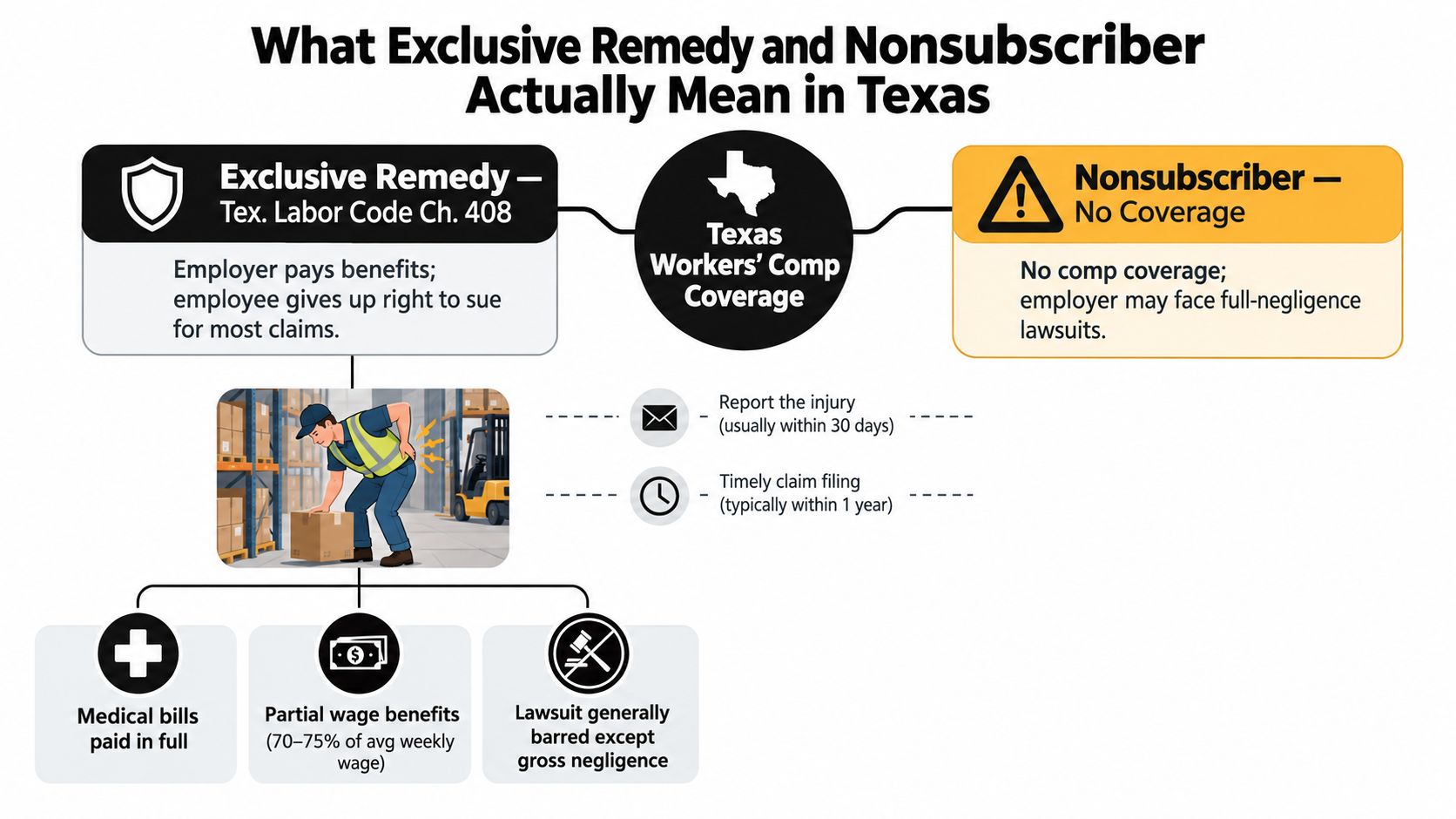
Think of a warehouse employee who hurts their back moving a pallet. If the employer subscribes to workers' compensation, the worker normally pursues benefits through the system. Medical treatment and income benefits follow statutory rules, and a permanent impairment determination may lead to an impairment benefit. In exchange, the worker generally gives up the right to sue the subscribing employer for ordinary negligence.
That's the exclusive-remedy doctrine. Texas Labor Code Chapter 408 reflects the bargain: the employee receives a benefits system without having to prove ordinary fault, while the subscribing employer receives protection from most employee injury lawsuits. The Texas Department of Insurance explains that the main statutory exception involving a subscribing employer is narrow, involving gross negligence that causes a fatality. TDI's employer FAQ provides the agency's explanation of that liability limit.
Texas private employers can choose not to carry workers' compensation. A company that makes that choice is called a nonsubscriber. The Texas Department of Insurance reported an employer subscription rate of 75% in 2022, leaving roughly 25% of employers as nonsubscribers, while employees working for subscribers reached 83%. The TDI 2022 nonsubscriber report also explains that the state publishes ongoing information about private employers that opt out.
What changes after an opt-out
A nonsubscriber may face an ordinary negligence action. The worker still has to establish that the employer owed a duty, breached that duty, and caused legally recoverable harm. But the employer typically can't rely on the same exclusive-remedy defense, and Texas law removes several common-law defenses.
The Texas Workers' Compensation rules can help you understand the benefits framework and reporting concepts. For employer coverage research, workers and families can also find Texas workers comp information through Select Insurance Group, Inc. These resources don't replace case-specific legal advice, but they can help you recognize the vocabulary.
In plain terms, a subscriber claim usually stays in the administrative benefits system. A nonsubscriber claim may proceed in court, where damages can include losses that workers' compensation doesn't pay in the same way, such as pain and suffering and certain future losses.
Side-by-Side Comparison of the Two Paths
The quickest way to understand the trade-off is to compare the claim paths against the same questions.
Subscribed vs Nonsubscriber Employer in Texas
| Decision Factor | Subscribed Employer | Nonsubscriber Employer |
|---|---|---|
| Medical bills | Paid through workers' compensation benefits under applicable rules | May be paid through employer funds or another injury plan, but coverage terms must be examined |
| Wage benefits | Statutory income benefits may apply | Civil damages may include wage losses if negligence and causation are proven |
| Lawsuit for full damages | Generally barred by exclusive remedy | Negligence lawsuit may be available |
| Burden of proof | Generally no need to prove ordinary employer negligence for covered benefits | Worker generally must prove employer negligence and causation |
| Pain and suffering | Generally not recovered as ordinary workers' compensation benefits | May be claimed as civil damages when supported by the case |
| Employer defenses | Exclusive remedy is the principal protection, subject to statutory exceptions | Several defenses are removed, but the employer can still dispute duty, breach, causation, and damages |
| Filing deadlines | Workers' compensation notice and claim deadlines apply | Civil limitations deadlines apply, along with any relevant notice requirements |
Why the table doesn't tell the whole story
Workers' compensation is usually the faster, more structured route, but it can limit the categories of recovery. You don't generally have to prove that your employer acted negligently to receive covered benefits, yet you also generally can't demand a jury award for pain and suffering against the subscriber.
A nonsubscriber lawsuit can offer broader damages, but it's not automatic money. You must prove fault, medical causation, and the extent of your losses. The Texas Guidebook for Employers describes nonsubscriber damages and attorney's fees as “almost unlimited,” while also recognizing that the employee still has a negligence case to prove. The Texas Workforce Commission's guidebook explains the practical difference.
Texas Labor Code Section 406.033 removes defenses including contributory negligence, assumption of risk, and fellow-employee negligence. The Texas Supreme Court's discussion of Section 406.033 is important because a nonsubscriber employer can't just blame the worker or a coworker as it might in another negligence dispute.
For a broader explanation of the relationship between comp and civil claims, review workers' comp versus personal injury. The central recommendation is simple: verify status before choosing a strategy.
Two Real Texas Scenarios That Show the Difference
Consider two workers with similar physical injuries but different employers.
Scenario A
A grocery store clerk lifts a pallet and develops a serious back injury. Her chain carries workers' compensation coverage. She reports the injury, files through the Texas Division of Workers' Compensation process, and receives medical care through the carrier. She may receive income benefits and an impairment-related payment based on the rating assigned in her claim.
The trade-off is significant. Even if the store failed to train her properly or allowed unsafe lifting practices, the exclusive-remedy rule generally prevents her from suing the subscribing employer for ordinary negligence. Her claim stays within the statutory benefits system.
Scenario B
A delivery driver works for a courier that doesn't subscribe to workers' compensation. During a work route, an untrained coworker runs a red light and causes a crash. The driver may pursue a civil case against the employer if the facts support negligence, seeking damages such as medical expenses, lost income, pain and suffering, and future losses.
The case still requires proof. The driver must connect the employer's conduct, such as inadequate training or supervision, to the collision and resulting injuries. The employer may also argue that another person or company shares responsibility.
The Texas Supreme Court has held that a negligence claim against a nonsubscriber is a fault-based damages action rather than a workers' compensation benefits claim. That means proportionate responsibility can apply, and fault may be allocated to a responsible third party. The Texas Supreme Court's 2025 decision adds an important layer to nonsubscriber litigation.
The practical lesson is blunt. The employer's coverage choice, not the worker's preference, usually sets the initial path. A company-vehicle crash may also create separate claims against a negligent driver, maintenance company, vehicle owner, or other third party. A nonsubscriber work-injury lawsuit against a Texas employer requires a fact-specific review of every actor involved.
Who Counts as the Employer and Why It Matters
The name on your paystub doesn't always settle the legal question. A staffing agency may issue your paycheck while a client company controls your daily work. A professional employer organization may share employment responsibilities. In trucking, the dispute may involve an owner-operator arrangement, a carrier, or a company that treated you as an independent contractor.
Texas courts describe the exclusive-remedy defense as requiring proof of two essential points: the injured worker was the defendant's employee or borrowed servant, and the defendant had workers' compensation insurance in effect when the accident occurred. If either element is missing, the defense fails. This Texas appellate decision illustrates why coverage and employment status must be investigated together.
Facts that can flip the result
A borrowed-servant dispute often turns on who controlled the details of the work. Who directed the task? Who supplied the equipment? Who could reassign or discipline you? Who trained you? Those answers may matter more than the company name printed on a uniform.
Gather records involving:
- Staffing arrangements: Agency contracts, onboarding documents, time records, and messages from the client company.
- Company vehicles: Dispatch instructions, vehicle ownership, maintenance records, driver policies, and crash reports.
- Day labor or leasing: Payment records, worksite instructions, safety training, and the entity that selected the job.
- 1099 classifications: The contract matters, but the actual working relationship matters too. A label alone doesn't decide whether you're legally an independent contractor.
Texas Labor Code Sections 401.012 and 406.121 provide statutory anchors for these questions. In practical language, the law looks at who fits the worker and employer definitions and how the relationship operates. Don't let an employer's marketing claim that it is a subscriber end the inquiry.
Ask for proof of the policy in force on the injury date, not just a general statement that the company “has insurance.” Coverage documents, policy dates, payroll records, and posted notices can determine whether your case belongs in the comp system or civil court.
Practical Steps Every Injured Texas Worker Should Take
You don't need to know your final legal theory on the first day. You do need to create a reliable record.
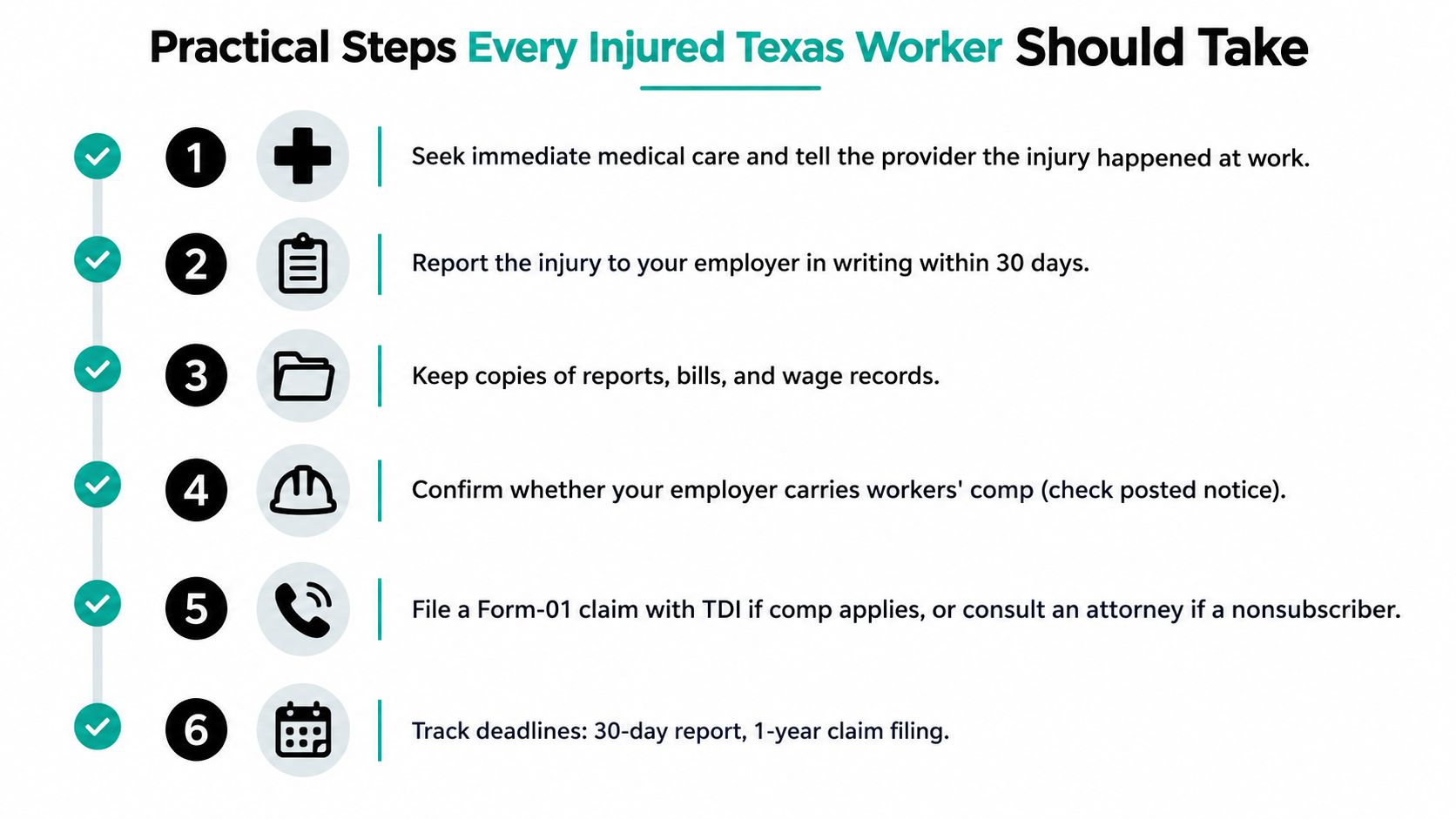
Get medical care immediately. Tell the provider that the injury happened at work and describe exactly what occurred. Follow treatment instructions and explain symptoms clearly, including symptoms that develop later.
Report the injury in writing. Give your supervisor or human resources the date, time, location, witnesses, and mechanism of injury. Keep a copy. Texas workers' compensation rules generally require prompt notice, and the infographic below identifies a 30-day reporting period and a one-year claim-filing period as key deadlines. Confirm the deadline that applies to your facts with a lawyer or the Texas Division of Workers' Compensation.
Preserve evidence. Photograph the scene, equipment, hazard, vehicle, and visible injuries if you can do so safely. Save your badge, schedule, text messages, emails, pay records, and names of witnesses.
Ask about coverage in writing. Request confirmation of whether the employer subscribes and ask for the policy information or relevant DWC documentation. Don't rely on a supervisor's verbal answer.
Handle insurers carefully. Notify your personal health or auto carrier when appropriate, but don't give a recorded statement or sign a broad release before you understand the claim. The same caution applies to employer forms.
Don't settle too soon. A quick payment may not account for surgery, future care, permanent limitations, or lost earning capacity. Nonsubscriber employers may present early settlement paperwork, so have it reviewed before signing.
The Workplace Injury and Third-Party Claims in Texas page provides general information about recovery options when you're hurt on the job in Texas. My recommendation is to consult a Texas work injury attorney within the first 30 days, because early evidence, notice issues, and third-party fault can shape the entire case.
Common Misconceptions That Can Cost You Your Case
Myth: Every Texas employer carries workers' compensation.
That's wrong. Texas allows private employers to opt out, and TDI maintains public information about nonsubscriber employers. Verify the employer's status instead of assuming you have either a benefits claim or a lawsuit.
Myth: Any fault blocks your claim.
The workers' compensation exclusive-remedy rule and nonsubscriber negligence rules are different. Texas Labor Code Section 408.001 contains the exclusive-remedy framework, while a nonsubscriber case remains a fault-based action. A worker's alleged mistake doesn't automatically resolve either claim.
Myth: Gross negligence automatically defeats exclusive remedy.
It doesn't. A subscribing employer's protection isn't removed merely because the worker alleges gross negligence. The fatality exception is narrow, and the statutory requirements must be satisfied. Section 408.002 addresses the additional standard involving intent or actual malice in the relevant exception.
Other assumptions that deserve scrutiny
Quitting ends your benefits.
Leaving the job doesn't automatically erase a work-injury claim. The timing, notice, medical evidence, and claim status matter. Don't assume a resignation answers the legal question.
All medical care must be pre-approved.
Workers' compensation treatment can involve authorization and network rules, but emergency care and claim circumstances matter. Ask how the carrier's process applies to your injury rather than skipping necessary treatment.
Nonsubscribers have no defenses at all.
They lose important common-law defenses, including contributory negligence, assumption of risk, and fellow-employee negligence. But they can still challenge whether the injury occurred in the course and scope of work, whether their conduct was negligent, whether it caused the injury, and whether the claimed damages are supported.
A waiver or arbitration agreement ends the case.
A signed document may affect procedure, but it doesn't automatically eliminate every common-law claim or decide whether a release is enforceable. Have it reviewed before signing anything else.
A 1099 label makes you an independent contractor.
It doesn't. The relationship, control, tools, supervision, and work arrangement can matter. Texas Supreme Court decisions such as Texas Mutual Insurance Co. v. Ruttiger and Kroger Co. v. Keng sit within the broader Texas workers' compensation legal framework, but your facts still control.

These myths appear often because online explanations reduce the issue to “subscriber means no lawsuit” and “nonsubscriber means unlimited liability.” The truth depends on coverage proof, employment status, negligence, comparative responsibility, and deadlines.
Your Next Step Toward a Fair Recovery
Use this decision framework:
Check coverage first. Find out whether the employer had valid workers' compensation insurance on the date of the accident. A policy that existed at another time may not answer the question.
Identify the real employer. Review staffing, borrowed-servant, PEO, owner-operator, and contractor facts. The company that paid you may not be the only entity involved.
Choose the correct claim path. A subscriber claim generally follows the workers' compensation system. A nonsubscriber claim may proceed as a negligence lawsuit, with broader damages but a requirement to prove fault and causation.
Investigate third parties. A negligent driver, equipment manufacturer, property owner, maintenance company, or staffing entity may have separate responsibility. In a company-vehicle crash, don't stop your investigation with your employer's name.
Texas personal injury law also includes comparative responsibility. In a civil case, the court or jury may evaluate the conduct of multiple responsible parties, and the allocation of fault can affect recovery. That's one reason a nonsubscriber case needs an early fault map rather than a quick assumption about who pays.
Deadlines matter
Texas civil claims generally have statutes of limitations, and workplace claims have their own notice and filing requirements. The exact deadline can depend on the injury, the parties, the claim type, and special legal circumstances. Waiting can cost you witnesses, surveillance footage, vehicle data, medical proof, and the ability to investigate a coverage dispute.
You can schedule a free consultation with the Law Office of Bryan Fagan, PLLC to discuss a subscriber claim, nonsubscriber lawsuit, company-vehicle crash, catastrophic injury, or wrongful death matter. The firm can review your documents, investigate the accident, identify potential third parties, and explain your options without requiring you to decide everything during the first conversation.
Act within days, not months, if you can. Your injury may feel overwhelming now, but recovery is possible, and legal help is available.
The Law Office of Bryan Fagan, PLLC offers free consultations for Texas workers and families facing workers' compensation, nonsubscriber, company-vehicle, catastrophic injury, and wrongful death claims. Visit Law Office of Bryan Fagan, PLLC to request a consultation and discuss your next step with a Texas personal injury lawyer.


