 Skip to content
Since February 13, 2015, Texas civil courts can admit evidence that a plaintiff wasn't wearing a seat belt, but only when the defendant shows that the nonuse caused or contributed to the claimed injuries. The rule came from the Texas Supreme Court's decision in Nabors Well Services, Ltd. v. Romero, 456 S.W.3d 553 (Tex. 2015).
A serious accident can change your life in seconds, but you don't have to face it alone. After a Houston freeway crash, you may be dealing with painful injuries, medical bills, lost income, and an insurance adjuster asking questions about why you weren't buckled up. It's understandable to worry that one fact has destroyed your claim.
It hasn't. Seat belt nonuse evidence admissible in Texas since 2015 doesn't create an automatic defense, and it doesn't decide who caused the collision. The question is whether the defense can connect nonuse to specific injuries through reliable medical or biomechanical evidence.
Why Seat Belt Evidence Matters for Your Texas Injury Claim
After a Houston freeway crash, another driver may change lanes into your vehicle. You may suffer a head injury and a broken arm while not wearing a seat belt. Soon afterward, the other driver's insurer may suggest that your injuries are your own fault. That statement can feel decisive, but an adjuster does not decide your legal claim.
Since the Texas Supreme Court's 2015 ruling, a defendant may ask the court to admit evidence about whether you used a seat belt. The ruling made that evidence potentially relevant, not automatically damaging. The court must still consider whether it helps explain the injuries at issue, and the defense must support its position with more than the fact that you were unrestrained. (Texas Supreme Court opinion)
The practical dispute is often medical and biomechanical. For example, the defense would need an expert to explain how a shoulder belt would have changed the forces on your specific head injury, not merely point out that you were unbelted. That analysis may depend on the collision's direction, the vehicle damage, your position, and the injury pattern documented by your doctors.
Your claim therefore involves separate questions:
- Who caused the crash? Evidence may include speeding, distraction, an unsafe lane change, or failure to yield.
- What injuries did the impact cause? Medical records, imaging, vehicle damage, and testimony can help establish the answer.
- Could restraint use have changed a particular injury? The defense should connect its theory to your medical evidence and the mechanics of this collision.
- How should the claim be valued? A belt-related argument may affect the discussion of damages, but it does not erase the need to evaluate your full injury picture.
A seat belt issue is evidence to investigate, not a verdict against you.
A hard impact may explain serious trauma regardless of restraint use. In another case, restraint use may relate to one injury while having little connection to another. Those distinctions can affect how your lawyer presents the claim and responds to an insurer's position.
You can review information about seat belt sign trauma to understand why doctors document certain injury patterns. Tell your lawyer about seat belt use early so the crash evidence, medical records, and expert analysis can be reviewed before the insurer settles on its version of events.
How Texas Law Changed in 2015
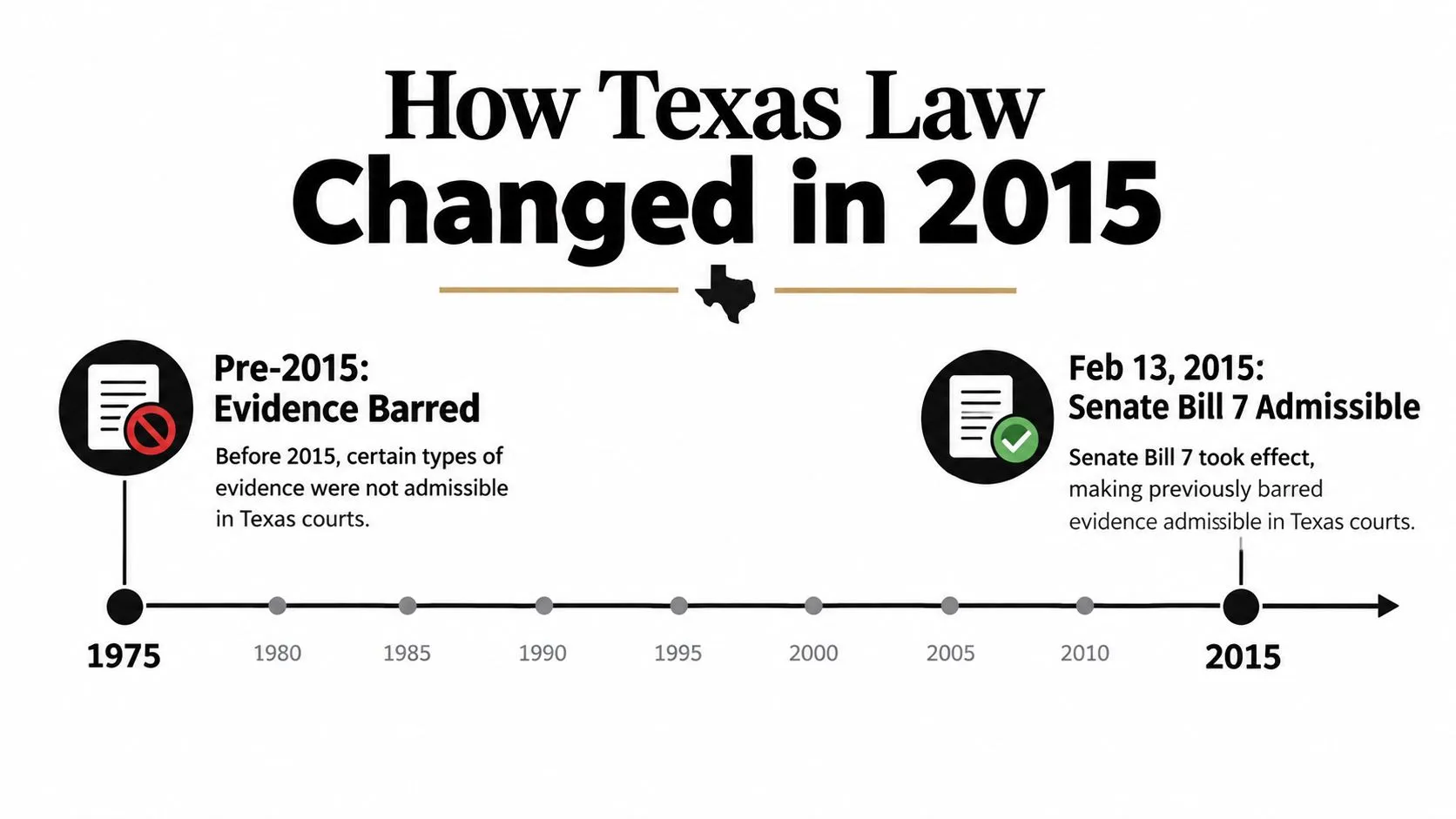
Before 2015, an injured passenger could face a serious collision and still have the defense kept from telling the jury that the passenger was not wearing a seat belt. For roughly 40 years, Texas civil courts generally barred that evidence. The concern was that jurors might treat nonuse as punishment or as proof that the injured person caused the crash, even when it did not explain the injuries.
That rule changed on February 13, 2015, when the Texas Supreme Court decided Nabors Well Services, Ltd. v. Romero, 456 S.W.3d 553. The ruling overturned roughly 40 years of precedent and held that relevant evidence of seat belt use or nonuse may be admitted in civil cases when deciding how responsibility should be apportioned. You can Read the court's decision.
The change in plain English
A defendant may now ask the court to admit evidence that a person was unbelted. The evidence still needs a meaningful connection to the claimed harm. The ruling did not make every unbelted plaintiff responsible for their injuries, and it did not make nonuse proof that the plaintiff caused the collision.
“Admissible” means the evidence may be considered. It does not mean the defense has proved its argument.
The practical question is often medical and biomechanical. In a rollover, side impact, passenger injury, or commercial-vehicle crash, lawyers may examine the seating position, impact direction and force, vehicle interior damage, injury pattern, and medical explanation. The defense must connect nonuse to a particular injury or loss, rather than point to the absence of a belt.
That distinction can affect compensation. A discussion of What Damages Can You Recover in a Texas Injury Case? explains categories of compensation available to Texas injury victims, including medical care, income, pain, and the effects of an injury. A seat belt argument may challenge part of a damages claim, but it does not automatically erase losses caused by the crash.
For general background on restraint systems and vehicle service history, since 2013 may provide useful context. That information does not establish legal causation, but it can help explain why the restraint system's condition and operation may matter during an investigation.
When Seat Belt Nonuse Evidence Is Admissible in Texas
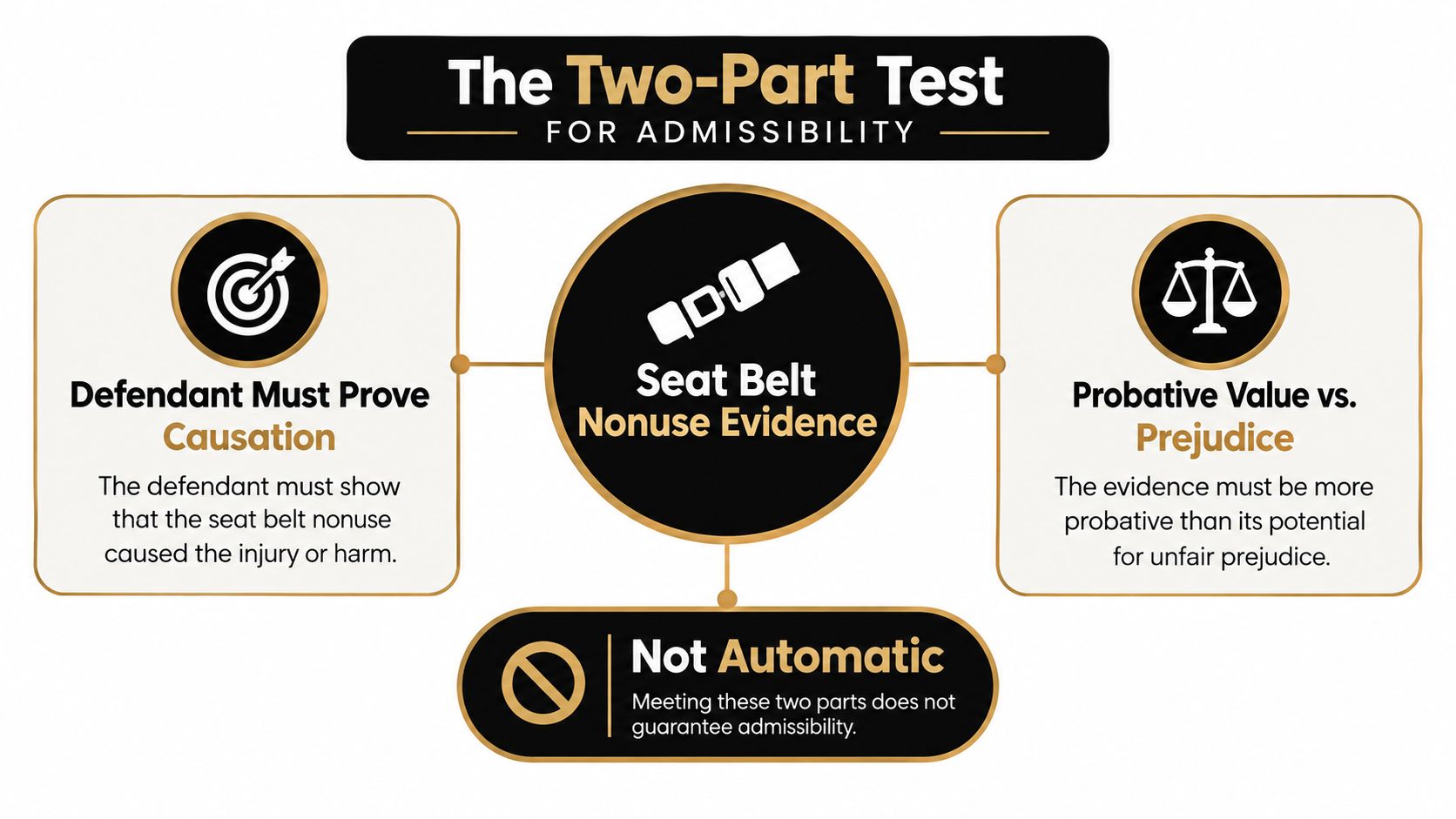
After a Texas crash, you may learn that the defense wants to tell the jury you were not wearing a seat belt. That request does not make the evidence admissible by itself. Admissibility is not automatic; the defense must satisfy causation and relevance requirements before the jury hears the evidence.
The defense generally must clear two hurdles:
- Causation. The defendant must show that nonuse caused or contributed to a claimed injury.
- Relevance. The trial court must decide whether the evidence has a meaningful connection to an issue in the case.
The Texas Supreme Court explained that seat belt evidence can be admitted when it is relevant and tied to causation. The trial judge remains responsible for applying the rules of evidence, including ordinary limits on what the jury may consider. Read the Texas Supreme Court analysis for the court's explanation of that legal framework.
The medical link is usually the central fight
Suppose you claim a spinal injury after a rear-end collision. The defense may argue that a seat belt would have prevented the injury or made it less severe. To support that position, the defense needs evidence explaining how your body moved, what forces affected it, and how those movements relate to the specific injury.
That explanation may come from a treating physician, biomechanical engineer, or another qualified expert. A statement that you were unbelted does not establish the medical connection. The defense must address the injury itself, not merely point to seat belt nonuse.
The connection may be harder to prove when medical records show trauma consistent with the collision. Questions also arise when the evidence does not separate injuries that would have occurred with a seat belt from injuries the defense says became worse because of nonuse.
Relevance is case specific
Seat belt evidence may relate to a chest injury while having little connection to a leg injury caused by intrusion into the passenger compartment. The analysis can change if the belt malfunctioned, the vehicle was defective, or a child or passenger was positioned unusually.
A judge may limit the evidence, restrict supporting expert testimony, or exclude it from the jury. A careful case review therefore considers vehicle damage, occupant movement, injury patterns, and medical records together. The practical litigation question is whether the defense can prove a medically supported link between nonuse and a particular loss.
How Seat Belt Evidence Affects Liability and Damages
A driver can cause a freeway collision, while the defense argues that an unbelted passenger suffered greater harm. Texas law separates responsibility for causing the collision from responsibility for the injuries and damages that followed. Seat belt evidence usually concerns the second question. The defense still must connect nonuse to a specific injury or loss with medical or biomechanical evidence.
After a Houston freeway collision, for example, another driver may be responsible for crossing into your lane. Your failure to buckle up would not explain why that driver crossed the lane. If the defense proves that nonuse worsened a particular injury, however, the jury may consider that conduct when assigning responsibility for the resulting harm. (Explanation of comparative fault and seat belt evidence)
This distinction helps prevent a common misunderstanding. “Comparative fault” does not necessarily answer who caused the wreck. It asks which conduct contributed to which harm, and how the evidence supports that conclusion.
How the percentage can affect recovery
Texas uses a proportionate-responsibility system. A jury may assign responsibility among people whose conduct contributed to the harm. Under Texas rules, a claimant found more than 50% responsible for that harm can be barred from recovery. (Texas comparative responsibility reference)
If a jury awarded $100,000 and found the plaintiff 20% responsible for the compensable harm, the award would be reduced by that percentage, leaving a hypothetical recovery of $80,000. This is only an illustration, not a prediction of what any case is worth or how a jury will decide.
The defense may seek a high percentage by claiming that nonuse caused the central injuries. Your lawyer can test that claim by separating injury categories, examining expert assumptions, reviewing medical records, and comparing the proposed explanation with the crash mechanics.
The final result should follow the proof. Shared responsibility does not automatically eliminate a claim, and a percentage proposed by an adjuster or defense lawyer does not bind the jury.
Common Defense Arguments and How Victims Fight Back
Seat belt disputes are contests over evidence. The defense may argue that your injuries would have been less severe if you had been restrained. Your response should focus on what the records, vehicle, experts, and crash mechanics show.
| Defense Argument | How Victims Counter It |
|---|---|
| Nonuse caused the claimed injuries. | Separate injuries caused by the collision from injuries the defense says were worsened by nonuse. |
| A defense biomechanical expert supports a large responsibility percentage. | Examine the expert's assumptions, qualifications, testing, and connection to the actual crash. |
| The plaintiff's conduct should exceed the 50% threshold. | Show that the other driver caused the collision and challenge unsupported attempts to transfer responsibility for the resulting harm. |
| The injury pattern proves nonuse. | Use treating doctors, imaging, vehicle damage, and the full medical history to test whether that conclusion follows. |
A serious injury can have more than one cause. The defense may focus on one fact while overlooking the impact force, intrusion, airbag deployment, vehicle deformation, or the timing of symptoms. Your legal team should ask whether the proposed explanation fits all of the evidence.
The defense argument is not the same as the jury's finding.
Evidence preservation can shape this fight. Photos of the interior may show steering-wheel contact, windshield damage, airbag condition, or the location of damaged components. Medical records can document when symptoms appeared and how doctors connected them to the crash. Witnesses may recall the position of the vehicle, the force of impact, or what happened immediately afterward.
You also deserve a fair investigation if a defective seat, belt, airbag, or vehicle structure may have enhanced your injuries. In that situation, the crash itself and the vehicle's conduct may present separate issues. A truck crash lawyer Houston families trust should also examine employer records, commercial-vehicle evidence, and additional parties when a truck is involved.
Practical Steps to Protect Your Claim After a Crash
The best time to preserve evidence is before an insurance company or salvage yard changes it. You don't need to conduct a legal investigation alone, but you should take practical steps that protect the information your lawyer and doctors may need.
Start with the physical evidence
- Photograph the interior: Capture the seats, belt buckles, airbags, dashboard, windshield, steering wheel, and any marks or damage. Take wide photos and close-ups if it's safe to do so.
- Preserve vehicle damage: Don't authorize repairs, disposal, or transfer of a severely damaged vehicle without understanding whether it may be evidence. Ask about preservation before signing salvage paperwork.
- Gather witness information: Write down names and contact details while memories are fresh. A witness who leaves the scene may be difficult to locate later.
- Save communications: Keep texts, emails, claim numbers, letters, and photographs from insurers, tow companies, and repair facilities.
Protect your medical record
Tell your healthcare providers about the crash and describe your symptoms accurately. Keep appointments, follow referrals, and preserve records that identify the injuries, treatment, restrictions, and prognosis. Those records may help distinguish trauma from the collision itself and address an argument that nonuse caused a particular injury.
A guide to spoliation of evidence can help explain why parties should preserve relevant physical and electronic evidence once a dispute is reasonably anticipated. The practical lesson is simple: don't assume the vehicle, video, data, or records will remain available without action.
Be careful with insurance communications
You usually don't need to give the other driver's insurer a recorded statement before speaking with a lawyer. Adjusters may ask questions about your speed, attention, seating position, belt use, prior symptoms, or what you could have done to avoid the crash. A rushed answer can be taken out of context.
You should report the collision as required by your own policy, but ask a Texas personal injury lawyer to review requests for recorded statements, broad medical authorizations, or settlement documents. Don't sign away a claim before you understand your diagnosis, future care, and the effect of any comparative-responsibility argument.
Watch the filing deadline
Texas personal injury lawsuits generally have a two-year filing deadline, subject to exceptions and different rules for some claims. Families should also address timing quickly when a death occurred. Learn more about the two-year deadline for Texas injury claims and get case-specific advice well before the deadline approaches.
How a Lawyer Uses Seat Belt Evidence at Trial
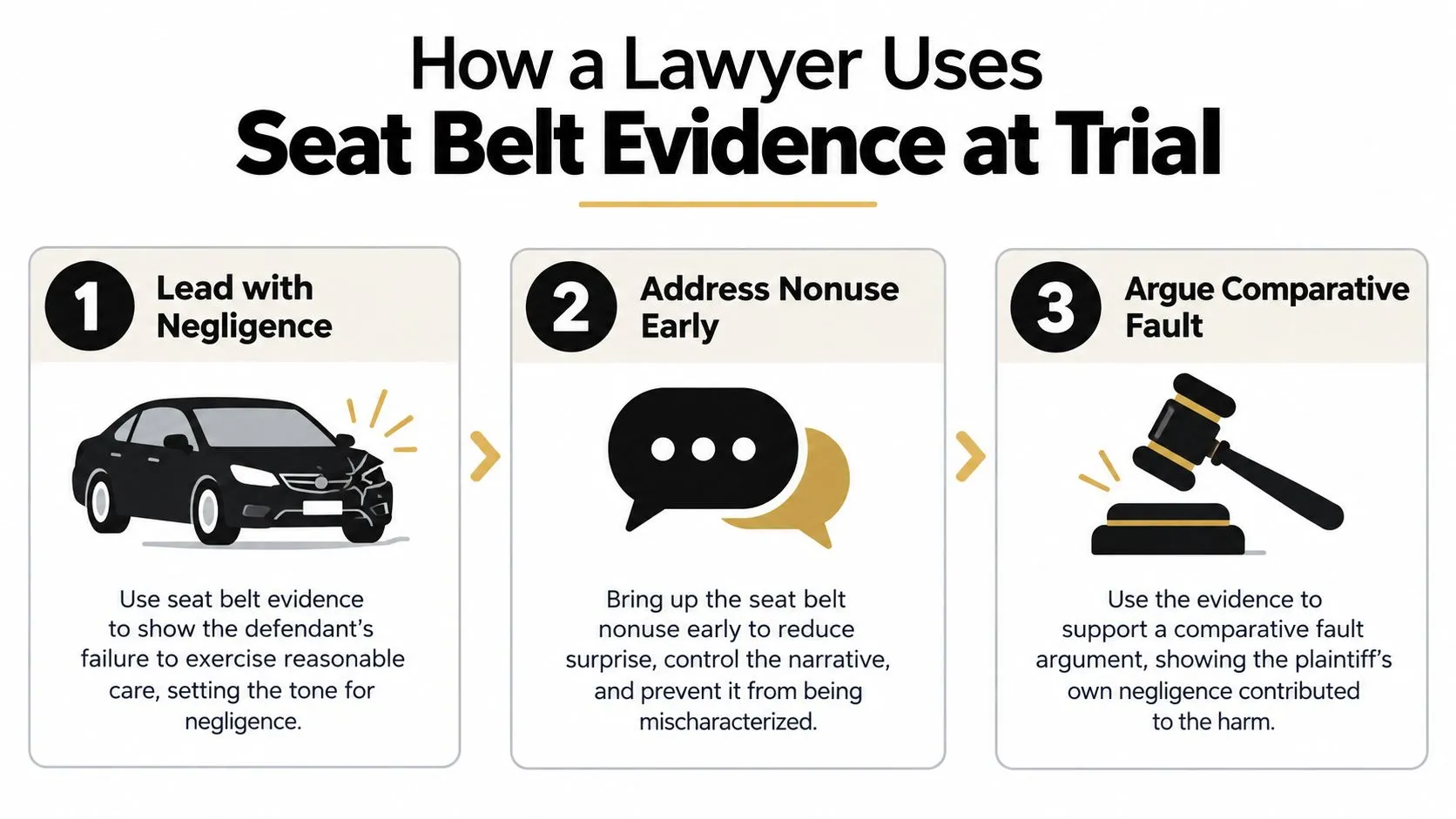
A Houston car accident attorney shouldn't wait for the defense to tell the jury an incomplete story. A strong trial presentation begins with the other driver's negligence, explains how the crash occurred, and then addresses belt use carefully.
The lawyer may present the case in three stages:
- Lead with the collision: Show what the defendant did, using photographs, witness testimony, vehicle evidence, records, and qualified reconstruction testimony.
- Address nonuse early: Explain what is known about the belt, what remains disputed, and why the defense must connect nonuse to specific injuries.
- Argue a fair allocation: If some contribution is supported, ask the jury to assign only the percentage supported by the evidence rather than accepting an inflated number.
Medical testimony can be especially important. A physician may explain the diagnosis and treatment. A biomechanical expert may address occupant movement and force. The lawyer's job is to connect that testimony to the actual evidence instead of allowing general assumptions to replace proof.
Truck cases can involve additional evidence about the commercial vehicle and the driver's work activities. A truck crash lawyer Houston families contact may investigate the carrier, vehicle condition, available data, and other potential sources of responsibility. When a family member dies, a wrongful death lawyer Texas families consult must also evaluate the family's legal claims separately from any claim belonging to the estate. Catastrophic injury cases may require evidence about long-term medical care, work limitations, and daily assistance.
Common questions from injured Texans
Can a passenger be affected by the rule
Yes, potentially. The rule concerns relevant evidence about a plaintiff's seat belt use or nonuse, so a passenger's restraint status may become part of the injury analysis. The defense still must connect nonuse to the claimed harm.
Does the rule decide who caused the crash
No. The evidence may help allocate responsibility for injuries, but it doesn't automatically establish who caused the collision.
Does the 2015 decision apply to every earlier crash
The decision was issued on February 13, 2015. Whether a particular earlier case is affected can depend on procedural posture, timing, and other legal issues. A lawyer should review the dates and history instead of assuming the answer.
What if the belt or vehicle failed
That may create a separate investigation involving the restraint system, vehicle design, maintenance, or other parties. Preserve the vehicle and related records before repairs or salvage activity changes the evidence.
You Can Still Recover Compensation, Get a Free Consultation
Seat belt nonuse evidence doesn't end a Texas injury claim. The defense must still prove a connection between nonuse and the injuries, and you can challenge the proposed percentage with medical, physical, and expert evidence.
The Law Office of Bryan Fagan, PLLC offers free consultations and contingency-fee representation, meaning you don't pay attorney fees unless the firm wins. The firm serves clients across Houston, Dallas-Fort Worth, Austin, San Antonio, and surrounding Texas communities in car, truck, catastrophic injury, and wrongful death matters.
You may feel overwhelmed, especially when an insurer focuses on one difficult fact instead of the full crash. Recovery is possible, and legal help is available to guide you through the evidence, deadlines, insurance process, and next steps.
If you were injured because another driver caused a crash, the Law Office of Bryan Fagan, PLLC can investigate the collision, preserve evidence, and address seat belt nonuse arguments with care. Schedule a free consultation so you can understand your options before speaking in depth with the insurance company.


