 Skip to content
A serious medical error can change your life in seconds, but you don't have to face the legal process alone. You may be sitting beside a loved one in a Houston ICU, reviewing records after a delayed diagnosis, or trying to understand what happened after surgery. At the same time, Texas law may require important steps before you can file a health care liability lawsuit.
Chapter 74 pre suit notice and authorization in Texas connects three procedural points: written notice, a medical authorization, and careful deadline tracking. Understanding how they fit together can help you avoid filing too early, sending the wrong form, or assuming that a notice letter automatically protects your claim.
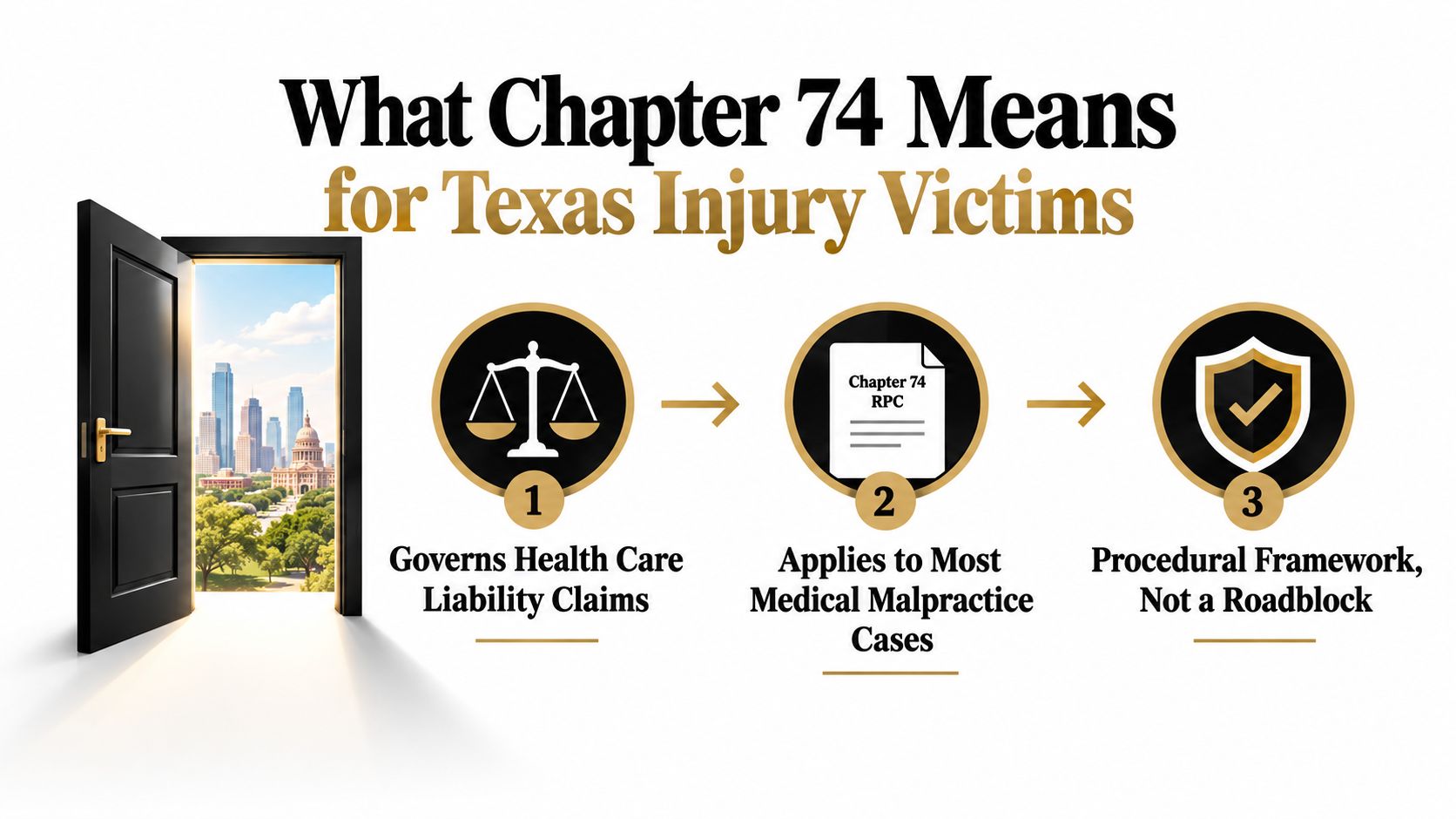
What Chapter 74 Means for Texas Injury Victims
After a serious medical error, a family may want to file suit immediately. Chapter 74 requires a different sequence. It governs health care liability claims involving allegations that a doctor, nurse, hospital, clinic, or another licensed provider failed to provide legally required care and caused injury or death.
The statute creates a gateway to court. It does not decide whether the claim has merit. Before filing, the claimant must send written notice to each physician or health care provider who may be sued and include the required medical authorization. The notice generally must arrive at least 60 days before filing suit, as provided by Texas Chapter 74.
That period works like a pause before the lawsuit begins. Providers can investigate the allegations, review records, and consider early resolution. The claimant's attorney can also identify the proper defendants and organize the medical evidence.
The two deadlines work together
Texas law generally gives an injured person two years to file many personal injury claims, as summarized in the Texas limitations rules. Health care liability claims follow their own limitations rules, so a family should not assume the deadline works exactly like the deadline for an ordinary car accident claim.
Proper notice and authorization also toll the limitations period for 75 days after notice is given. The tolling rule can provide additional time when a family is close to the filing deadline, but it does not replace prompt legal advice or careful date calculations. Filing early, sending notice to the wrong provider, or using a defective authorization can undermine the protection the family expected.
The notice and authorization should be handled as one legal package. A useful way to remember the process is that the notice identifies the dispute, while the authorization allows access to relevant medical information.
A claim may involve medical expenses, lost income, physical pain, emotional harm, or the loss of a family member. Texas also limits noneconomic damages in many health care liability cases. See this overview of the Texas medical malpractice noneconomic damages cap. Before filing, determine whether Chapter 74 applies and calculate every relevant date.
Who Must Send the Notice and Who Receives It
The claimant, or the claimant's attorney, must send the written notice. The notice should go to each physician and health care provider who may be a defendant, not only the most visible facility involved in the treatment.
Section 74.051 requires certified mail with return receipt requested. This is similar to sending a formal notice before suing a contractor. You need proof that the right person or organization received the letter, and you need to preserve the mailing and delivery records.
Identify every potential provider
A hospital may be one defendant, but it may not be the only one. A surgeon could have practiced independently. An anesthesiologist may have billed through a separate medical group. A clinic, emergency department, imaging company, or nursing service may also require separate attention.
The notice should be directed to the provider's appropriate address. For a physician or individual practice, that may include the last known office address. For an institution, counsel may need to verify the registered agent or responsible officer through the Texas Secretary of State.
A common Houston or Dallas mistake is sending notice only to the hospital because that is where the patient received care. If an independently practicing surgeon or clinic is later added as a defendant, the original notice may not satisfy the statute for that separate provider.
Track the ordinary filing deadline
The Texas limitations period remains a central concern. A notice does not give a family permission to ignore the underlying deadline. It creates a required waiting period and, when properly provided with the authorization, can affect the limitations calculation.
The petition must also state that the claimant complied with the applicable notice and authorization requirements. That pleading detail matters because a provider may challenge compliance if the lawsuit was filed too soon or the package was incomplete.
A careful lawyer starts with a defendant list and a date chart, not with a form letter.
What the Notice Packet Must Contain
A Chapter 74 notice packet should tell the provider what claim is being asserted and provide a legally compliant way to obtain relevant protected health information. The packet isn't merely a demand for money, and the authorization isn't a generic records release copied from an unrelated matter.
The notice should identify the patient, the involved providers, the date or period of treatment, the medical condition or injury, and the general basis of the claim. It should also describe the losses in a way that allows the provider to understand the nature of the dispute without requiring a complete trial brief.
Use a packet checklist
The medical authorization must accompany the notice. Texas law treats the authorization as a privacy-limited release that helps the provider obtain records from other treating physicians and evaluate the claim under applicable privacy standards.
| Required Item | Statutory Basis | Common Defect |
|---|---|---|
| Written presuit notice | Section 74.051 | Sent fewer than 60 days before filing |
| Delivery by certified mail with return receipt requested | Section 74.051 | No reliable proof of receipt |
| Names of the relevant physicians and providers | Section 74.051 | Hospital listed, independent provider omitted |
| Description of the claim and injury | Section 74.051 | Notice is too vague to identify the dispute |
| Medical authorization | Section 74.052 | Generic HIPAA release does not meet statutory requirements |
| Permission to obtain related records | Section 74.052 | Provider cannot gather records from other treating sources |
| Complete compliance in later pleadings | Section 74.051 | Petition does not affirmatively plead compliance |
A family should review the authorization line by line with counsel. Common problems include a missing signature, an incorrect patient name, omitted providers, restricted dates that exclude relevant care, or language that doesn't allow the provider to investigate the claim.
Medical records can affect the evaluation of negligence, causation, and damages. A useful guide to how medical records affect a Texas injury claim can help you understand why a complete file matters.
Shared responsibility is a separate issue from presuit notice. If the evidence shows that an injured person contributed to an injury, Texas Comparative Fault and the 51% Bar Rule explains how shared fault can reduce or eliminate recovery under Chapter 33.
The 75-Day Tolling Rule and Authorization Pitfalls
The 75-day tolling rule is one of the most important reasons to treat the authorization as part of the notice itself. When a claimant provides both required components, Chapter 74 can toll the applicable limitations period for 75 days after notice is given.
That rule doesn't mean every document labeled “authorization” will protect the claim. The provider may argue that the form was incomplete, revoked, improperly limited, or otherwise failed to meet the statutory requirements. Texas law provides that failure to include the authorization can abate further proceedings until 60 days after the provider receives the required authorization. If the authorization is modified or revoked, another abatement issue may arise until a compliant replacement is received, as described in Section 74.052.

Compare a clean packet with a defective one
A clean packet identifies the claimant and providers, includes the required authorization, uses reliable delivery, and leaves a clear record of when receipt occurred. A defective packet may contain a missing signature, the wrong provider name, a form that has expired, or language that prevents the provider from obtaining relevant records.
The practical danger is delay. A provider may ask the court to pause proceedings, and the family may lose valuable time while counsel corrects the defect. If the original limitations deadline passes during that uncertainty, the dispute becomes much harder to manage.
The notice process also shouldn't be confused with the later expert-report requirement. Chapter 74 imposes separate litigation obligations after a lawsuit begins. A lawyer evaluating a potential claim should review the Chapter 74 expert report deadline separately from presuit notice.
Here is a short video overview that may help you recognize the timing issues:
A Houston Family's Experience With Chapter 74
Consider a representative example. After a surgical error at a Houston-area hospital, a family may believe the safest step is to file a lawsuit immediately. They name the hospital, attach an outdated medical authorization, and don't send the required Chapter 74 notice to the surgeon or other involved providers.
The defense may respond with a plea in abatement. The court can pause the case while the family provides the required notice and a compliant authorization. The family hasn't necessarily lost the underlying negligence claim, but the early filing has created a procedural problem that consumes time and weakens momentum.
What the correction process looks like
Counsel may then investigate the full provider list, prepare a new notice packet, correct the authorization, and document certified-mail delivery. The 60-day waiting period must be respected before suit proceeds, and the limitations calculation must be reviewed again to determine whether the notice qualifies for the statutory tolling protection.
The family may also need to explain why the original authorization was defective. A form that was outdated, too narrow, or directed to the wrong entity may not give the provider the access Chapter 74 contemplates.
This example is not a guarantee that every defect can be fixed. The result depends on the dates, documents, providers, and court rulings involved. It shows why a family should contact a lawyer before filing, especially when records are incomplete or the deadline is approaching.
The underlying claim still requires proof of negligence, causation, and damages. A procedural correction cannot replace the medical investigation needed to determine whether the provider's care fell below the applicable standard and caused the injury.
Exceptions and Consequences of Getting It Wrong
Chapter 74 has narrow exceptions to its ordinary notice and waiting requirements. They may include urgent injunctive relief, declarations concerning death, and certain fraud-related claims. These exceptions are limited. A serious injury, an angry provider, or a records dispute does not automatically excuse the notice process.
For an ordinary health care liability claim, treat the notice, authorization, and waiting period as connected parts of one timeline. Filing before that timeline is complete can create a procedural problem even when the underlying facts appear strong.
Understand the possible outcomes
| Scenario | Required Action | Typical Result |
|---|---|---|
| Notice and authorization are properly delivered | Wait the required period and preserve proof of receipt | The claim can proceed, subject to other legal requirements |
| Notice is sent without authorization | Provide a compliant authorization and reassess the dates | The court may abate proceedings until the required period after receipt |
| Notice is sent to only one of several providers | Identify and separately notify each potential defendant | A missed provider may challenge compliance |
| Lawsuit is filed before the waiting period ends | Review whether the filing was premature | The court may pause the case or require correction |
| Authorization is modified or revoked | Provide a compliant replacement | Further abatement may occur until the replacement is received |
| The family relies on an exception without legal review | Confirm that the exception applies to the specific claim | The provider may challenge the lawsuit |
The consequences may extend beyond a temporary pause. Delay can make electronic records harder to preserve, witnesses harder to locate, and settlement discussions harder to maintain while the provider investigates. A filing defect may also raise questions about whether the claim was brought within the applicable deadline.
The authorization itself deserves attention. If it is too narrow, directed to the wrong entity, or later revoked, the provider may argue that the packet did not satisfy Chapter 74. Correcting the form may require reviewing who received it and when.
Fault creates a separate issue. Unlike a Chapter 74 notice defect, which concerns the case's procedure, comparative responsibility under Chapter 33 affects the damages calculation after liability is proven. A claimant's recovery may be reduced by the claimant's share of responsibility and barred at the applicable threshold, as explained in the Texas limitations and fault overview. Do not treat a procedural abatement as a finding that the claimant caused the injury.
Practical Steps To Protect Your Claim
When you suspect that medical care caused harm, start preserving information before memories fade and records become difficult to obtain. You don't need to prove the case by yourself, but you do need to protect the facts that a lawyer and medical expert will later review.

Start with the evidence
Request complete medical records and imaging from every facility involved. Save itemized bills, insurance statements, prescription information, discharge papers, photographs of wounds or devices, and messages with providers.
Write a timeline while events are fresh. Include appointments, symptoms, calls, medication changes, emergency visits, diagnoses, procedures, and the point when you first learned that something may have gone wrong.
A useful starter file includes:
- Medical records: Request charts, nursing notes, operative records, imaging, laboratory results, and discharge instructions.
- Financial records: Keep medical bills, travel expenses, wage information, and receipts connected to care.
- Personal notes: Record symptoms, limitations, missed work, and changes in daily activities.
- Provider list: Write down every doctor, nurse, facility, clinic, imaging center, and medical group involved.
- Communication file: Preserve emails, portal messages, letters, and insurance correspondence.
Build the Chapter 74 packet carefully
Once the potential defendants and dates are identified, counsel can draft the written notice and the statutory medical authorization. The packet should be sent by certified mail with return receipt requested, and the family should preserve copies of everything mailed and received.
A plain-language example of authorization wording might read:
“I hereby authorize [defendant] to obtain complete medical records from [provider] for the period [dates] related to the incident of [date].”
That example is only a starting point. The actual form must comply with Chapter 74 and applicable protected-health-information requirements. Don't sign a broad release from an insurer or provider without understanding what information it permits others to obtain.
Calendar the notice date, delivery date, waiting period, and limitations deadline. The two-year limitations period continues to matter, so don't wait until the last moment to call a lawyer.
When To Call a Texas Personal Injury Lawyer
You should consider a free consultation if you suspect a surgical error, delayed diagnosis, birth injury, wrong medication, discharge despite worsening symptoms, or a provider's refusal to release records. A consultation doesn't require you to know the legal answer. It gives you a chance to discuss the timeline, identify possible defendants, and learn what evidence may be needed.
A Texas personal injury lawyer can investigate the medical records, consult qualified professionals, and determine whether the facts support a health care liability claim. The lawyer can also prepare and serve the 60-day notice, review the authorization, monitor the tolling calculation, and protect the filing deadline if settlement isn't reached.
Help is available across Texas
Families in Houston may begin by searching for a Houston car accident attorney when a traffic collision caused the injury, but a medical negligence claim requires a different procedural analysis. If a commercial vehicle caused the crash, a truck crash lawyer in Houston can investigate the driver, company, and insurance issues involved.
When a family loses someone because of negligent care or a fatal collision, a wrongful death lawyer in Texas can explain who may bring the claim and how the legal process may affect the family. For life-changing injuries, a catastrophic injury attorney can help evaluate long-term treatment, lost earning capacity, and future care needs.
The Law Office of Bryan Fagan, PLLC describes its representation as contingency-fee based, meaning clients don't pay attorney fees unless the firm wins, and offers consultations for people across Houston, Dallas, San Antonio, Austin, Fort Worth, and surrounding Texas communities. Ask directly about fees, expenses, the potential claim, and what the firm will handle before signing an agreement.
You don't have to confront a hospital, insurance company, or defense lawyer by yourself. Early advice can help you avoid an incomplete authorization, identify every potential provider, and preserve the opportunity to pursue compensation for medical expenses, lost income, pain, and family loss.
The Law Office of Bryan Fagan, PLLC can review your potential Chapter 74 claim, help identify the proper providers, and prepare the presuit notice and authorization paperwork. Visit Law Office of Bryan Fagan, PLLC to request a free, confidential consultation, and take the next step toward protecting your family's rights. Recovery is possible, and legal help is available.


