A serious accident can change your life in seconds, but you don't have to face it alone. After a crash, you may be dealing with hospital bills, missed work, painful treatment, and an insurance company asking questions that seem harmless. Those questions can become arguments that you caused your own injuries.
Texas calls this system proportionate responsibility, often known as comparative negligence. It determines how fault is divided and whether an injured person can recover compensation. For victims and families, understanding comparative negligence in Texas is critical because a fault percentage can reduce an award or eliminate recovery altogether.
A Serious Accident Can Change Everything
After a Houston freeway crash, a driver may remember only the impact, the sound of twisting metal, and the pain that followed. The driver may have been rear-ended on I-35 in Austin, taken to a hospital, and diagnosed with a herniated disc. Weeks later, a letter from the other driver's insurer might claim the injured person was 60% responsible because they braked suddenly.
That letter can feel like an accusation at the worst possible time. You may be focused on medical appointments and whether you can return to work, while the insurer is building a case that shifts responsibility onto you. The company may point to braking, lane position, speed, phone use, or an alleged failure to react quickly enough.

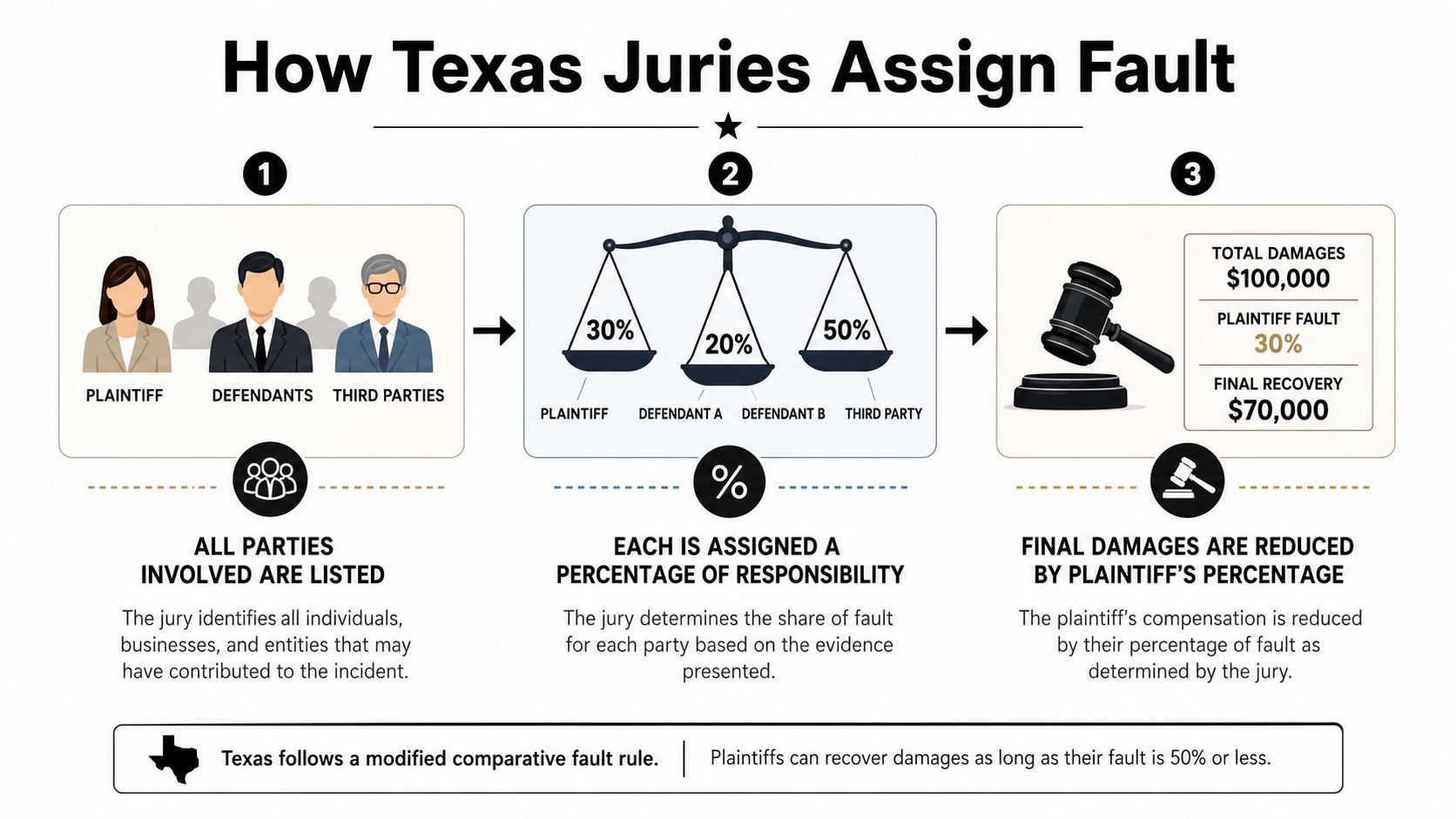
Texas law provides a framework for dealing with shared fault. Texas Civil Practice and Remedies Code Chapter 33 governs proportionate responsibility and requires fault to be assigned among the people and entities whose conduct contributed to an injury. Under Section 33.003, the factfinder assigns responsibility in whole-number percentages to claimants, defendants, settling people, and designated responsible third parties. Texas Civil Practice and Remedies Code Section 33.003 explains this allocation process.
The rule matters in car crashes, truck collisions, pedestrian accidents, rideshare claims, and wrongful death cases. It doesn't determine who was careless. It can decide whether you receive compensation at all, and how much each responsible defendant must pay.
Practical rule: An insurer's fault percentage is an argument, not a final legal finding.
You shouldn't accept an adjuster's conclusion because it appears in a letter. Evidence may show that the other driver created the danger, that your response was reasonable, or that another party contributed to the collision. A Texas personal injury lawyer can investigate before important evidence disappears and challenge a blame-shifting narrative before it controls settlement discussions.
How the 51% Bar Rule Works in Texas
Texas uses a modified comparative negligence system, formally called proportionate responsibility. Under Texas Civil Practice and Remedies Code Section 33.001, a claimant may recover damages when their responsibility is 50% or less. The award is reduced by the claimant's percentage of fault. Once responsibility is greater than 50%, recovery is barred. Texas Civil Practice and Remedies Code Section 33.001 contains the governing rule.
That creates the rule commonly called the 51% bar. A person found 50% responsible can still recover, but the award is cut in half. A person found 51% responsible recovers nothing from other negligent parties. A one-point change can therefore move a claim from partial recovery to zero.
Suppose a jury determines that total damages are $200,000. The math works this way:
| Plaintiff Fault % | Damage Reduction | Amount Recovered | Barred? |
|---|---|---|---|
| 20% | $40,000 | $160,000 | No |
| 40% | $80,000 | $120,000 | No |
| 50% | $100,000 | $100,000 | No |
| 51% | $200,000 | $0 | Yes |
The calculations reflect the statutory rule described in Texas Civil Practice and Remedies Code Section 33.001. Every percentage assigned to you reduces the recoverable award in direct proportion until the bar applies.
How Texas differs from other systems
Texas isn't a pure comparative negligence state. In a pure system, a person found 90% responsible could still recover the remaining 10%. Texas also doesn't use contributory negligence, where even minimal responsibility can prevent recovery. Texas instead uses a threshold that allows recovery at 50% or less and bars it above 50%.
The rule makes fault allocation a high-stakes dispute. An insurer may argue that you were following too closely, failed to maintain a lookout, or braked without reason. The response should focus on causation and reliable evidence, not on accepting every criticism as proof of legal responsibility.
Settled parties can also matter. In F.F.P. Operating Partners v. Duenez, the Texas Supreme Court addressed how the responsibility of settling parties is considered in the Chapter 33 process. That principle is important in cases where one party settles early but other defendants continue disputing fault.
For a concise overview of how shared fault reduces or eliminates recovery under Chapter 33, see Texas Comparative Fault and the 51% Bar Rule. The central lesson is simple: protecting your fault percentage is as important as proving the severity of your injuries.
How Fault Is Assigned Among Multiple Parties
Fault isn't always a two-person question. In a chain-reaction crash, responsibility may involve several drivers, a trucking company, a vehicle owner, a road contractor, or a person who isn't formally named as a defendant. Chapter 33 permits the allocation process to include responsible third parties, often called RTPs, under Section 33.004.
A defendant may seek to designate an RTP to argue that another person or entity contributed to the injury. That person could be a driver who fled the scene, a company responsible for a vehicle, or a government entity accused of failing to maintain a roadway. If the designation is accepted, the defense may argue that the plaintiff's share should be measured against a broader group of responsible actors.
Why trucking cases are especially complex
Commercial vehicle litigation has developed additional procedural challenges. In Werner Enterprises, Inc. v. Blake, the Texas Supreme Court addressed the designation of a nonparty driver as a responsible third party in a trucking dispute. The decision illustrates how a defense can try to place responsibility on someone who isn't present as a traditional defendant.
House Bill 19 also introduced a bifurcated trial structure for certain commercial motor vehicle cases. The first phase can focus on whether the driver was negligent, while a later phase may address broader employer-liability issues. Recent coverage describes how House Bill 19 and the Texas Supreme Court's June 2025 Werner Enterprises reversal are changing arguments in trucking and commercial-vehicle litigation. Recent Texas legal changes affecting personal injury cases provides background on that developing area.
The practical concern is that the defense may present fault as a web of contributing conduct rather than a direct collision caused by one driver. A victim needs evidence that identifies what each party did, whether that conduct caused the crash, and whether the proposed third party belongs in the allocation analysis.
For a closer look at disputes involving several vehicles, review this guide to fault in a Texas multi-vehicle accident. Discovery may involve vehicle data, driver records, communications, maintenance files, witness testimony, and crash reconstruction. Those details can determine whether a percentage rests on proof or speculation.
Real Texas Accident Scenarios and How Fault Applies
Concrete examples make the rule easier to understand. These are illustrations, not predictions of how a particular jury will decide a case.
Houston freeway rear-end collision
A lead driver stops abruptly in a travel lane on a Houston freeway. The following driver strikes the vehicle. Suppose the injured lead driver has $100,000 in damages and a factfinder assigns 30% fault to the lead driver and 70% fault to the following driver. The injured person could recover $70,000, subject to the full facts, available insurance, and other legal issues.
The following driver may argue that the stop was unreasonable. The lead driver may respond that traffic conditions, an obstruction, or another vehicle created the need to brake. Photos, event data, witness accounts, and roadway evidence can help explain what happened before impact.

I-35 commercial truck pileup
In an I-35 pileup, a commercial truck, a passenger vehicle, and another driver may all appear in the evidence. Suppose one injured driver has $200,000 in damages and is found 20% responsible. The recoverable amount would be $160,000. Another injured driver in the same collision could be assigned 51% responsibility, which would bar that driver's recovery from other negligent parties under Section 33.001.
The difference may turn on braking data, lane position, visibility, driver conduct, and whether a responsible third party should be included. The same crash can produce different outcomes because each claimant's conduct and injuries must be evaluated separately.
Rideshare collision
A rideshare passenger suffers $80,000 in damages after the rideshare driver and another motorist share responsibility. If the passenger is assigned 10% fault, the recoverable damages would be $72,000. The remaining responsibility might be divided between the rideshare driver and the other motorist based on the evidence and applicable insurance coverage.
Uber and Lyft claims can involve multiple policies and coverage questions. A Houston car accident attorney can examine the drivers' conduct, the passenger's status, the available policies, and the allocation arguments instead of treating the claim as an ordinary two-car case.
Video reference:
Critical Steps to Protect Your Claim After a Crash
The first hours after a collision can shape the fault record. You may be shaken, but small actions can preserve information that later becomes difficult to obtain.
Build an independent record
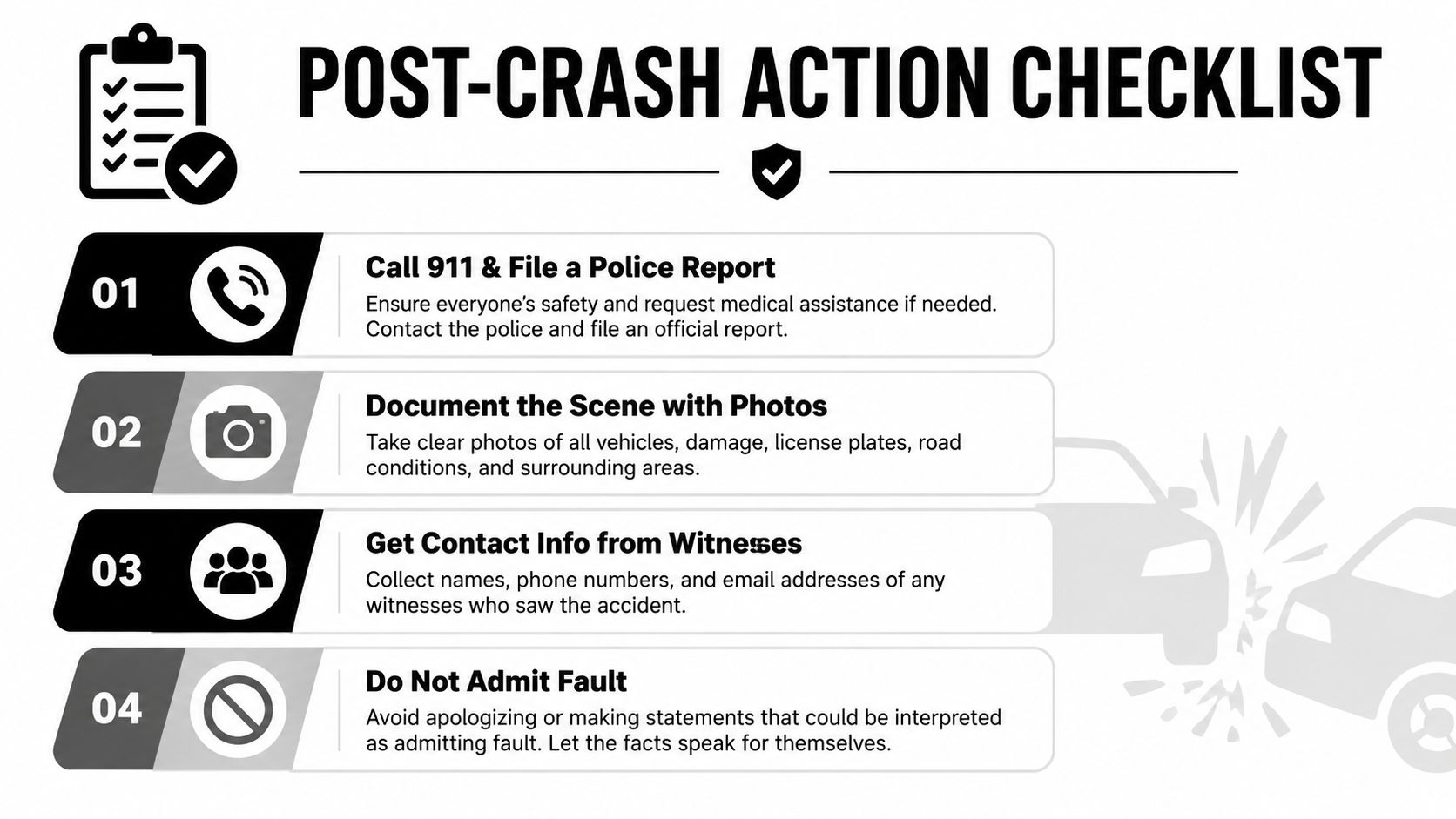
- Call 911: Request emergency help and make sure law enforcement prepares an official crash report. Tell responders where you hurt, even if symptoms develop gradually.
- Photograph the scene: Capture vehicle positions, damage, skid marks, debris, traffic signals, lane markings, lighting, and road conditions before vehicles are moved when it is safe to do so.
- Identify witnesses: Ask for names and contact information while memories are fresh. Independent witnesses may contradict an insurer's version of the collision.
- Preserve recordings: Save dashcam footage immediately. Ask about nearby traffic or business-camera video before it is overwritten or discarded.
Protect your statements and medical record
Don't give a recorded statement to the other driver's insurer before getting legal advice. An adjuster may ask a question that sounds routine but invites you to speculate about speed, braking, visibility, or your symptoms. You can provide basic claim information without offering a recorded narrative that could later be used against you.
Get medical care and follow the treatment plan. Delayed treatment gives an insurer an argument that the injury was minor, unrelated, or pre-existing. Social media can create similar problems. Posts, photographs, and comments may be taken out of context to suggest that you weren't hurt or that you accepted responsibility.
Preservation matters: Keep medical records, bills, wage documentation, photographs, vehicle information, and every communication with an insurer in one secure place.
Don't repair or discard a damaged vehicle before the relevant evidence is documented. If you were hurt in a truck crash, preserve information about the vehicle, employer, driver, and any available electronic data. Early advice from a truck crash lawyer Houston victims can reach may help protect evidence before the defense develops its own account.
How Comparative Negligence Affects Settlements and Insurance
Comparative responsibility changes the negotiation itself. An insurer may point to the possibility of a 51% finding and use that risk to justify a low offer. The company may not need to prove its position during an initial claim review, so unsupported blame can still affect negotiations unless you answer it with organized evidence.
A strong claim connects three questions: who acted negligently, how that conduct caused the collision, and what losses followed. Scene evidence can address the first question. Crash analysis can address the second. Medical records, wage proof, and documentation of daily limitations can establish the third.
Multiple insurers and shared responsibility
When several drivers or companies are involved, their insurers may point at one another. That can slow negotiations while each carrier argues that another party should pay. In a rideshare claim, uninsured or underinsured motorist coverage may add another layer of review. Your own percentage of fault can affect the amount available under a UM or UIM claim, depending on the policy and applicable law.
A settlement decision should account for fault risk, damages, insurance limits, responsible parties, and the evidence available at trial. You shouldn't evaluate an offer by looking only at the gross damages claimed. The percentage the defense may assign to you can change the practical value of the case.
For information about insurance choices unrelated to an existing injury dispute, readers may also review this resource on how to lower your Texas car insurance costs. It's separate from pursuing compensation after a crash, but understanding your policy can help you identify potential UM or UIM coverage.
A lawyer may retain a crash reconstruction professional, request vehicle and trucking records, examine electronic logging device data, interview witnesses, and challenge improper fault arguments. The goal isn't to promise a particular result. It is to place the evidence in front of the insurer or jury before a percentage becomes accepted as fact.
See this explanation of how comparative fault affects a Texas settlement for another practical discussion. Handling a serious fault dispute alone can leave you negotiating against an experienced claims team while you are still recovering.
You Do Not Have to Face This Alone
Being partly blamed doesn't automatically end your Texas injury claim. Under Chapter 33, a claimant found 50% or less responsible may still recover, with the award reduced according to the assigned percentage. A finding above 50% can bar recovery, which is why an insurer's effort to move your share upward deserves careful scrutiny.
The most useful response is early preparation. Preserve the scene, protect medical evidence, avoid recorded statements, save video, identify witnesses, and keep the insurance company from defining the facts before you have had a fair opportunity to present them.
A Texas personal injury lawyer can investigate vehicle positions, braking evidence, witness accounts, medical causation, and the conduct of other drivers or responsible third parties. The Law Office of Bryan Fagan, PLLC handles car, truck, rideshare, catastrophic injury, and wrongful death matters for Texas families. If a loved one died, a wrongful death lawyer Texas families can consult can also evaluate how responsibility affects the estate and surviving family members.
Texas personal injury claims generally carry a two-year filing deadline under Texas Civil Practice and Remedies Code Section 16.003, including claims for injury resulting in death, with accrual for the death claim on the injured person's death. Texas Civil Practice and Remedies Code Section 16.003 provides the statutory language. Don't wait until the deadline is close, because investigating fault and preserving evidence takes time.
For guidance on timing, see when to contact a Texas accident lawyer. Recovery is possible even when an insurer says you share blame. Schedule a free, no-obligation consultation to discuss what happened, what evidence may exist, and how Texas comparative negligence law may affect your claim.
The Law Office of Bryan Fagan, PLLC offers free consultations and personal injury representation for Texas car, truck, rideshare, catastrophic injury, and wrongful death claims. Contact the firm to protect evidence, respond to fault-shifting tactics, and take the next step toward pursuing compensation for medical bills, lost wages, and the harm your accident caused.