A serious accident can change your life in seconds, but you don't have to face it alone. If your child was hurt in a Houston car crash, you may be trying to manage medical appointments, insurance calls, school disruptions, and a settlement offer all at once. Then you learn that the money can't be deposited into a family account.
Texas requires special protection for a minor's recovery. Minor settlement court approval and a 142 trust in Texas are related, but they aren't the same decision. A judge first decides whether the settlement is fair. The judge then decides how the child's money should be held, managed, and accessed.
Understanding Why Texas Treats a Minor's Settlement Differently
After a Houston freeway crash, a parent may receive a settlement offer while the child is still attending therapy or missing school. The offer can feel like relief, especially when medical bills are arriving and the family needs stability. But accepting the amount isn't the final step when the injured person is a minor.
The child owns the claim for the child's injury. A parent or another adult may act as the child's next friend, helping bring the legal action, but that adult doesn't have unlimited authority to settle or spend the recovery. Under Texas Rule of Civil Procedure 44, a next friend or attorney may compromise a minor's lawsuit only with court approval. The court must hold a hearing and receive evidence that the settlement serves the child's best interest. (Federal court decision applying Texas law)
The practical rule: A parent can help make decisions for a child, but a parent can't replace the judge's independent review.
Why the judge becomes involved
Children may have medical, developmental, educational, or earning-related losses that aren't fully visible when the insurance company makes an offer. A head injury, for example, may affect learning or future work capacity long after the first emergency treatment ends. A settlement that looks adequate today may need to fund care for years.
The court therefore examines more than the headline settlement amount. The judge may review the gross recovery, attorney's fees, case expenses, medical liens, the child's expected needs, and the proposed way to protect the remaining funds. The judge isn't reviewing the case for the parents' convenience. The central question is whether the resolution protects the injured child.
Approval changes the legal effect of the settlement
Once the court approves the compromise and enters judgment, the settlement becomes binding and conclusive on the child. That finality protects the insurer and the family, but it also means the court must have enough information before signing the order.
A guardian ad litem may be appointed if the court sees a possible conflict between the child and a parent or another representative. This can feel uncomfortable, but the guardian ad litem's role is to provide an independent view focused on the child's interests.
The same protective reasoning continues after approval. The court doesn't just ask whether money should be paid. It asks where the money should live, who may control withdrawals, what expenses may be covered, and how the funds can support the child's future.
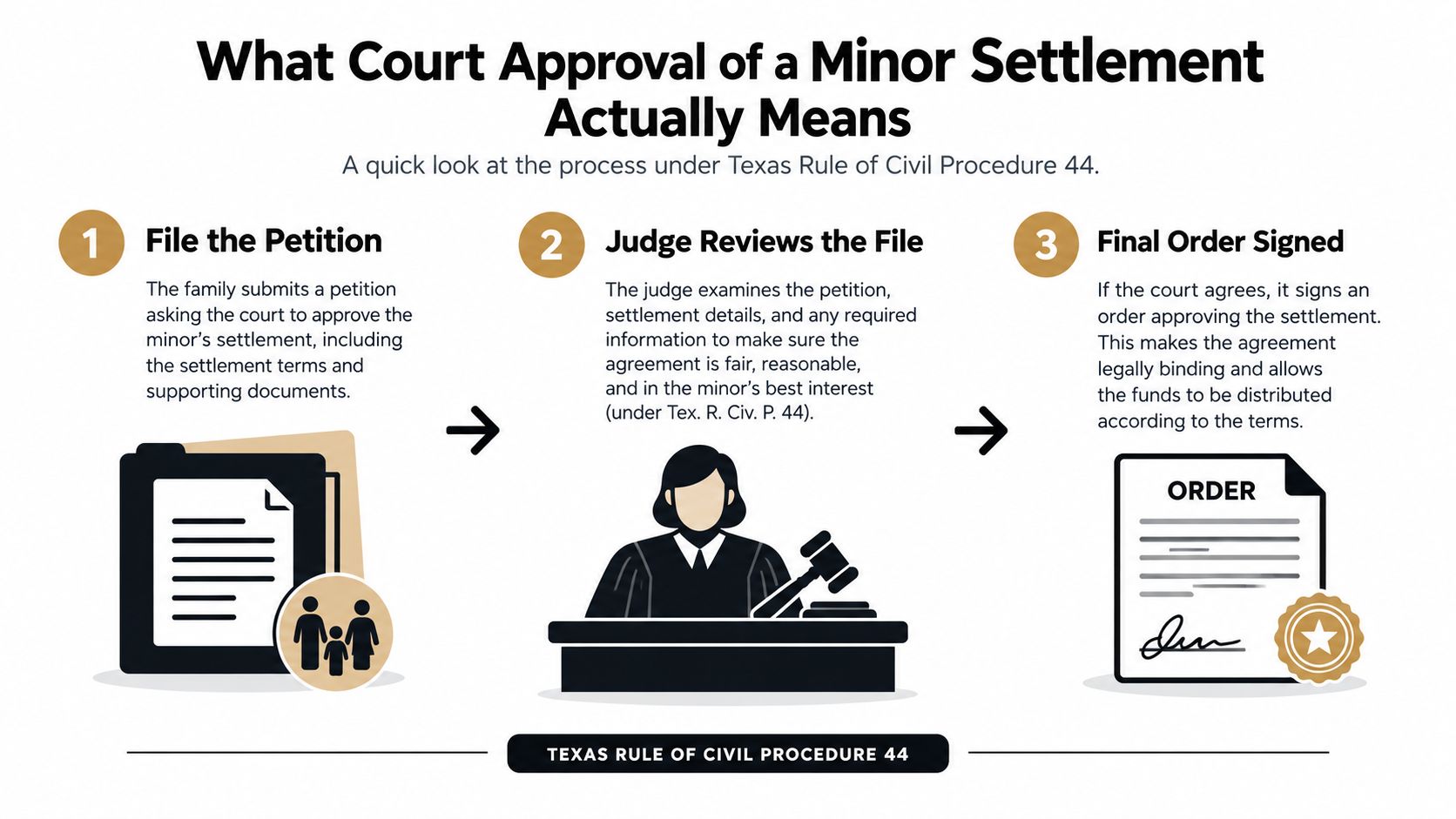
What Court Approval of a Minor Settlement Actually Means
Court approval is a legal review, not a rubber stamp. The family and attorneys must give the judge enough information to evaluate both the settlement and the plan for the child's net recovery.
The court reviews the proposed compromise
A settlement presentation generally identifies the accident, the injuries, the treatment, the disputed issues, and the amount offered. It also addresses the deductions that will reduce the gross recovery, including attorney's fees, case expenses, and medical liens or reimbursement claims.
The court needs a clear picture of what the child will receive. Relevant medical records and information about future care can help the judge understand whether the proposed resolution accounts for ongoing treatment, therapy, educational needs, or possible long-term impairment. The proposed disposition of funds is also important because the child's net recovery must be protected after the case closes.
A careful filing may include:
- The settlement agreement: The judge needs to know what claims will be released and what payment is being proposed.
- Medical documentation: Treatment records help connect the settlement to the child's injuries and future needs.
- Financial deductions: Fees, expenses, liens, and other deductions should be identified rather than hidden inside a single net number.
- A protection plan: The filing should explain whether the funds will go to the court registry, a structured settlement, or a court-created trust.
- Conflict information: If a parent or representative could benefit differently from the child, the court may need additional safeguards.
The judge decides what protects the child
The judge may approve the settlement as presented, request more evidence, question the proposed deductions, require a different method of protecting the money, or decline to approve the agreement. A court may order restricted funds, structured payments, or a trust, depending on the child's circumstances and the available legal options.
Shared fault can affect the value of the underlying claim before the settlement reaches court. Under Texas proportionate-responsibility law, a claimant whose responsibility is greater than 50 percent can't recover damages, while responsibility at 50 percent or less generally reduces recovery according to the assigned percentage. Evidence such as photographs, traffic-camera footage, vehicle damage, witness accounts, phone records, and medical documentation may help establish fault. Families can review Texas Comparative Fault and the 51% Bar Rule for a plain-language explanation of how shared fault reduces or eliminates recovery under Chapter 33.
The result is a signed order that should clearly identify the beneficiary, settlement amount, deductions, fiduciary or trustee, deposit or investment arrangement, and conditions for later withdrawals. No responsible parent should feel embarrassed about asking for an explanation of each line. The order affects the child's financial security long after the hearing ends.
How a Texas 142 Trust Works Under Property Code Section 142
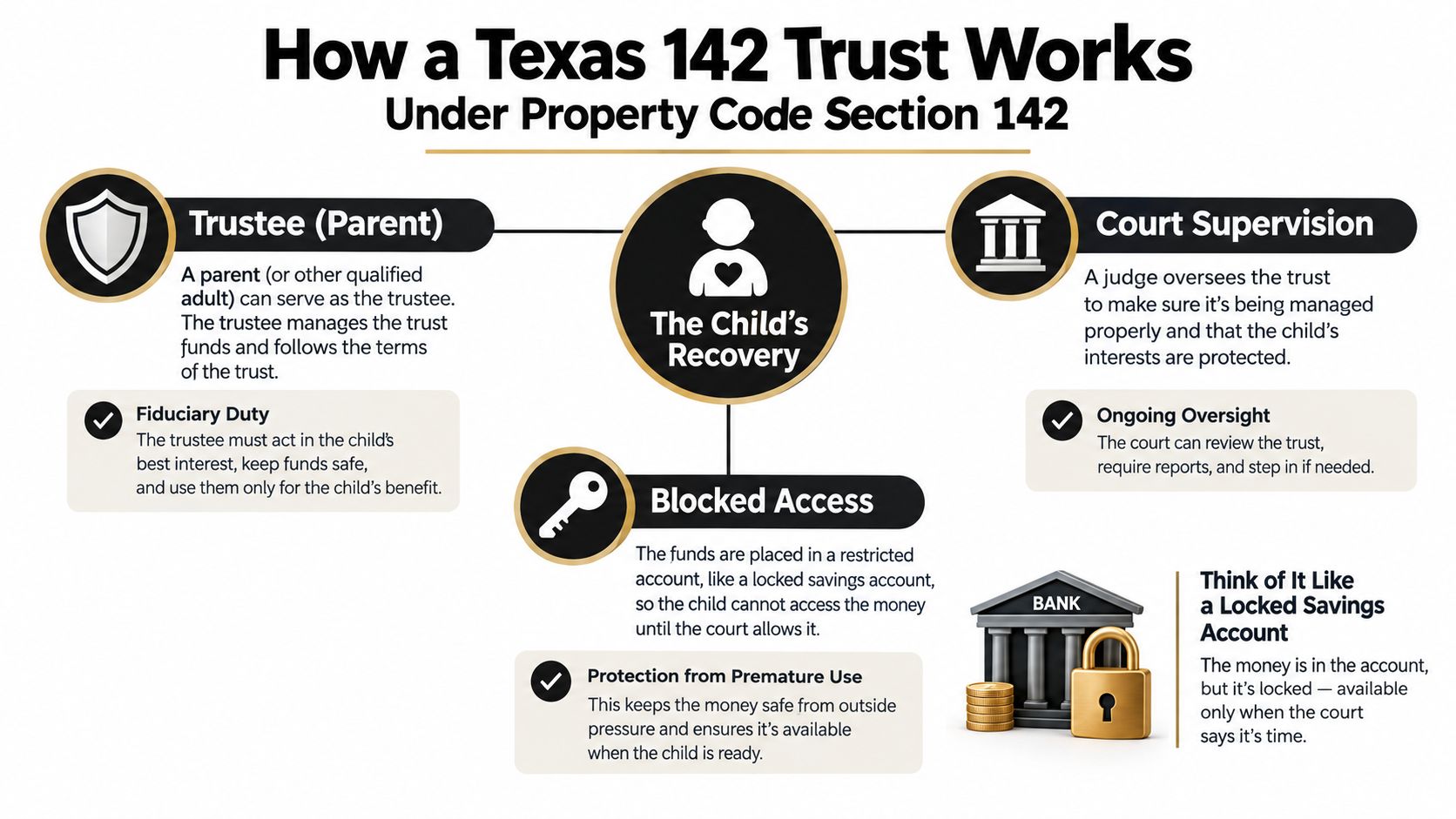
A parent may leave the settlement hearing with an approved amount but still face a separate question: where will the child's money live, and who may authorize its use? A 142 trust answers that second question. It is a court-created arrangement for settlement or judgment funds belonging to a minor or incapacitated person. Under Texas Property Code Section 142.005, the court may direct the clerk to deliver the money to a financial institution after an application and a finding that the trust serves the beneficiary's best interests.
A 142 trust works like a dedicated account in the child's name that only the court-appointed trustee can draw from under the order. The child owns the money, while the trustee manages it for the child. That distinction helps prevent the settlement from becoming part of the household's ordinary spending account.
Ownership and control are different
The court may appoint a parent as trustee in some circumstances. It may instead choose a bank, attorney, or independent fiduciary. The order and trust documents define the trustee's authority, reporting duties, and limits. The trustee must follow those terms and preserve the funds for the child's approved needs.
A withdrawal request should connect the expense to the child's health, education, maintenance, rehabilitation, or another authorized purpose. A therapy invoice, school expense, adaptive-equipment estimate, or medical bill gives the trustee and court something concrete to review. The paperwork functions like a receipt trail, showing why the money is being requested and how it serves the child.
A legitimate family expense may still fall outside the trust's purpose. Ordinary household bills, unrelated debts, and costs that mainly benefit adults may not qualify just because the child lives in the home. The trust keeps the child's recovery separate from the family's general finances.
Court supervision continues after settlement
Texas Property Code Chapter 142 addresses how property recovered for a minor is held and administered. A court-created trust may include restricted access, judicial control, accounting, and procedures suited to the child's future needs. A generic trust or ordinary custodial account may not satisfy the signed order.
The court retains continuing jurisdiction over the trust. Depending on the circumstances, it may modify, revoke, terminate, or construe the arrangement when the child's medical, educational, or other needs change. That continuing oversight makes the trust a long-term court structure, not merely a place to deposit settlement proceeds.
Families comparing a court-created trust with other arrangements may find this explanation of how lawyers set up Texas trusts useful. The specific court order remains controlling because it sets the trustee's authority, the approval process, and the child's access to the funds.
Comparing Court Options for Protecting the Child's Money
A judge has three main tools for holding a minor's recovery. Each gives the child protection, but the rules for access, control, and future payments differ.
| Feature | Court Registry | Structured Settlement | §142 Trust |
|---|---|---|---|
| Basic design | Funds remain in the court registry under the court's direction. | An annuity or qualifying government-backed obligation provides scheduled payments. | A court-created trust holds and manages the funds. |
| Access before adulthood | A later request to the court is usually required for child-related expenses. | Access follows the payment schedule approved in the settlement. | Withdrawals follow the trust order and court supervision. |
| Flexibility | Limited while the money remains restricted. | Predictable, but changes may be difficult if the child's needs shift. | May allow approved distributions for recurring care and other child-centered expenses. |
| Payment timing | Funds generally remain protected until the court authorizes release. | Payments arrive over time instead of as one immediate distribution. | Timing depends on the trust order and approved requests. |
| Important questions | Who may request funds later, and what approval is required? | What are the payment dates, funding documents, present value, and conditions? | Who serves as trustee, which expenses qualify, and what accounting is required? |
The court registry is often the simplest holding arrangement. It can keep the money protected, but a family may need to return to court when the child has an approved expense. A structured settlement can provide reliable payments when future needs are reasonably predictable. Families can review structured settlements in Texas when considering how scheduled payments might fit the child's care.
A §142 trust may better fit changing needs, such as recurring therapy, adaptive equipment, rehabilitation, or medical treatment. The trustee handles requests within the authority granted by the order, while the court remains the decision-maker for matters reserved to it. That structure can provide more practical access without placing the money under a parent's unrestricted control.
Texas law also provides a simplified procedure for certain minor settlements of $25,000 or less. The family still must confirm that the procedure applies to the facts and that the proposed arrangement follows current requirements.
The judge can approve the settlement itself and choose a different method for holding the net proceeds. Those are two separate judicial choices. Approval answers whether the agreement protects the child. The money-management decision determines where the recovery lives, who controls withdrawals, and how the arrangement may affect the child years after the crash.
Walking the Settlement Through Court Step by Step
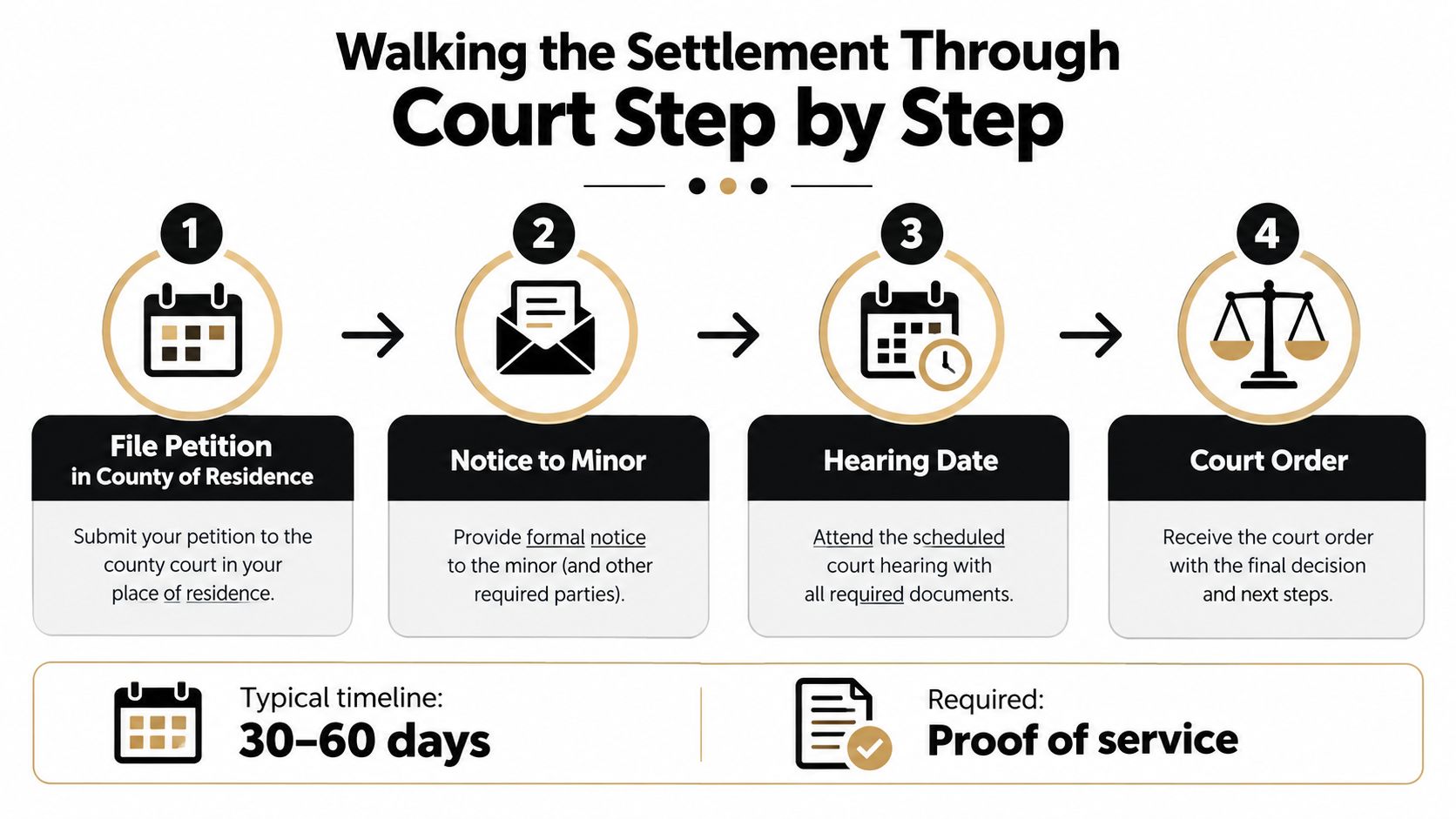
The process usually begins after the parties reach a proposed agreement, but the insurance company's promise to pay isn't enough. The settlement must be presented to the appropriate court, and the judge must decide whether it protects the child.
Filing and preparing the record
Counsel prepares a petition or application explaining the accident, injuries, settlement terms, deductions, and proposed fund arrangement. The file should preserve the signed agreement, allocation of the gross recovery, attorney's fees and expenses, medical-lien documentation, and the method for protecting the net proceeds.
Medical evidence gives the court context. A child may look better at the hearing while still needing therapy, follow-up treatment, educational support, or future care. Parents should tell their attorney about changes in symptoms, missed school, new diagnoses, and expenses that may not appear in the first medical file.
Hearing and final order
At the hearing, the judge may ask the parent or next friend about the child's condition, the settlement, the deductions, and the proposed account or trust. If a guardian ad litem is involved, that person may provide an independent recommendation. A proposed trustee may also need to be identified and evaluated.
Families should ask their attorney what local filing and hearing practices apply. The timing can vary based on the county, the court's schedule, missing documents, disputed liens, the severity of the injury, and the complexity of the protection plan. A parent shouldn't sign a final release or assume funds are available until the required order has been entered.
The court's order should state where the money goes and who controls it. If medical providers or insurers assert reimbursement claims, those issues should be addressed before distribution. Families can learn more about liens and related deductions through this resource on Texas Hospital Lien issues under Property Code Chapter 55.
The court maintains an electronic settlement database for covered agreements under legislation enacted through HB 770. Those agreements are retained indefinitely, while access is restricted to settlement parties, their attorneys, and the minor's or incapacitated person's guardian, next friend, or guardian ad litem. (Texas Judicial Branch settlement database)
The following video provides another general visual explanation of the process:
What Trustees Actually Do After the Hearing
Consider a teenager who suffers a traumatic brain injury in a truck collision. The settlement is placed into a court-created trust because the child may need continuing therapy, specialized schooling, home modifications, and replacement equipment.
The trustee doesn't hand over the entire balance when a parent asks. The trustee reviews the request, checks whether the expense benefits the child, confirms that the request fits the trust terms, and asks for records that support the payment. A therapy invoice and treatment explanation may support a request. A household mortgage payment or unrelated family debt presents a different question.
A trustee protects the beneficiary's purpose
The trustee holds legal title for management purposes, while the minor remains the beneficiary. That separation prevents a parent from treating the settlement as family income. It also creates a process for evaluating future expenses when the child's needs become clearer.
The trust may support medical care, rehabilitation, education, maintenance, or other approved needs. The trustee should keep records of distributions and follow the reporting requirements in the order and trust documents. The court can require an accounting, and the court's continuing jurisdiction allows it to address disputes or changes in circumstances.
A good request explains three things clearly: what the expense is, how it benefits the child, and which trust term or court order authorizes it.
This oversight can feel slow when a family needs equipment or services. It exists because a substantial recovery may need to last through changing medical, developmental, and educational needs. The trustee's job is to keep the funds available for those needs rather than allowing a series of undocumented withdrawals to reduce the child's protection.
Common Mistakes That Put a Child's Recovery at Risk
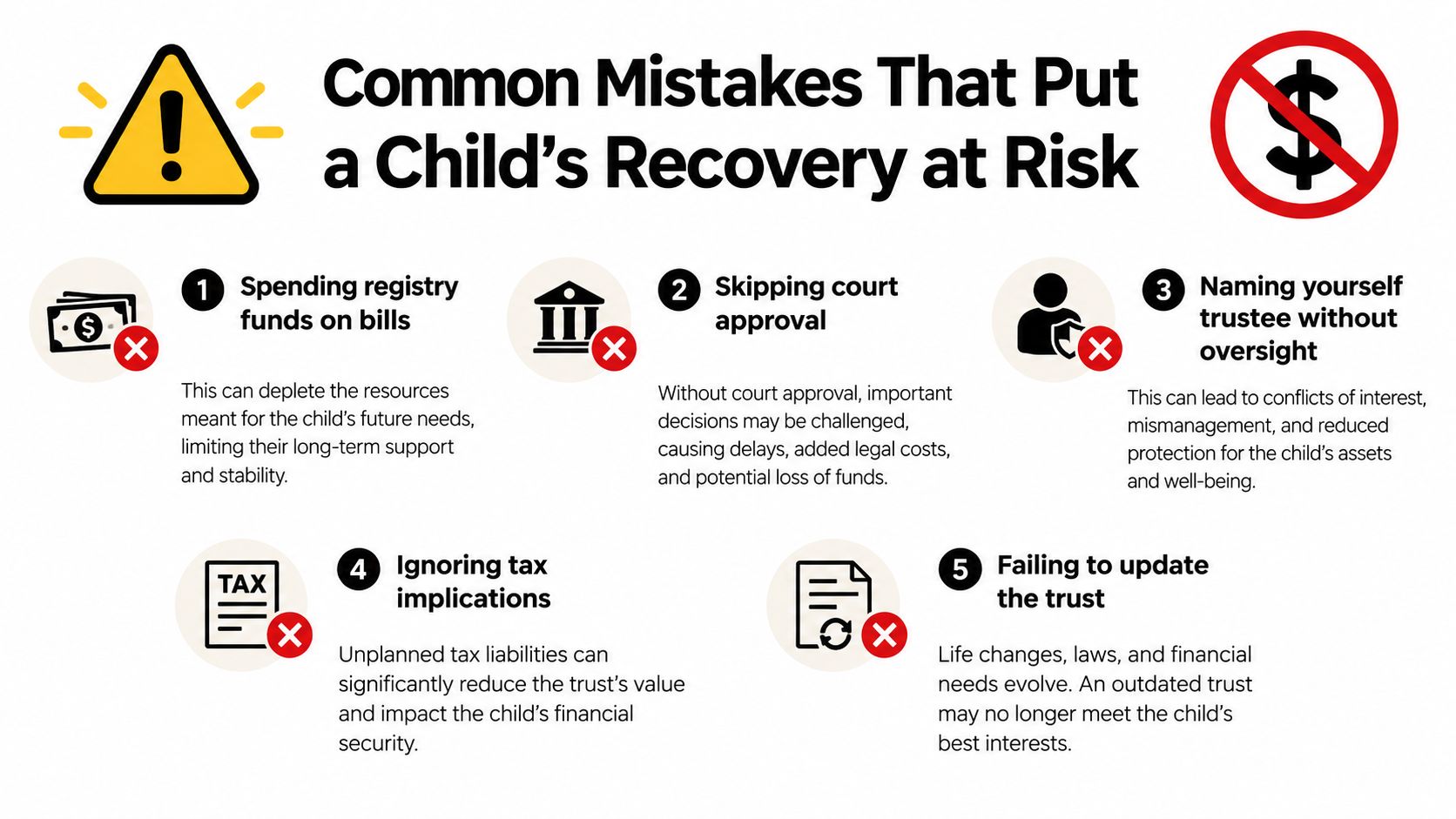
Parents usually make mistakes because they're trying to help. The danger comes from treating protected funds like ordinary money or assuming that court approval ends all legal responsibilities.
- Spending registry funds on family bills: A parent shouldn't use a child's protected recovery for unrelated household expenses. A request must focus on the child's health, education, maintenance, rehabilitation, or another authorized purpose.
- Skipping court approval: A private agreement may not become binding on the minor only because a parent signed it. Rule 44 requires court approval for a next friend or attorney to compromise the lawsuit.
- Choosing a structure without asking who controls withdrawals: The trust document and order should identify the trustee, permitted uses, records, fees, and process for requests.
- Treating an annuity like cash: A structured settlement follows its approved payment schedule. It isn't an ordinary account that a parent can liquidate whenever a new expense appears.
- Assuming the case ends when the check clears: The court may retain supervision over the funds, and the trustee may have continuing accounting and distribution duties.
Questions to ask before signing
Before approving settlement paperwork, ask:
- What is the gross recovery, and what deductions will reduce the amount preserved for the child?
- Are medical liens, reimbursement claims, and expenses documented?
- Who will control the money after the order is signed?
- What expenses can be paid before the child reaches adulthood?
- What records, accountings, or court requests will be required?
- How might the arrangement affect future medical care or needs-based benefits?
- What happens if the child's condition changes?
Families dealing with reimbursement claims can also review subrogation in Texas personal injury cases before agreeing to a final distribution. A written answer to these questions can prevent confusion later.
Fault Deadlines Families Cannot Afford to Miss
A child's settlement can be carefully planned, yet the family may still lose valuable options if the injury claim is filed too late. Texas Civil Practice and Remedies Code Section 16.003 provides a two-year limitations period for many personal-injury and wrongful-death claims, although the exact deadline depends on the legal basis and the people involved. (Texas Civil Practice and Remedies Code Section 16.003)
Settlement discussions with an insurer do not automatically stop the clock. After a fatal Dallas-area collision, eligible relatives may need to evaluate a wrongful-death claim promptly. After a child is injured, record the crash date, identify potentially responsible parties, and seek advice before signing a release.
Fault can affect both timing and value
Texas proportionate-responsibility rules assign fault among people whose conduct contributed to the harm. A claimant found more than 50 percent responsible may be barred from recovering damages under Section 33.001. Useful evidence may include crash-scene and medical evidence, along with information showing when the injury was discovered and how the parties acted afterward.
A disputed account of fault can slow negotiations. That delay should not push a family to accept an offer before understanding the child's future needs or how the recovery will be protected. An attorney can examine whether responsibility may involve a negligent driver, commercial carrier, vehicle owner, government entity, uninsured motorist, or another party.
The filing deadline may change when the claim involves a minor, a governmental entity, delayed discovery, or another legal exception. Tolling may apply in some circumstances involving a minor, but families should not assume that every deadline is postponed until adulthood. The facts and claim type determine the rule. An experienced Texas personal injury attorney can preserve evidence and confirm the filing deadline for your family's claim.
Keep the crash date visible on the calendar. Early advice leaves time to investigate fault, assess future losses, address liens, prepare the court filing, and make two separate decisions: obtaining approval for the settlement and choosing whether the money belongs in a 142 trust or another court-approved arrangement.
The Law Office of Bryan Fagan, PLLC helps Texas families evaluate injury settlements, prepare for minor settlement court approval, and protect a child's recovery through a court-supervised arrangement. Visit Law Office of Bryan Fagan, PLLC to schedule a free consultation about a child's injury or wrongful-death matter.