A serious accident can change your life in seconds, but you don't have to face it alone. You may be sitting at your kitchen table with an insurance letter in front of you, wondering whether the number on the page is fair, whether you should negotiate, or whether rejecting it could hurt you later. Under Texas law, that decision can affect more than your immediate payment. It can change your net recovery after trial.
Consider a Houston driver who receives a $100,000 settlement offer after a crash. The adjuster urges her to accept it quickly. She believes her injuries and losses justify more, so she rejects the offer. At trial, the jury awards $65,000. Now the insurer asks the court to shift certain post-rejection litigation costs onto her.
That is the financial problem behind offer of settlement Rule 42.004 Texas cost shifting. The central question isn't only whether an offer feels too low. You also need to ask whether you can defend rejecting it if the final judgment is worse. A Texas personal injury lawyer can evaluate the offer, the evidence, the risks, and the likely net result before you make a decision.
When a Settlement Offer Becomes a Risk You Did Not See Coming
The Houston driver's case illustrates why settlement decisions require more than comparing two headline numbers. She sees a $100,000 offer and a $65,000 verdict. At first glance, the verdict looks like the clear loss. But the financial impact may continue because Texas law can allow the offering party to recover certain litigation costs incurred after the offer was rejected when the statutory conditions are met.
The insurer isn't automatically entitled to every dollar it spent defending the case. The court must examine whether the offer qualified, whether it was rejected, and whether the judgment crossed the statutory threshold. Still, the risk is real enough that rejecting an offer without careful analysis can be a costly mistake.
Practical rule: Never evaluate a settlement by asking only, “Can I get more at trial?” Ask, “What will I keep if trial goes badly?”
That question matters in car crashes, commercial truck collisions, motorcycle wrecks, pedestrian claims, catastrophic injuries, and wrongful-death cases. Liability may look strong until a witness changes testimony. Medical records may leave gaps. A jury may reduce damages because it believes you shared responsibility under Texas comparative-responsibility law. Fault, negligence, proof of damages, and the credibility of every witness can affect the final judgment.
The right decision requires a net-recovery model. That model considers the offer, the probable verdict range, comparative responsibility, recoverable costs, legal fees, medical documentation, and the time and uncertainty involved in continued litigation. You shouldn't make that calculation alone, especially while recovering from a serious injury or grieving a death.
The law doesn't require you to accept every proposal. It does require you to understand the consequences of rejecting a qualifying offer. With proper advice, you can protect your claim and make a decision based on evidence rather than pressure.
What Texas Rule 42.004 Actually Does
Texas Civil Practice and Remedies Code Chapter 42 created the offer-of-settlement cost-shifting framework as part of the Legislature's 2003 tort-reform legislation. Its basic purpose was to encourage parties to make and accept reasonable settlement offers earlier, instead of forcing every dispute through trial. The statute isn't designed to punish someone solely because that person lost before a jury.
Section 42.004 applies only when several conditions come together:
- One party makes a qualifying settlement offer.
- The opposing party rejects the offer.
- The final judgment is materially worse for the rejecting party under the statute's comparison test.
The Texas Supreme Court later adopted Texas Rule of Civil Procedure 167 to provide the procedural details. In plain English, Section 42.004 supplies the cost-shifting authority, while Rule 167 helps explain how the offer process operates in litigation.
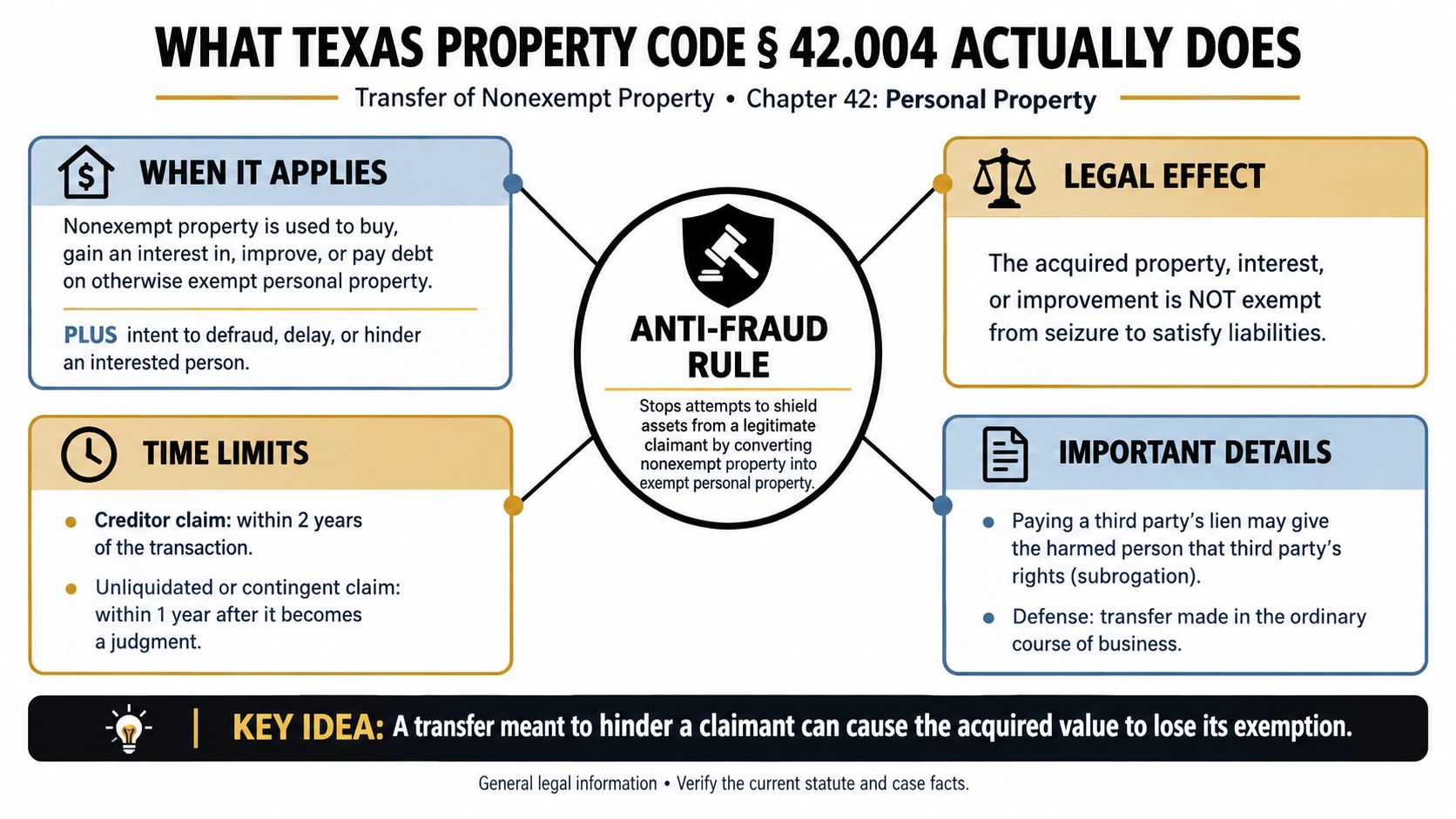
The rule is not an automatic trial penalty
Think of the statute like a referee who doesn't decide which team wins the game. The referee does, however, apply a specific consequence when a team rejects a reasonable resolution and then performs materially worse under the rule's test. Losing at trial alone isn't enough.
That distinction matters because an injury victim may hear the phrase “cost shifting” and assume the court will punish any rejected offer. That isn't how the framework works. The offer must comply with the applicable requirements, the opposing party must reject it, and the judgment must fall on the required side of the statutory comparison.
The law also works in both directions. A claimant who rejects a defense offer may face consequences if the award is materially lower. A defendant that rejects a claimant's offer may face consequences if the judgment is materially higher. The numbers are different for each side, which makes the identity of the offeror and rejecting party important from the beginning.
The 80 Percent and 120 Percent Thresholds Explained
The statutory test is intentionally asymmetric. If the claimant rejects the offer, the consequence can apply when the final award is less than 80% of the rejected offer. If the defendant rejects the offer, the consequence can apply when the judgment is more than 120% of the offer. The governing framework appears in Texas Civil Practice and Remedies Code Section 42.004.
| Party Who Rejected | Triggering Judgment | Outcome |
|---|---|---|
| Claimant | Final award is less than 80% of the rejected offer | Offering party may recover qualifying post-rejection litigation costs |
| Defendant | Judgment is more than 120% of the rejected offer | Offering party may recover qualifying post-rejection litigation costs |
When the claimant rejects
Suppose an insurer makes a qualifying $100,000 offer to an injured claimant. The claimant rejects it. If the final award is below $80,000, the statutory test may be met, assuming the other requirements are satisfied. A $65,000 verdict falls below that threshold, which is why the Houston example creates a potential cost-shifting issue.
That doesn't mean the claimant automatically owes the insurer every litigation expense. The court still must determine whether the offer qualified and which costs the statute permits. But the claimant's decision can affect the amount ultimately retained from the recovery.
When the defendant rejects
The direction changes when the claimant makes the offer. If a claimant makes a qualifying $100,000 demand and the defendant rejects it, cost shifting may apply if the judgment exceeds $120,000. The framework therefore discourages a defendant from refusing a reasonable demand and forcing the injured person through unnecessary litigation.
The asymmetry reflects the Legislature's effort to address both unreasonable demands and unreasonable defenses. A claimant shouldn't use trial as a gamble after rejecting a defensible offer, and a defendant shouldn't force trial merely because it hopes a jury will award less.
Shared fault can complicate the comparison. Texas comparative responsibility may reduce an injured person's recovery based on assigned fault, and in some situations can eliminate recovery altogether. For a plain-language discussion of that issue, see Texas Comparative Fault and the 51% Bar Rule. Your lawyer should compare the offer with the likely judgment after accounting for liability disputes, fault allocation, interest, fees, and costs that belong in the calculation.
What Costs Can Actually Be Shifted Under the Rule
Cost shifting sounds like a separate lawsuit-sized threat, but Chapter 42 limits the award. Under Section 42.004(c), the recoverable amount is tied to litigation costs incurred by the offering party after the rejection date. Expenses from before rejection don't qualify under this mechanism.
The statutory definition includes amounts spent or obligations incurred that directly relate to the action. The categories include court costs, reasonable attorney's fees, and reasonable fees for no more than two testifying expert witnesses, as described in the governing statute. A lawyer should request itemized support instead of accepting a broad demand for “all costs.”
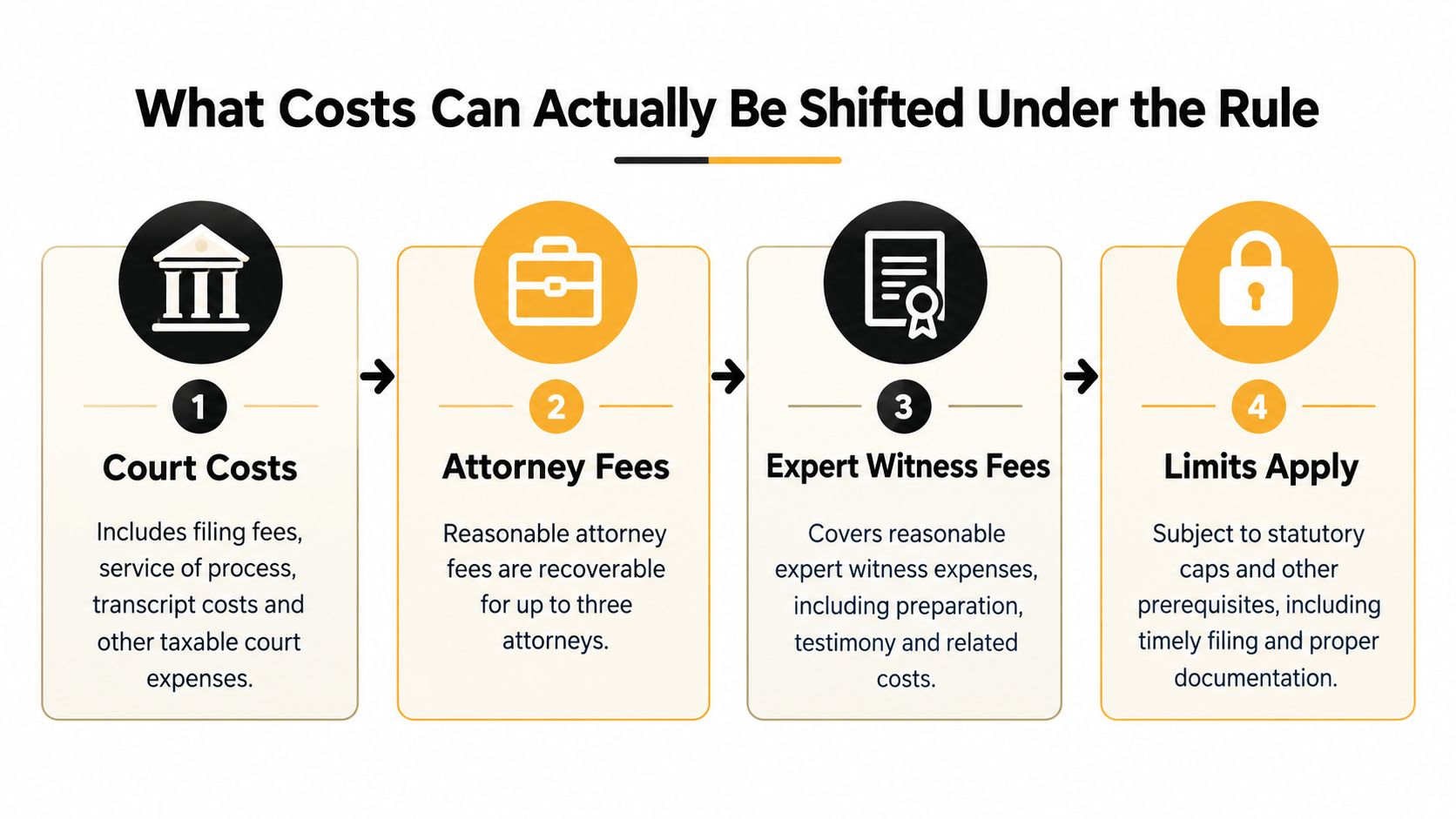
Three limits change the practical result
Post-rejection expenses only. The date of rejection matters. Counsel should calendar it and separate qualifying expenses from costs incurred earlier.
An offset against recovery. When cost shifting is imposed against a claimant, the amount is entered as an offset against the claimant's recovery. That means the issue may reduce the verdict rather than arrive as an entirely separate collection demand.
A global ceiling. Chapter 42 limits litigation costs so they can't exceed the claimant's recovery before adding claimant-favorable litigation costs or subtracting defendant-favorable costs. The rule also prevents double recovery. If another law independently authorizes certain fees or costs, those amounts may be excluded from the Chapter 42 calculation or otherwise treated to avoid duplication.
The number on the verdict sheet is not the number that belongs in your bank account.
That is why your lawyer should model the net recovery before you accept or reject a proposal. The calculation should account for the offer, the likely judgment, comparative responsibility, medical proof, expert expenses, attorney's fees, interest, recoverable costs, and the statutory offset. Review the fee arrangement as well. The explanation of how contingency fees work in a Texas personal injury case can help you understand why the headline verdict and your final recovery may differ.
Why Most Insurance Letters Are Not Real Chapter 42 Offers
A written insurance letter isn't automatically a Chapter 42 settlement offer. The statutory framework is technical, and a document that discusses vehicle damage, immediate medical bills, or a partial payment may not address the claims and parties involved in the full personal-injury lawsuit.
After a Dallas-area truck collision, an insurer might send a proposal offering to pay for vehicle repairs and documented emergency treatment. The injured person may assume that rejecting the letter creates a Rule 42.004 risk. But if the document doesn't satisfy the applicable statutory requirements or resolve the relevant claims, it may not function as a Chapter 42 offer for the entire case.
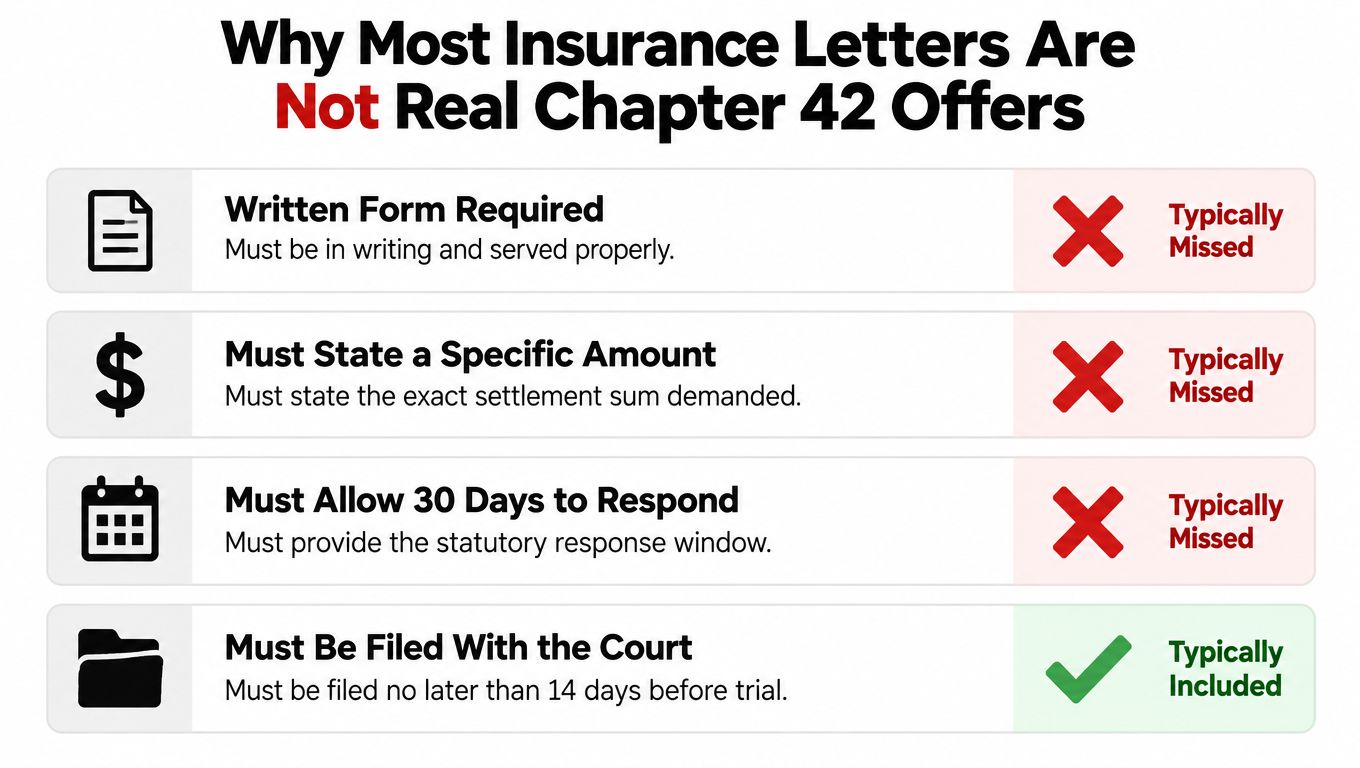
Review the document before responding
Look at the proposal itself, not just the number. Your lawyer should examine:
- Covered claims: Does the document address the bodily-injury claims, property damage, and any other claims at issue?
- Covered parties: Does it identify the parties who would be released or protected?
- Settlement terms: Does it clearly state what payment would resolve and what rights you would give up?
- Procedural compliance: Does it satisfy the applicable Chapter 42 and Rule 167 requirements?
- Response and service details: Was it delivered in the way required for the framework?
Keep every letter, email, attachment, release, and text message. Don't admit fault to the adjuster, minimize your symptoms, or speculate about future treatment. A carefully prepared Texas personal injury demand letter is different from an informal insurance communication, and the legal effect depends on the document's substance and compliance.
How the Two Year Deadline Shapes Every Settlement Decision
Settlement talks don't replace filing a lawsuit. Under Texas Civil Practice and Remedies Code Section 16.003, Texas personal-injury and wrongful-death claims generally carry a two-year limitations period. Personal-injury claims generally must be filed within two years after accrual, while a wrongful-death cause of action generally accrues on the date the injured person dies.
The exact deadline can depend on the facts, the defendant, the claimant's legal status, and the type of claim. Exceptions and specialized provisions exist, so don't calculate the date casually from memory. Identify the accident date, the date of death if applicable, and any facts that could affect accrual as soon as possible.
Negotiations don't protect the deadline
An Austin family may spend months waiting for an insurer to “do the right thing” after a fatal collision. If negotiations continue while the filing deadline approaches, the family could lose important legal rights by assuming the insurance process pauses the clock. It doesn't safely replace filing suit.
Preserve the crash report, photographs, medical records, employment information, witness details, insurance correspondence, and written offers. If you're dealing with a fatal accident, a Texas injury claim deadline guide can provide general information, but it can't determine the deadline for your particular family.
This short video offers additional background on Texas injury claims. Watch it after reviewing your dates and documents, not instead of speaking with counsel.
Treat the statute of limitations as the hard floor beneath every settlement decision. A qualifying offer may affect cost shifting, but it doesn't give you permission to wait past the filing deadline.
When to Accept, Counter, or Reject an Offer in Texas
You should accept, counter, or reject an offer only after reviewing four questions. First, how strong is the evidence that the other party was negligent? Second, how much comparative responsibility might a jury assign to you? Third, do your medical records fully show the injury and future care needs? Fourth, what will you actually keep after litigation costs and other deductions?
Accept when the offer protects the real recovery
Acceptance may make sense when liability is uncertain, your treatment record is complete, the offer fairly reflects the documented damages, and continued litigation creates a meaningful risk of a lower net result. For example, a driver with disputed fault and limited medical proof may decide that a defensible offer provides more practical security than an uncertain trial.
That decision still requires a careful release review. Don't sign away future claims before understanding whether treatment is complete, whether liens or medical bills remain, and whether the release covers claims involving other responsible parties.
Counter when the evidence supports more
A counteroffer can be appropriate when the insurer recognizes liability but undervalues lost income, pain, future care, or permanent impairment. Use records, photographs, witness statements, crash evidence, and medical opinions to explain the value. Don't let an adjuster's deadline replace your own medical and legal timeline.
If you want a broader discussion of preparing for negotiations, this resource on how to maximize your settlement compensation provides additional context. It shouldn't replace a Texas-specific review of Chapter 42, comparative responsibility, and your deadline.
Reject only after modeling the downside
Rejection may be justified when the offer is plainly inadequate, liability proof is strong, damages are well documented, and the likely net recovery remains favorable after projected post-rejection costs. Your attorney should identify whether the proposal is a qualifying offer, calculate the applicable threshold, and preserve the reasons supporting the decision.
Fault is central. Texas negligence claims generally require proof that another person or company failed to act reasonably, caused the collision or injury, and created compensable harm. The other side may argue that you contributed to the accident, and that argument can reduce the recovery under comparative responsibility rules.
The Law Office of Bryan Fagan, PLLC handles car, truck, motorcycle, pedestrian, rideshare, workplace-vehicle, catastrophic-injury, and wrongful-death claims. A Houston car accident attorney or truck crash lawyer Houston families trust should be prepared to discuss both the value of the claim and the financial consequences of continuing toward trial.
Your Next Step Toward a Fair Recovery in Texas
You don't have to decide what an offer means by yourself. A careful lawyer should review the document, determine whether it qualifies under Chapter 42, calendar the rejection date, evaluate negligence and comparative responsibility, and model your likely net recovery instead of focusing only on the verdict.
Bring these items to a free consultation if you have them:
- Crash information: Accident reports, photographs, videos, witness names, and insurance details.
- Medical records: Bills, treatment notes, prescriptions, diagnoses, and information about future care.
- Settlement documents: Every insurance letter, demand, offer, release, email, and text message.
- Financial records: Wage-loss information, employer records, receipts, and a simple summary of your expenses.
- Family documents: For a wrongful-death claim, preserve the death certificate, funeral records, estate information, and records showing the family's losses.
The firm represents injured people and families across Houston, Dallas-Fort Worth, Austin, San Antonio, and surrounding Texas communities. Whether you need a Texas personal injury lawyer, a wrongful death lawyer Texas families can consult, or counsel for a serious truck collision, the immediate goal is the same: protect your rights, understand the offer, and pursue a fair recovery.
Recovery is possible, even when the process feels overwhelming. You have legal options, and experienced help is available before you accept or reject a settlement that could shape your future.
The Law Office of Bryan Fagan, PLLC offers free consultations and contingency-fee representation for Texas injury and wrongful-death claims, so you pay no fees unless the firm wins. Visit Law Office of Bryan Fagan, PLLC to discuss your settlement offer, filing deadline, and next step with a Texas injury team.