A serious accident can change your life in seconds, but you don't have to face it alone. If you're recovering after a Houston freeway collision, dealing with a truck wreck near San Antonio, or grieving a fatal crash in the Dallas area, one early question can shape the entire case: where should the lawsuit be filed?
Texas venue law is more than a courthouse address. The county can affect the judge assigned to important motions, the jury pool, discovery scheduling, trial logistics, and the insurance company's assessment of settlement risk. Understanding Texas venue mandatory vs permissive personal injury rules early can help protect your options before a petition is filed or a transfer motion is raised.
Why the County You File In Can Shape Your Texas Injury Case
After a Houston freeway crash, a family may focus first on medical treatment, vehicle damage, and the insurance adjuster's calls. Those issues matter, but the filing county can also influence who manages the case and which local jurors may eventually hear it. A collision that happened in one county may involve a driver who lives elsewhere, a trucking company with its principal Texas office in another county, and medical treatment across several communities.
That creates choices under Texas's general venue rules. When more than one county is legally available, the plaintiff may have a meaningful decision to make. The strongest choice usually reflects the location of the crash, the evidence, the defendants, and the practical needs of the people bringing the claim.
Practical rule: Venue should be investigated while evidence is still easy to locate, not after the defense has already filed a motion to transfer.
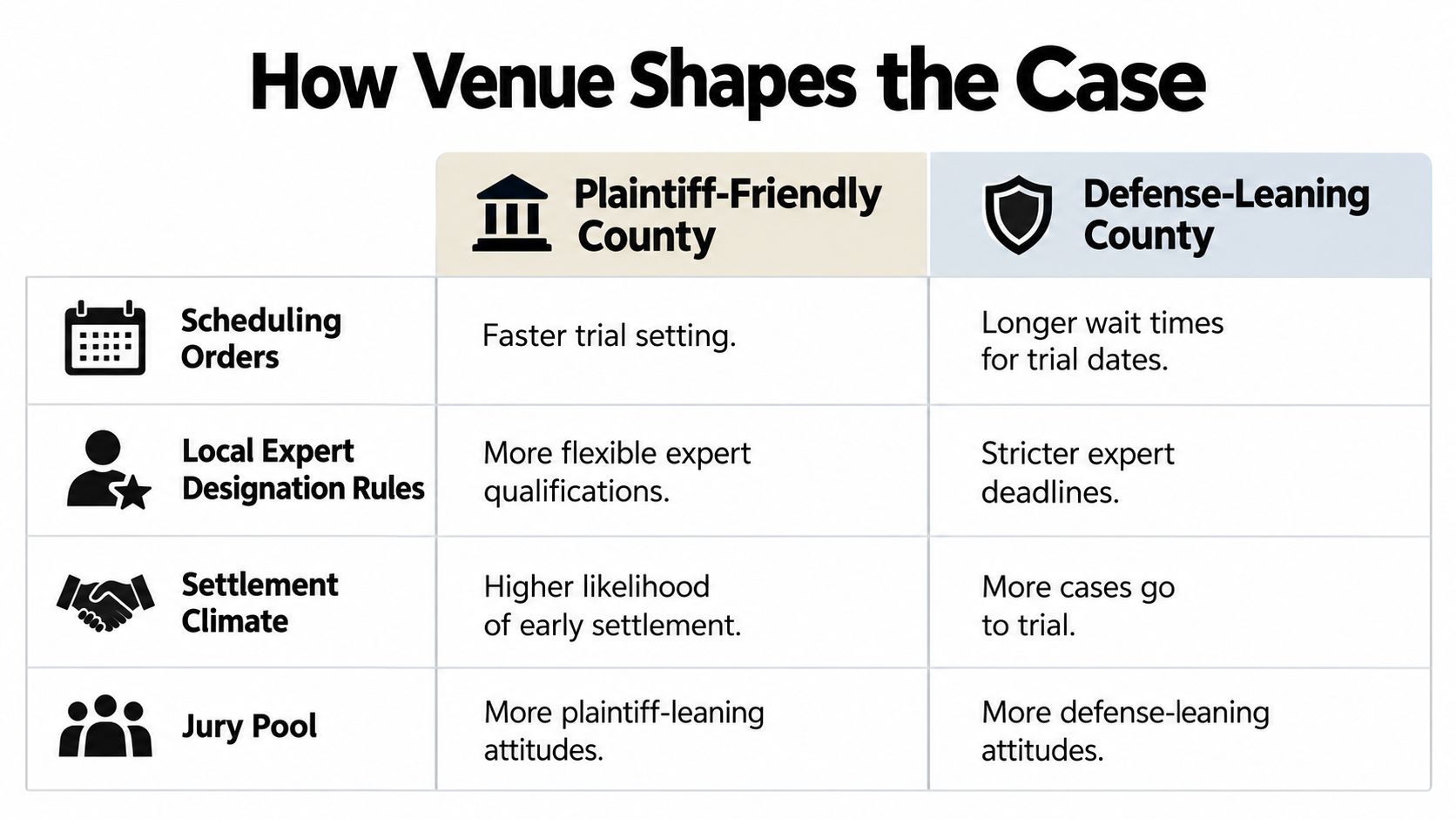
Venue can shape the rhythm of litigation. Local court procedures may affect scheduling orders, discovery disputes, expert deadlines, and the path toward mediation or trial. The jury pool may also affect how attorneys present arguments about disputed responsibility, serious injuries, lost income, or the value of a life.
A mandatory venue rule changes that analysis. If a statute requires the case to proceed in a particular county, the plaintiff generally can't preserve a preferred forum by choosing it first. A permissive rule, by contrast, identifies counties where the case may properly be filed.
The practical difference is significant. Two cases with similar evidence may face different procedural settings depending on whether the plaintiff has a lawful choice among counties or must file where a mandatory statute directs. That's why a Texas personal injury lawyer should evaluate venue with the underlying facts, not treat it as a formality at the end of the intake process.
What Mandatory and Permissive Venue Mean Under Texas Law
Permissive venue means Texas law identifies one or more counties where a lawsuit may be filed. Under Texas Civil Practice and Remedies Code §15.002, the general rule allows suit in the county where all or a substantial part of the events or omissions occurred. It may also allow filing where an individual defendant lived when the claim accrued, where a business defendant maintained its principal Texas office, or, if the other choices don't apply, where the plaintiff lived when the claim accrued. The statute is available through the Texas Legislature's Chapter 15 venue provisions.
For an injury claim, the collision county is often central because police materials, vehicle evidence, eyewitnesses, and early medical information may connect the dispute to that location. Section 15.093 separately provides that a tort action for damages may be brought in the county and precinct where the injury was inflicted. The wording matters because permissive provisions generally authorize a proper county rather than naming one unavoidable location.

When a statute controls the county
Mandatory venue applies when another statute requires the lawsuit to be brought in a specified county. Section 15.016 gives those mandatory provisions priority. The general rule doesn't override a statute that says the action must proceed somewhere else.
Section 15.038 illustrates the difference in language. A provision using “may be brought” generally describes permissive venue. A mandatory provision directs the filing location with language requiring the action to be brought in a particular county. This distinction can decide whether a plaintiff has a genuine forum choice.
Joinder can create another complication. Under §15.004, if properly joined claims arise from the same transaction or occurrence and one claim is governed by a mandatory venue provision, the entire suit may have to proceed in the county required by that mandatory rule. Adding related claims doesn't always preserve a preferred county for the personal-injury claim.
Venue is also evaluated using facts existing when the cause of action accrued. Section 15.006 means a later move by the injured person or defendant ordinarily doesn't rewrite the original venue facts. Counsel should therefore document where the parties lived, where the business maintained its principal office, and where the significant events occurred at the relevant time.
Mandatory vs Permissive Venue Side by Side
The difference becomes easier to apply when the rules are compared by their practical effect.
| Issue | Mandatory Venue | Permissive Venue |
|---|---|---|
| Primary authority | A statute requires the action to be filed in a particular county, as recognized by §15.016. | The general rules identify counties where suit may be filed, including the event county or a defendant's qualifying county, under §15.002. |
| Statutory wording | The rule directs where the case must proceed. | The rule commonly says an action “may be brought” in an authorized county, as reflected by §15.038. |
| Plaintiff's choice | Limited or eliminated when the mandatory statute applies. | Meaningful, provided the chosen county is supported by the statute and evidence. |
| Typical venue ties | The specific county named by the controlling statute. | The county where events occurred, where an individual defendant lived, or where a business defendant maintained its principal Texas office. |
| Risk of a challenge | Filing elsewhere can lead to a transfer request because the statute controls. | The defendant may still challenge the selected county, but the plaintiff can defend the choice by proving a statutory connection. |
| Effect of joined claims | A mandatory claim may pull the entire properly joined case into the required county under §15.004. | A permissive claim doesn't necessarily displace a mandatory rule affecting another joined claim. |
The table's central lesson is simple: mandatory venue controls, while permissive venue creates lawful alternatives. That doesn't mean a plaintiff can file anywhere that feels convenient. Each chosen county needs a valid statutory connection, and the petition should state facts supporting that connection.
A defendant who believes the plaintiff chose an improper county may seek transfer. That can create expense, delay, and additional litigation before the merits are addressed. A well-supported permissive venue decision gives the plaintiff a stronger position, while a mandatory venue analysis prevents the case from being filed in a county the statute won't permit.
The wrong strategy is to assume the plaintiff always controls venue. The better strategy is to identify every proper county, check for a mandatory exception, and choose based on evidence and litigation needs.
Real-World Fact Patterns From Across Texas
A venue decision can shape a Texas injury case before the parties exchange discovery. The county tied to the crash, defendants, witnesses, and records may affect where jurors are drawn, how efficiently evidence is developed, and how each side assesses settlement.
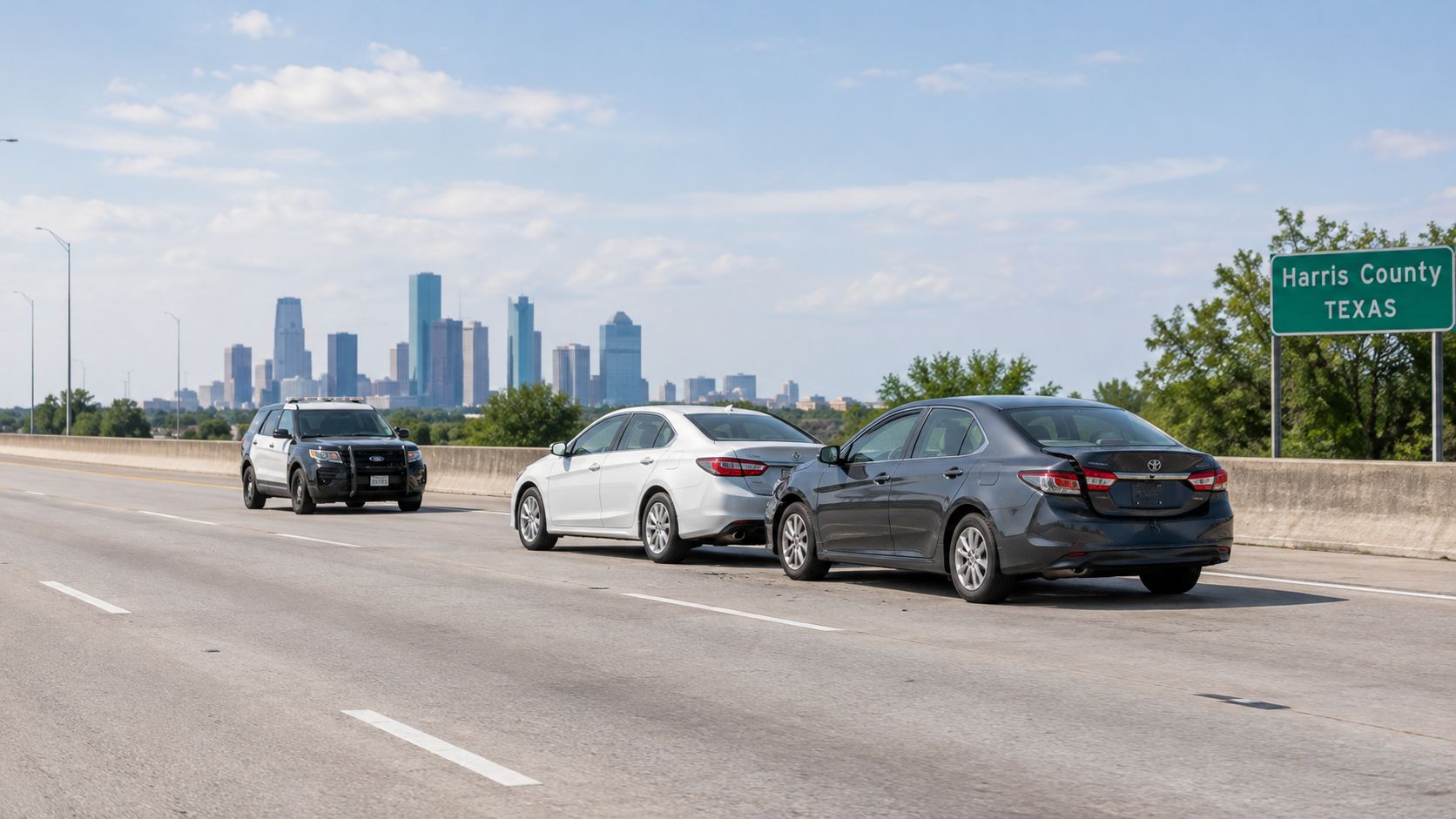
A Houston freeway collision
A driver is injured in a Houston-area collision. The crash occurred in Harris County, while the other driver lived in a neighboring Texas county. Section 15.002 may support more than one permissible venue because substantial events occurred in Harris County and the individual defendant's residence may provide another statutory connection.
Convenience alone should not decide the filing county. The police investigation, vehicle inspection, treating providers, witnesses, and likely trial evidence may all favor the collision county. A Houston car accident attorney can assess those connections before filing, when changing course is easier and less expensive.
A Dallas-area drunk-driving death
A fatal crash near Dallas may lead to both a wrongful-death claim and a survival action. The family must identify the proper claimants, responsible parties, and any statute that affects venue. If a properly joined claim falls under a mandatory venue provision, §15.004 may place the entire lawsuit in the county required by that provision.
Evidence preservation should begin at the same time. Employment records, medical information, financial documents, and insurer communications may affect damages and liability. A fatal collision can involve negligence, gross negligence, and potential exemplary damages. Government-related facts also require prompt attention, including the Texas Tort Claims Act notice deadline guidance.
A San Antonio commercial truck wreck
A commercial truck hits a passenger vehicle in San Antonio, while the carrier maintains its principal Texas office in another county. The crash county may qualify under §15.002 because substantial events occurred there. The carrier's principal office may create another permissible connection.
A truck crash lawyer Houston or counsel handling a similar commercial case should investigate every responsible entity, not only the driver. The carrier, vehicle owner, broker, maintenance company, and other businesses may hold separate records and have different venue ties. Those differences can affect discovery access and the defendant's willingness to negotiate.
A rideshare collision crossing county lines
A rideshare trip begins in one county, the collision occurs in another, and the driver lives in a third. Before discovery starts, the parties may dispute which county has the strongest statutory connection.
The petition should link the selected county to concrete facts. The dispute may concern where the crash occurred, where the defendant lived when the claim accrued, or where a business maintained its principal office. Early documentation of those facts can protect the plaintiff's position and reduce avoidable venue litigation.
How to Choose, Preserve, and Challenge Venue in Texas
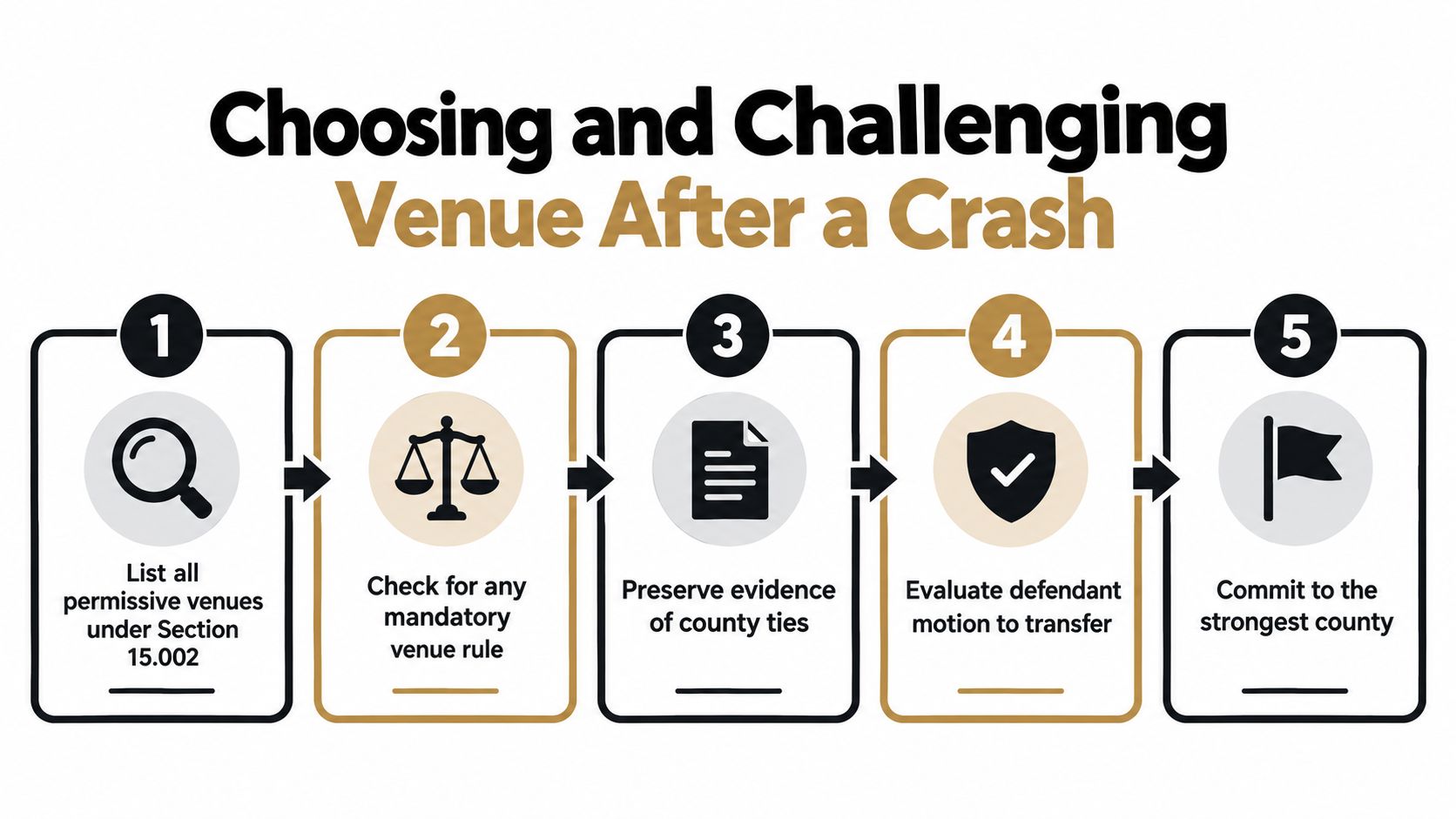
Venue strategy begins with evidence. Before filing, identify every county tied to the collision, the defendants, medical treatment, and events that created the claim. Separate counties that may qualify under permissive venue rules from any mandatory provision that controls where the case must proceed. That early choice can affect the judge, jury pool, discovery disputes, and settlement posture.
A practical early-case sequence
List the statutory connections. Identify the crash county, each individual defendant's residence when the claim accrued, each business defendant's principal Texas office, and other facts that may support venue under §15.002.
Check for mandatory provisions. Review each cause of action and every properly joined claim. Section 15.016 gives priority to a statute prescribing mandatory venue, while §15.004 may determine the location of the entire suit.
Preserve county evidence. Keep the crash report, photographs, medical records, witness statements, vehicle records, and documents showing residence or a business principal office. Venue evidence may disappear even when liability evidence remains available.
Prepare for a transfer challenge. Texas Rule of Civil Procedure 86 governs venue procedure, including the defendant's opportunity to challenge the county. A motion to transfer generally must be raised within the required pleading window. Do not assume the issue can wait until trial.
A strong response to a venue challenge relies on admissible, specific facts rather than speculation. County records, residence proof, accident reports, treatment records, business filings, and witness information can show why the selected county is proper. If a defendant fails to object within the applicable period, that may limit the challenge, but the rules and case facts still require careful review.
Bring the crash location, names and addresses of known defendants, the police report, insurance letters, medical information, and any notice sent to a governmental entity when consulting a lawyer. A Car Accident Lawyer in Texas can use those materials to assess venue and representation for people injured in Texas collisions.
How Venue Shapes Discovery, Settlement, and Trial Strategy
Venue affects the case after filing, not just the first page of the petition. Each county has its own courtroom practices, scheduling habits, discovery expectations, and approach to setting disputes for hearing. Counsel must learn how the assigned court handles expert designations, continuances, docket control, and trial preparation.
A plaintiff may prefer a county with strong factual ties because witnesses and evidence are nearby. A defendant may argue that another county is proper or more convenient. Even when a challenge doesn't succeed, it can consume time and create uncertainty before the parties exchange full discovery.
The effect on evidence and experts
Court scheduling can determine when medical records, employment evidence, vehicle data, and expert opinions must be ready. A case involving a catastrophic injury may require testimony about future care, lost earning capacity, rehabilitation, and life changes. Counsel who selects venue without studying local procedure may face avoidable pressure when deadlines arrive.
The jury pool also matters. Local jurors may bring different experiences with highways, commercial vehicles, workplace travel, medical treatment, and family losses. Venue doesn't guarantee a result, but it can affect how a jury hears competing arguments about negligence and comparative responsibility.
Texas uses modified comparative responsibility. The fact finder assigns whole-number responsibility percentages to the claimant, defendants, settling parties, and properly designated responsible third parties. A claimant whose responsibility is greater than 50 percent can't recover damages. If the claimant is 50 percent or less responsible, the court reduces damages by that percentage, so a $200,000 award reduced by 20 percent would generally produce $160,000 before other applicable issues, as provided by Texas Chapter 33.
That framework gives venue practical importance. Defense counsel may argue that the injured person failed to act reasonably, while the plaintiff must show why the defendant's conduct caused the harm. The county doesn't change the legal standard, but local courtroom experience can affect how attorneys present fault evidence and prepare for trial.
A supported venue choice can also improve settlement posture. When the defense sees that the plaintiff has preserved venue evidence, identified the proper defendants, and prepared for discovery, a transfer motion becomes less useful as a delay tactic. Trial readiness often makes negotiations more serious. Readers considering the litigation process can review what happens when a Texas injury case goes to trial.
Your First 30 Days After a Texas Crash or Loss
The first month should create an evidence record, protect deadlines, and give counsel enough information to analyze venue. You don't need to solve the entire case immediately, but you do need to avoid decisions that can limit it.
Preserve what may disappear
Save photographs of the vehicles, roadway, injuries, property damage, and surrounding conditions. Keep dashcam footage, the police crash report, witness contact information, medical records, repair estimates, employment documents, and every message from an insurer. In a death case, preserve the decedent's employment, medical, financial, and insurance records.
Don't give a recorded statement or sign a release just because an adjuster says it will speed payment. Insurance communications can affect how the carrier frames fault, injury severity, and damages. Dealing With Insurance Companies After a Texas Accident addresses how insurers try to reduce payouts and how to protect your claim.
Identify the full set of claims and defendants
A car crash may involve the driver, an employer, a vehicle owner, a trucking carrier, a maintenance company, a rideshare company, or another business. A drunk-driving case may require investigation of additional parties under the facts. Naming the wrong defendant or overlooking a responsible entity can complicate both venue and recovery.
Texas personal-injury liability generally turns on negligence, including duty, breach, causation, and compensable harm. The Texas Wrongful Death Act recognizes liability when death results from wrongful conduct, neglect, carelessness, unskillfulness, or default, and it permits exemplary damages when the death resulted from a willful act or omission or gross negligence.
Confirm deadlines immediately
Personal-injury and wrongful-death claims have legal deadlines, and the proper deadline depends on the claim and circumstances. Review the Texas personal injury statute of limitations promptly, especially if a governmental defendant, minor, or unusual claim is involved.
Family members should also confirm who may bring a wrongful-death claim. A wrongful death lawyer Texas families trust can review eligibility, venue, fault, and damages together rather than treating each issue separately.
Get Help Choosing the Right Venue for Your Case
You may be hurt, missing work, facing medical bills, or grieving someone who should still be here. You shouldn't have to decide whether a county is proper while an insurer is asking for statements and releases.
The Law Office of Bryan Fagan, PLLC handles car, truck, motorcycle, pedestrian, rideshare, catastrophic-injury, and wrongful-death matters for people across Houston, Dallas–Fort Worth, Austin, San Antonio, and surrounding Texas communities. The firm's work includes reviewing crash facts, identifying potentially responsible parties, preserving evidence, communicating with insurers, and evaluating venue before an avoidable transfer dispute develops.
A free consultation is a practical first step. The firm offers contingency-fee representation, meaning there's no fee unless the case is won, subject to the written agreement and applicable law. On the first call, bring the crash date and location, defendant information, police materials, medical records, insurance communications, and any evidence showing where the important events occurred.
If your legal team also needs administrative support for document organization or case-related tasks, HireParalegals Virtual legal assistants may be a useful resource to consider separately. The priority remains clear legal judgment about venue, liability, deadlines, and the next steps for your family.
You can schedule a consultation before signing a release, responding to a recorded-statement request, or filing in a county that may later be challenged. Early guidance can protect your choices and give you a clearer plan for the next 30 days.
The Law Office of Bryan Fagan, PLLC offers free consultations to review your crash or wrongful-death facts, analyze Texas venue, and help protect your claim from early insurance and filing mistakes. Visit Law Office of Bryan Fagan, PLLC to schedule a consultation, because recovery is possible and legal help is available.