A serious accident can change your life in seconds, but you don't have to face it alone. After a Houston freeway crash, you may remember the ringing in your ears, your hands gripping the steering wheel, and the shock arriving before the pain does. While you're trying to understand what happened, medical questions, missed work, insurance calls, and concern for your family can all demand attention at once.
The path forward is to protect your health, preserve evidence, and build a clear record of how the crash affected you. Texas law makes fault, available insurance, and filing deadlines important to your claim, but none of those questions should be left to guesswork. This guide explains what to do after a collision, what compensation may cover, how uninsured-driver coverage can help, and when a lawyer can help organize the process.
A Serious Accident Can Change Your Life in Seconds
Your first priority is safety and medical care. You don't have to decide what your claim is worth at the roadside. You do need to get help, save what evidence you can, and avoid making assumptions about how badly you're hurt or who caused the crash.
The financial consequences can extend far beyond the first hospital visit. NHTSA's analysis of motor-vehicle crash costs includes medical expenses, lost productivity, legal and court costs, emergency services, insurance administration, congestion, property damage, and workplace losses. That wider view matters in a serious injury case: treatment, rehabilitation, time away from work, and lasting limits on everyday activities may all need to be considered.
A strong claim develops from facts, not promises. The records you keep, the medical care you receive, and the policies that apply can shape what recovery is available. If recovery includes a long rehabilitation process, this injury rehabilitation roadmap from Arizona Valley Acupuncture offers additional context on the recovery journey.
Start with what you can control: get medical attention, preserve records, and don't sign away rights before you understand the full picture.
If you're a worker hurt while driving for your job, or a family dealing with a fatal crash, the right compensation route may involve more than one claim or policy. A careful review can help identify the options without asking you to sort out every legal detail while you're still coping with the aftermath.
What to Do in the First 48 Hours After a Texas Crash
At the scene, check for injuries and help injured people if you can do so safely. TxDOT advises calling police whenever a crash involves injury or death, a vehicle can't be moved, intoxication is suspected, a driver has no insurance, or someone leaves the scene. If vehicles can be moved safely, get out of traffic before exchanging information.
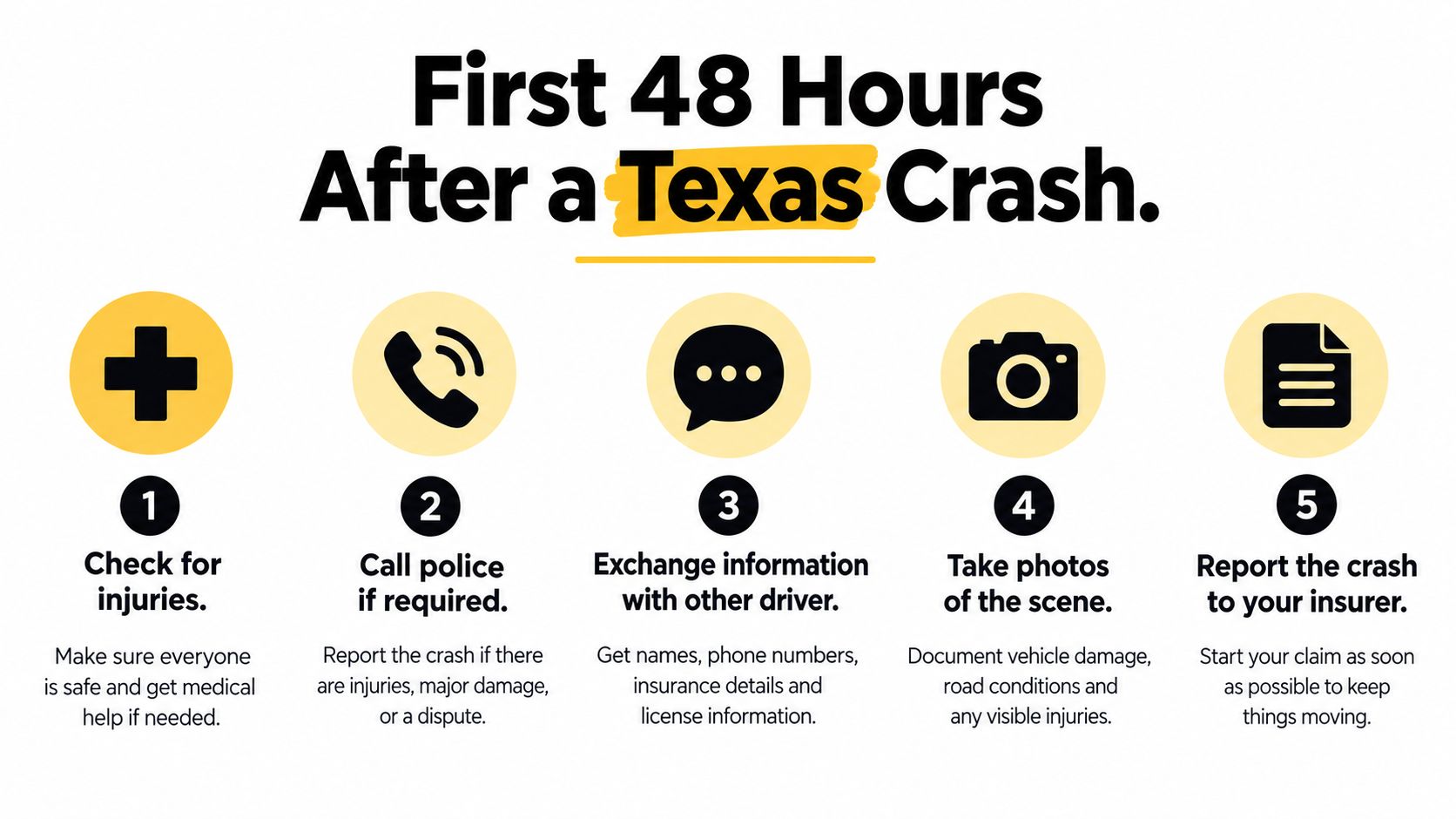
Exchange names, contact information, driver's license details, insurance information, license plates, and vehicle-identification information. Photograph vehicle damage, the scene, road conditions, and visible injuries when it's safe. Ask witnesses for their contact details. TxDOT's collision guidance also advises drivers to notify their insurer promptly.
Seek medical care even if your symptoms seem minor. Some injuries aren't obvious right away, and medical records can help connect your symptoms to the collision. Keep discharge papers, bills, prescriptions, and work-restriction notes. Write down how you feel and how your symptoms affect daily tasks.
Keep the record clear
In an Austin SUV crash, a photograph of a cracked bumper and a saved message from a witness may help explain what happened later. Don't post details about the collision or your recovery online. When an insurer calls, stick to necessary facts, don't speculate about fault, and don't minimize pain or agree to a broad release before you understand your injuries.
For more on insurer communications and protecting a claim, see Dealing With Insurance Companies After a Texas Accident. You can also ask how to obtain the official crash report. TxDOT says officers investigating crashes involving injury, death, or apparent property damage of at least $1,000 must submit a written report by the tenth day; people directly concerned may request its release in writing and pay the required fee, as described in TxDOT's crash-records information.
Building Your Case With Evidence and Negligence
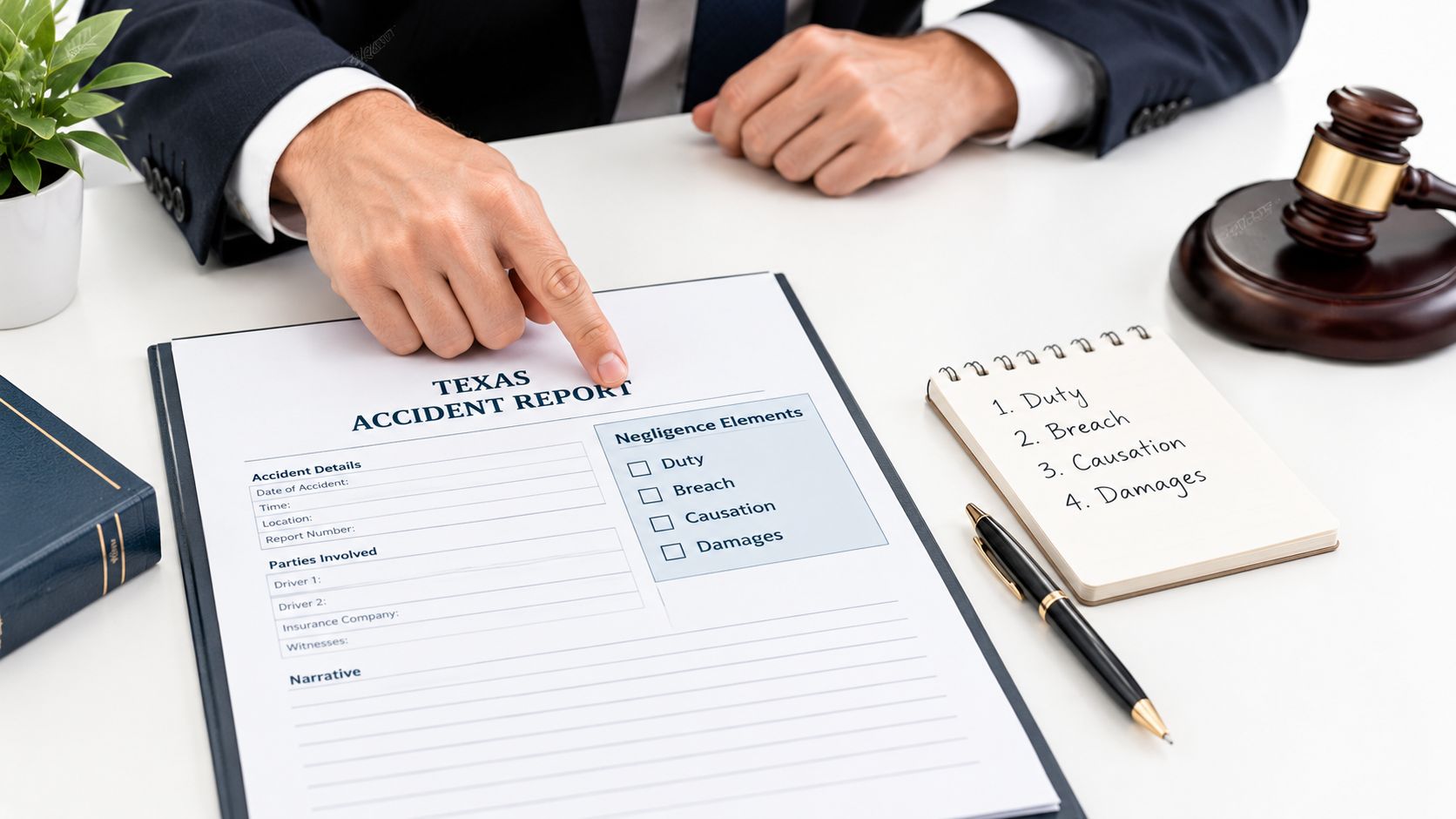
A Texas injury claim generally depends on proving negligence: someone owed you a duty of reasonable care, failed to meet it, and caused harm that resulted in damages. Each part calls for evidence. A crash report, photographs, witness accounts, and vehicle data can help show what the other person did. Medical records help connect that conduct to your injury and document its effects.
Consider a Dallas truck collision. If available vehicle data or dashcam footage shows how the truck was being driven, those details may help establish whether the driver breached a duty. Medical records can then show how the impact caused a particular injury and what treatment followed. The point isn't to collect evidence for its own sake. It's to connect conduct, collision, injury, and loss in a way that can be tested.
Treat the crash report as one part of the case
An official report can identify involved people and record what the officer observed, but it isn't automatically the final word on fault. Compare it with photographs, witness information, vehicle evidence, medical records, and any available video. A lawyer may help request the report and preserve evidence that could otherwise be lost.
Don't wait for an insurance dispute to decide what evidence matters. Save what you have now, and keep a record of where it came from.
For a practical evidence checklist, see what evidence is needed for an injury claim in Texas. Preserve original photos and messages when possible, keep copies of treatment records, and make note of witnesses while their contact details are still available.
Types of Compensation You Can Recover After an Injury
Compensation should reflect the harm the injury caused, not just the first bill that arrived. A useful way to assess damages is to look at the course of the injury: what you've already lost, what future care is medically expected, how your ability to earn has changed, and how the injury affects daily life.
Economic losses can include past and future medical care, rehabilitation, lost wages, reduced earning capacity, household services, and property damage. Non-economic losses may include pain, emotional harm, disfigurement, permanent impairment, and the loss of activities that mattered to you. In a catastrophic injury case, a hospital bill is only one part of the picture. Future surgeries, equipment, attendant care, and reduced earning capacity may also need support.
NHTSA's crash-cost analysis identifies medical expenses, lost productivity, legal and court costs, emergency services, insurance administration, congestion, property damage, and workplace losses as relevant costs. Its population-level benchmarks are not settlement values for an individual claim. They do, however, underscore why a serious injury evaluation should look beyond immediate treatment.
Match each claimed loss to evidence
| Damage Category | Type of Loss | Supporting Evidence | Common Pitfall |
|---|---|---|---|
| Medical care | Past treatment and probable future care | Medical records, bills, physician opinions, treatment projections | Assuming billed charges alone establish the value of all care |
| Income and earning capacity | Missed wages or reduced ability to earn | Employment, wage, tax, and vocational records | Counting the same loss twice |
| Household services | Help with tasks you could previously manage | Care records and documentation of needed assistance | Overlapping the value of services with another loss |
| Property damage | Damage to a vehicle or other property | Photos, repair records, and related documents | Leaving property damage out of the overall loss |
| Non-economic harm | Pain, impairment, disfigurement, and loss of normal life | Treatment notes and a consistent injury diary | Treating serious effects as impossible to document |
Future care and earnings require reliable support, not guesswork. If you're helping a loved one plan for care at home, the Ontario families care funding guide may offer general background on care funding. For a Texas case, review the available types of damages and get advice suited to your evidence.
When the At-Fault Driver Has No Insurance
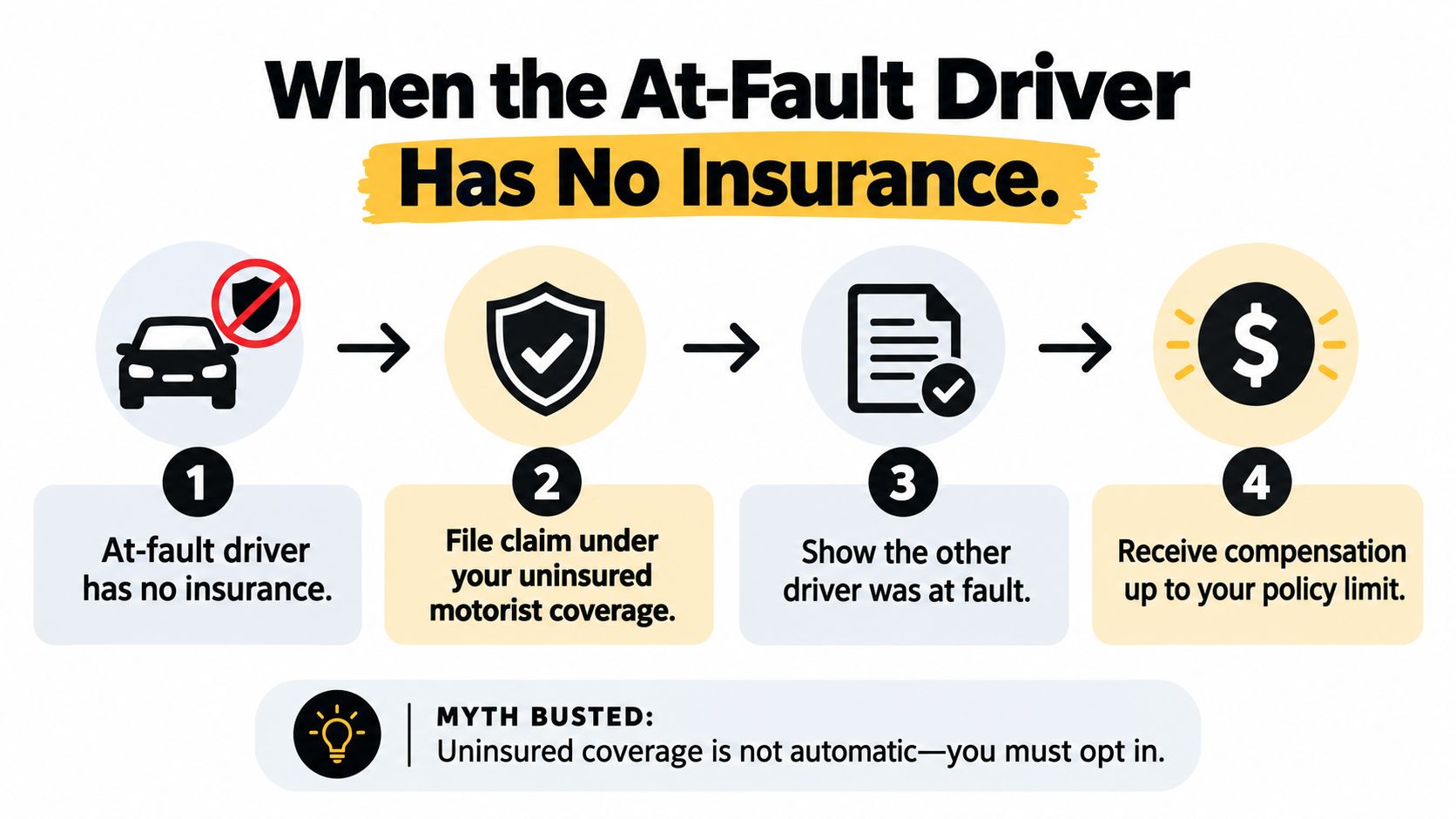
An uninsured driver doesn't automatically mean you have no path to recovery. But your own insurer won't necessarily pay the full value of a claim just because the other driver lacks coverage. Uninsured/underinsured motorist coverage, often called UM/UIM, may help when the responsible driver has no insurance, too little insurance, or can't be identified after a hit-and-run. The Texas Department of Insurance explains the coverage in its consumer guidance.
The risk is real in Texas. TDI data cited in the Texas Tribune's report on uninsured vehicles and Texas medical-damages proposals says more than 2.4 million registered vehicles, about 12 percent, were not matched to an insurance policy. That makes your own policy worth checking before a crash happens, not after.
Protect a possible UM/UIM claim
After a Houston hit-and-run, notify your insurer promptly and preserve the crash report, medical records, photographs, and witness information. Ask which policies might apply, including household, employer, rideshare, and vehicle policies. Review the policy's notice and cooperation requirements, and don't sign a release or give a recorded statement before you understand the coverage and its effect on other claims.
Practical rule: Prove the full injury claim first, then identify which policies may pay and what limits or exclusions apply.
Coverage can involve fault disputes, settlement-consent requirements, competing claims, or policy exclusions. A comparison of underinsured motorist policies for truckers provides insurance-focused context, though your own policy language and circumstances control. For Texas-specific claim issues, learn more about uninsured and underinsured coverage.
Comparative Fault and the Two-Year Deadline in Texas
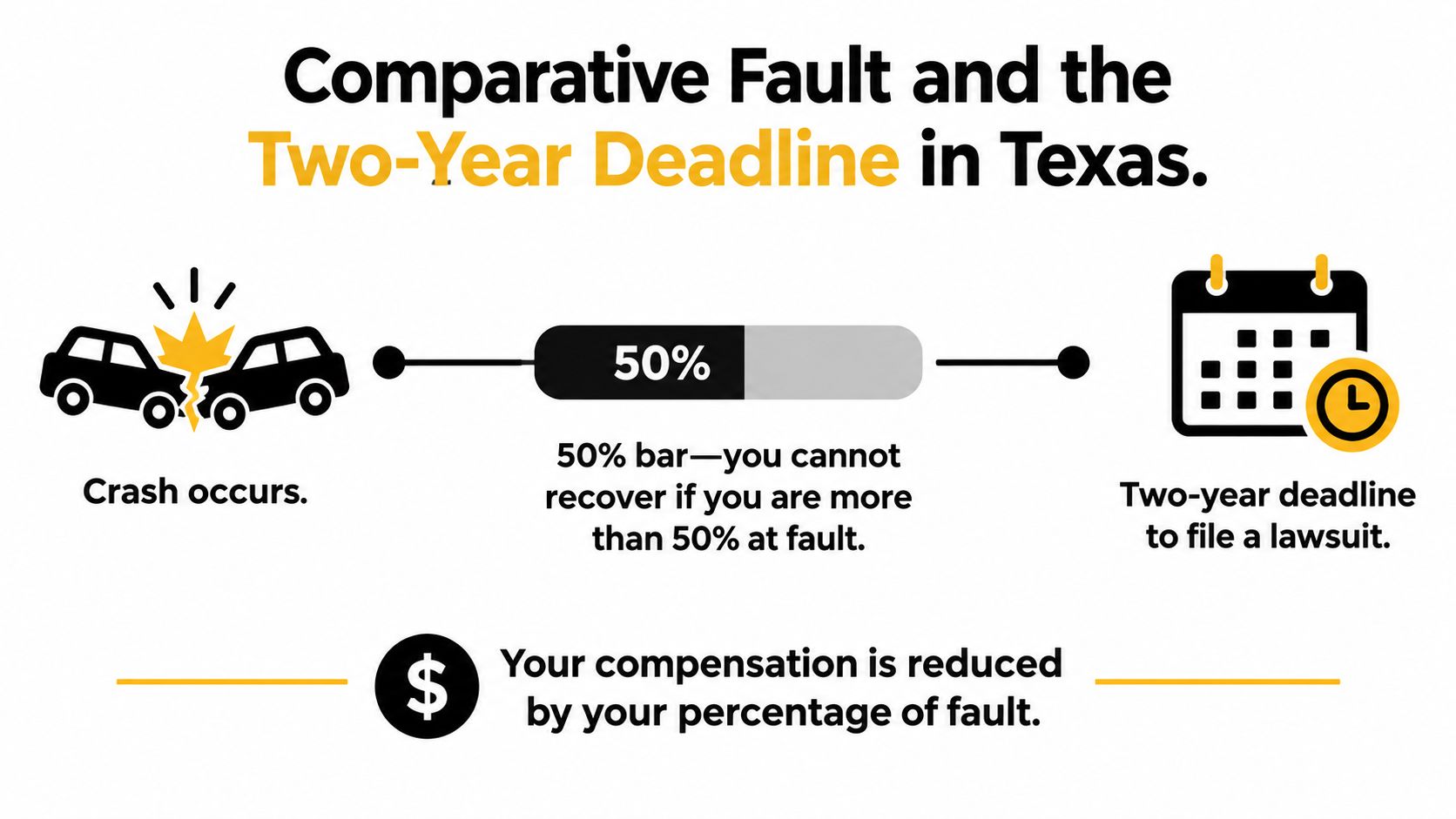
Texas uses a negligence-based system for most personal injury claims. More than one person or company can share responsibility. Under the state's proportionate-responsibility rule, you generally can't recover if you're found more than 50 percent responsible. If you're 50 percent or less responsible, your damages are generally reduced by your share of fault.
For example, after a Houston freeway crash, if the other driver is found 80 percent responsible and you 20 percent responsible, a $100,000 award would generally be reduced to $80,000. Evidence matters because insurers may argue that your actions contributed to the collision. Don't guess about fault or make sweeping statements before the facts are clear.
Know the filing deadline
Many Texas personal injury claims must be filed within two years after accrual, under Chapter 16 of the Texas Civil Practice and Remedies Code, including Section 16.003. The rule and its possible exceptions are set out in the Texas limitations statute. Wrongful-death and governmental claims can involve different rules or notice requirements, so don't assume the usual deadline applies to your situation.
A San Antonio pedestrian struck by a vehicle should preserve evidence and get legal advice promptly. Witnesses can become difficult to locate, video can be overwritten, and vehicles may be repaired or sold. Insurance negotiations don't necessarily preserve your right to file suit, and ongoing treatment doesn't automatically extend a deadline. If the injured person is a minor, has a brain or spinal-cord injury, or the claim involves a government entity, ask about deadlines early.
For another explanation of how fault and filing deadlines can affect a claim, watch:
How a Texas Personal Injury Lawyer Helps You Recover
A lawyer can investigate the crash, preserve evidence, obtain records, identify responsible parties, and handle insurer communications while you focus on treatment and your family. In a serious case, the legal team may also work with medical, vocational, or economic professionals to document future care and income losses. That support is especially useful when fault is disputed, the injury is permanent, or several insurance policies may apply.
The Law Office of Bryan Fagan, PLLC represents people and families in car, truck, motorcycle, pedestrian, rideshare, catastrophic injury, and wrongful-death matters across Houston, Dallas–Fort Worth, Austin, San Antonio, and surrounding Texas communities. The firm handles cases on a no-fee-unless-we-win basis, and a free consultation gives you a chance to discuss your situation and possible next steps.
A Houston car accident attorney or truck crash lawyer Houston families consult can help evaluate the evidence, explain how comparative responsibility may affect recovery, and identify potential UM/UIM issues. A wrongful death lawyer Texas families speak with can also explain how a fatal-crash claim may differ from an injury claim. The right advice depends on the facts, but you don't have to face those questions alone.
Recovery may take time, and no lawyer can promise a particular result. You can still take a useful first step: preserve your records, follow medical advice, and get clear answers about your options.
If you or someone you love was injured in a Texas crash, contact the Law Office of Bryan Fagan, PLLC to discuss your injuries, evidence, and possible sources of compensation. The firm offers a free consultation and represents injury victims on a no-fee-unless-we-win basis. Recovery is possible, and legal help is available while you work toward it.