A serious accident can change your life in seconds, but you don't have to face it alone. You may have left a Houston or Dallas fender-bender thinking you were fine, only to wake up with neck stiffness, a pounding headache, or trouble concentrating. Those symptoms deserve medical attention, even if your car still drives and the damage looks minor.
An acceleration deceleration injury happens when crash forces rapidly move your body, often back and forth. Whiplash is a familiar example, but the force can also affect the brain, spine, muscles, and nerves. Getting checked promptly and keeping clear records can protect your health and help establish what happened if an insurer disputes your claim.
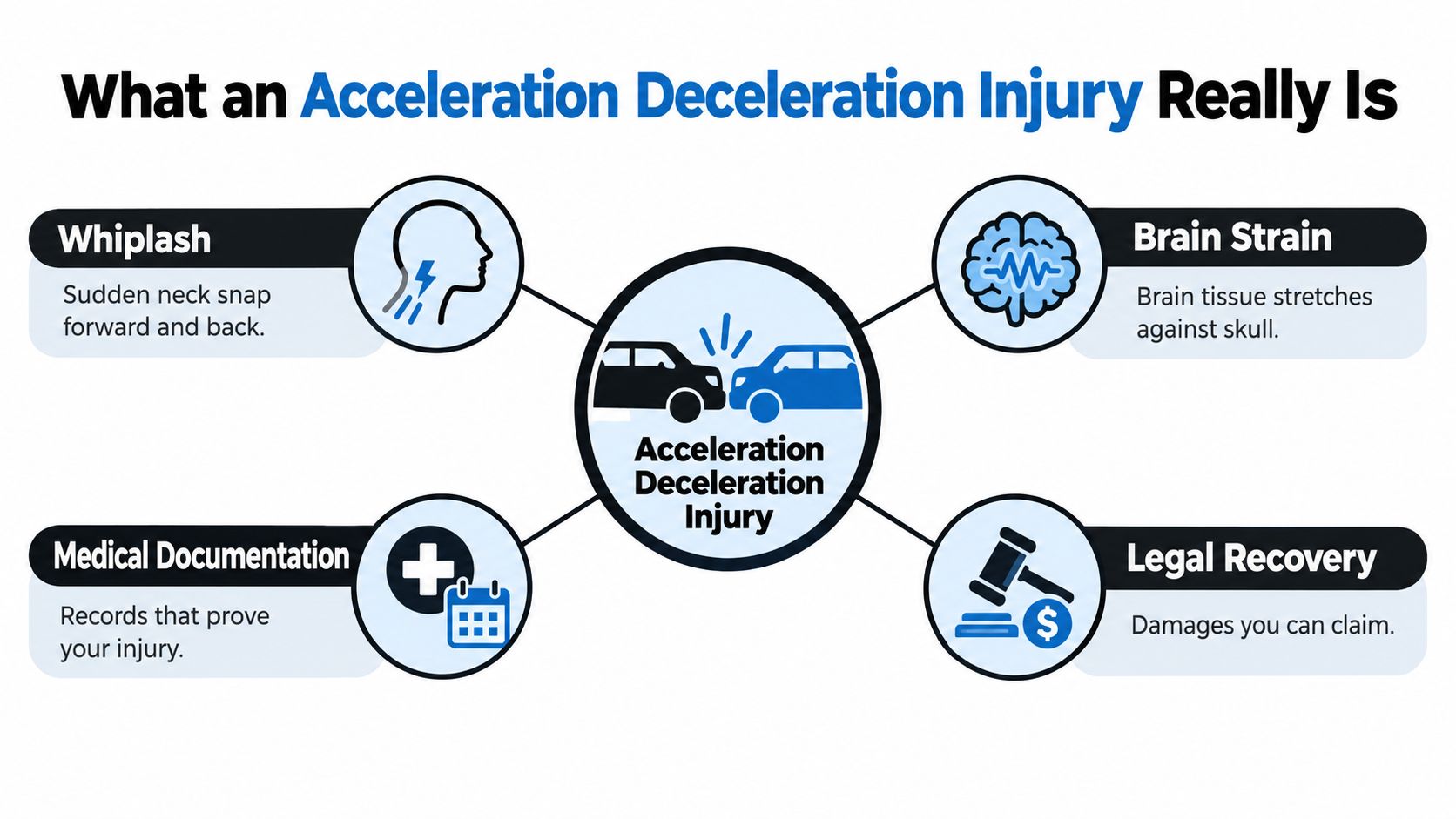
What an Acceleration Deceleration Injury Really Is
You're driving home in Houston when another car bumps yours in traffic. At the scene, you feel shaken but not hurt. Later, your neck tightens, your shoulder aches, and a headache begins. That pattern can follow an acceleration-deceleration injury, even when the crash seemed small.
During a collision, the vehicle changes speed suddenly while your body keeps moving. The seat and seat belt restrain and move your torso, but your head may lag behind. That rapid transfer of energy can strain the neck and other soft tissues. It may also affect the brain without a direct blow to the head.
Why a minor-looking crash still matters
A peer-reviewed analysis of 105 real-world minor U.S. crashes reported an average struck-vehicle speed change of 6.3 km/h and average acceleration of 1.4 g. Among 113 occupants assessed within five weeks, clinicians recorded 427 crash-attributed injuries, and 99.5% of those injuries were classified as the least severe level on the Abbreviated Injury Scale. The publication also cited a National Highway Traffic Safety Administration estimate of approximately 806,000 whiplash injuries annually and associated costs exceeding $9 billion per year (World Health Organization publication).
Those figures don't tell you how seriously you're hurt. They do show why a low-speed impact or modest vehicle damage can't, by itself, settle the question. Your symptoms, examination, diagnosis, and recovery matter.
Practical rule: Don't decide you're uninjured based only on how your car looks or how you felt at the roadside.
Get medical advice, describe every symptom clearly, and keep a record of how the crash affects work and daily life. The same evidence can help a doctor understand your condition and help a lawyer evaluate medical expenses, lost income, pain, and future care. The sections below address symptoms, records, Texas deadlines, shared fault, and the choices involved in pursuing a claim.
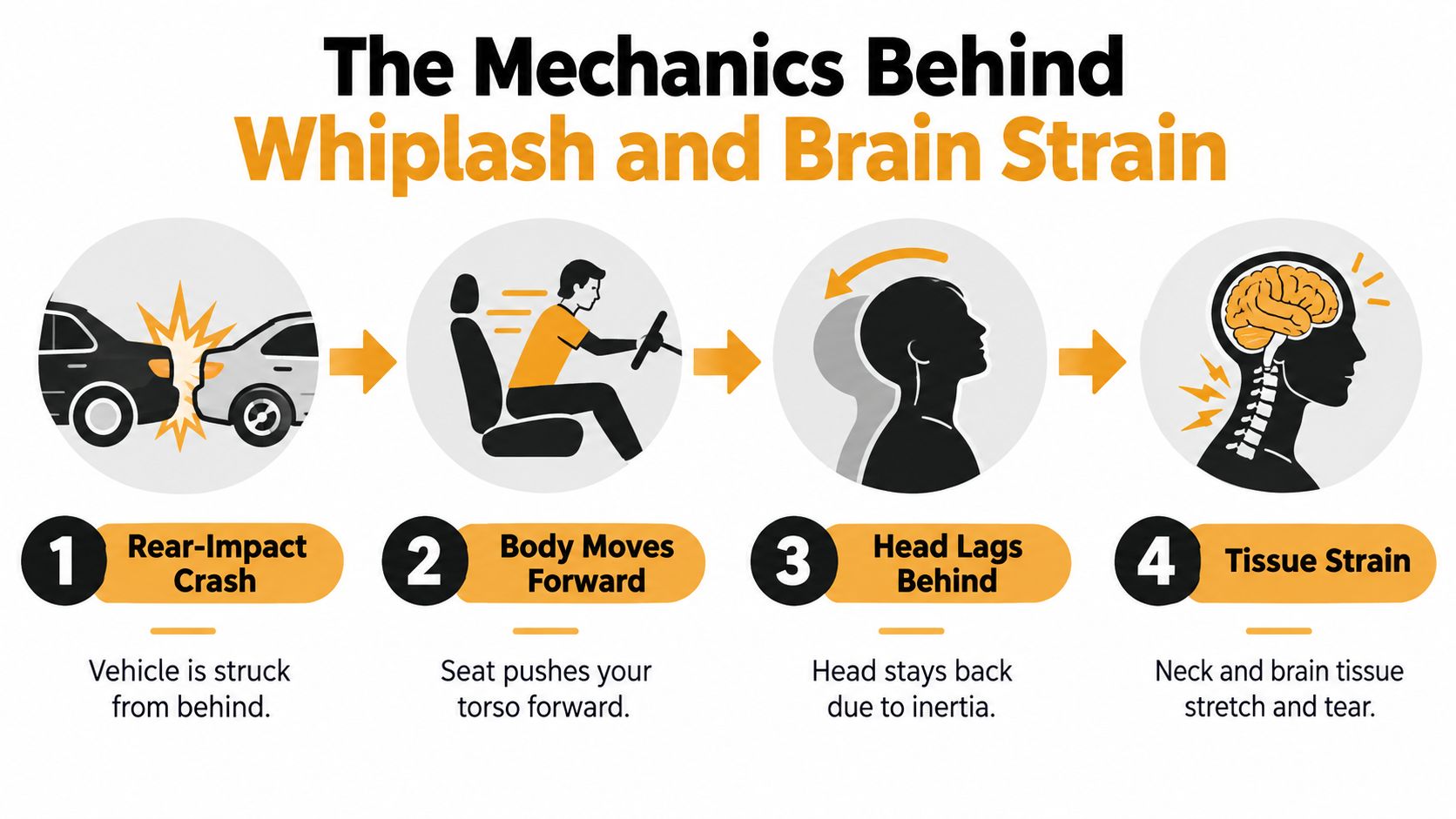
The Mechanics Behind Whiplash and Brain Strain
In a rear-end crash, the seat pushes your torso forward. Your head may lag for a moment, then move as your neck catches up. The movement can resemble a whip or a bobblehead, but the important point is that the neck doesn't always bend as one smooth unit.
The lower cervical spine may briefly form an S-shaped curve. Lower segments extend while upper parts of the neck move relatively into flexion. That uneven motion concentrates movement at individual levels, rather than spreading it evenly across the neck.
Why a scan may not show the whole injury
Biomechanical modeling identified the C4–5 and C5–6 facet joints as the joints with the highest modeled probability of pinching in a rear-impact scenario. The model also described vertebral movement and rotation during the event (biomechanical research on whiplash). A joint capsule, muscle, or nerve can be irritated or strained even when an initial X-ray doesn't show a fracture. A normal image shouldn't be treated as proof that you have no symptoms or need no follow-up.
The brain can also be affected without striking the steering wheel or window. Translational and rotational movement can strain brain tissue. A concussion is a clinical diagnosis based on the injury mechanism and symptoms, not just an imaging result. A CT or MRI may be normal in concussion, so tell your clinician about headaches, dizziness, memory trouble, light sensitivity, sleep disruption, or emotional changes (clinical guidance on mild traumatic brain injury).
This video offers a visual overview of how a rear impact can move the head and neck:
If you're looking for practical information about care and recovery, this guide to whiplash recovery at Midwest Pain may help you prepare questions for your provider. For a Texas claim, preserve what you can about impact direction, seat-belt use, headrest position, vehicle damage, and when symptoms began. If the insurer argues that shared fault reduces or bars recovery, Texas Comparative Fault and the 51% Bar Rule explains how shared fault affects recovery under Chapter 33.
Symptoms That Show Up Right Away and Days Later
Some people notice pain at the scene. Others don't recognize a problem until stiffness, headache, or dizziness develops later. A delay doesn't prove that a crash caused an injury, but it also doesn't automatically disprove it. Tell your provider when each symptom began and how it changed.
Watch for symptoms in several areas:
- Neck and shoulders: Pain, stiffness, limited motion, muscle tenderness, or pain that spreads into the shoulder.
- Head and balance: Headache, dizziness, poor balance, light sensitivity, or slower reactions.
- Nerves and movement: Tingling, numbness, weakness, radiating pain, or difficulty coordinating movements.
- Thinking and mood: Trouble concentrating or remembering, disrupted sleep, irritability, or emotional changes.
Know when to seek urgent help
Don't wait for a routine follow-up if you develop a worsening headache, repeated vomiting, increasing confusion, weakness, a seizure, declining consciousness, or worsening coordination. Seek emergency care for these warning signs. Your clinician can decide whether additional assessment or testing is appropriate.
A simple symptom journal can make a delayed or changing condition easier to explain. Note the date, what you feel, how severe it is, what activity you couldn't do, changes in sleep, and any missed work or appointments. Be accurate rather than dramatic, and don't leave out symptoms because they seem minor.
Write down what changed: “My neck hurts” is useful. So is a clear note that the pain worsened after sitting at work, interrupted sleep, or made turning your head difficult.
Some people also find it helpful to learn about hidden physical signs of trauma, including symptoms that may be less obvious at first. For more about delayed symptoms, see this Texas guide to how long after an accident injuries can appear. Tell your medical provider what you're experiencing, when it started, and whether it's improving or worsening. That supports your care and creates a clearer record if an insurer later questions the timing.
Medical Documentation That Protects Both Health and Claim
Good medical care and clear claim documentation go together. Start with an emergency department if your symptoms are severe or a clinician recommends emergency assessment. For less urgent concerns, contact a doctor or urgent-care provider promptly and follow their advice about next steps.
At the appointment, describe the crash and every symptom, including headaches, dizziness, tingling, sleep changes, and difficulty concentrating. Don't downplay pain to seem tough. Ask what follow-up is appropriate and what symptoms should prompt another visit. A normal initial X-ray doesn't mean you should ignore persistent or worsening problems.

Keep the records that show the full picture
Your care team may recommend imaging, physical therapy, medication, or a referral to a specialist such as a neurologist, orthopedist, or pain specialist. Follow the plan or discuss concerns with the clinician before changing it. Skipping appointments without explanation can interrupt care and leave gaps in the medical record.
Keep copies of:
- Medical records: Discharge summaries, examination notes, imaging reports, therapy notes, and referral information.
- Treatment details: Prescription history, medication effects, home-care instructions, and follow-up plans.
- Work and expense records: Work restrictions, employer correspondence, wage information, travel costs, and out-of-pocket receipts.
- Your own notes: A dated record of symptoms, treatment, missed activities, and changes in daily function.
Your records help show what you reported, what clinicians found, and how your condition affected you over time. This guide to how medical records affect a Texas injury claim explains why consistent documentation matters. Never change or exaggerate a record. If a note is inaccurate, ask the provider about the proper way to correct it.
Texas Deadlines, Police Reports, and the Evidence You Must Preserve
Evidence can disappear while you're focused on getting through the day. Photograph the vehicles, visible injuries, road conditions, and crash location if it's safe. Get names and contact information for witnesses, and ask promptly about preserving dashcam or nearby surveillance footage. Keep work records and receipts that show what the crash has cost you.
Texas law generally gives an injured person two years from the date the injury accrued to file a personal-injury lawsuit under Civil Practice and Remedies Code section 16.003 (Texas Civil Practice and Remedies Code section 16.003). Exceptions and other claim types can have different rules. Wrongful-death claims and claims involving government entities need separate deadline analysis, and government claims may have additional notice requirements. Don't assume that treatment or insurance negotiations pause a filing deadline.
Know what the crash report can and can't do
Under Texas Transportation Code section 550.062, an officer investigating a crash involving injury, death, or apparent property damage of at least $1,000 must submit a written report to TxDOT no later than the tenth day after the crash. TxDOT retains crash records for ten years plus the current year and identifies an $8 certified-copy fee for an eligible requester (TxDOT crash reports and records). The report is a starting point, not a medical assessment. Photos, field notes, or dashcam material may need to be requested from the investigating agency.
| Item | Texas rule | Practical window |
|---|---|---|
| Personal-injury lawsuit | Generally two years from accrual | Get legal advice early |
| Officer's crash report | Due to TxDOT within ten days when the rule applies | Request it when available |
| TxDOT crash records | Retained for ten years plus the current year | Preserve your own evidence promptly |
| Certified crash-report copy | TxDOT lists an $8 fee for eligible requesters | Check eligibility and request process |
Avoid guessing about fault in a recorded statement or signing a release before you understand the claim and your medical condition. Early action is protection, not panic.
Settlement or Trial, How Texas Victims Make That Choice
A settlement can resolve a claim without a trial, but accepting one usually means giving up the right to seek more compensation for the same injury later. That decision should wait until you understand your medical condition and the likely costs of continued care. A quick offer may not account for symptoms that are still changing.
A claim's value depends on the evidence and losses, not just the name of the injury. Relevant damages may include past and future medical expenses, lost wages, reduced earning capacity, pain and suffering, and impairment. Keep bills, wage records, treatment notes, and information about limitations in daily life so your lawyer can assess the claim as a whole.
Compare the trade-offs
Negotiation may be more private and give you a faster, more predictable resolution, but an insurer may dispute fault, the cause of symptoms, or the amount of future care. Filing suit can give your lawyer formal tools to seek evidence and prepare for trial, but it can take longer and brings uncertainty. A trial gives a judge or jury the decision, not either party.
Texas follows proportionate responsibility under Civil Practice and Remedies Code section 33.001. If you're found more than 50 percent responsible, you can't recover damages. If you're 50 percent or less responsible, your award is generally reduced by your share of responsibility (Texas Civil Practice and Remedies Code section 33.001). For example, the verified statutory explanation gives a $100,000 damage finding reduced by 20 percent fault to $80,000.
That rule makes evidence important when an insurer tries to shift blame. Don't guess about what happened or agree to a fault assessment you don't understand. The firm's guide to settlement versus trial in a Texas personal injury case can help you prepare questions for a lawyer. Ask what evidence supports the offer, which future losses it covers, and what rights you'd give up by signing.
Your Next Steps and How a Texas Lawyer Can Help
Start with your health. Arrange medical care, report symptoms clearly, follow your treatment plan, and keep copies of records and receipts. Preserve photographs, witness details, work documents, and the crash report when available. Don't give a recorded statement or accept a quick settlement before you understand the injury and the claim.
A Texas personal injury lawyer can investigate how the crash happened, obtain available reports and vehicle evidence, interview witnesses, and work with medical or crash-reconstruction professionals when needed. The lawyer can also evaluate shared fault, document medical costs and lost income, assess future-care needs, and handle insurer negotiations or litigation. Ask how the fee works, what costs may arise, and who will communicate with you.
After a Houston freeway crash, you may need a Houston car accident attorney to help gather evidence and address an insurer's questions. A serious commercial-vehicle collision may call for a truck crash lawyer Houston. If a family has lost someone, a wrongful death lawyer Texas can explain the separate legal issues involved. The Law Office of Bryan Fagan, PLLC represents injured people and families across Texas and offers free consultations with contingency-fee representation, meaning no fees unless the firm wins.
You don't need every answer before asking for help. Prompt care, careful records, and timely legal advice can make the path forward clearer while you focus on recovery.
If you've been hurt in a crash or lost a loved one, contact Law Office of Bryan Fagan, PLLC to schedule a free consultation about your acceleration deceleration injury and Texas claim. The firm can discuss evidence, deadlines, and possible compensation, with no fees unless it wins. Recovery takes time, but you and your family don't have to face the legal process alone.