A serious accident can change your life in seconds, but you don't have to face it alone. If you're reading this days after a fatal crash, you're probably juggling funeral calls, insurance calls, and questions you never expected to ask. A wrongful death attorney free consultation gives you one clear, no-cost place to start.
A Free Consultation After a Fatal Crash in Texas
A widow in Houston sits at her kitchen table three days after a freeway crash took her husband. The funeral home needs decisions, an insurance adjuster keeps calling, and the crash report doesn't answer the question she cares about most. What happens to her family now?
That uncertainty is normal. You don't need to decide whether to file a lawsuit before you talk to a Texas personal injury lawyer. A free consultation isn't a commitment to sue. It's a conversation about who can file, what deadlines apply, what evidence matters, and what your options are while that evidence is still fresh.
Why Talking Early Helps
Vehicles get repaired or scrapped. Video gets overwritten. Witnesses move or forget details. When you meet early, a lawyer can tell you what to preserve, what not to sign, and which insurer should be put on notice first.
You should also expect honesty, not pressure. A consultation doesn't guarantee recovery, and any lawyer who promises an outcome in the first meeting isn't being straight with you. What you can expect is a clear map. You'll leave knowing whether Texas law gives your family a claim, who should bring it, and what steps come next.
You don't have to have every document or every answer before you call. Bring what you have. Ask what you're missing.
The goal that first day is simple. Trade confusion for a plan, and let someone else carry the legal weight while you focus on your family. Recovery is possible, and help is available.
What a Texas Wrongful Death Consultation Actually Covers
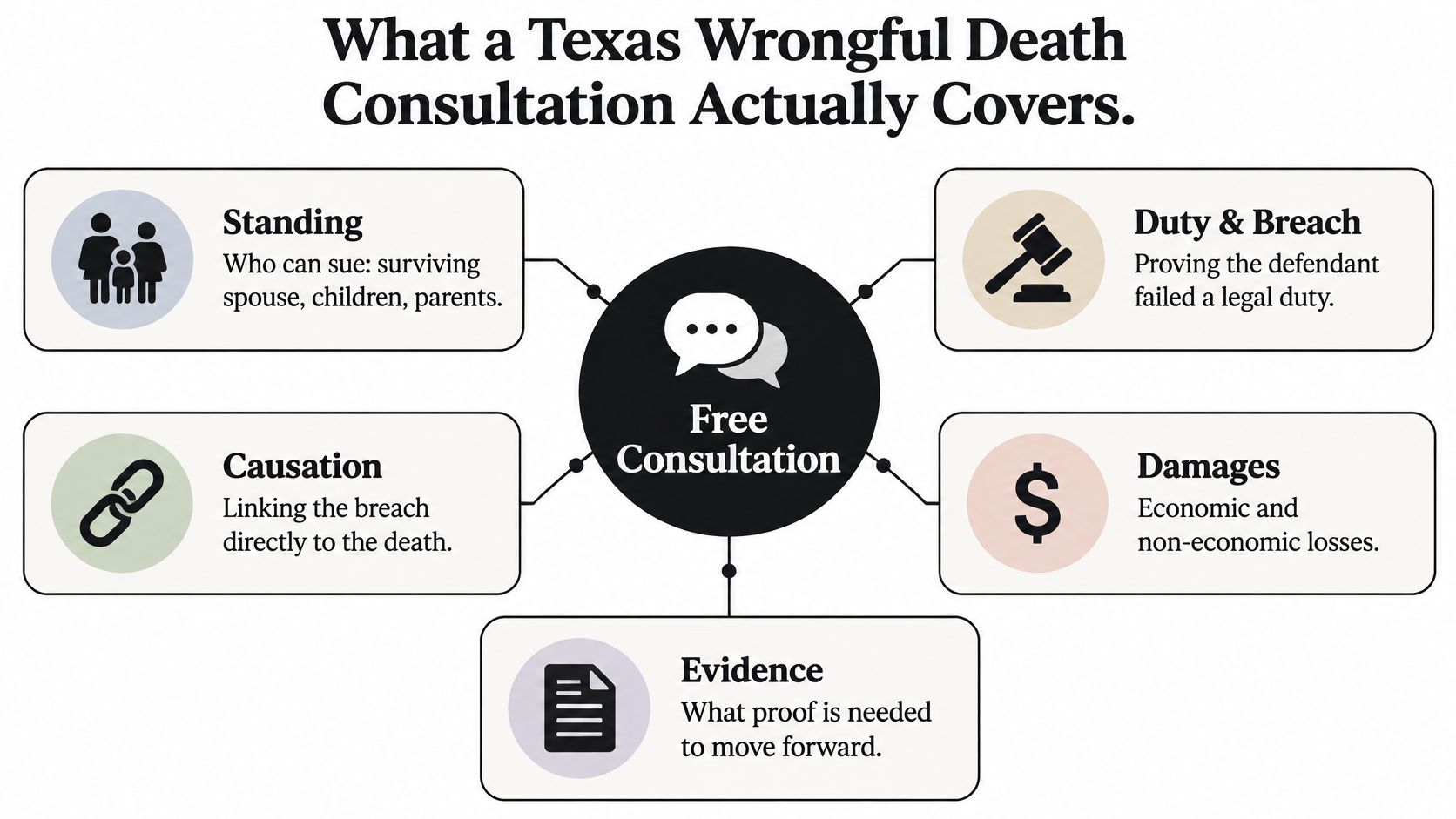
A good consultation is structured, not a sales pitch. The lawyer is evaluating standing, liability, damages, deadlines, and coverage, all in one conversation. That is what it looks like in the room.
Who Has Standing to File
Under Chapter 71 of the Texas Civil Practice and Remedies Code, Texas gives the primary right to seek damages to the surviving spouse, children, and parents of the person who died, and Section 71.004 identifies them as the exclusive beneficiaries of a wrongful death action, as set out in Texas Civil Practice and Remedies Code Chapter 71. Siblings and extended family often ask about filing, so the lawyer will sort this out first. Getting the claimants right protects the whole case.
That same statute authorizes actual damages when legal liability exists. It also permits exemplary damages when the death resulted from a willful act or omission or gross negligence.
Wrongful Death Versus a Survival Claim
These are two different claims, and families often have both. A wrongful death claim belongs to eligible relatives for their own losses. A survival claim belongs to the estate for claims your loved one could have pursued before death. Your lawyer separates them early because they involve different damages and, at times, different timing.
How Long Do You Have to File a Claim in Texas
The general deadline is two years from the date of death, and a separate survival action can have different timing, as explained in guidance on Texas wrongful death and survival claims from UNT Dallas College of Law. Don't assume settlement talks extend that deadline. They don't.
The lawyer will also discuss damages beyond funeral expenses. Depending on the evidence, that can include lost income and support, household services, loss of companionship and society, and mental anguish. Representation for families who lost a loved one to negligence is described by a Wrongful Death Lawyer in Texas, and a wrongful death lawyer Texas families trust will explain each category in plain language during that first meeting.
Documents and Questions to Bring to the Meeting
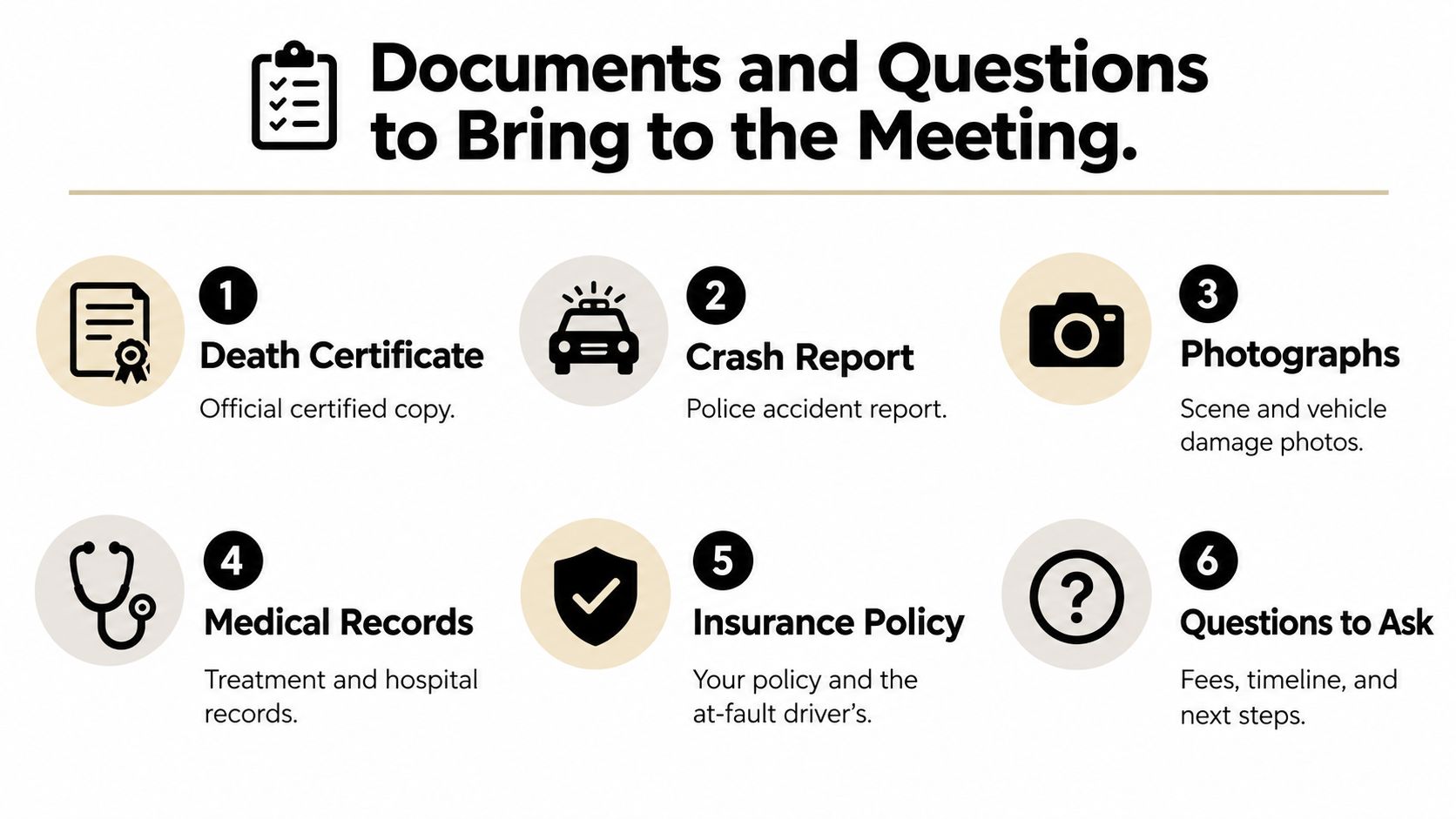
You don't need a perfect file. You need a useful starting file, and gathering it the night before makes the meeting far more productive.
What to Gather First
- Death Certificate and Crash Report: Bring certified copies if you have them, plus any police or incident report.
- Photos and Witness Names: Scene photos, vehicle damage, and contact information for anyone who saw the crash.
- Medical and Funeral Records: Treatment records before death, hospital bills, and funeral or burial costs.
- Insurance Information: Every policy that might apply, not just the other driver's policy.
- Income Documentation: Pay records, tax returns, or employer information showing the support your loved one provided.
If you're missing something, say so. A lawyer can often order records you can't easily get while grieving.
Questions Worth Asking
Ask how the firm handles fatal crash cases, who'll be your main contact, and how often you'll get updates. Ask how fees and expenses work, what the next thirty days will look like, and what you should stop doing right now, especially with insurers.
Law firms prepare for these meetings too, and reviewing common intake questions for injury lawyers can help you anticipate what you'll be asked about the crash, treatment, and insurance. That preparation cuts both ways. You'll answer more completely, and you'll spot gaps in your own file before you walk in.
Practical rule: Bring every insurance card, letter, and policy declaration page you can find, even if you're not sure it applies. Coverage analysis starts with paper, not guesses.
Write your questions down. Grief makes details hard to hold, and there's no penalty for reading from a list.
How a Texas Attorney Evaluates a Wrongful Death Claim
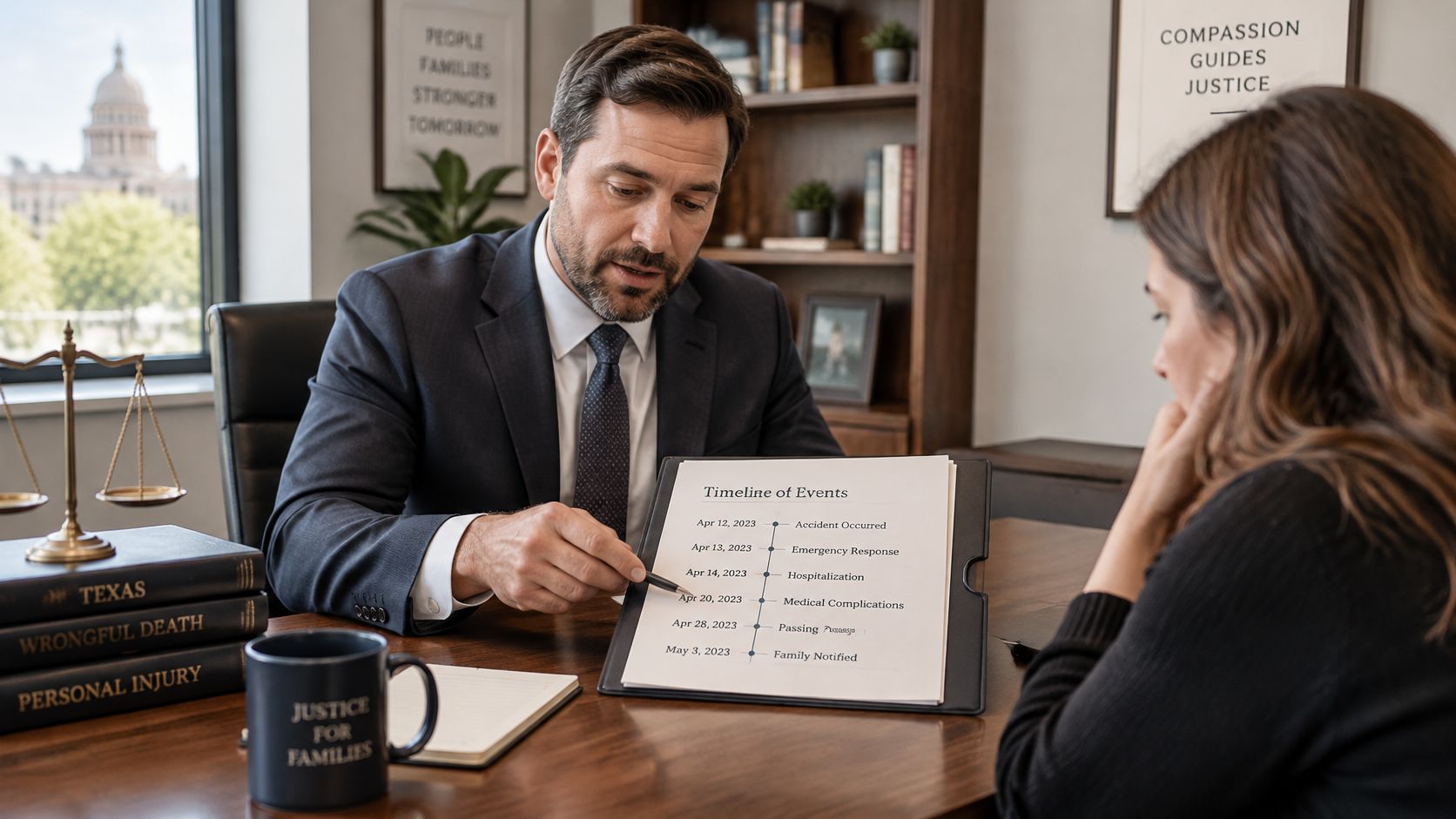
After a Houston freeway crash, a family often assumes the police report settles fault. It doesn't. A lawyer builds the case from evidence, then tests it against Texas fault rules.
The photo below reflects the kind of timeline review that happens once records start coming in.
Duty, Breach, Causation, and Damages
The lawyer asks four questions. Did the other driver or company owe a legal duty? Did they breach it through negligence, carelessness, or a wrongful act? Did that breach cause the death? What legally recognized damages followed?
Evidence answers those questions. Photos, vehicle data, surveillance video, cell phone or commercial driver records, maintenance files, toxicology results, witness statements, and medical records all matter. A Houston car accident attorney or a truck crash lawyer Houston families hire for a fatal commercial crash will move quickly to preserve that material before it's lost.
The video below offers additional background on how these evaluations unfold.
Proportionate Responsibility in Plain English
Texas uses proportionate responsibility under Chapter 33. A claimant can't recover if their own responsibility is greater than 50 percent, and a $100,000 award could be reduced to $70,000 if the injured driver was found 30 percent responsible, under the framework in Texas Civil Practice and Remedies Code Chapter 33.
That's why insurers fight over percentages. A few points of fault can change the value of a claim, even when the loss itself isn't disputed. Understanding the difference between a Texas wrongful death claim and a survival action also matters here, because fault and damages must be allocated to the correct claim.
Case value, in the end, rests on documented liability and documented damages. Severity of grief alone doesn't set the number. Proof does.
Contingency Fees and How the Math Works
A free consultation should never leave the economics vague. You deserve the math in writing before you sign anything.
Texas law requires a contingent fee contract to be written and signed by both lawyer and client, and the client should receive a written closing statement showing the recovery and distribution method, as described in State Bar guidance on contingent fee contracts. Ask whether the percentage changes at settlement, trial, or appeal. Ask whether expenses come out before or after the fee is calculated. That ordering alone can move your take-home by thousands.
A Sample Calculation You Can Follow
The figures below are hypothetical and for illustration only. They show why a percentage alone never tells you your net recovery.
| Line Item | Amount | Notes |
|---|---|---|
| Gross recovery | $300,000 | Hypothetical settlement amount |
| Attorney fee at 33.3% | $100,000 | One-third is a common rate; yours must be stated in the written contract |
| Case expenses | $18,000 | Reconstruction, experts, filing fees, records |
| Medical liens or subrogation | $25,000 | Verified and negotiated before distribution |
| Net to family | $157,000 | Shown on the written closing statement |
Read that table top to bottom and the point becomes clear. A 33.3 percent fee sounds modest until $43,000 in expenses and liens comes off on top of it. In this example, the family's check is $157,000, a little more than half the gross.
Questions That Reveal Your Net Recovery
- Fee Timing: Is the fee calculated on the gross recovery, or on what's left after expenses?
- Expense Risk: Who pays expert and filing costs if the case doesn't recover?
- Liens: Will the firm verify and negotiate medical liens before disbursing funds?
Those answers create an auditable chain from gross settlement to your final check. You can read more about how contingency fees work in Texas personal injury cases before your meeting, then ask the lawyer to run sample figures using realistic expenses and liens.
If a lawyer won't walk through a sample distribution on paper, keep looking.
No upfront attorney fee means you can get advice without writing a check to start. It should never mean accepting a fee structure you can't follow line by line.
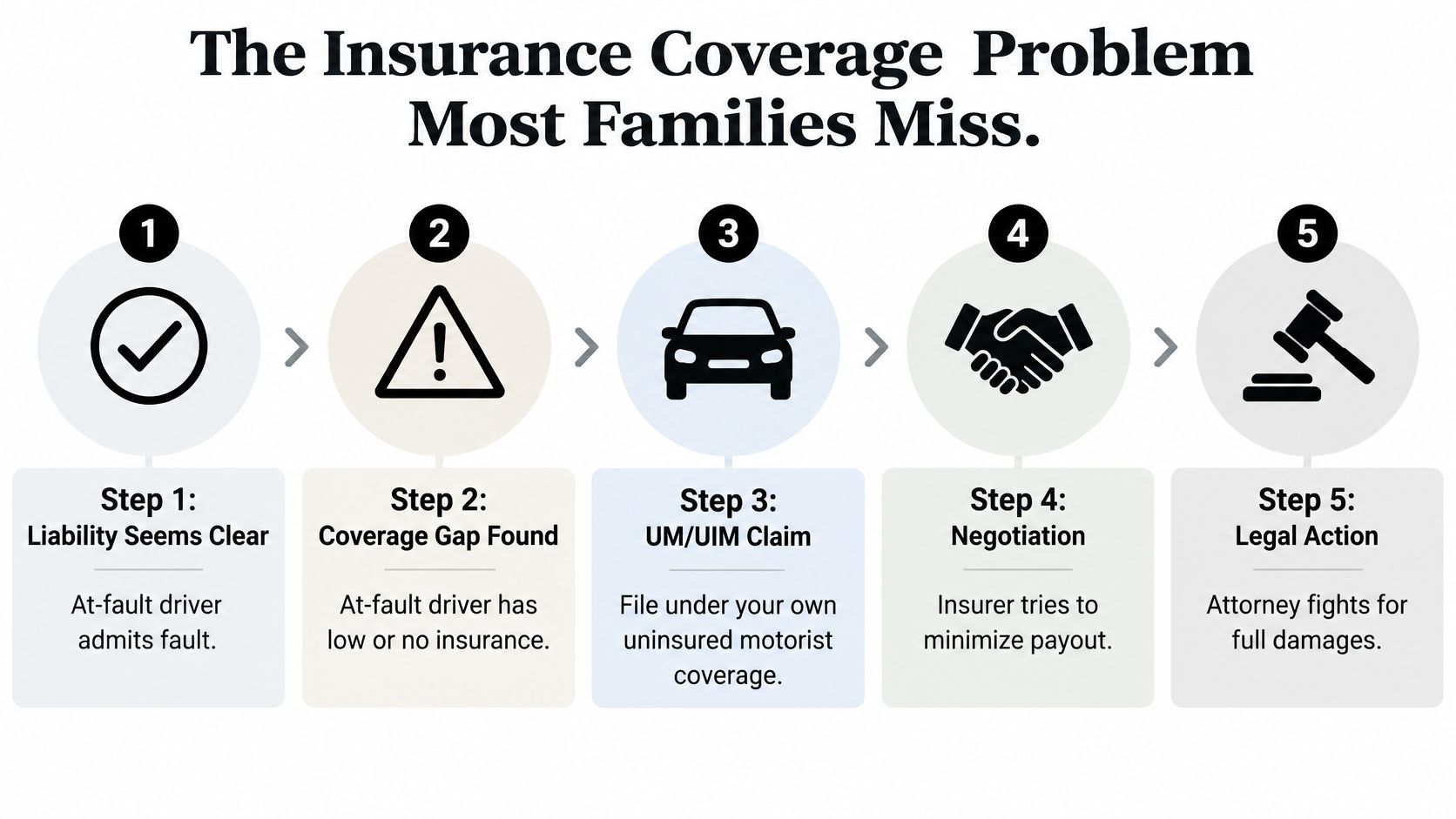
The Insurance Coverage Problem Most Families Miss
Liability can look obvious and recovery can still fall short. The problem is often coverage, not fault.
When the At-Fault Driver Cannot Pay
The Texas Department of Insurance notes that uninsured and underinsured motorist coverage may apply when the at-fault driver has no insurance, insufficient insurance, or is unidentified in a hit-and-run, and Texas UM/UIM coverage generally includes a $250 deductible, according to Texas Department of Insurance consumer guidance on commercial insurance rights. Covered losses can include bodily injury, death, and related damages.
Pursuing your own UM/UIM insurer isn't admitting fault. It's a contract claim under a policy your family paid for, and it requires timely notice and careful policy analysis.
Policies to Inventory at the First Meeting
- Household Policies: Auto policies for resident relatives may matter.
- Employer and Commercial Policies: Company vehicles and commercial trucks can bring separate coverage.
- Rideshare and Umbrella Policies: Additional layers may apply depending on how the crash happened.
- The At-Fault Driver's Policy: Limits may have to be divided among multiple claimants.
Hit-and-run claims raise extra proof issues, including possible physical contact requirements and policy exclusions. Your lawyer should inventory every policy, calendar notice deadlines, and compare available coverage before you sign any release. Background on uninsured and underinsured coverage in Texas helps you understand why that inventory can't wait.
A release signed too early can close doors you didn't know existed. Get the coverage inventory first.
In fatal crashes involving a commercial vehicle or an uninsured driver, damages often exceed the first policy anyone mentions. Coverage work is where a consultation earns its value.
What a Texas Wrongful Death Case Can Look Like in Real Life
Consider a San Antonio family after a fatal intersection crash. At the scene, first steps still matter for surviving occupants and witnesses. TxDOT advises exchanging names, addresses, phone numbers, vehicle identification and license plate numbers, driver's license information, and insurance details, and calling police whenever a fatality is involved or a driver leaves the scene, as noted in TxDOT guidance on what to do after a collision.
In the first consultation, the lawyer identifies the spouse and children as claimants, separates the estate's survival claim, and sends preservation letters for video and vehicle data. The family gathers income records and funeral bills while counsel handles adjusters.
Next comes investigation and a demand supported by records, not adjectives. If the insurer disputes fault or undervalues the loss, the case moves into litigation and, if necessary, trial preparation.
That process has a shape, even when grief makes everything feel formless. You focus on your family. Your lawyer focuses on deadlines, evidence, and negotiation.
Your Next Steps and How to Reach a Texas Wrongful Death Lawyer
Preserve photos, vehicles, and paperwork. Don't post about the crash on social media, don't guess about fault to an adjuster, and don't sign an insurer's release without legal review. Schedule a wrongful death attorney free consultation soon, well before the two-year deadline creates pressure. The Law Office of Bryan Fagan, PLLC invites families in Houston, Dallas and Fort Worth, Austin, San Antonio, and surrounding communities to request that no-cost conversation, with no attorney fee unless the firm obtains a recovery. You don't have to carry this alone.
If you've lost a loved one in a Texas crash, the Law Office of Bryan Fagan, PLLC offers a free, no-obligation wrongful death consultation to review standing, deadlines, evidence, and insurance coverage. There's no attorney fee unless the firm obtains a recovery, so you can get clear answers before you make any decision. Visit Law Office of Bryan Fagan, PLLC to request your consultation and take the next step for your family.