A serious accident can change your life in seconds, but you don't have to face it alone. If you need answers about a Wrongful Death Lawsuit Payout after losing someone you love, you're probably looking for clarity, not a sales pitch or a made up average. This guide gives you straight answers in plain English, so you can protect your family and make decisions with confidence.
When Families Start Asking About a Wrongful Death Payout in Texas
Most families don't start with a legal question. They start with a phone call from a hospital, a trooper at the door, or a loved one who never came home from work. Within days you're planning a funeral, fielding calls from relatives, and hearing from an insurance adjuster who sounds kind but is already asking questions you aren't ready to answer.
That's usually when the money questions hit. Who pays the hospital bills. How the mortgage gets paid without your spouse's paycheck. Whether the driver who caused this will be held accountable. A Wrongful Death Lawsuit Payout isn't a price tag on a life, and no honest Texas personal injury lawyer will treat it that way. It's the civil law's way of replacing the support your family lost and recognizing the human harm you now live with every day.
Texas doesn't publish one universal average payout that predicts your case. Your family's recovery will rise or fall on specific evidence, specific relationships, and specific insurance coverage.
After a Houston freeway crash, for example, one family may have clear video, a commercial policy, and decades of lost income to document. Another family, after a rural two lane collision, may face disputed fault and a driver with almost no coverage. Those cases won't, and shouldn't, produce the same number.
What You Should Take From This Guide
You'll learn who can file, what damages Texas recognizes, what moves a settlement up or down, and why the money rarely arrives as one equal check for everyone. You'll also learn the deadline that can end a strong claim and the practical steps that protect value in the first weeks. Read it at your pace. You don't need to memorize statutes to make a good next decision.
How Texas Law Defines a Wrongful Death Claim
Texas wrongful death law comes from Chapter 71 of the Civil Practice and Remedies Code. Under Chapter 71 on wrongful death and eligible beneficiaries, damages are allowed when a person's death results from another party's wrongful act, neglect, carelessness, unskillfulness, or default, and the surviving spouse, children, and parents are the primary beneficiaries.
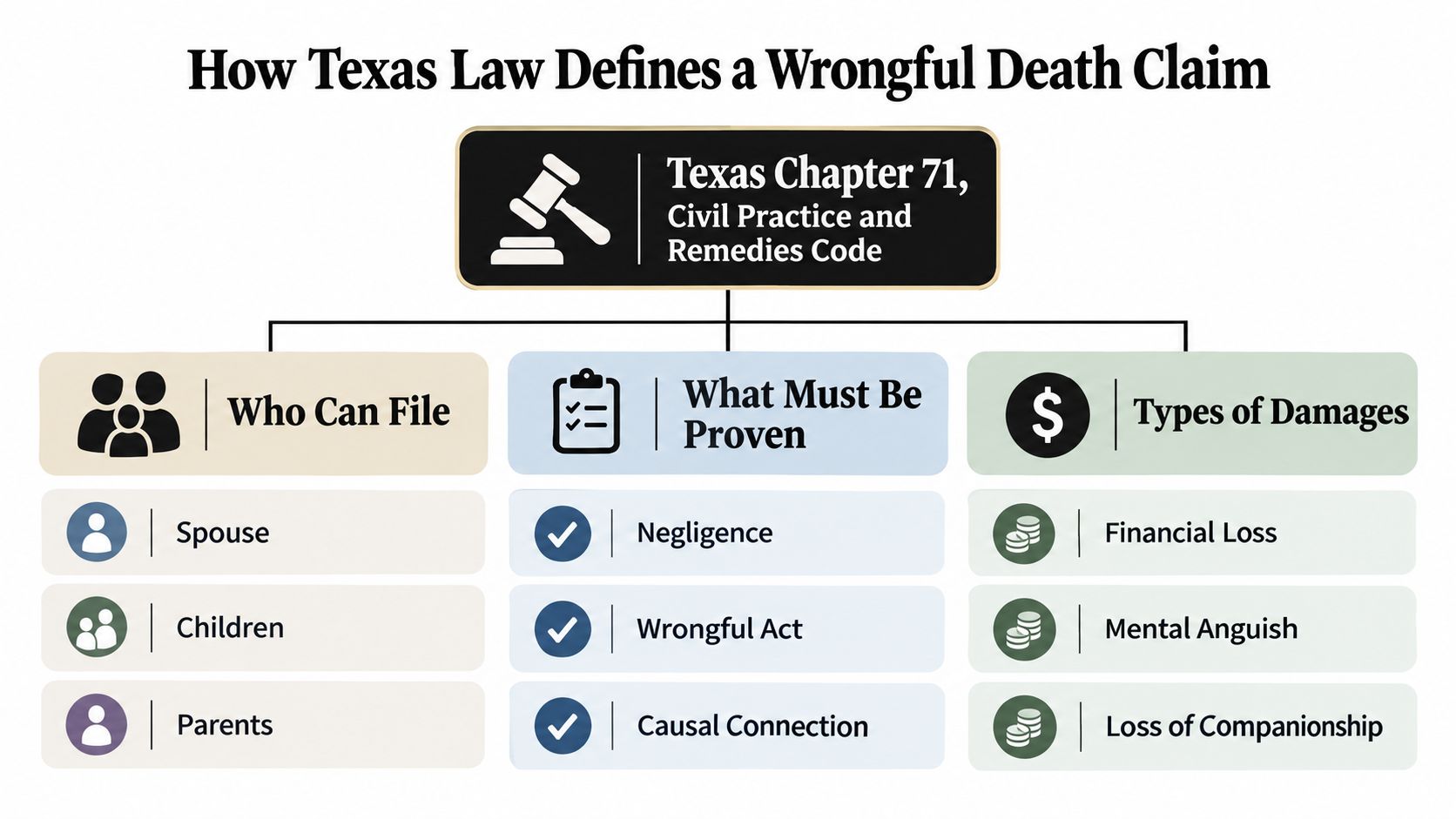
In plain terms, you must prove someone failed to use reasonable care, or acted wrongfully, and that failure caused the death. That's negligence plus causation. A driver texting through an intersection, a trucking company sending out an exhausted driver, or a drunk driver crossing the center line can all fit that definition if the evidence connects the conduct to the fatal injuries.
A Civil Claim Is Not a Criminal Case
Police and prosecutors decide criminal charges. Your family decides whether to bring a civil claim for money damages. The cases can move at the same time, and a civil claim can succeed even when no criminal conviction follows, because the purpose and burden of proof are different.
Don't confuse a wrongful death claim with a survival claim. They're related, but they aren't the same, and the difference between a Texas wrongful death claim and a survival action affects who brings the claim and what losses it covers. Wrongful death focuses on the survivors' losses. A survival claim focuses on claims the deceased person could have brought before death.
If you're unsure where your family fits, a Wrongful Death Lawyer in Texas provides representation for families who lost a loved one to negligence and can sort standing, beneficiaries, and related claims before you sign anything. That early sorting matters, because naming the wrong claimant or missing a related claim can create problems that are hard to fix later.
Types of Damages That Make Up a Texas Wrongful Death Payout
A payout isn't one lump invented by an adjuster. It's built category by category, and each category needs its own proof. When families understand the building blocks, settlement talks make a lot more sense.
Economic Damages
Economic damages are the financial losses you can document with records. Think lost wages and earning capacity, lost benefits, medical bills tied to the fatal injury, funeral and burial expenses, and the value of household services your loved one provided. Pay stubs, tax returns, employer records, and receipts carry real weight here. If your spouse handled childcare, home repairs, bookkeeping, or care for an aging parent, that unpaid work has value too, and a good claim documents it instead of ignoring it.
Non-Economic Damages
Non-economic damages cover the human losses that don't come with an invoice. Texas law recognizes loss of companionship and society, mental anguish, and the loss of guidance, care, and relationship your family expected to have for years. A minor child losing a parent's daily guidance is different from an adult child losing a close but independent parent. Both are real. They're proved differently, through testimony about the relationship, routines, dependence, and the life you shared.
Exemplary Damages
Texas also permits exemplary damages when the death was caused by a defendant's willful act or omission or gross negligence. These aren't automatic and they aren't part of every case. A severely impaired or reckless driver presents a different picture than a momentary mistake, and the evidence must support that higher level of misconduct.
| Damage Category | What It Covers | Texas Examples |
|---|---|---|
| Economic | Lost income, benefits, services, medical and funeral costs | A Houston wage earner whose paycheck paid the mortgage and childcare |
| Non-economic | Mental anguish, loss of companionship, loss of guidance | A spouse losing a life partner, a child losing daily parental guidance |
| Exemplary | Willful conduct or gross negligence | A fatal crash caused by a highly impaired or reckless driver |
Practical rule: If a loss matters to your family, document it. Insurers discount what you can't prove, even when everyone in the room knows it's real.
One more reality shapes every category. Insurance policy limits can act as a practical ceiling on what an insurer will pay voluntarily, even when documented damages are larger. That's why identifying every policy and every responsible party matters as much as adding up bills.
Five Factors That Move a Settlement Up or Down
Families often ask why one case resolves for far more than another that sounds similar on the surface. In my experience, five factors explain most of that gap, and you can influence some of them.

- Strength of Liability Evidence: Clear video, consistent witnesses, and a crash report pointing one direction give you an advantage. If drivers blame each other and there's no independent witness, an insurer will price that risk into every offer.
- Income and Expected Work Life: A younger worker with a long expected career and documented raises or benefits usually presents larger future economic loss than someone already retired. That's math, not a judgment about worth.
- Closeness and Dependency: A spouse and minor children who depended daily on the deceased person present different evidence than financially independent adult relatives who lived far away.
- Available Insurance Coverage: A commercial truck policy, an employer policy, and your own underinsured motorist coverage can change what's collectible. A driver with minimal coverage and no assets limits your options, no matter how strong the grief is.
- Comparative Responsibility: Texas fault rules matter. If the insurer argues your loved one shared fault for the crash, it will push to reduce the payout, and fault evidence becomes central to negotiation.
These are the same kinds of variables discussed in the factors that affect an injury settlement in Texas, applied here to the facts of a fatal crash. A truck crash lawyer Houston families call after a commercial collision, for example, will look hard at company records and coverage layers, because the driver alone may not be the only responsible party.
You can't change your loved one's age or rewrite the crash. You can preserve records, avoid guessing about fault in recorded calls, and make sure every policy gets identified before you accept an early number. That's where families protect value.
Real-World Texas Case Examples
Examples help, as long as you treat them as illustrations and not promises. Two families can lose someone on the same weekend in Texas and face completely different legal and insurance pictures.
The image below reflects what these cases are really about, the everyday relationships and routines that end when a fatal crash happens.

A Working Parent in a Commercial Truck Crash
After a Houston freeway crash, a working parent is killed by a distracted commercial driver. The spouse is young, the children are minors, and wage records show steady income and benefits the family counted on. Liability evidence from the truck, witnesses, and the crash investigation is strong, and a commercial policy is available. That combination supports substantial economic loss, loss of companionship, and loss of parental guidance. It also raises allocation questions early, because the spouse and each child have separate losses.
A Retired Adult Hit by an Uninsured Driver
Contrast a retired adult killed in a Dallas area intersection crash by a driver with no insurance. Future wage loss may be limited, but funeral costs, mental anguish, and loss of companionship for a surviving spouse remain significant. The practical fight may shift to the family's own uninsured or underinsured motorist coverage and to proving fault without help from the other driver's insurer.
For context only, the Bureau of Justice Statistics Civil Justice Survey of State Courts reported a median wrongful death jury award of approximately $961,000 based on 2005 trial data, according to the summary of that Civil Justice Survey finding. That's a historical trial figure, not a guaranteed Texas settlement and not a prediction for either example above. Most settlements are private, so public numbers never tell the whole story.
The video below walks through related family considerations after a fatal loss and can help you frame questions for a lawyer.
Who Actually Receives the Money and How It Gets Divided
Here's the part most payout articles skip, and it's the part that surprises families most. A settlement is rarely one clean check split evenly at the kitchen table.
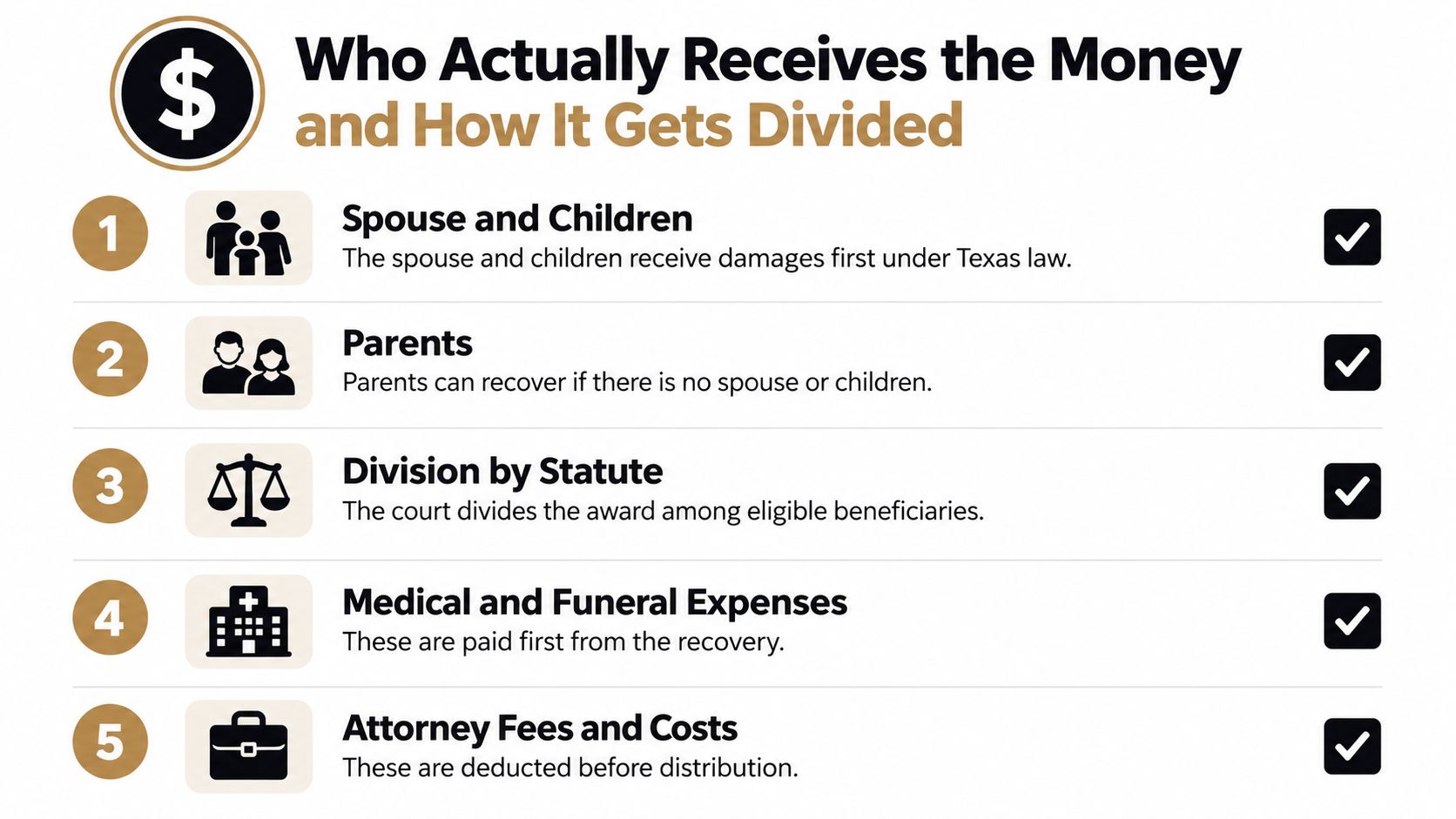
Texas identifies the surviving spouse, children, and parents as statutory beneficiaries, and damages are divided in shares reflecting each person's injury rather than automatically split evenly, as described in the case summary on beneficiary shares. A dependent minor child, a spouse who lost both income and companionship, and a financially independent parent don't present the same loss, so the law doesn't require equal slices.
Why Allocation Gets Complicated
Estrangement, second marriages, adult children from a prior relationship, and one relative paying funeral costs can all complicate allocation. If your settlement agreement doesn't address allocation expressly, disagreement can delay distribution and may require court involvement. Minors need extra safeguards and court oversight before funds are released or structured, which protects the child but adds time families should expect.
Ask for the allocation in writing before you sign a release. Vague promises about splitting it fairly later create conflict when grief is already high.
Gross Recovery Is Not What You Take Home
The headline number is the gross recovery. Attorney fees, case expenses, medical reimbursement claims, governmental claims, funeral costs, and liens may reduce what each beneficiary receives. None of that means a settlement is bad. It means you need clear math.
Request a written closing statement showing gross recovery, fees, expenses, liens, each person's allocation, and net proceeds. A trustworthy wrongful death lawyer Texas families rely on should welcome that request and explain every line without rushing you. If the numbers don't make sense on paper, don't sign until they do.
Statute of Limitations and Critical Deadlines in Texas
Timing can change a payout to zero. That's blunt, but you need to hear it early while you still have options.
How Long Do You Have to File a Claim in Texas
Under Texas Civil Practice and Remedies Code Section 16.003(b) on the two year filing period, a wrongful death lawsuit generally must be filed within two years after the death causing injury. The cause of action accrues on the injured person's death, and special issues involving minors, legal disability, government defendants, or other circumstances can change the analysis, so don't calculate this deadline on your own.
You can review the details in the Texas wrongful death statute of limitations guide, but a calendar reminder isn't a legal strategy. Investigation takes time. Your lawyer needs to identify defendants, locate policies, obtain medical and autopsy records, and evaluate future dependency before filing a well supported case.
Talking to an Insurer Does Not Pause the Deadline
Don't assume negotiation protects you. Reporting a crash, requesting records, and discussing settlement are not the same as filing a lawsuit in court. If limitations expire while talks drag on, a settlement discussion won't automatically save the claim, and counsel may need to file suit to preserve your rights and position.
Insurer response deadlines are separate from your lawsuit deadline. An adjuster moving slowly, or quickly, doesn't extend your right to sue. Treat those timelines as different clocks, because they are.
Evidence also runs on its own clock. Vehicle event data can be overwritten, surveillance footage can be deleted, and witness memories fade. Preserve the death certificate, crash report, photographs, medical and funeral records, employment information, and insurance documents now. Prompt review matters even more when a government vehicle, public roadway, commercial carrier, or multiple defendants may be involved, because added notice or procedural rules can apply.
How to Pursue Maximum Compensation After a Fatal Texas Crash
You don't need to do everything in one week, but you do need a sequence. The families who protect case value best aren't aggressive or dramatic. They're organized early, careful with insurers, and unwilling to sign away rights they don't yet understand.
Build the File Before You Negotiate the Number
Start with the paper that proves what happened and what your family lost.
- Get the Core Records: Secure the crash report, death certificate, medical records, autopsy records when available, funeral bills, and photographs of vehicles and the scene.
- Preserve Vehicle and Electronic Evidence: Don't let a totaled vehicle, phone data, dash camera footage, or commercial truck data disappear without legal review.
- Document Financial Dependency: Gather wage records, tax documents, benefit statements, and notes about household services your loved one provided every week.
- Identify Every Responsible Party: Look beyond the driver to employers, commercial carriers, vehicle owners, and other entities whose conduct or policies may be involved.
- Find Every Policy: Liability coverage is only the starting point, and missing a policy can leave collectible money untouched.
When cause of death or the sequence of injuries is disputed, families sometimes need independent medical clarity. Resources explaining how private autopsies strengthen claims can help you understand when that step may support causation evidence, especially if an insurer argues the death came from something other than the crash.
Handle Insurers Carefully and in Writing When Possible
Report the crash promptly, keep communications factual, and don't guess about fault, speed, or injuries. Avoid a recorded statement before legal review, and don't sign a broad release to get a quick check for funeral costs without understanding what you're giving up. Early offers often arrive before future losses are calculated. Quick money can be expensive money.
Check your own coverage too. Texas uninsured or underinsured motorist coverage can apply when the at fault driver has no insurance or insufficient limits, and hit and run coverage generally requires physical contact with the unidentified vehicle, according to Texas Department of Insurance guidance on uninsured and underinsured motorist coverage. After a San Antonio hit and run fatality, for example, a police report and prompt notice to applicable insurers matter because policy conditions can affect coverage.
Know When Filing Suit Protects a Fair Settlement
Filing suit isn't a failure of negotiation. Sometimes it's the step that forces full disclosure of policies, preserves testimony, and stops the limitations clock. A Houston car accident attorney or other Texas counsel may recommend filing while talks continue, particularly when fault is contested, a commercial defendant controls key records, or the deadline is approaching.
The Law Office of Bryan Fagan, PLLC is one option families consider for contingency fee representation, which means you don't have to decide today whether you can afford hourly counsel to investigate a fatal crash. Whether you hire that firm or another, choose a lawyer who explains beneficiaries, allocation, liens, deadlines, and net recovery in plain English and puts the closing math in writing.
The Mistakes That Cost Families Most
- Signing a Release Too Early: A general release can end claims against parties and policies you haven't identified yet.
- Accepting the First Number: An offer made before wage loss, benefits, and future dependency are documented rarely reflects full value.
- Ignoring Your Own Policy: Families overlook uninsured or underinsured motorist coverage that they already paid for.
- Waiting to Preserve Evidence: Deleted video and lost vehicle data can't be recreated months later.
- Assuming Equal Division: Beneficiaries who expect identical shares without discussing dependency and loss invite conflict at distribution.
The core lessons are simple. Texas has no set average that decides your case. Chapter 71 defines who can recover and for what kinds of harm. Documented economic loss, credible evidence of relationship and anguish, clear fault, and available coverage drive value. Allocation is beneficiary by beneficiary, net recovery is what matters after fees and liens, and the filing deadline doesn't wait for an adjuster.
Recovery is possible, including financial stability for the people your loved one left behind, and legal help is available while you focus on your family. You don't have to carry the investigation, the insurer calls, and the paperwork alone.
If your family lost someone in a fatal Texas crash, the Law Office of Bryan Fagan, PLLC offers a free consultation and contingency fee representation to help you understand beneficiaries, damages, insurance coverage, allocation, and deadlines before you sign anything. Visit Law Office of Bryan Fagan, PLLC to schedule your free case review today and get clear, compassionate guidance on your next step.