A serious accident can change your life in seconds, but you don't have to face it alone. If you're reading this from a hospital bed, a tow lot, or your kitchen table while medical bills stack up, you're probably asking the same question most Texas families ask after a Truck Versus Car crash. Why does this feel so different from a normal wreck, and what do you do next?
When a Truck and a Car Collide on a Texas Highway
After a Houston freeway crash, traffic slows for construction and you brake with everyone else. The commercial truck behind you doesn't stop in time. Your sedan is pushed into the car ahead, your airbag deploys, and within minutes you're exchanging information with a driver who works for a company you've never heard of, while an insurer you didn't call is already asking questions.
That scene explains why a Truck Versus Car case isn't handled like a routine fender bender. The vehicle is larger, the injuries are often more serious, and the claim may involve a driver, a carrier, a broker, and several insurance policies instead of one driver and one adjuster.
Why These Crashes Hit Car Occupants Hardest
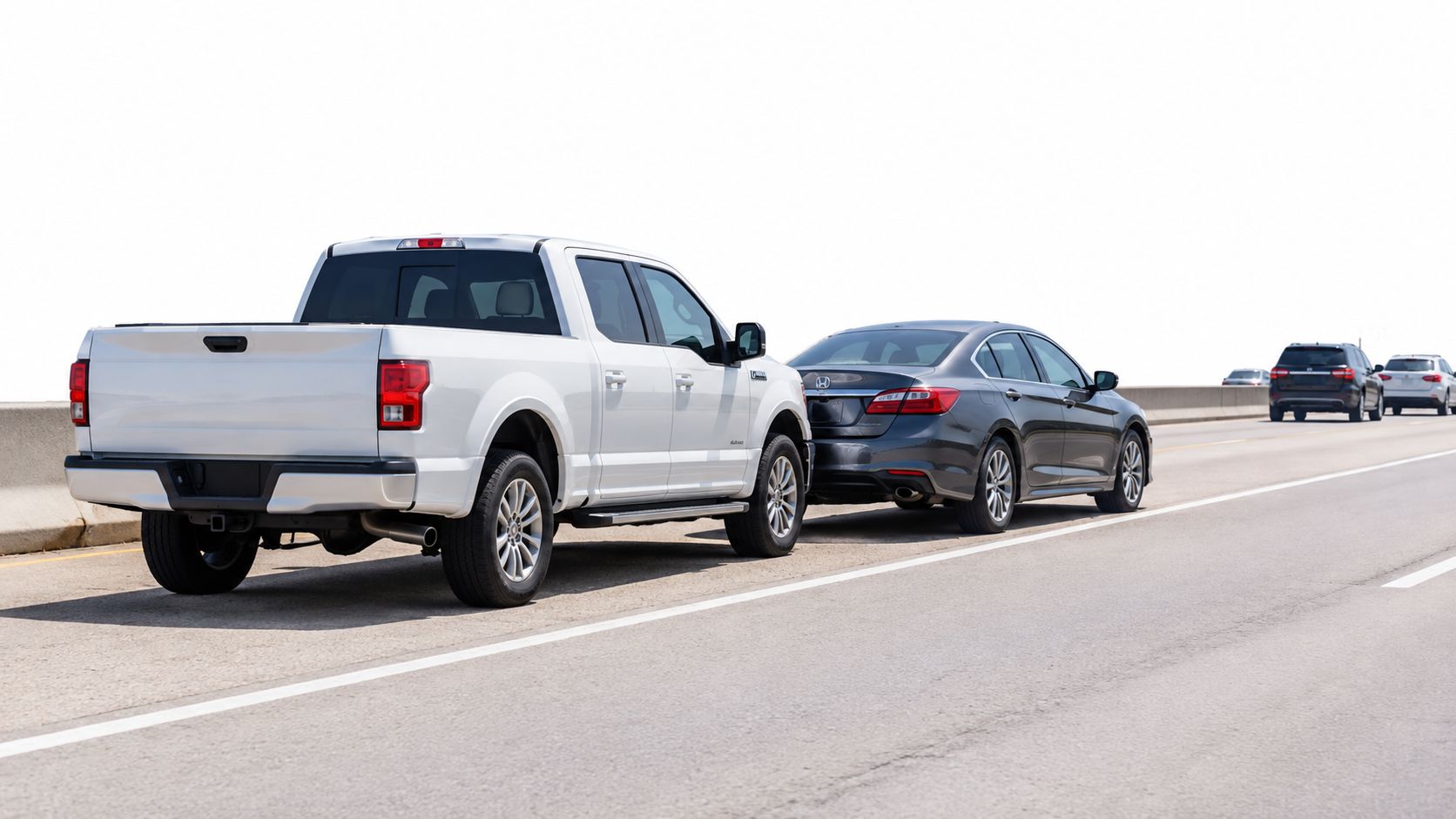
The national numbers show the imbalance clearly. In 2021, 5,788 people died in crashes involving large trucks, and 4,149 of them, 72%, were occupants of other vehicles, according to NHTSA large truck fatal crash data for 2021. That same source reports 81% of large trucks in fatal crashes were in multivehicle crashes, compared with 63% of passenger vehicles.
Those figures don't prove fault in your case. They do explain why you shouldn't let anyone minimize what happened because your car was drivable or because you walked away from the scene.
Practical rule: Treat a truck crash as a commercial case from day one, even if the other driver was polite and the damage looks manageable.
You'll need clear answers on seven things. How crash physics affect injuries, what evidence disappears first, what causes these wrecks, what to do this week, who can be liable, what compensation covers, and when to get a Texas personal injury lawyer involved. You have a path forward, and it starts with protecting your health and the record of what happened.
Why the Physics of a Truck Versus Car Crash Change Everything
Crash force doesn't split evenly between two vehicles. The heavier vehicle generally changes speed less, while the lighter car experiences greater acceleration and more intrusion into the space where you sit. That's why your injuries can be severe even when the truck shows modest damage.
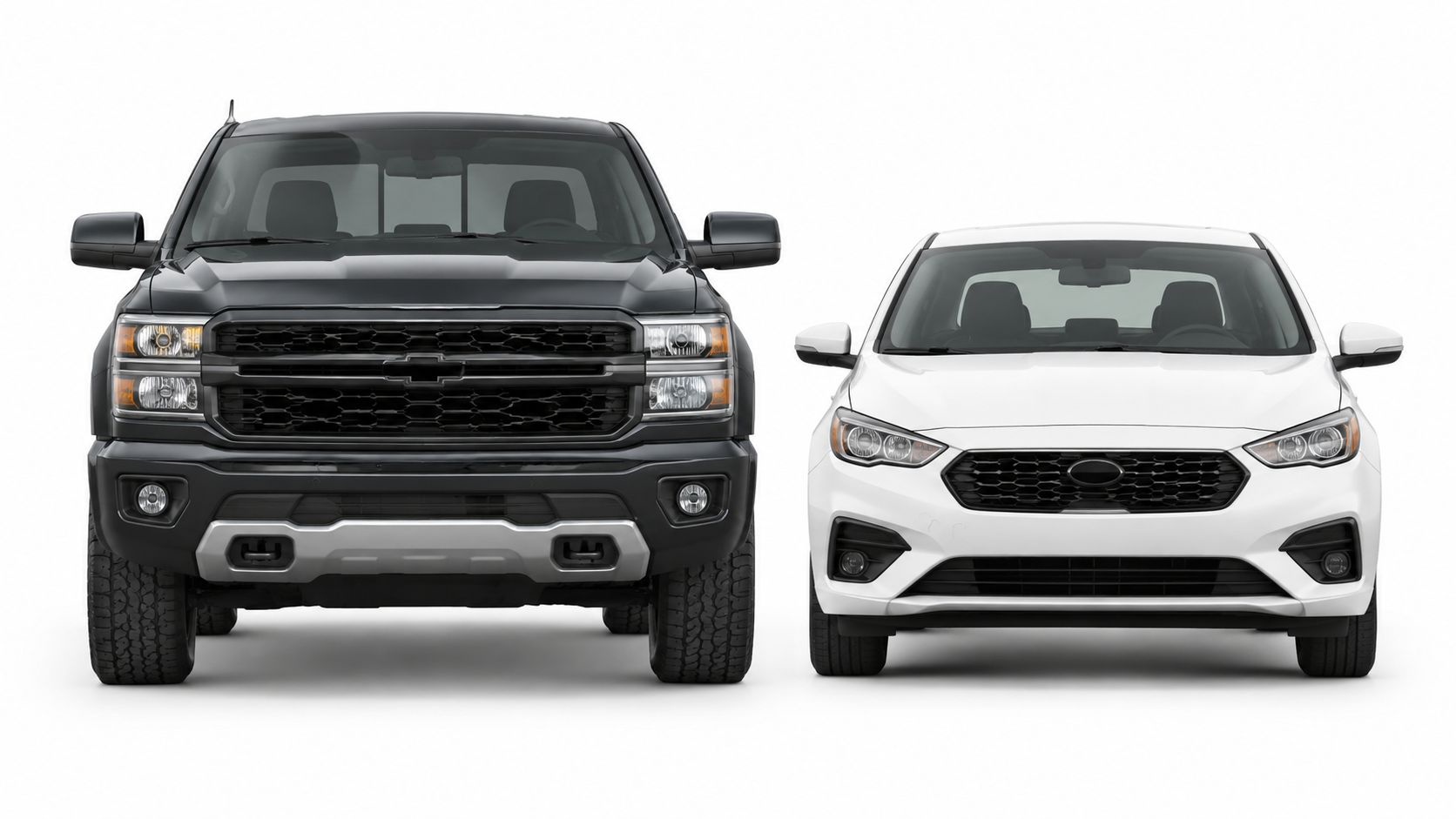
NHTSA research found that approximately 80% of fatalities in car and light truck crashes were occupants of the cars, as reported in NHTSA research on vehicle compatibility in car and light truck crashes. Height mismatch makes it worse. If a truck bumper or frame doesn't line up with your car's energy absorbing structures, one vehicle can override or underride the other and push force into doors, footwells, legs, pelvis, and lower spine instead of the crumple zone.
Compatibility Matters More Than Size Alone
Pickups create a specific problem. A federal review found pickups in 2013 to 2016 were associated with a 158% higher partner driver death risk than comparable car versus car crashes, detailed in the federal review of pickup and car crash compatibility. SUVs and pickups also carry rollover risk because of design and center of gravity.
In 2024, rollover crashes accounted for 20% of occupant deaths in cars, 38% in pickups, and 33% in SUVs, according to IIHS fatality statistics for passenger vehicle occupants. Speed, restraint use, road conditions, and impact direction still matter in every individual case.
- Mass difference: The lighter vehicle absorbs more of the change in motion.
- Height mismatch: Bumpers and frames miss each other, so force reaches the cabin.
- Stiffness difference: A rigid front end can intrude instead of collapsing as designed.
- Impact geometry: Angle and crush height help explain injuries that photos alone can't.
If you're hurt as a driver or passenger, Car Accident Lawyer in Texas describes representation for drivers and passengers injured in Texas car accidents. In a truck case, don't accept a simple bigger vehicle explanation. An experienced Houston car accident attorney should look at bumper heights, crush patterns, event data, and medical records together.
The Evidence That Matters Most After a Truck Crash
Two wrecks can look identical on the police report and be nothing alike once lawyers get involved. In a car case, the evidence is mostly public: photos, the crash report, witness statements. In a truck case, the proof that decides the case sits inside systems and files the trucking company controls, and some of it can be overwritten, repaired away, or discarded in the ordinary course of business if nobody demands it fast.
Start with what you control at the scene. Photograph vehicle positions, damage, license plates, DOT numbers, company markings, skid marks, debris, road signs, and visible injuries before the vehicles are repaired or salvaged. Get witness names and phone numbers. Keep every insurance document, and don't delete texts or calls about the crash.

Commercial Records You Don't Have in a Car Case
A truck crash lawyer Houston families trust will move fast to preserve records that can show speed, braking, fatigue, and company decisions. Each record answers a different question.
| Record | What it can show |
|---|---|
| Electronic logging device data | Driving time and rest periods tied to hours of service rules |
| Engine control module data | Speed, braking, and throttle around the moment of impact |
| Dashcam and forward facing video | Lane position, following distance, driver reaction |
| Driver qualification file | Licensing, training, medical certification, prior safety history |
| Maintenance and inspection records | Whether brakes, tires, lights, or steering were neglected |
| Dispatch and load documents | Deadlines, weight, routing, and who loaded or secured the cargo |
A preservation letter puts the carrier on notice not to destroy that material. Our guidance on sending an ECM and black box data preservation letter after a Texas truck wreck explains why that step can't wait until settlement talks stall.
Don't give a recorded statement to the trucking insurer before you understand what data exists and what coverage may apply. You can be polite, brief, and firm.
Get medical care and follow through, even when symptoms build over days. Your treatment records connect the crash forces to your injuries. Gaps in care hand the insurer an argument, and they will use it.
Most Common Causes of Truck Versus Car Crashes in Texas
An 18 wheeler drifts across a lane line at highway speed and a sedan has nowhere to go. When investigators pull that crash apart, the cause almost never turns out to be exotic. It is usually an ordinary failure, the kind that would be a fender bender between two cars, made lethal by the size and weight of a commercial truck.
Some of those failures happen behind the wheel. Fatigue slows reaction time and degrades lane control. Phones, dispatch devices, and in cab systems pull a driver's eyes off traffic. Speed and short following distances erase the extra stopping room a loaded truck needs. Blind spots the size of a car hide vehicles during merges and turns.
Other failures happen before the truck ever leaves the yard. Carriers that defer brake and tire work, overload trailers, or hand drivers impossible schedules create the conditions for a wreck. Federal hours of service, qualification, inspection, and cargo securement rules exist precisely because these failures repeat, and a violation can be strong evidence that a driver or company failed to use reasonable care. Equipment problems matter just as much, including the issues covered in our analysis of semi truck tire blowout crashes and liability.
How Texas Proportionate Responsibility Affects Fault
Cause and fault are not the same thing, and Texas law treats the difference seriously. Under Texas Civil Practice and Remedies Code Chapter 33 on proportionate responsibility, a claimant who is greater than 50% responsible cannot recover damages, and a claimant at 50% or less generally has damages reduced by that percentage.
Here is the math in plain terms. If a jury finds a truck driver 70% responsible and you 30% responsible, a $100,000 award would generally be reduced to $70,000. That threshold explains why trucking insurers work so hard to pin blame on the car driver for braking, merging, speed, or lane position.
Protect yourself at the scene. State facts, get the report number, photograph everything, and let vehicle data, witnesses, and camera footage make the fault argument later.
What to Do in the First Days After a Texas Truck Crash
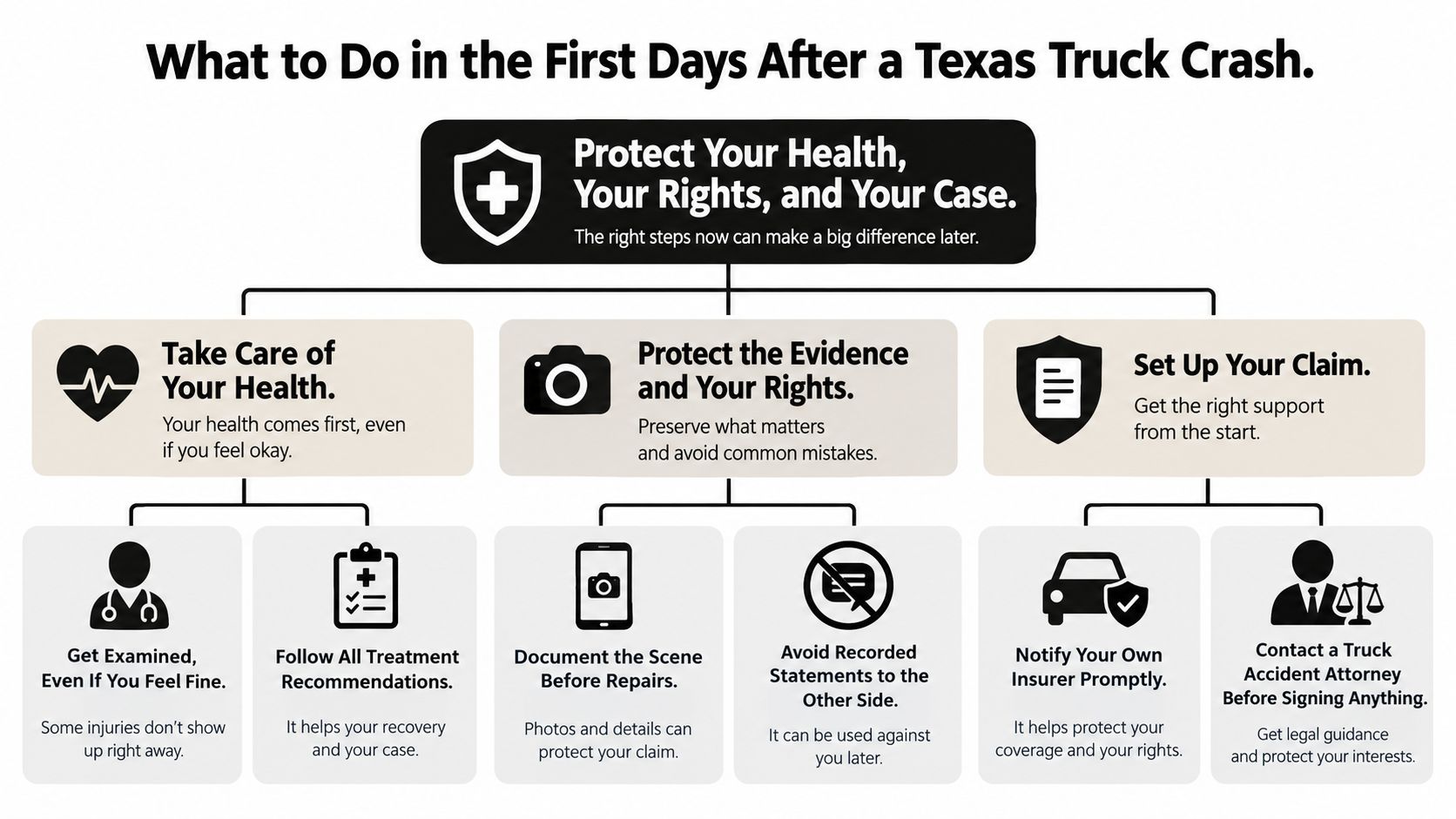
Your first job is medical, not legal. Get examined the same day if you can, even if you feel mostly fine, because neck, back, head, and internal injuries may not announce themselves at the roadside. Follow treatment instructions, attend follow up visits, and tell every provider that symptoms started after a truck collision.
TxDOT gives a practical sequence after a collision. TxDOT guidance on what to do after a Texas collision advises checking for injuries, moving vehicles out of the roadway if possible, exchanging names, addresses, phone numbers, vehicle identification numbers, license plate numbers, driver's license information, and insurance details, and recording the location and witness contacts. It also says police should always be called when anyone is injured or killed, a vehicle can't be moved, intoxication is suspected, a driver has no insurance, or a driver leaves the scene.
Your First Week Checklist
- Report and document: Get the crash report information and save photos before repairs begin.
- Notify your insurer promptly: Give basic facts, but don't speculate about fault or injuries.
- Decline recorded statements from the other side: You can say you're obtaining advice first.
- Track symptoms and missed work daily: Note pain, sleep problems, missed shifts, and tasks you can't do.
- Keep every bill and receipt: Save towing, rental, pharmacy, mileage, and wage loss records.
- Talk to a lawyer before signing: Releases and quick checks can close claims you still need.
Neck pain and stiffness are common after rear end and side impacts, and many people look for practical home guidance while they follow medical advice. If that describes you, you can find whiplash recovery support as a supplemental resource, but it doesn't replace an examination or prescribed treatment.
Watch for early contact: A commercial insurer may call within hours. That speed protects their claim file, not your recovery.
Call a lawyer promptly when injuries are serious, fault is disputed, a commercial vehicle is involved, an insurer delays, or a loved one died. Waiting rarely improves your position.
Who Can Be Held Liable in a Texas Truck Versus Car Case
A routine car crash usually starts and ends with one negligent driver. A commercial case can involve several people and companies whose decisions put that truck on the road, loaded it, maintained it, or set an unsafe schedule. Your job isn't to sort that web alone, but you should understand why a Texas personal injury lawyer investigates beyond the driver.
The scope is broader than occupants of cars, too. NHTSA reported 5,340 deaths in crashes involving large trucks in 2024, with 70% of those killed being occupants of other vehicles, and Texas recorded the highest number of people killed in large truck crashes among states, according to NHTSA 2024 large truck and pedestrian fatality data. The same data show light trucks were the striking vehicle in 50.4% of U.S. pedestrian fatalities in 2024, compared with 40.6% for passenger cars.
Who Can Be Liable in a Texas Truck Versus Car Crash
| Party | Typical Car Case | Truck Versus Car Case |
|---|---|---|
| Driver | Negligent driving is usually the focus | Negligent driving, fatigue, distraction, impairment, log violations |
| Employer or carrier | Rarely involved unless driver was working | Hiring, training, supervision, dispatch pressure, vicarious liability |
| Broker, shipper, or loader | Usually not part of the claim | Unsafe load, overweight cargo, negligent selection of carrier |
| Maintenance provider | Seldom identified | Negligent inspection, repair, or failure to remove unsafe equipment |
| Manufacturer | Possible if a vehicle defect contributed | Possible for brakes, tires, steering, underride guards, or other defects |
The legal theory follows the conduct. Negligent hiring looks at who the carrier put behind the wheel, negligent maintenance looks at inspection and repair, and negligent entrustment asks why an unsafe driver or vehicle was allowed to operate. Federal rule violations can support the claim, as explained in our discussion of FMCSR violations and negligence per se in Texas trucking cases.
Don't assume the police report names everyone responsible. It rarely captures broker contracts, lease arrangements, maintenance vendors, or the full insurance structure, and those details can determine whether full compensation is available.
Damages You Can Pursue After a Texas Truck Crash
A trucking insurer usually knows what your claim is worth long before you do. Their first offer tends to arrive while you're still treating, and it rarely reflects what the evidence would support in front of a Texas jury.
Your recoverable losses fall into two broad categories. Economic damages are the ones with paper behind them: emergency care, hospital bills, surgery, rehabilitation, prescriptions, future medical treatment, lost income, and reduced earning capacity. Keep proof for each one, because undocumented losses are the first thing an adjuster discounts.
Non economic damages carry no receipts. Pain, emotional distress, physical impairment, disfigurement, and the loss of activities you once did without thinking all count. Medical records, a symptom log, work history, and testimony from the people who live with you show how daily life changed after the collision.
Wrongful Death and Coverage Issues
Texas law recognizes a wrongful death claim when death results from another person's wrongful act, neglect, carelessness, unskillfulness, or default. The Texas wrongful death statute in Chapter 71 allows actual damages when liability exists and exemplary damages when the death resulted from a willful act or omission or gross negligence.
Chapter 71 also sets a three month rule on who must bring the action. If the spouse, children, or parents haven't filed within three calendar months after the death, the estate's personal representative can be required to pursue it. After a fatal crash, such as a truck versus SUV collision outside Dallas, families shouldn't assume the probate process protects every claim automatically. A wrongful death lawyer Texas families consult can coordinate the wrongful death case alongside any survival claim.
Coverage questions drive valuation. The tractor, the trailer, and other responsible businesses may carry separate policies, and your own uninsured or underinsured motorist coverage can add another layer of recovery. A fast settlement offer often lands before anyone knows what future care will cost, so resist signing until your medical picture is clear. On the fee side, contingency arrangements mean you pay no attorney fee unless the firm recovers compensation for you, under the terms of your agreement.
A fair number connects the physics, the medical proof, the liability evidence, and every available policy. Leave one piece out, and the offer reflects the gap.
Your Next Step After a Texas Truck Versus Car Crash
You don't need to solve the whole case this week. You need three things protected now. Your health, the commercial evidence, and your right to full compensation under Texas law.
Get examined, follow treatment, and keep records. Don't give the trucking insurer a recorded statement or sign a release before you understand your injuries, fault exposure, and available coverage. Those early choices shape the claim long before settlement talks begin.
How Long Do You Have to File a Claim in Texas
Deadlines can bar a claim even when liability is clear, and wrongful death timing has its own complications. Don't rely on an adjuster's timeline or assume informal negotiations stop the clock. Ask a lawyer to calculate every deadline that applies to your specific claims and family members.
The Law Office of Bryan Fagan, PLLC offers a free consultation and contingency fee representation for injured Texans in Houston, Dallas Fort Worth, Austin, San Antonio, and surrounding communities. Recovery is possible, and legal help is available while you focus on getting your life back.
If a truck crash left you injured or took someone you love, contact Law Office of Bryan Fagan, PLLC today to schedule your free consultation and learn how we can preserve evidence, identify every liable party, and pursue compensation for your medical care, lost income, and future needs. You don't have to face the trucking company or its insurer alone, and you pay no fee unless we win for you.