
A serious accident can change your life in seconds, but you don't have to face it alone. If you were shocked on a Texas jobsite, in a warehouse, near a downed line, or even in a home with unsafe wiring, the aftermath can feel confusing and frightening. You may be dealing with burns, nerve pain, a fall, heart symptoms, missed work, or the shock of learning that a loved one did not survive.
A Texas electrocution accident lawyer can help you sort out what happened, who is responsible, and what evidence needs to be preserved right away. That matters because electrical cases often turn on details that disappear quickly, like scene photos, equipment condition, work orders, and witness memories. It also matters because Texas law does not treat every electrical injury the same, and fault can be shared, contested, or hidden behind layers of contractors and insurance carriers.
When an Electrical Shock Changes Everything
A foreman shuts off a machine, but no one verifies the circuit is de-energized. A worker reaches for a cable, gets hit with a shock, and goes down before anyone understands what happened. In a home setting, a family member touches a damaged outlet or a wet appliance and suddenly needs emergency care, while everyone around them scrambles to figure out whether the property owner, landlord, electrician, or manufacturer failed to do their job.
Those moments are overwhelming, but they are not the end of the story. Texas law gives injured people and grieving families real paths toward compensation when negligence caused the danger. The practical question is not just what happened, but who had a duty to keep the scene safe, who failed, and what proof still exists.
For workplace cases, the legal route can involve a contractor, a premises owner, a utility company, or an equipment maker. For family cases, the path may lead to a wrongful death claim if the shock proved fatal. Either way, the earlier you act, the more likely it is that the facts stay intact and the legal claim stays strong.
Practical rule: after an electrical injury, health comes first, but evidence preservation has to start almost immediately.
If you're trying to make sense of the next step, a Texas personal injury lawyer can help you protect both your medical recovery and your legal claim. A local team that handles serious injury matters, including construction accident representation, can also help when the electrocution happened on a dangerous jobsite.
Common Causes of Electrocution Accidents in Texas
Electrocution usually traces back to a preventable hazard. A damaged cord, exposed wiring, missing guard, wet work area, or a line that was never properly isolated can create the conditions for a serious shock. Texas legal reporting on industrial fatalities shows how serious that risk remains, and OSHA still treats electrocution as one of construction's “Fatal Four” causes of death (Lanier Law Firm).
Where the danger usually starts
On jobsites, the failures are often straightforward. Workers may be exposed to overhead power lines, damaged cords, missing lockout/tagout procedures, or equipment that should have been repaired or taken out of service. In homes or rental properties, the danger often comes from faulty wiring, overloaded circuits, water damage, or unsafe repairs.
The risk also shows up in the numbers. Texas legal analysis reports 22 workers died in 2023 from electricity exposure. Another Texas-focused source reports 29 electrical fatalities in 2019, which was 20% higher than the year before, followed by a 24% decrease in 2020 (Lanier Law Firm). Those figures matter because they point to recurring danger, not a rare event.
The nonfatal cases are just as serious. According to Allen Nunnally, a Texas legal source citing government and industry data, there were 1,900 nonfatal workplace electrical injuries in 2019, a 22% increase over 2018, along with 166 workplace deaths from electricity in 2019. Burns, nerve damage, cardiac arrest, and long-term neurological effects can all support compensation claims when the injured person survives.
A claim for damages may include medical bills, lost wages, and future care. For a plain-English overview of those categories, What Damages Can You Recover in a Texas Injury Case? explains the kinds of compensation Texas injury victims may pursue.
If the shock happened on a jobsite, early evidence matters even more. A prompt conversation with a Texas construction accident lawyer can help preserve records, identify the responsible parties, and keep the claim focused on the facts.
How Texas Law Determines Fault in Electrocution Cases
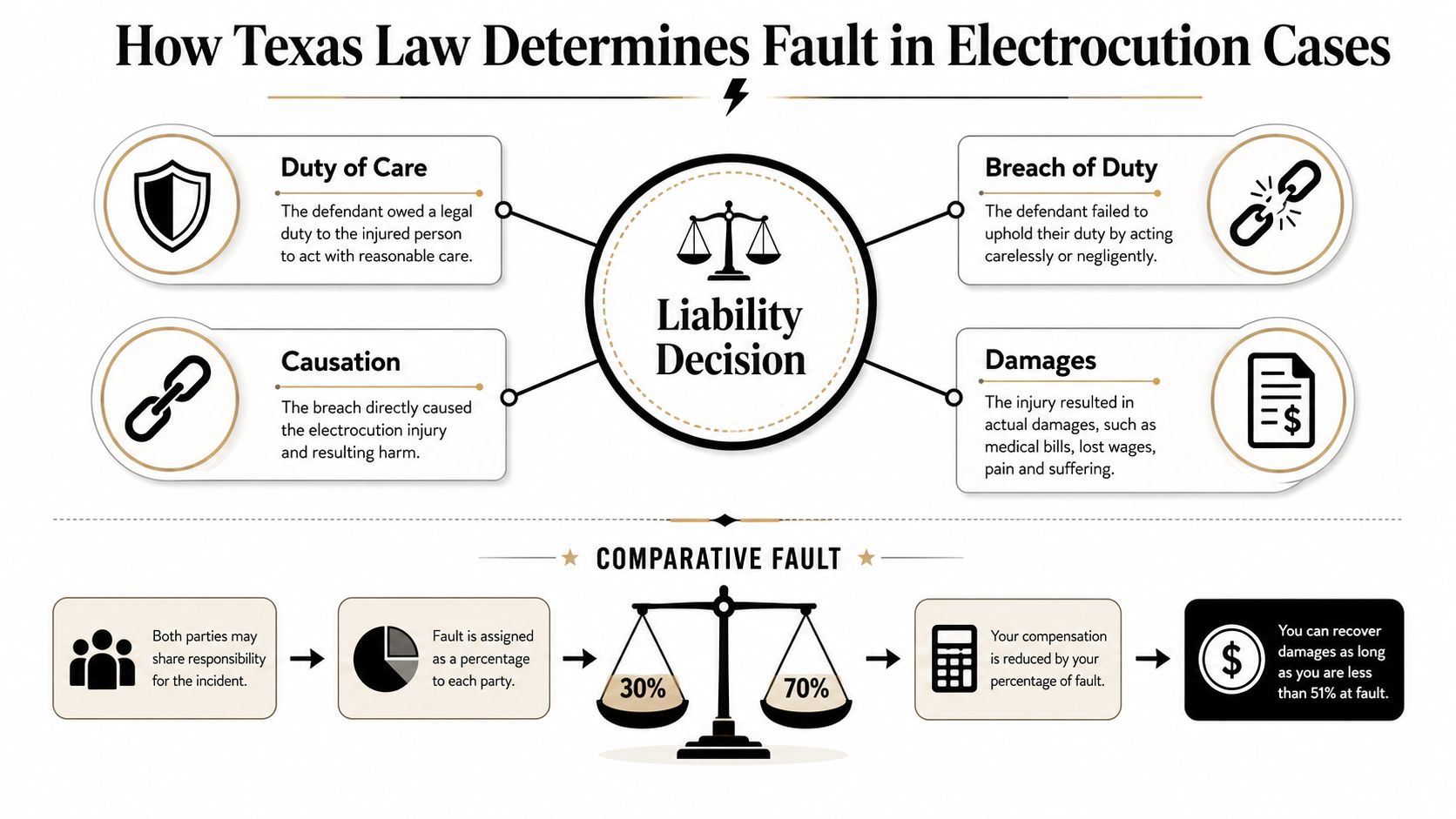
Texas electrocution cases turn on negligence, not just on the fact that someone got shocked. To recover compensation, the injured person has to prove duty, breach, causation, and damages. That means showing the defendant had a duty to act safely, failed to meet that duty, caused the injury, and left measurable harm behind (Cain Firm).
What has to be proven
A duty can come from a jobsite role, property ownership, equipment control, or utility responsibility. A breach happens when a person or company ignores safety rules, skips inspections, leaves circuits energized, or allows dangerous equipment to stay in use. Causation links that failure to the actual injury, and damages show the medical, wage, or family losses that followed.
Texas also uses a shared-fault rule. An injured person may still recover damages so long as they are not more than 50% at fault (Liggett Law Group). That makes early evidence especially important, because the defense often tries to shift blame onto the worker, the homeowner, or the person who was shocked.
Common defendants include contractors, premises owners, utility companies, and equipment manufacturers. In workplace cases, a victim may pursue a workers' compensation nonsubscriber claim or a third-party personal injury claim depending on who created the hazard. A claim against a defective product can also fit when the equipment itself created the danger, which is why a case involving faulty tools or wiring may overlap with a Texas product liability claim.
The strongest electrocution claims usually come from proof, not outrage. Photos, maintenance records, lockout/tagout logs, inspection reports, and witness statements often matter more than anyone expects.
The legal standard is straightforward, even if the facts are not. The injured person must connect the unsafe conduct to the injury with evidence, and the defendant's role has to be shown clearly. A Texas electrocution accident lawyer helps organize that proof before it disappears.
Critical Steps to Take Right After an Electrocution Injury
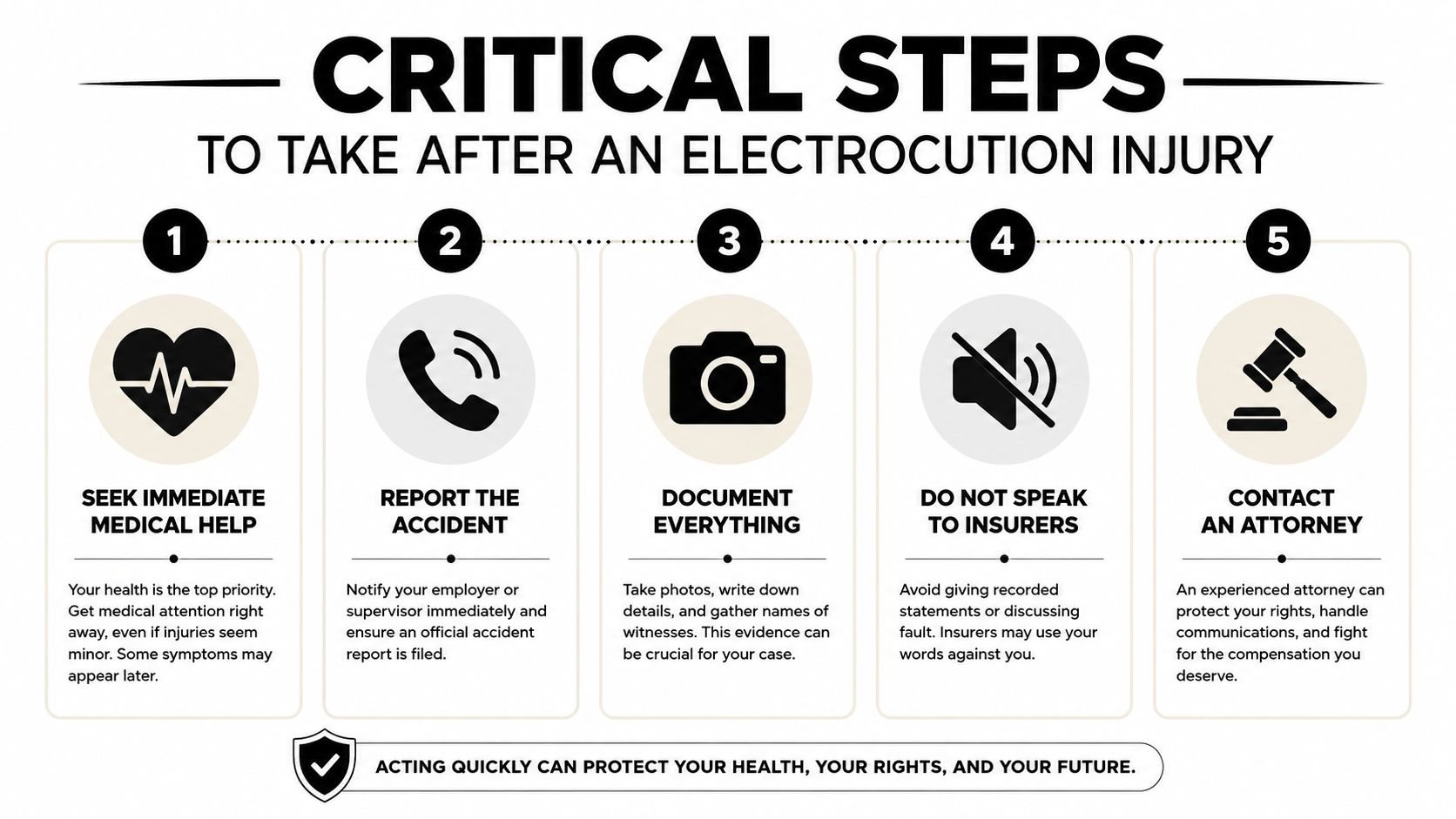
The first priority is medical care. Even when the victim looks alert, electrical trauma can affect the heart, muscles, nerves, and brain in ways that aren't obvious at the scene. Texas guidance on electrocution injuries stresses that victims should get care right away, because that medical record becomes part of the proof linking the shock to the damage (Armstrong Law).
Protect your claim while you protect your health
If you can do so safely, document the scene before anything is moved. Take photos of the equipment, cords, outlets, control panels, wet areas, warning signs, and anything that looks damaged or out of place. Get names and phone numbers for witnesses, and report the incident to a supervisor, property owner, or manager as soon as possible.
Do not give a detailed recorded statement to an insurer or company investigator before you speak with a lawyer. Those statements can be used to narrow your account, pin blame on you, or suggest your injuries are less serious than they are. The safer path is to stick to basic facts, get medical treatment, and let counsel handle the deeper conversation.
The legal clock also matters. For Texas personal injury claims, the filing deadline is typically two years from the injury date, and wrongful death claims generally run from the date of death (GVI Law). When there may be exceptions to filing deadlines, it helps to review a clear explanation of key exceptions to filing deadlines so you can understand whether any special rule might apply.
A short checklist after the accident
- Get emergency care immediately. Tell doctors exactly how the shock happened.
- Report the event promptly. Put the incident on record with the right person.
- Preserve evidence. Save photos, clothing, equipment, and witness information.
- Avoid insurer statements. Don't guess, minimize, or speculate.
- Call a lawyer early. Technical evidence can disappear fast.
A careful first response can make the difference between a claim that's still supported later and one built on missing records. That's especially true when the injury happened at work, where evidence may be controlled by an employer or contractor.
Workplace Electrocution Claims Versus Wrongful Death Cases
A workplace electrocution claim and a wrongful death case can arise from the same shock, but they do different legal work. A personal injury claim seeks payment for the injured person's own losses, while a wrongful death claim belongs to the family after a fatal electrocution. In either setting, Texas law still turns on the same core questions, who acted carelessly, what duty was broken, and how that failure caused the harm.
Side by side comparison
| Factor | Personal Injury Claim | Wrongful Death Claim |
|---|---|---|
| Who brings the case | Injured worker or victim | Eligible family members or estate representative |
| Main purpose | Recover losses from the injury | Recover losses caused by the death |
| Common damages | Medical bills, lost wages, future care costs | Funeral expenses, death benefits, and loss of companionship |
| Common defendants | Contractors, premises owners, utilities, manufacturers | Same, depending on who created the danger |
| Deadline | Usually two years from injury | Generally two years from death |
A workplace case may also turn on how the employer is set up. If the employer does not carry workers' compensation, the injured person may have a nonsubscriber claim, and the details of Texas workers' compensation rules can shape that analysis. In other jobs, a third-party claim may be the better path, especially when a contractor, property owner, utility company, or equipment maker created the hazard.
That choice affects evidence from the start. The right defendant is not always the employer, and early decisions about where to focus the investigation can change what records get preserved, what witnesses get questioned, and how fault is divided under Texas law. If the wrong theory is pursued first, key proof can disappear before it ever supports the claim.
Families also need to know how insurers respond after a fatal or catastrophic shock. Dealing With Insurance Companies After a Texas Accident explains the kinds of tactics insurers use to reduce payouts and why early documentation matters. That lesson applies directly here, because the defense may argue the shock was unavoidable, blame the worker, or try to shift responsibility to another company on the jobsite.
A wrongful death lawyer Texas families trust can sort out the evidence, preserve the record, and pursue compensation while the family focuses on grief and practical decisions. The sooner the claim is reviewed, the better the chance of keeping records, equipment, and witness memories intact.
How a Texas Electrocution Accident Lawyer Fights for You
A strong electrocution case usually starts with fast investigation. That means preserving the accident scene, requesting jobsite records, reviewing equipment logs, and looking for safety failures such as missing lockout/tagout procedures, damaged cords, or inadequate warnings. The legal value of that work is simple, it turns a painful event into admissible proof.
What the case work looks like
An attorney may coordinate with electrical and medical professionals to connect the shock to burns, arrhythmia, neurological injury, or secondary trauma from a fall. The lawyer then uses that evidence to negotiate with insurers or defendants who want to reduce the claim. If settlement offers don't reflect the harm, the case has to be ready for court.
Contingency fee representation matters because it removes the upfront cost barrier. You should not have to pay a retainer just to find out whether you have a case. In a serious injury matter, the goal is to let the facts drive the claim, not your ability to pay out of pocket.
For firms trying to reach injured people quickly, strong intake and follow-up systems matter too. Good outreach depends on clear calls to action, prompt responses, and easy contact paths, which is why resources like top tactics for law firms often focus on speed and trust. In practice, the same principle applies to electrocution claims, if the law firm doesn't move fast, the evidence may be gone.
The Law Office of Bryan Fagan, PLLC can evaluate electrocution cases alongside other serious injury matters such as truck crashes, catastrophic injuries, and wrongful death claims. When the injury happened in a larger incident, a truck crash lawyer Houston style approach to evidence and liability analysis often becomes useful because the same urgency applies.
A case gets stronger when someone starts preserving records before the scene is cleaned up and the story gets rewritten.
You Do Not Have to Face This Alone
A man reaches out for help after a shock at work, then learns the circuit was never properly secured. A family later finds out a loved one's death might have been prevented if the right safety steps had been taken. Those cases are painful, but they're not hopeless. With medical care, evidence preservation, and a careful look at Texas fault rules, recovery and accountability are both possible.
The two-year deadline matters, and so does every early decision after the accident. If you're unsure whether your case is a personal injury matter, a wrongful death claim, or a workplace claim involving multiple companies, talk to a lawyer before the evidence changes. A steady legal team can help you protect your rights while you focus on healing.
The Law Office of Bryan Fagan, PLLC helps injured Texans and grieving families across Houston, Dallas, Fort Worth, Austin, and San Antonio. If you need clear answers after an electrocution, a serious workplace injury, or a fatal accident, schedule a free consultation and find out what your options look like.
The Law Office of Bryan Fagan, PLLC helps clients investigate electrocution accidents, preserve evidence, and pursue compensation under Texas law. If you need help after a serious shock injury or a wrongful death in your family, visit Law Office of Bryan Fagan, PLLC to schedule a free consultation and get practical guidance on your next step.