A serious accident can change your life in seconds, but you don't have to face it alone.
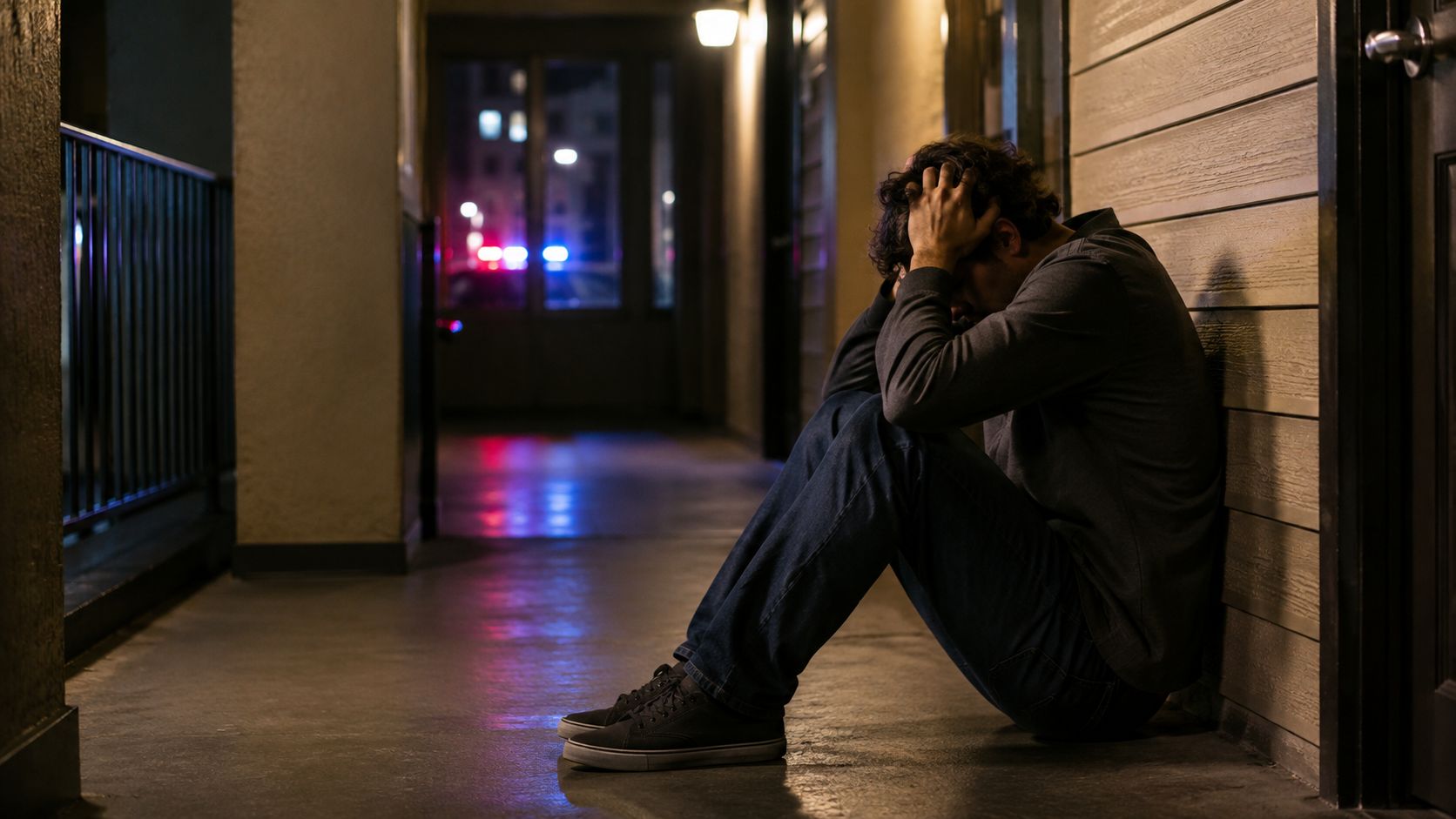
If you were assaulted, robbed, or shot at an apartment complex in Texas, the fear doesn't end when the police leave. You're left with questions about safety, money, and whether the people who ran the property should have done more. In a lot of Houston-area cases, the injury isn't just caused by the attacker, it's also tied to broken gates, bad lighting, ignored complaints, and records that vanish fast.
That's why a Texas apartment crime negligent security lawsuit can matter. The criminal case goes after the person who committed the attack. The civil case asks whether the apartment owner or manager failed to take reasonable steps to prevent a foreseeable crime. When that question is answered with the right evidence, a renter or family may have a path toward compensation, accountability, and some measure of stability.
When an Apartment Attack Is More Than a Crime
A woman walks to her car after work in a dim parking lot. The gate beside the dumpster has been stuck open for weeks, one light is out near the stairwell, and another resident already complained about strangers coming onto the property. Then someone rushes her before she reaches the vehicle. That's not just a frightening crime, it can also be the kind of event that raises a civil claim against the apartment operator.
People often blame themselves first. They wonder if they walked too slowly, parked in the wrong place, or should've noticed something sooner. Those feelings are common, but they don't answer the core legal question, which is whether the property owner ignored a risk they should've taken seriously.
The criminal process and the civil case move on separate tracks. Police and prosecutors focus on the attacker. A civil claim focuses on the apartment's security failures, the owner's notice of danger, and whether reasonable steps could've reduced the risk. That's where records, photos, and written complaints start to matter in a very practical way.
A good mental model is this, if the complex had repeated trouble and management knew about it, the case may be about more than bad luck. It may be about a landlord failing to act when a problem was already visible. For readers trying to understand what a safe property should look like, the principles discussed in expert home and business protection Cardiff can help frame the basics, even though Texas law decides the claim.
The question isn't whether the attack was shocking. The question is whether it was foreseeable and preventable.
Recovery starts with that shift in focus. You're not overreacting by asking whether the property should've done more. You're asking the right question.
What Negligent Security Means in Texas
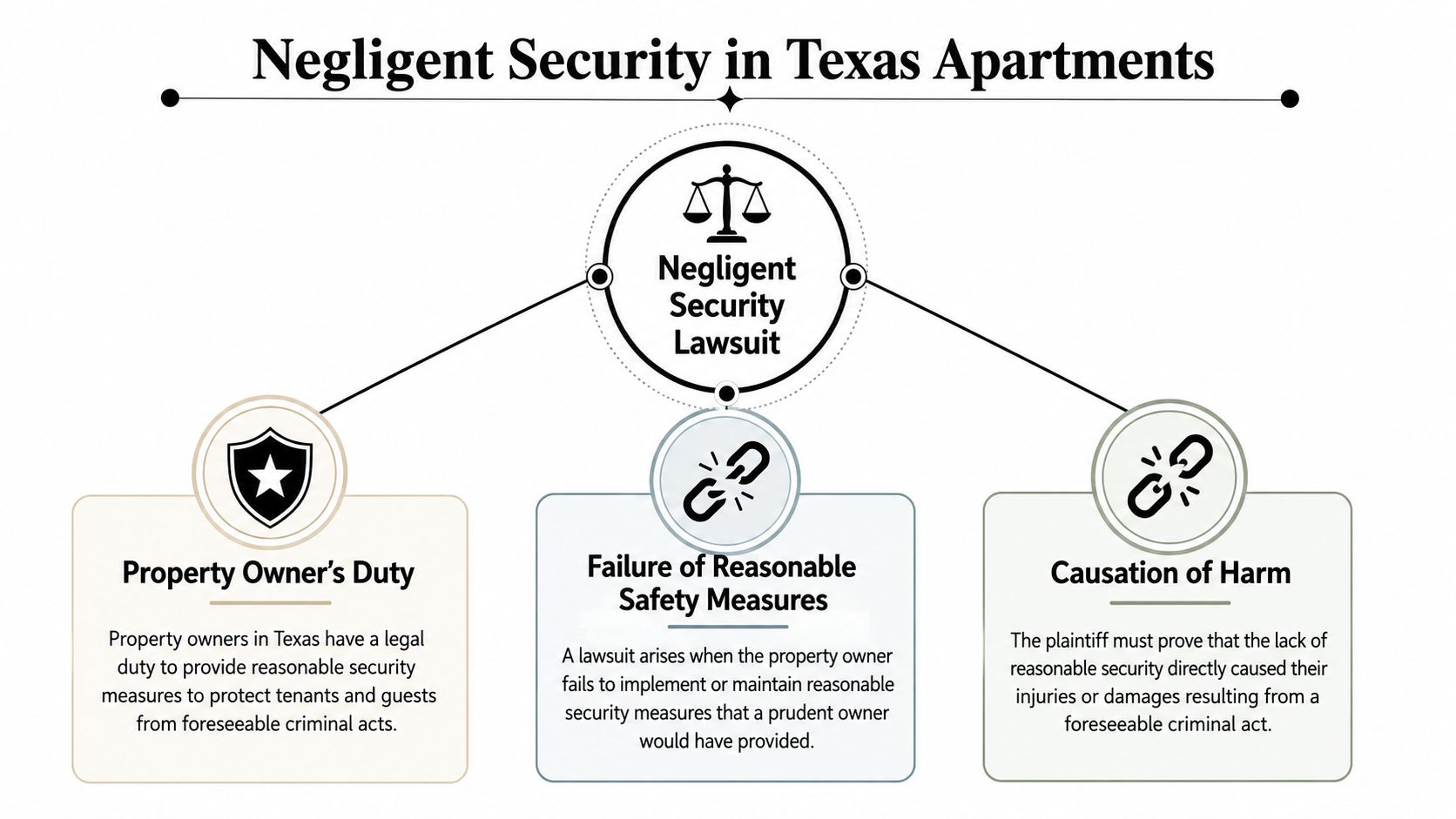
A negligent security claim is a type of premises-liability case. In plain English, it says the apartment owner or manager failed to use reasonable safety measures, and that failure helped create the conditions for a third party's crime. The claim isn't about making landlords guarantee perfect safety. It's about whether they ignored obvious, fixable risks.
Here's how that looks in a real apartment parking-lot case. If the gate had been broken, the lot was dark, the doors didn't lock properly, and management did nothing after notice, that may be a breach of duty. If the lack of lighting or access control helped the attacker get close to the victim, that's where causation comes in. If the victim suffered medical bills, missed work, pain, or trauma, damages follow.
The four parts of the claim
Texas premises-liability law still turns on duty, breach, causation, and damages. The facts change from case to case, but the structure stays the same. A property owner owes a duty to use reasonable care, breaches that duty by failing to act, and may be liable if that failure caused actual harm.
This is different from a broken-step case or a puddle in a hallway. The harm comes from a stranger's criminal act, but the legal issue is whether the apartment's security setup helped make that act more likely. That's why a claim can survive even when the attacker isn't part of the lawsuit.
A few examples make the difference clearer:
- Duty: The complex had a responsibility to maintain reasonable security for residents and lawful visitors.
- Breach: Management ignored a broken gate, failed to fix lighting, or left access controls in poor condition.
- Causation: The security failure made the attack easier or more likely.
- Damages: The victim suffered physical injury, emotional trauma, or financial loss.
For a broader overview of Texas premises cases, see What Is Premises Liability Law.
If you're wondering whether cameras in rental properties are even legal, that question often comes up in these cases too. Guidance on legal use of cameras in rentals can be useful context when you're thinking about what security measures a landlord could've used without crossing legal lines.
How Foreseeability Actually Works in Texas
Foreseeability is the hinge point in most apartment crime cases. Texas courts don't ask whether crime is possible in the abstract, because crime is always possible. They ask whether the apartment owner knew, or should've known, that this kind of crime was a real risk at this property.
What courts and lawyers actually look for
Texas practice commonly evaluates prior crime through four practical factors, proximity, recency and frequency, similarity, and publicity or awareness. In plain terms, the earlier incidents have to be close enough, recent enough, similar enough, and known well enough to management to matter. That's why a vague “high-crime area” label usually isn't enough by itself.
The evidence that moves this analysis is often boring, but it's powerful:
- Police call logs near the property
- Resident complaints about gates, locks, or loitering
- Maintenance tickets showing broken access controls or dark areas
- Emails or memos showing management knew about the risk
- Incident reports from the property itself
- Neighborhood crime patterns around the same block or complex
A strong case often turns on the apartment's own records. If a gate was broken repeatedly, if tenants complained in writing, and if no repair followed, that paper trail can be more important than a witness's memory. The earlier those records are preserved, the better.
Practical rule: if the apartment knew about a dangerous condition and left it alone, foreseeability gets much easier to prove.
A separate national review of negligent-security litigation found that apartment operating companies paid a median $1.5 million in jury-award damages and $1.7 million in settlements over the 10 years studied, with 19 cases involving apartment complexes and defendants winning 52% of 1,086 jury trials examined (verdicts and settlements review). That doesn't predict any individual case, but it does show how much these cases can turn on evidence and proof.
The hard part is honesty. Texas courts have dismissed claims when foreseeability wasn't shown as a matter of law, so it's not enough to say a crime happened. You need the records that tie the property's knowledge to the attack.
For a related discussion of risk analysis in property settings, insurance risk scoring guide can help explain how owners and insurers think about recurring hazards, even though a courtroom uses its own standards.
Who You Can Sue After an Apartment Crime in Texas
A lot of victims assume the lawsuit only belongs against the apartment complex name on the sign. In real cases, the responsible parties are often broader than that. The owner, the management company, a corporate parent, and sometimes a security contractor can all matter, depending on who controlled the property and who let the danger stay in place.
The owner matters because the owner usually carries the core duty to keep the property reasonably safe. The on-site manager matters because that is often the team receiving complaints, logging repairs, and deciding whether a broken gate gets fixed. A regional corporate parent can matter when policies, budgets, or safety decisions are made above the property level. A third-party security company can matter if it failed to patrol, monitor, or respond the way it promised.
Texas law also allows more than one defendant to be responsible for the same harm. If a jury finds multiple parties at fault, the victim may be able to pursue the judgment from a responsible defendant that has the ability to pay, even if another defendant cannot. That is why apartment ownership structure and insurance coverage matter so much in these cases.
Common defendant questions that change the strategy
Sometimes the attacker was a resident or even an employee. That can shift the case toward negligent hiring, negligent retention, or a different premises theory, depending on what happened. The identity of the attacker does not erase the property owner's duty to act on known risks.
A few practical points help sort the parties:
- Property owner: usually responsible for the condition and overall safety of the premises.
- Management company: often responsible for day-to-day maintenance, complaints, and repairs.
- Corporate affiliate: may matter if it controlled security policies or budgets.
- Security contractor: may be liable if its own failures contributed to the attack.
The better the evidence, the clearer the target. Incident logs, repair requests, camera records, and witness statements can show who knew about the problem and who had the power to fix it. For a closer look at the kinds of records that matter, see what evidence is needed for an injury claim in Texas.
If you are trying to protect a claim, timing matters too. Most Texas injury lawsuits have to be filed within two years under CPRC 16.003, and families should not wait for the apartment or its insurer to do the right thing on its own.
What to Do in the First Days After an Apartment Crime
The first 72 hours matter because evidence goes missing fast. Security footage gets overwritten, lights get repaired, locks get changed, and people's memories start to blur. You don't need to solve the legal case this week, but you do need to protect the facts.
Start with the basics. Call 911, get medical attention, and ask for the police report number before you leave if you can. Write down what you remember while it's still fresh, including the time, lighting, where the attacker came from, whether the gate was working, and whether anyone else saw the scene.
Then put the apartment on notice in writing. That can be a short email or letter saying the crime happened, what conditions existed, and that all video, incident reports, repair records, and witness information should be preserved. That step matters because it helps create a record that the property was told to keep evidence.
What helps most in the first few days
- Photograph the scene: broken lights, damaged gates, dark walkways, or missing locks.
- Save every message: texts, emails, portal notices, and repair requests.
- Ask for witnesses: neighbors, visitors, or staff who saw the condition before the attack.
- Stay off social media: insurers and defense lawyers can use casual posts against you.
- Refuse rushed statements: especially if an insurance adjuster wants a recorded interview before you've had medical advice.
A practical detail that can decide cases is the video loop. Many apartment systems overwrite footage within days, not months. That's why a written request for preservation needs to go out quickly, while the recording still exists.
For a deeper checklist on what evidence matters in Texas injury claims, What Evidence Is Needed for Injury Claim Texas gives a useful overview of the same preservation mindset.
Damages You Can Recover and the Texas Filing Deadline
A civil case is about money, but not in the casual sense people sometimes assume. The point is to make the victim whole as far as Texas law allows, especially when medical care, missed work, and trauma start stacking up after an apartment attack. A claim can include both financial losses and the human cost of what happened.
| Damage Category | What It Covers | Typical Proof |
|---|---|---|
| Medical expenses | ER bills, follow-up care, therapy, medication, future treatment | Bills, records, doctor testimony |
| Lost income | Time missed from work and reduced future earning ability | Pay stubs, tax returns, employer records |
| Pain and suffering | Physical pain, anxiety, panic, and emotional trauma | Testimony, treatment notes, mental health records |
| Scarring or disfigurement | Visible injury and its lasting impact | Photos, medical reports, surgeon records |
| Loss of enjoyment of life | Activities and routines you can't do the same way | Personal testimony, family observations |
Texas law can also allow punitive damages in narrower situations, but that usually takes more than ordinary carelessness. It requires proof of especially serious conduct, not just a bad repair decision or a slow response.
Why the deadline matters so much
Most Texas personal-injury claims, including negligent-security cases, must be filed within two years of the injury. The practical problem is that the best evidence often disappears long before that deadline gets close. That is why early legal work is about recovery and preservation at the same time.
The deadline is explained in The Two-Year Deadline for Texas Injury Claims, and a broader overview of timing is also available in Texas statute of limitations for personal injury. The damages categories are also consistent with the recovery framework in What Damages Can You Recover in a Texas Injury Case?.
Bottom line: if you wait too long, you can lose both the proof and the right to file.
A Texas personal injury lawyer should review the records early, before the apartment, the insurer, or the defense side has a chance to shape the file around its own version of events.
Common Questions Texas Apartment Crime Victims Ask
People usually ask the same honest questions after an apartment assault or robbery. They want to know whether the case still exists if the attacker was never caught. The answer is yes, because the civil claim focuses on the property's conduct, not on whether criminal charges were filed.
They also ask whether guests can sue. In many cases, a lawful visitor can still bring a claim if the apartment owner owed them a duty and failed to take reasonable security steps. The key issue stays the same, whether the crime was foreseeable and whether the property failed to act.
Comparative fault comes up too. If someone propped open a door or ignored a secure entrance, that can affect recovery under Texas's modified comparative negligence rule. It doesn't automatically end the case, but it can become part of the defense argument about responsibility.
Insurance is another real concern. Some apartment defendants have thin coverage, exclusions, or layered policies that make recovery more complicated. That doesn't kill a claim, but it means the lawyer has to identify every viable defendant and every source of coverage early.
People also want a plain answer on timing. These cases can move slowly because they involve records, security experts, and negotiation over fault. A straightforward investigation can still start quickly, and that early work often determines whether the case has room to resolve or whether it needs to be filed and pushed forward.
How a Texas Negligent Security Lawyer Can Help You Move Forward
A lawyer handling an apartment crime case should move fast on preservation, records, and expert review. That means pulling public police data, sending evidence-preservation letters within days, and looking at the scene with a security lens instead of just a police-report lens. It also means coordinating with your doctors so the injury file tells the full story.
The Law Office of Bryan Fagan, PLLC handles Texas injury claims on a contingency-fee basis, so cost doesn't have to stop you from asking questions. The firm serves clients in Houston, Dallas, Fort Worth, Austin, San Antonio, and surrounding communities, and it also handles related matters such as car accidents, truck crashes, wrongful death, and catastrophic injury.
If the apartment complex failed to fix the problem before someone got hurt, you deserve clear answers about what happened and who should be responsible. Recovery is possible, and legal help is available.
If you're dealing with an apartment shooting, assault, or robbery, the Law Office of Bryan Fagan, PLLC can help investigate the security failures, preserve the records that matter, and explain your options in plain English. Visit Law Office of Bryan Fagan, PLLC to schedule a free consultation and get steady guidance from a Texas personal injury lawyer who handles serious injury claims across the state.