A serious accident can change your life in seconds, but you don't have to face it alone. If your SUV rolled after a tire blew on a Texas highway, you're not dealing with a routine fender bender. You're dealing with a crash that may involve the driver, the vehicle owner, the tire shop, the retailer, the manufacturer, and sometimes a trucking company too.
That's why a Texas tire blowout rollover accident lawyer has to think differently from a normal car-crash lawyer. These cases turn on the tire itself, the maintenance history, and who handled the vehicle before the crash. If you're hurting, overwhelmed, or trying to help a family member after a violent rollover, focus on the facts that still exist and move fast.
Why Texas Tire Blowout Rollovers Are More Dangerous Than Other Crashes
A parent is driving an SUV on I-45 outside Houston. Traffic is moving fast, the kids are in the back seat, and then the front tire lets go with almost no warning. The steering wheel jerks, the vehicle drops hard, and a tall SUV starts to tip before the driver can even process what happened.
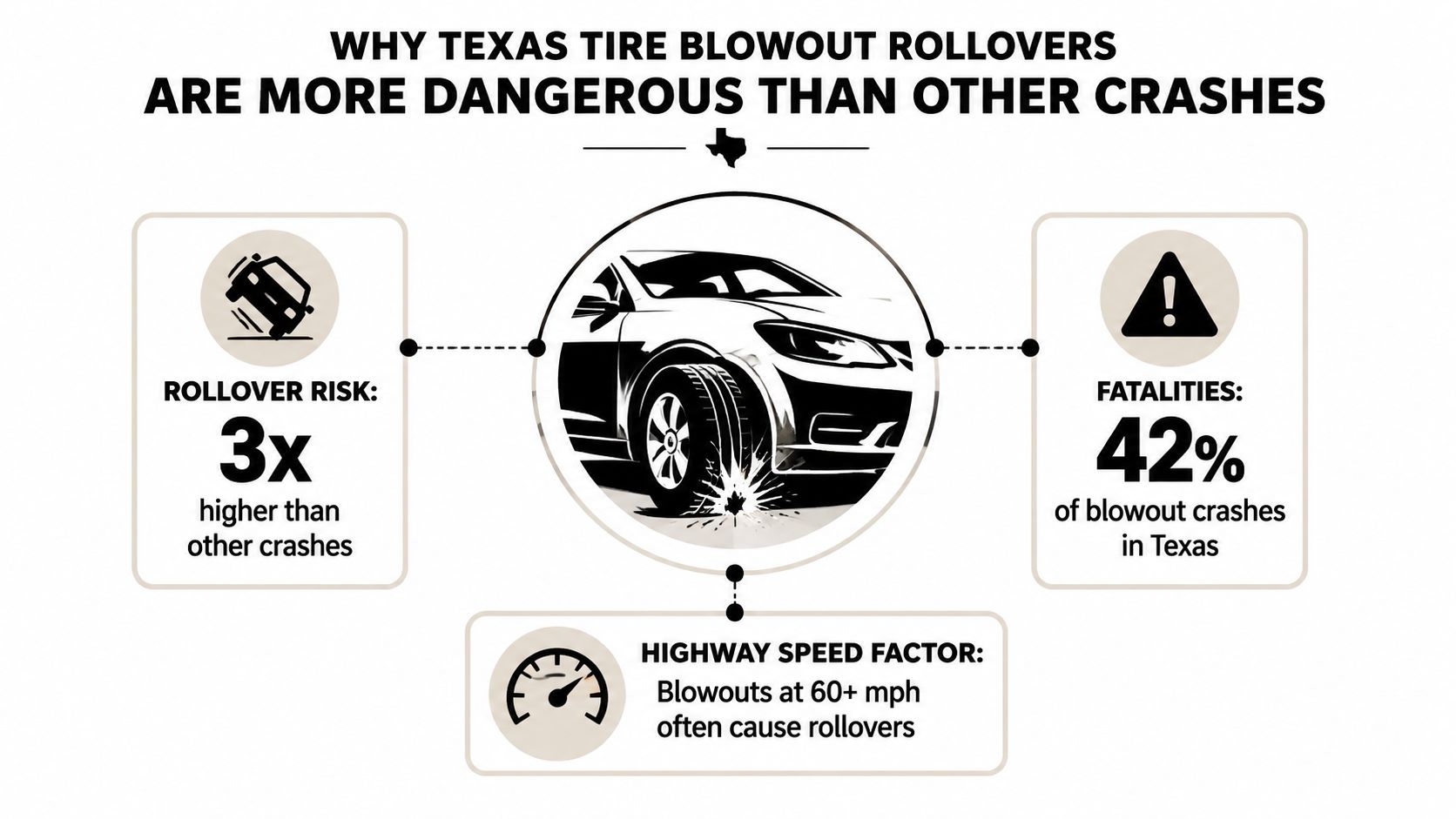
That's the kind of crash that turns a tire problem into a life-changing injury case. Tire blowouts are linked to nearly 6% of all highway crashes, with more than 75,000 blowout incidents each year and about 400 fatalities directly tied to those crashes according to an independent legal analysis citing federal and industry data from DeHoyos Injury. Another source reports 738 deaths in tire-related crashes in 2017, which is why lawyers treat a blowout as a serious liability event, not a random mishap.
Why rollovers happen so fast
A tire failure can shift weight, change traction, and trigger overcorrection. That's especially dangerous in taller vehicles like SUVs and pickups, which already sit higher off the ground. On Texas highways, where speeds stay high for long stretches, a blowout has less room for correction and more force behind the loss of control.
Rollover data drives that point home. One source reports tire blowouts were involved in 4.81% of rollover accidents, compared with 0.28% of non-rollover crashes, and that about 414 deaths and 10,275 injuries occur each year in rollover crashes caused by tire failure, with 74% of fatalities and 64% of injuries happening on highways posted at 55 mph or higher from Denena Points. That matters in Texas because long, high-speed corridors make a blowout more violent and make negligence easier to prove when someone skipped maintenance, overloaded the vehicle, or sold a defective tire.
Practical rule: if a blowout ended in a rollover, treat it like a serious evidence case from the start, not just a wreck report.
What To Do In the First Minutes After a Blowout or Rollover
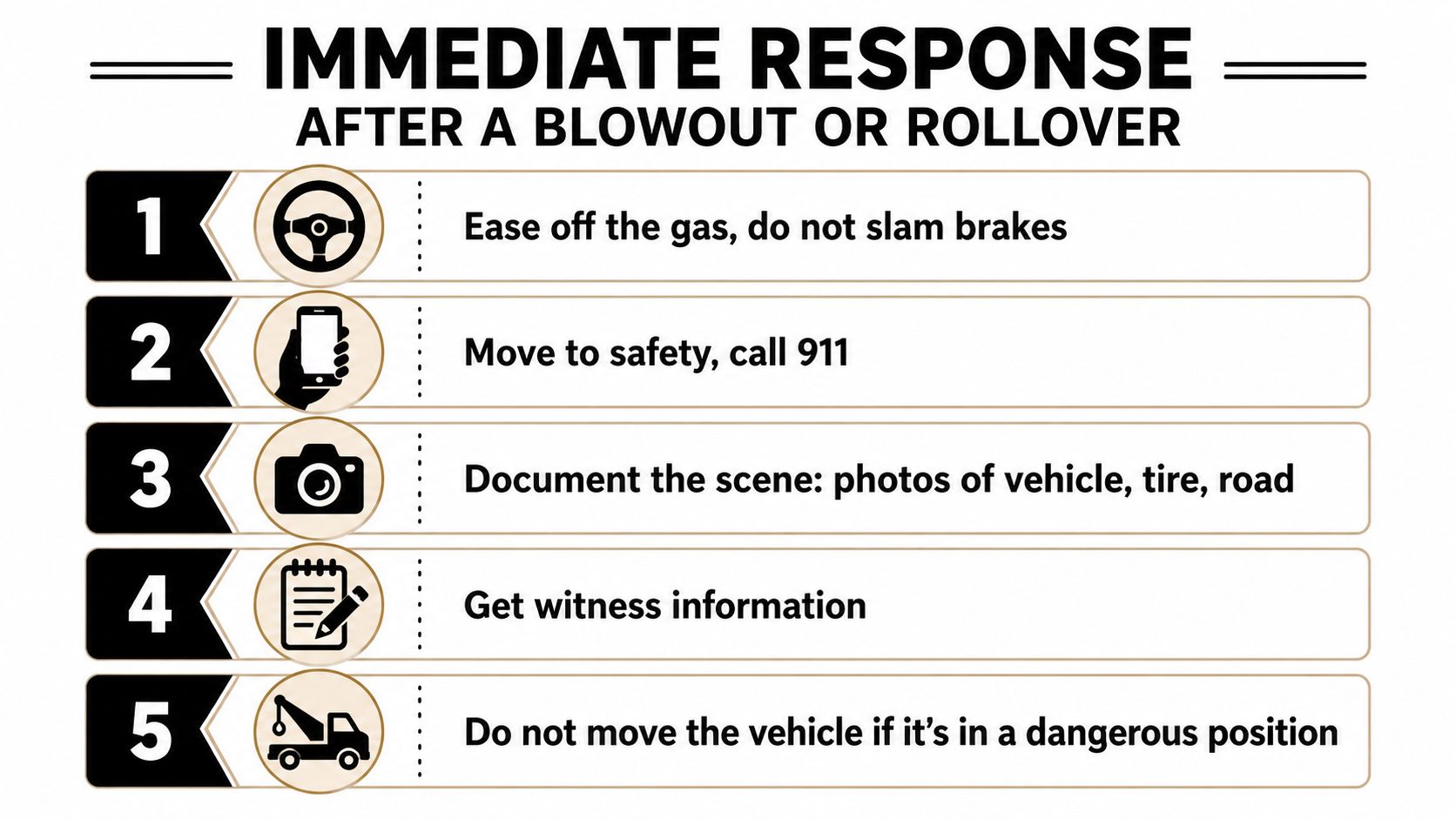
The first minute matters. If the tire blows while you're still moving, ease off the accelerator, keep both hands on the wheel, and don't slam the brakes. A hard brake application can make a bad situation worse, especially if the vehicle is already pulling or starting to rotate.
Once you're able to get clear, move to the shoulder or another safe spot and turn on the hazards. If anyone is hurt, call 911 right away. Texas drivers are commonly told to stay calm, keep the vehicle as steady as possible, and get out of traffic only when it's safe to do so, which matches the safety guidance from Sutliff & Stout.
What to document before the tow truck leaves
If you can do it safely, take photos of the vehicle, the tire debris, the roadway, the final rest position, and any visible injuries. Get witness names and phone numbers. If the tire fragments are still on scene, photograph those too, because the debris can show tread separation, sidewall failure, or impact damage.
That evidence disappears fast. Adrenaline blurs memory, and insurance companies often move quickly to change the story before the vehicle is inspected. If you want a practical checklist for the immediate aftermath, the guide on documenting evidence at the scene is useful because it focuses on the first facts that tend to vanish.
If this was a passenger-vehicle crash, a Car Accident Lawyer in Texas handles injuries to drivers and passengers in Texas car accidents. If the vehicle is stuck in a dangerous position, don't let anyone push it around just to clear the scene before the evidence is recorded.
Call 911 first. Evidence can be recreated later. Your safety can't.
Who Can Be Held Liable For a Texas Tire Blowout Rollover
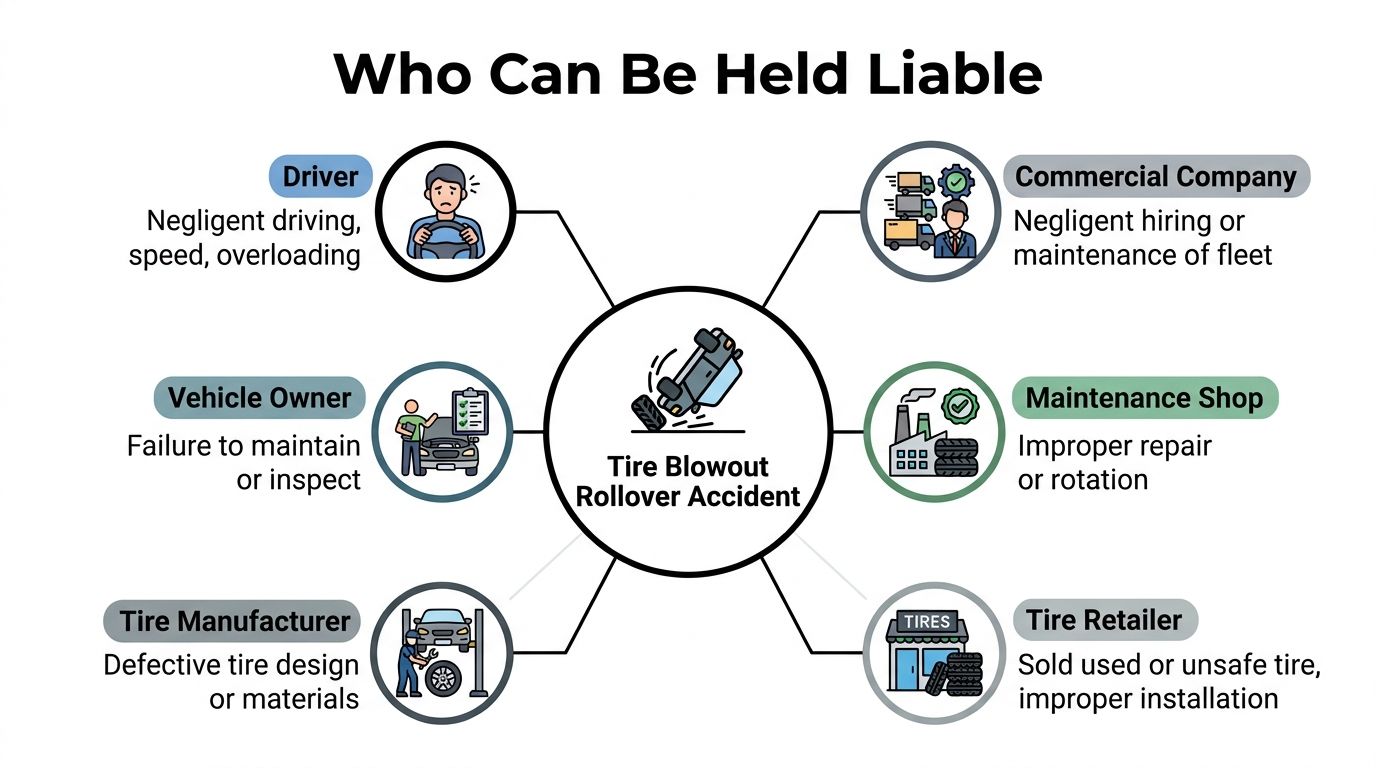
A blowout rollover is rarely one person's fault. Texas law looks at who had a duty to keep the tire, vehicle, and load safe, then asks who failed to do it. That can include the driver, the vehicle owner, a maintenance shop, the retailer that sold the tire, the manufacturer, and in commercial cases, the trucking company or carrier.
The possible defendants change with the vehicle
The driver may be responsible if they sped, ran an underinflated tire, or ignored obvious wear. The vehicle owner can also be on the hook if they failed to inspect or maintain the tire. The legal theory there is ordinary negligence, and the claim is stronger when there's proof the owner knew or should have known the tire was unsafe.
The tire maker is a different kind of defendant. A defective tire can support a product-liability claim involving design or manufacturing problems, and Texas rollover pages often point out that these cases are about more than a driver mistake. That's why a lawyer may also examine the retailer, the installer, or the shop that last worked on the tire. If a specific recall or defect issue is suspected, a vehicle-history resource like Ford Explorer vehicle recalls can help frame the investigation, especially when the crash involved a common SUV platform.
Commercial crashes raise the stakes
If the blowout involved an 18-wheeler or company vehicle, the case can expand fast. A truck crash lawyer Houston families call may need to look at the driver, the motor carrier, the maintenance vendor, and the tire supplier all at once. Trucking companies have separate maintenance obligations, and a tire failure on a commercial rig can create responsibility well beyond the person behind the wheel.
The right defendant list is part of the case. Miss one, and you can miss the recovery source.
For families comparing options, a Truck Accident Lawyer in Texas handles victims of commercial truck and 18-wheeler collisions. In a passenger-car case, the claim may center on driver negligence and a tire defect. In a truck case, it often becomes a multi-defendant investigation with logs, service records, and company policies in play.
Building the Evidence That Wins a Tire Blowout Case
A strong case starts with the tire itself. If the tire, wheel, or vehicle gets discarded before inspection, you lose the best proof of what failed and why. A qualified lawyer will move quickly to preserve those parts, inspect the tread, sidewall, rim, and wear pattern, and compare the physical evidence against the crash sequence.
That's not theory. In one Houston-area scenario, a family's SUV rolled on US-59 and the attorney got the tire preserved within 48 hours. The inspection later showed underinflation and an aged tire. That kind of result depends on speed, not luck.
The documents and data that matter most
The investigation should pull maintenance and service records, tire purchase records if they exist, and any notes from the shop that last serviced the vehicle. For commercial vehicles, event data recorder information can help show speed, braking, and movement before impact. An accident reconstruction expert can then connect the tire failure to the loss of control sequence.
For more detail on expert involvement, see accident reconstruction expert witness. The chain of custody matters too. If the tire moved from the scene to a tow yard to a salvage lot with no record of who touched it, the defense will argue the evidence can't be trusted.
The clearest cases are the ones where every step is documented. Preserve the tire. Photograph it. Store it. Inspect it quickly. That's how you keep insurers from claiming the crash was just “driver error” when the physical evidence says otherwise.
Before you hand over the vehicle, make sure your lawyer understands how to secure the proof first.
Texas Comparative Fault and the Two-Year Filing Deadline
Texas uses comparative responsibility, which means fault gets divided. If the injured person is partly responsible, the recovery can be reduced by that percentage. If the insurer can push the blame onto the driver for overcorrecting, speeding, or running a tire that was already unsafe, they'll try to shrink the claim fast.
That's why the evidence from the tire matters so much. Texas personal injury law generally requires you to prove fault and negligence, and in a blowout case that means showing how the crash happened and who failed to use reasonable care. A clear explanation of this rule is available in comparative fault definition.
Don't let the filing deadline run out
For Texas truck or car tire blowout claims, the statute of limitations is typically two years from the date of the crash to file a personal injury lawsuit, as noted by Israel Garcia Law. That deadline is not generous, and it doesn't wait for you to feel better, finish treatment, or figure out how bad the injuries are. If you miss it, you can lose the right to sue.
A simple comparison shows why timing matters. One driver calls a lawyer within a week, preserves the tire, and the case stays alive. Another waits a year, the vehicle is scrapped, and the insurer says there's no proof the blowout caused the rollover.
Practical rule: if the tire is still available, your lawyer needs to move before the evidence disappears.
What You Can Recover After a Texas Tire Blowout Rollover
A strong claim reaches beyond the car. You can recover medical bills, lost wages, future care costs, rehab expenses, vehicle loss, pain and suffering, mental anguish, and loss of enjoyment of life when the facts support it. In a fatal case, the family may also pursue funeral costs, loss of companionship, and lost financial support.
The value of the case turns on injury severity and proof of liability. A plain-English guide to the difference between economic and non-economic damages is here: economic and non-economic damages explained. The stronger the physical evidence and expert support, the more likely the case reflects the full harm instead of an insurer's low offer.
Realistic settlement benchmarks
| Injury Severity | Typical Recovery Range | Key Drivers |
|---|---|---|
| Minor injuries | $20,000 to $75,000 | Short treatment, limited wage loss, clearer liability |
| Severe or fatal injuries | $1 million+ | Major medical care, long-term impairment, wrongful death evidence |
These bands come from the public claims of Texas firms cited in the verified data, including a firm that reports tire-detread rollover settlements of $10 million, $10.2 million, and $12 million, and another that lists broad settlement ranges from $20,000 to $75,000 for minor injuries up to $1 million+ for severe or fatal injuries from Ammons Law. Don't chase the biggest number. Chase the best evidence.
What drives the higher end
The biggest recoveries usually require preserved physical evidence, expert reconstruction, and a clean link between the blowout and the loss-of-control sequence. If the case involves a fatal rollover, a Texas wrongful death lawyer may also examine who controlled the tire, the vehicle, and the maintenance history before the crash.
Families in serious cases also need coordinated medical care. A practical resource on OWCP-compliant injury care can help when treatment planning and documentation both matter.
Choosing the Right Texas Lawyer and Taking the Next Step
A tire blowout rollover is a multi-party liability case, and the lawyer you hire needs to treat it that way from day one. The work starts with preserving the tire, the wheel, the vehicle, and the service records before anyone scraps, repairs, or loses them. It also means identifying every possible defendant, the driver, the vehicle owner, the tire shop, the retailer, the manufacturer, and, in commercial cases, the trucking company that controlled the vehicle or its maintenance.
You need a lawyer who knows how to build the case around the tire itself. That means looking for someone who moves fast on evidence preservation, understands tire defects and reconstruction, and knows how to press for records that companies usually try to keep buried. If a commercial vehicle was involved, the firm should already know how to handle logbooks, inspection records, maintenance files, and the people who control them.
Ask direct questions before you hire anyone. Find out whether the lawyer will secure the tire and vehicle immediately, whether they work with reconstruction experts and product-defect issues, and whether they are ready to take the case to trial if the insurer stalls or lowballs the claim. If the answers are vague, keep looking.
The Law Office of Bryan Fagan, PLLC handles Texas personal injury matters with free consultations and contingency-fee representation. If you are recovering from a rollover, get the case reviewed now, while the vehicle still exists and the story has not been written for you by an insurance company.
Good injury care matters too. If your treatment plan needs to stay organized while the case is being built, OWCP-compliant injury care can help keep medical documentation on track.
A Texas personal injury lawyer should make your next step clear. Reach out, get the facts reviewed, and let a lawyer start locking down the evidence before it disappears.