A serious accident can change your life in seconds, but you don't have to face it alone. You may be looking at an Uber receipt, a hospital discharge sheet, and unanswered messages from an insurer, wondering who's supposed to pay. A rideshare accident attorney can help answer that question by identifying the driver's app status at the moment of impact, then connecting that evidence to fault, insurance, and your losses.
Why a Rideshare Crash Is Not an Ordinary Car Wreck
A passenger is riding in an UberX through Houston when another driver runs a red light and strikes the car. The passenger suffers a broken collarbone and may wonder which insurer should handle the claim. The answer depends in part on what the rideshare driver's app showed at the moment of impact.
The claim can move from the driver's personal policy to the platform's insurance depending on whether the driver was waiting for a request, had accepted a trip, or was carrying a passenger. That app status helps identify the relevant coverage, while evidence about the collision helps establish who was at fault.
What makes the claim different
- More parties. The driver, another motorist, and several insurers may need to be considered.
- More digital records. Trip receipts, acceptance timestamps, GPS history, and app logs can help establish the driver's status at impact.
- Precise timing. A driver who has accepted a ride may raise a different coverage question from one still waiting for a request.
Those records matter because a claim depends on piecing together what happened at a specific moment. A receipt may show the trip, while app logs or GPS history can help confirm the timeline. Together with evidence of the crash, they help clarify which insurer may be responsible.
Road deaths are part of the broader traffic safety context. 40,901 people died in 2023, according to NHTSA's national traffic fatality report. The report does not separately identify Uber or Lyft crashes, so the figure is not a rideshare-specific count.
For an injured passenger, the immediate focus can stay on medical care and keeping relevant records. The app timeline helps identify the coverage question; the collision evidence helps determine fault and the losses tied to the crash.
What to Do and Avoid in the First Days After a Crash
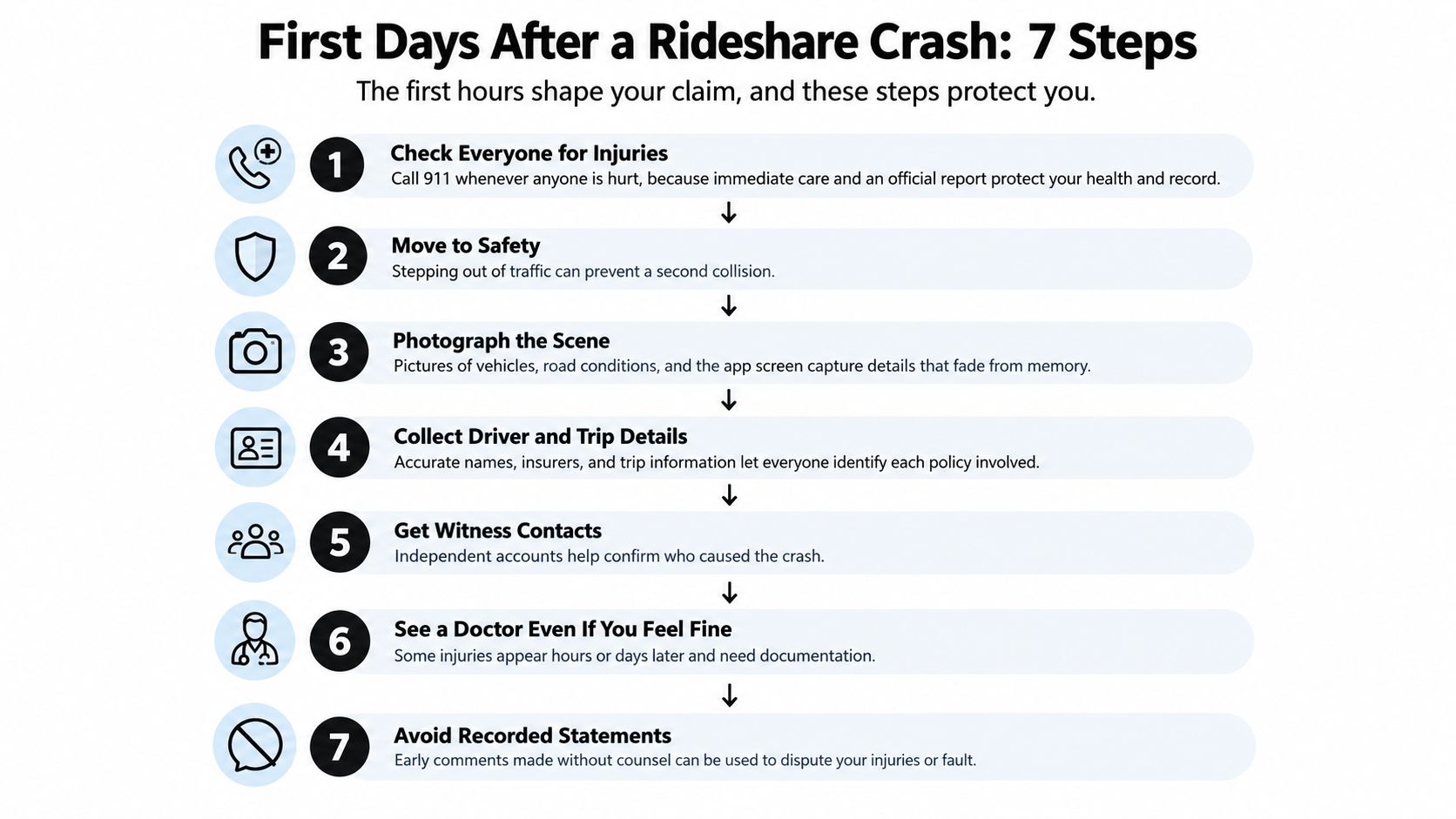
The first hours help shape the claim, but you don't need to do everything perfectly. Focus on safety first, then save what you reasonably can.
Steps that protect your health and records
- Check for injuries and call 911. Get emergency help when someone is hurt or a vehicle can't be moved so responders can assist and document the scene.
- Move out of traffic when it's safe. Moving a drivable vehicle to a safer location can help prevent another collision.
- Exchange information and identify witnesses. Collect names, addresses, phone numbers, license details, vehicle identification and plate numbers, and insurance information so the people and policies involved can be located.
- Photograph the scene. Safe photographs of vehicle damage, road conditions, and visible injuries preserve details that may change quickly.
- Save the rideshare information. Screenshot the trip details and driver profile, preserve any visible app-status information, and keep the receipt to help establish the trip timeline.
- Report the collision. Notify the rideshare platform and your own insurer while keeping copies of what you submit.
- Get medical care. Even if you initially feel fine, seek an evaluation because symptoms may develop later and your condition needs accurate documentation.
TxDOT's collision guidance supports prioritizing injuries, moving safely, exchanging information, identifying witnesses, and contacting police when appropriate.
Keep this checklist available while you organize the first records.
What to avoid
- Arguments and guesses. Describe what you observed without admitting fault or debating blame.
- Premature recorded statements. Get advice before discussing injuries or responsibility on a recording.
- A rushed release. Understand your medical needs and financial losses before accepting a settlement.
For example, a San Antonio rider could keep medical bills, appointment notes, pay stubs, and insurer letters in one folder. That simple habit helps connect each claimed expense or missed shift to a record.
If another driver has no insurance, call police and ask that the information be documented. You can cooperate with reporting requirements without guessing about who should ultimately pay.
Who Pays at Each Stage of a Rideshare Trip
A rideshare crash happens, and the driver's app status at that exact moment can determine which insurance coverage applies. Establishing that status is the first step. The cause of the crash and evidence of fault help determine whose liability coverage may pay.
A driver who is logged off is in a different coverage phase from a driver waiting for a request. Once the driver accepts a trip, another phase begins, even before the passenger gets into the vehicle. The app timeline is like a clock: its records help place the driver in the right phase at impact.
Rideshare coverage by app status at impact in Texas
The required limits below are set out in Texas Insurance Code Section 1954.052. The statute permits the driver's insurer, the transportation network company, or both to provide the required coverage.
| App status at impact | Required liability limit | Coverage that usually responds |
|---|---|---|
| Logged off the app | No platform minimum applies | Driver's personal auto policy, if applicable |
| Logged on, waiting for a request | $50,000 per person, $100,000 per incident, $25,000 for property damage | Driver's insurer, the platform, or both |
| Request accepted, driving to pickup | $1 million aggregate per incident when engaged in a prearranged ride | Applicable rideshare coverage; acceptance timestamps help resolve disputes |
| Passenger in the vehicle | $1 million aggregate per incident | Applicable rideshare liability policy; potentially your UM/UIM if another at-fault driver lacks adequate coverage |
Start with the app status, then check the required limit and the actual policy documents. The $1 million figure is a per-incident cap shared across claimants, not a payment amount reserved for you. The final amount depends on the evidence, the policy terms, and the losses involved.
For example, in a Fort Worth crash, a driver may have accepted a request shortly before impact without reaching the passenger. The acceptance timestamp can help show whether the driver had entered the covered prearranged-ride phase.
Why pickup trips deserve careful review
An empty back seat alone does not establish that a driver was still waiting for work. Compare the acceptance record, dispatch information, route, and crash time to determine the app status at impact.
A personal auto policy may exclude commercial rideshare activity, so the driver's insurance card may not answer which policy applies. Reviewing the policy itself can clarify whether it covers the driver during that phase.
Coverage checkpoint: A screenshot can help document app activity, while the complete app timeline and insurance policies provide a fuller record.
The table gives a starting point, not a claim decision. App status, evidence of fault, policy wording, and applicable coverage dates must be reviewed together to identify which insurer may owe payment.
How Driver, Platform and UM Coverage Work Together
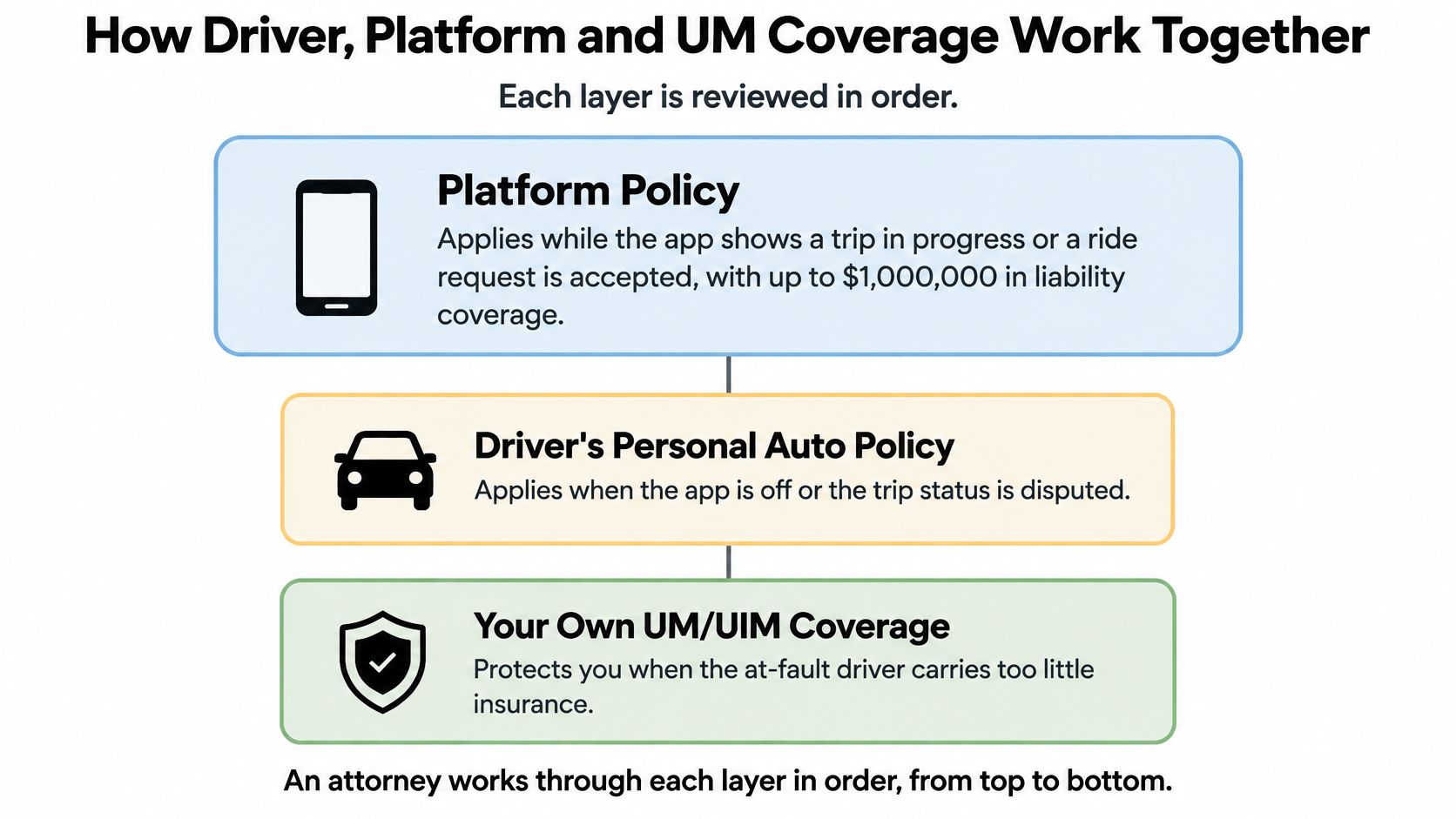
Three possible policies may respond, and each has a different trigger: the rideshare platform's policy, the driver's personal auto policy, and your own coverage. The driver's app status at the moment of impact helps determine which policies may apply. Later coverage questions depend on that point in the timeline.
The diagram shows how platform and personal policies may fit into a rideshare claim. Whether either applies depends on the policy terms and evidence of the trip status.
When the driver and digital records disagree
A driver may recall waiting for a request while platform records show one had already been accepted. People outside the rideshare vehicle, including pedestrians, cyclists, and occupants of another car, may not be able to access those records themselves. Formal requests and legal processes can help obtain them.
Policy dates matter, too. The Texas legislative text addressing rideshare coverage changes states that the changes apply to policies delivered, issued, or renewed on or after January 1, 2026. An attorney can check the policy's dates and applicable requirements rather than assume all policies changed at once.
Other coverage that may matter
The app-status question identifies which rideshare policy may respond. Separate coverage may also affect how much of your loss can be paid. The relevant terms, limits, and claim requirements depend on the policies in force.
If another driver caused the crash, that driver's liability policy may pay covered damages up to its limits. When those limits are too low, your own underinsured motorist coverage may help address the shortfall, subject to the policy and claim requirements. Review uninsured and underinsured coverage to identify questions about your own policy.
Texas personal injury protection, or PIP, can cover medical bills and some lost wages regardless of fault, unless the policyholder rejected it in writing. Coverage must be in place, and policy limits apply.
An attorney can begin by checking three things:
- Status. What do app and trip records show about the driver's activity at impact?
- Policies. Which contracts were in force on the crash date, and what do their terms cover?
- Claim steps. Which notices and claims should be submitted promptly to preserve available coverage?
How an Attorney Builds Your Evidence File
Preservation comes before negotiation. Video can be overwritten, electronic records can become unavailable, and useful documents can be misplaced while you're focused on treatment.
Your attorney should organize the evidence around the impact timeline. The question isn't whether a trip existed, but whether the acceptance, pickup, route, and collision records support the same account.
Start with the crash report, then fill the gaps
Under Texas Transportation Code Section 550.062, an investigating officer generally must submit a report to TxDOT no later than the 10th day after a qualifying crash involving injury, death, or apparently at least $1,000 in property damage; TxDOT's crash-report guidance also explains requests by directly involved people or authorized representatives, subject to a written request and fee.
The report may identify the location, vehicles, apparent injuries, witnesses, citations, and the officer's initial account. It's valuable, but it may not establish the driver's precise app status or include every available recording.
Rideshare evidence, why it matters and how fast it fades
| Evidence | What it proves | How fast it fades |
|---|---|---|
| Trip receipt and app-status logs | Whether the driver was available, waiting, or engaged | Retention can be limited; request early |
| Dispatch and acceptance timestamps | When a request was dispatched and accepted | Preserve with the app records |
| GPS history and vehicle telematics | Available location, route, speed, and braking information | May be overwritten or affected by repair or sale |
| Dashcam and surveillance video | Collision sequence and possible fault | May be overwritten within days or weeks |
| 911 call records | Timing and early accounts of injuries and conditions | Agency retention rules vary; request promptly |
| Crash report | Officer's initial account and recorded observations | Request once submitted |
| Medical records and bills | Injury history, treatment, and costs | Collect throughout treatment |
| Wage and employment records | Missed work and lost income | Save pay records and request employer confirmation |
An attorney can send preservation requests for platform records, seek surveillance and dashcam footage, obtain available vehicle data, and organize medical and employment evidence. A preservation request is an important step, but obtaining records may still require formal legal procedures.
For example, after a Dallas intersection collision, an injured passenger's treatment records explain the injury while employer records show which scheduled shifts were missed. Together, they support the claim more clearly than a general statement that the passenger couldn't work.
Write down what you remember while it's fresh. Separate what you personally saw from what someone later told you.
This explanation of evidence needed for a Texas injury claim can help you prepare a useful file without trying to conduct the investigation yourself.
How Comparative Fault Changes Your Recovery
Negligence means failing to use reasonable care and causing another person's injury. In a rideshare crash, your attorney must connect unsafe conduct to the collision and your losses, not merely show that a driver was using an app.
Texas also considers your own share of responsibility. Under Texas's proportionate-responsibility framework, you generally may recover when your responsibility is 50% or less, with damages reduced by your share; responsibility greater than 50% bars recovery.
Recovery on $100,000 in damages by share of fault
The following hypothetical calculations illustrate that statutory rule, not a prediction of any claim's value.
| Your share of fault | Recovery on $100,000 in damages | Result |
|---|---|---|
| 0% | $100,000 | Full recovery |
| 20% | $80,000 | Reduced by your share |
| 50% | $50,000 | Still recoverable at the threshold |
| 51% | $0 | Barred from recovery |
After a Houston freeway crash, responsibility might be disputed among the rideshare driver, another motorist, and the injured claimant. Witness accounts, photographs, vehicle data, medical evidence, and traffic-camera footage can help resolve those disputes.
Before speaking with an adjuster: Describe observations accurately. Don't turn uncertainty about braking, speed, or distance into an admission.
A Texas personal injury lawyer can assess those arguments alongside medical costs, lost income, pain, and future needs before you decide whether a settlement is reasonable.
How Long You Have to File a Claim in Texas
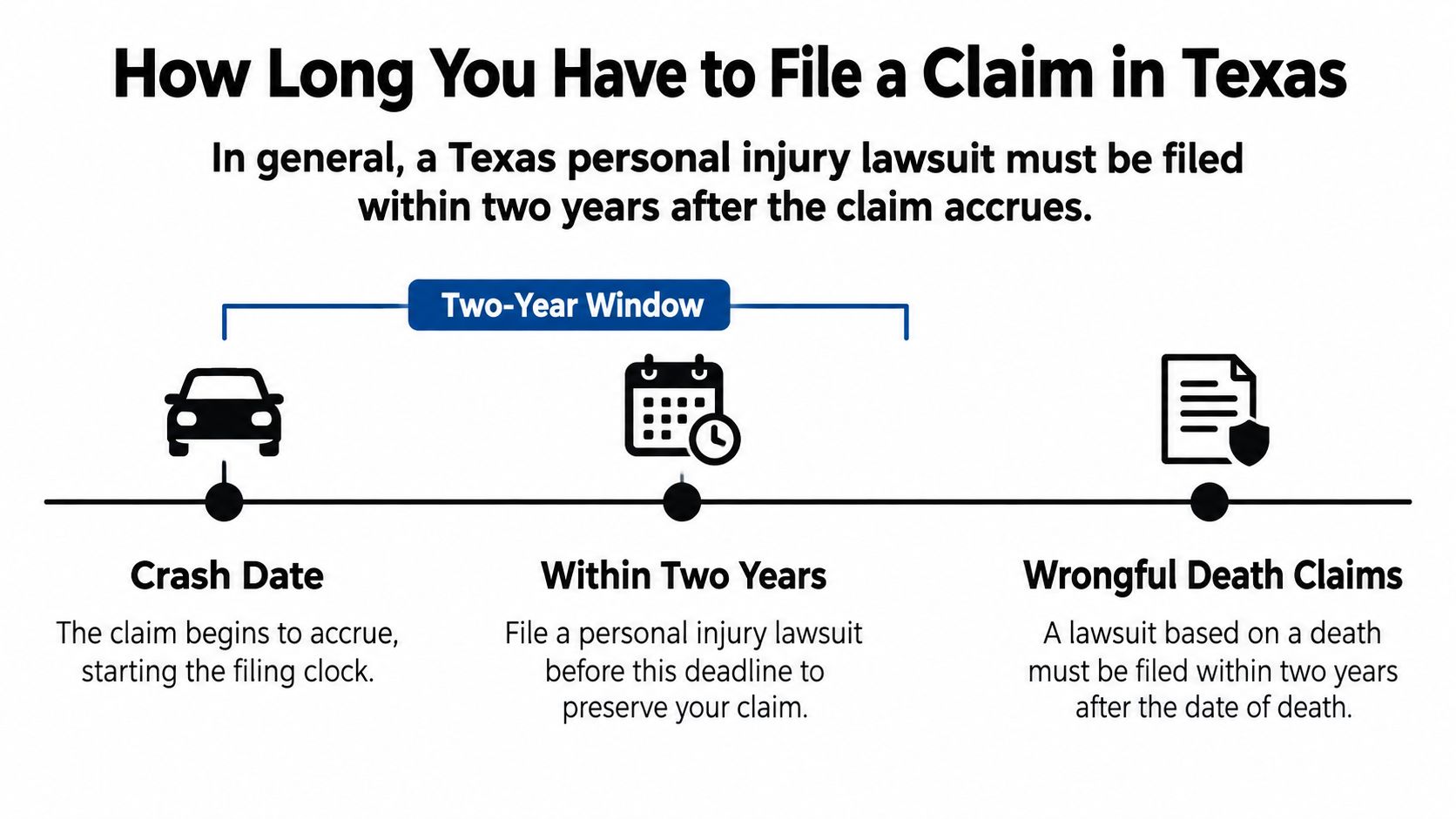
After a rideshare crash, you may be focused on treatment or waiting for an insurance decision. Texas court deadlines keep running during that time. A personal injury lawsuit generally must be filed within two years after the claim accrues. A lawsuit for an injury that resulted in death generally must be filed within two years after the death, under Civil Practice and Remedies Code Section 16.003. Court deadlines control here; talking to an adjuster does not extend them.
Waiting for a traffic or criminal case to finish also does not protect a civil claim. The deadline should be checked against the facts of your case, including when the claim accrued and who is bringing it.
Texas rideshare claim deadlines and milestones
The crash report and a lawsuit have separate timing rules. The report can document the collision, while the lawsuit deadline determines how long you generally have to bring a court claim.
| Milestone | Texas timing | Why it matters |
|---|---|---|
| Crash report filed with TxDOT | Within 10 days after the crash | The report can be requested after submission |
| Personal injury lawsuit | Within two years after the claim accrues | Missing the deadline usually bars the claim |
| Wrongful-death lawsuit | Within two years after the death | Beneficiary and other claim rules can apply |
| Insurance claim or adjuster talks | Negotiations do not pause the lawsuit deadline | Discussions alone do not protect the filing deadline |
| Injured minor | Special rules may alter the deadline | The claimant and type of claim need individual review |
| Government-owned vehicle involved | Separate notice deadlines may apply much earlier | Notice requirements can arise before the lawsuit deadline |
Why an early deadline review helps
A family dealing with a death after a rideshare collision may need to consider a wrongful-death claim and who is eligible to bring it. Records such as the death certificate, crash report, funeral bills, medical records, and employment information can help document the loss.
Ask a lawyer to check the details that can change the timing:
- Minors. Special rules may affect time limits, and an extension for one claim may not apply to every related claim.
- Government involvement. A city-owned vehicle may bring shorter notice requirements.
- Insurance notices. A policy may require notice before a lawsuit is due.
- Unusual facts. The claimant, defendant, and nature of the claim can affect the deadline.
Waiting until the filing period is nearly over can also leave less time to obtain app records showing the driver's status at the moment of impact. That status can help identify which insurance coverage may apply. Evidence gathering can begin while you continue receiving care, and it does not require accepting an early settlement.
Reviewing Texas injury-claim filing deadlines can help you prepare questions. Ask your attorney for a deadline assessment based on your specific circumstances.
When to Call a Rideshare Accident Attorney
After a rideshare crash, you may be managing medical care while trying to work out which insurance applies. The driver's app status at impact can determine the coverage, so getting advice early can help preserve records that show whether the driver was waiting for a ride, heading to a pickup, or carrying a passenger.
Call when injuries require continuing care, the trip status is unclear, or an insurer asks you to sign a release before you understand your recovery needs. Bring what you have. Missing paperwork can be identified and requested later.

Reasons to get advice now
- Continuing medical needs. Ongoing treatment or lasting limitations can affect how an injury claim is evaluated.
- Conflicting accounts. The driver's explanation may differ from the app's trip history.
- Insurance pressure. Before giving a recorded statement or accepting an offer, understand what you are agreeing to.
- Inadequate coverage. If the other driver has no insurance or too little, additional policy coverage may need review.
- A death in the family. A lawyer can help clarify who may bring a claim and what records support it.
For your first call, gather the rideshare receipt or trip screenshot, crash report, medical paperwork, and any letters or messages from insurers. These documents give the attorney a starting point for checking the driver's app status and identifying records that may be missing. The firm handles car and truck accident claims, wrongful-death cases, and catastrophic injuries.
Managing Attorney Bryan Fagan leads a team serving Houston, Dallas-Fort Worth, Austin, San Antonio, and surrounding communities. The firm offers free consultations and contingency-fee representation, meaning there is no attorney's fee unless it wins. Review the written agreement to understand fees and expenses.
Uber and Lyft Accident Claims in Texas explains liability and coverage in platform-related crashes. Car Accident Lawyer in Texas describes representation for injured drivers and passengers.
The Law Office of Bryan Fagan, PLLC offers free consultations for injured people and families. You can bring available trip, medical, and insurance records to discuss your situation. Legal guidance can help you focus on your health and family while the claim is assessed.