A serious accident can change your life in seconds, but you don't have to face the legal aftermath alone. Medical bills, missed work, insurance calls, and unanswered questions can become overwhelming, especially when you're trying to understand whether a deadline has already started.
Texas injury law uses more than one legal clock. Most personal injury claims generally have a two-year statute of limitations under Texas Civil Practice and Remedies Code § 16.003, while certain claims also face a separate statute of repose tied to an earlier event, such as a product sale, medical act, or substantial completion of construction. Those rules can overlap, and missing either one may end a claim. Texas Civil Practice and Remedies Code § 16.003
What These Two Texas Deadlines Mean for Your Injury Claim
After a Houston freeway crash, you might feel neck pain immediately, or symptoms might become obvious only after medical testing. You may assume the only question is whether two years have passed since the collision. For a typical car accident, that limitations deadline is central. But a defective vehicle part, construction defect, or medical injury can bring another deadline into the analysis.
A statute of limitations usually measures time from when the injury claim accrues. In many Texas personal injury cases, that means the clock generally begins on the date of the injury. A statute of repose works differently. It starts with a fixed event connected to the product, project, or professional act, and it can bar a claim even if the injured person hasn't discovered the harm.
Why one deadline may not be enough
Consider a crash caused by a defective steering component. You may have an ordinary injury claim based on the collision, along with a products-liability claim involving the component. The crash claim and the product claim may be governed by different timing rules. Investigating the accident quickly helps identify which legal theories exist and which deadlines apply.
The distinction also matters in wrongful-death cases. Texas generally gives injured people a two-year limitations period for personal injury and death claims under § 16.003, but a separate repose period may apply when the underlying harm involves a product, construction project, or health-care liability claim. Texas personal injury deadline guidance explains why early investigation matters when the usual deadline runs from accrual rather than from the point when every consequence becomes known.
Practical rule: Treat every date as important. The accident date, product sale date, project completion date, medical treatment date, and date of death may all affect the legal analysis.
The key point is simple. A claim can appear valid because the ordinary limitations period hasn't expired, yet still face an outside repose deadline. A Texas personal injury lawyer can review the facts, identify the possible claims, and determine which clock could control.
Statute of Limitations and Statute of Repose Explained
Understanding these deadlines starts with one question: what event begins the clock?
A statute of limitations generally gives you a defined period to file after your injury claim accrues. For most Texas personal injury claims, that period is two years, usually measured from the date the injury occurs under Texas Civil Practice and Remedies Code § 16.003(a). A Texas personal injury lawyer can evaluate the accident, evidence, and applicable deadline while representing injury victims across Texas on a no-fee-unless-we-win basis.
A statute of repose sets an outside cutoff tied to an earlier fixed event. That event may be the sale of a product, substantial completion of an improvement, or the negligent medical act. The cutoff can apply even if the injured person did not yet know about the harm. Once the outer period expires, the claim may be barred despite later symptoms or discovery. Learn more about Texas personal injury limitations before assuming delayed discovery preserves a case.
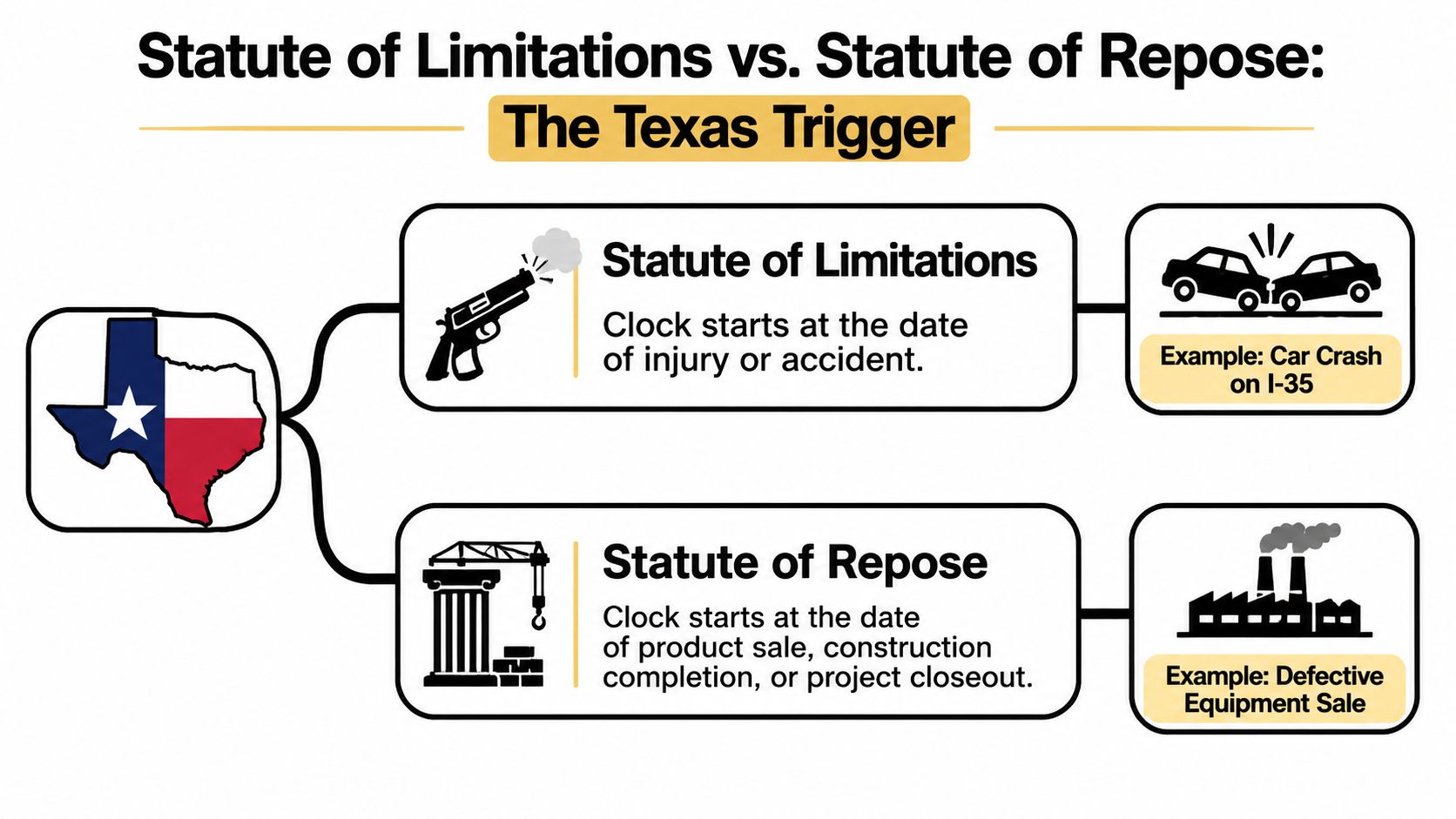
A simple side-by-side explanation
For a Houston driver injured in a collision, the crash date usually provides the starting point for the ordinary limitations period. The resulting claim may include negligence, vehicle damage, medical treatment, lost income, and other losses. The injury date and the two-year filing period therefore deserve prompt attention.
Repose uses a different reference point. In a product case, the product's sale date may control the outside deadline, even if the defect causes harm much later. For a construction injury, substantial completion of the improvement may matter. In a medical malpractice case, the date of the negligent medical act can become the starting point for the repose period, even when symptoms appear afterward.
Discovery can affect limitations in some circumstances, while repose is designed to provide finality after a fixed period. That distinction explains why a claim may still appear timely under the ordinary injury deadline yet face an expired outer bar. Delayed symptoms, continuing treatment, or late notice do not automatically overcome a repose defense. Recognizing both clocks early helps identify whether a car-crash, product-defect, construction, or medical claim can proceed.
Key Differences Between the Two Deadlines
The phrase Texas statute of repose vs statute of limitations injury describes a distinction that can determine whether an injury claim proceeds. The table below shows how the two legal clocks differ.
| Feature | Statute of Limitations | Statute of Repose |
|---|---|---|
| Starting point | Usually the date the injury claim accrues | A fixed event, such as product sale, medical act, or substantial completion |
| Discovery | Discovery may matter in limited situations involving hidden injuries | Discovery generally doesn't restart the outside deadline |
| Common application | Most car, truck, motorcycle, pedestrian, rideshare, and other personal injury claims | Certain product, construction, and health-care liability claims |
| Effect of expiration | A late lawsuit may be dismissed | The claim may be absolutely barred after the outside period |
| Flexibility | Some tolling or exceptions may apply | Extensions are narrow and uncommon |
The trigger event controls the analysis
When you assess a claim, two questions matter: when did the harm begin, and when did the defendant perform the act that created the risk? For a car crash, the accident and resulting injury usually start the ordinary limitations analysis. For a product claim, Texas law provides a 15-year repose period from the date of sale of the product. Texas product-liability guidance explains why that outside period can bar a claim regardless of when the injury becomes known.
Construction claims generally involve a 10-year repose period after substantial completion of the improvement. Health-care liability claims generally involve a 10-year repose period after the negligent act. These deadlines reflect a legal policy favoring finality and limiting indefinite exposure for defendants. Insurance and Texas deadline background describes the difference between accrual-based limitations and event-based repose.
The key consequence is practical: an injury may appear timely under the ordinary limitations period while still facing an expired repose bar. A product defect discovered late, a construction injury appearing after completion, or harm linked to an earlier medical act can raise that problem.
Discovery can help, but it isn't a universal answer
If you do not immediately know that an injury occurred, a court may examine whether a discovery rule applies. That question usually concerns when the claim accrued, not whether a separate repose period exists. Someone who discovers harm later still must identify the underlying event and determine whether the applicable outer deadline has passed.
A limitations defense may sometimes involve tolling, delayed discovery, or another recognized exception. Repose is generally more rigid, so a lawyer should check both dates early, before an insurer, manufacturer, hospital, or contractor frames the dispute around only one deadline. For a plain-language explanation, review this Texas statute of repose guide.
Real-World Examples Across Car, Product, Construction, and Medical Cases
Legal clocks become easier to understand when you place them in familiar Texas situations. These examples are general illustrations, not conclusions about any particular claim.
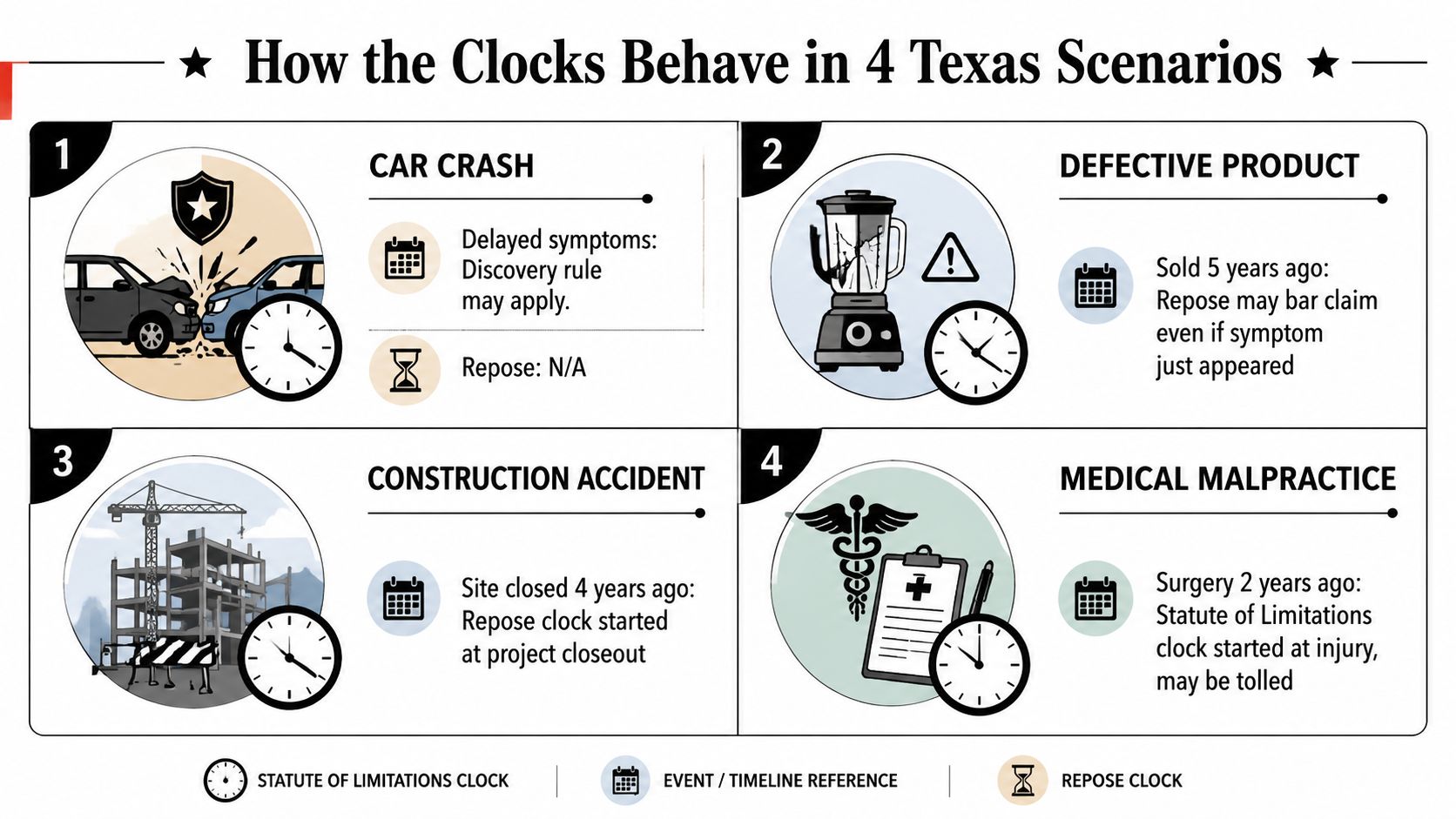
A Houston freeway crash with delayed symptoms
After a Houston freeway crash, a driver feels shaken but doesn't notice the full extent of a back injury until medical follow-up. The ordinary personal injury analysis generally centers on the accident and the date the injury claim accrued. Texas commonly gives most personal injury plaintiffs two years to file, so waiting for symptoms to become severe can create a serious timing problem. Texas deadline overview explains that the ordinary rule generally runs from the date the injury occurs.
A routine vehicle collision usually doesn't involve a separate product statute of repose just because the car was older. But if a defective tire, airbag, brake, or other component contributed to the crash, a products-liability theory may create another timing question. The investigation must identify whether the injury resulted from driver negligence, a vehicle defect, or both.
A defective auto part sold years earlier
Suppose a defective auto part injures someone years after the product was sold. The person may have a timely injury theory based on when the harm occurred, but Texas products-liability law also includes a 15-year repose period measured from the product's sale. If that outside period has expired, the product claim may be barred even though the symptoms are recent.
That doesn't automatically answer whether other claims exist. A lawyer may need to separate the product claim from possible negligence claims against another party, examine the sale records, preserve the part, and determine what event Texas law uses for the repose calculation.
A construction injury discovered after completion
A worker, resident, or visitor may suffer harm from a construction defect that becomes apparent after a project is finished. Texas generally imposes a 10-year repose period after substantial completion of the improvement. The ordinary injury limitations period may also apply once a person is injured.
This creates a two-date problem. The injury date may govern limitations, while substantial completion may govern repose. Building permits, inspection documents, contracts, photographs, repair records, and project-closeout documents can help establish the dates and identify responsible parties.
Medical malpractice with late-discovered harm
A patient may learn later that a medical act caused an injury. Texas health-care liability law uses a two-year limitations period and a separate 10-year statute of repose under Texas Civil Practice and Remedies Code § 74.251. Texas civil-case deadline discussion describes the repose period as an absolute cap that generally overrides discovery-based arguments.
Medical records, consent forms, treatment dates, diagnostic images, and expert review may all become important. Do not assume that continuing treatment or a delayed diagnosis automatically extends every deadline.
Tolling, Discovery Rules, and Exceptions That Can Buy You Time
Some legal rules can pause or affect a statute of limitations. They don't provide a safe excuse for waiting, and they generally don't erase the need to investigate promptly.
Discovery rules focus on when the injury could be known
The discovery rule may matter when the injury is difficult to recognize at the time it occurs. A court may examine when a reasonable person could have discovered the injury and its connection to the wrongful conduct. That analysis is fact-specific. Delayed symptoms alone don't guarantee extra time.
Texas law may also provide tolling protections in particular circumstances involving a minor plaintiff or mental incapacity. In some cases, the defendant's absence from Texas or fraudulent concealment may raise separate questions. Courts treat these issues narrowly, and the facts must support the claimed exception.
Repose usually remains a hard outer boundary
A tolling argument aimed at the limitations period may not overcome a statute of repose. The repose clock is tied to the product sale, construction completion, or medical act rather than to the injured person's awareness. Texas health-care liability law's separate 10-year repose period illustrates why a delayed discovery argument may not preserve a claim forever.
The safest approach is to investigate exceptions while the ordinary deadline is still open, not after it has passed.
If your case involves a medical injury, preserve records and obtain a careful legal review of both clocks. The Texas medical malpractice statute of limitations can involve accrual questions, notice issues, and the separate repose limit, so a general car-accident deadline isn't enough.
Fraudulent concealment may receive special treatment in narrow circumstances, but you shouldn't assume that a defendant's mistake, silence, or disagreement qualifies. A lawyer will need to evaluate what the defendant knew, what was communicated, and whether the conduct prevented discovery.
Practical Steps to Protect Your Texas Injury Claim
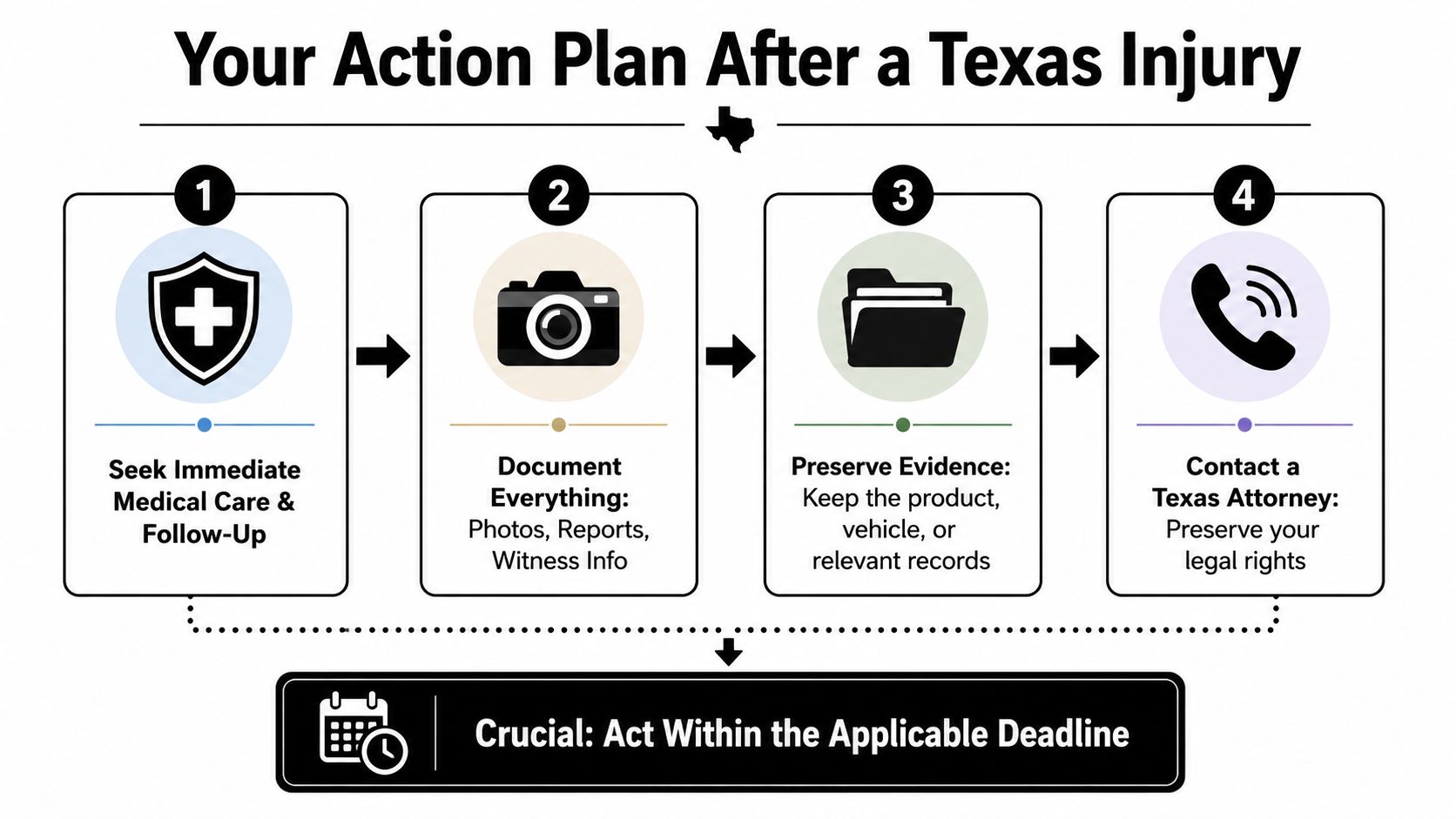
Deadlines are easier to protect when you create a record early. Whether you were hurt in a car collision, truck wreck, workplace incident, construction accident, or medical setting, take these steps as soon as you reasonably can.
Get medical care and follow the treatment plan. Tell providers about every symptom, including pain that appears minor. Keep appointment records, prescriptions, referrals, bills, and written instructions.
Preserve evidence before it disappears. Photograph the vehicles, roadway, visible injuries, equipment, property damage, and surrounding conditions. Keep the defective product, damaged safety gear, vehicle part, or other physical evidence in its current condition when possible.
Write down the timeline. Record the accident or treatment date, symptoms, conversations, work absences, medical visits, and changes in daily activities. A dated personal account can help organize facts that become harder to recall later.
Handle insurance communications carefully. Give necessary claim information, but don't guess about fault, minimize your injuries, or provide a recorded statement before understanding your rights. Insurance adjusters work for the carrier, not for you.
Track financial losses. Save wage information, medical expenses, transportation costs, repair documents, and evidence of future care needs. Your lawyer needs proof, not just a general description of hardship.
Families can also use a structured calendar to defend against missed deadlines while gathering records and identifying every possible legal date. A calendar won't replace legal advice, but it can help keep accident, treatment, notice, and filing dates visible.
Contact a Texas personal injury lawyer early, especially if a product, construction project, medical procedure, or delayed diagnosis is involved. Early legal review can help preserve evidence before a vehicle is repaired, a product is discarded, a site changes, or records become more difficult to obtain.
How Timing Connects to Fault, Damages, and Getting Help
Filing on time is necessary, but it isn't enough by itself. You still need to prove that another person or company acted negligently or otherwise caused the injury, and you need evidence supporting medical expenses, lost wages, pain, impairment, and future care when those losses apply.
Texas follows modified comparative responsibility. A claimant who is more than 50% responsible cannot recover damages, while a claimant who is 50% or less responsible has recovery reduced by that share of fault. Texas comparative responsibility information
That rule makes early investigation important in car, truck, motorcycle, pedestrian, and rideshare cases. It also matters in wrongful-death claims, catastrophic injuries, uninsured-motorist disputes, and accidents involving company vehicles. Photos, vehicle data, witness accounts, medical records, and employment documentation can help address both fault and damages.
A Houston car accident attorney, truck crash lawyer Houston families can reach quickly, or wrongful death lawyer Texas families trust should review the deadlines before an insurer asks you to accept a settlement. Recovery is possible, and you don't have to sort through overlapping legal clocks by yourself.
The Law Office of Bryan Fagan, PLLC offers free consultations and contingency-fee representation for Texans dealing with serious injuries and wrongful-death claims. Visit Law Office of Bryan Fagan, PLLC to discuss the statute of limitations, statute of repose, evidence, and next steps with a Texas personal injury lawyer.