
A serious accident can change your life in seconds, but you don't have to face it alone. You may be recovering in a hospital bed after a Houston freeway crash, trying to understand words like “incomplete lesion,” “rehabilitation,” or “future care.” Your family may be answering calls from an insurance adjuster while also waiting for doctors to explain what comes next.
A spinal cord injury claim isn't limited to the emergency room bills. It may involve changing medical needs, lost earning capacity, home and vehicle modifications, attendant care, pain, and the loss of activities you once took for granted. A spinal cord injury lawyer in Texas can help protect the evidence and build a claim that reflects the full effect of the injury.
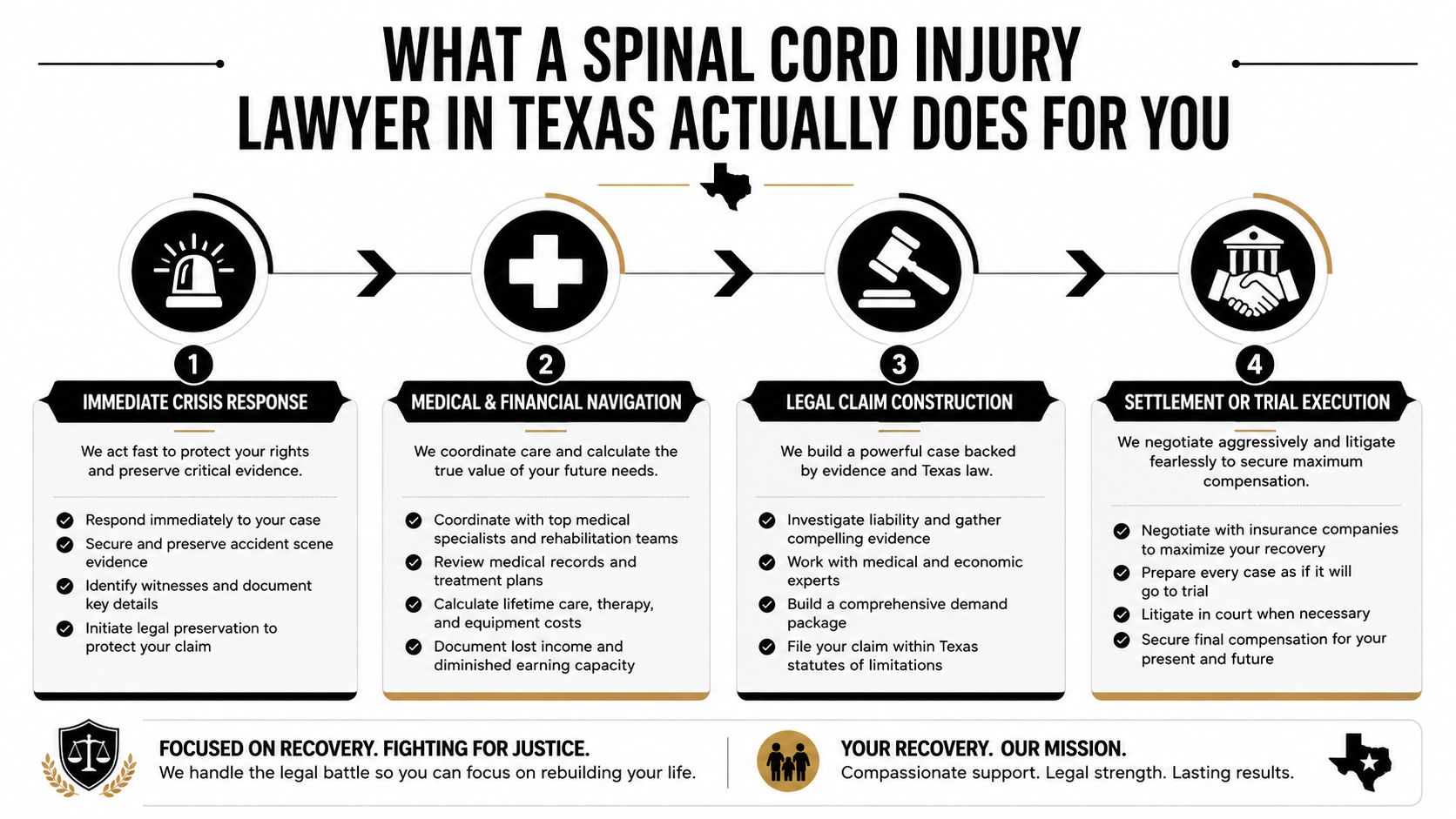
What a Spinal Cord Injury Lawyer in Texas Actually Does for You
In the first hours after a Texas crash, your family's attention belongs with the injured person. There may be a helicopter transfer, a crowded waiting room, urgent surgery, and long stretches of silence while doctors assess movement, sensation, and breathing. During that time, an insurance company may already be asking for a recorded statement.
A spinal cord injury lawyer steps into the legal side of that crisis. The lawyer investigates how the collision happened, identifies every potentially responsible party, and protects information that can disappear quickly. That may include vehicle data, dash-camera footage, photographs, electronic control module downloads, driver records, and witness accounts.
Building the medical and financial record
The lawyer also coordinates the records needed to explain the injury over time. Hospital charts, rehabilitation notes, imaging, specialist opinions, and prognosis evidence can show why a person who retains some movement may still have an incomplete spinal cord injury with serious future needs. Texas's injury registry definition includes incomplete lesions, cauda equina injuries, and bladder or bowel dysfunction, not only paralysis. Texas Department of State Health Services data dictionary
A complete case may require a life-care planner to project medical treatment, equipment, therapy, home changes, and attendant care. A vocational expert and economist can evaluate how the injury affects work, career progression, and earning capacity. The lawyer may also communicate with hospitals, address Medicaid or Medicare liens, and organize documents so the family isn't forced to manage legal paperwork during rehabilitation.
Practical rule: Don't give a recorded statement or sign a broad medical release before you understand what the insurer is requesting and why.
Texas counsel can also handle local procedure and venue issues in Harris, Dallas, Bexar, and Travis counties. Whether the claim follows a car collision, commercial truck crash, or fatal accident, the attorney manages pleadings, negotiations, evidence preservation, and litigation while your family focuses on care.
How Texas Fault and Comparative Responsibility Affect Your Claim
Texas negligence law starts with a basic question: Did another person or company act unreasonably, and did that conduct cause your injury? A driver who speeds, follows too closely, drives while distracted, or changes lanes without proper care may have breached the duty owed to other road users.
After a Houston freeway crash, suppose an 18-wheeler moves into a pickup's lane and the collision causes a spinal cord injury. The investigation may examine the truck's blind spots, turn signals, speed, driver attention, loading, maintenance, and electronic data. It may also examine the pickup driver's speed, lane position, phone use, and reaction.
How percentage fault works
A jury assigns responsibility in whole-number percentages. If the injured driver bears 20% fault, the award is reduced by that percentage. If the jury finds the injured person 51% or more responsible, Texas law bars recovery under the state's modified comparative responsibility rule. A claimant who is 50% or less at fault may recover, subject to the reduction for the assigned share. Texas proportionate responsibility explanation
For example, if proven damages total $3 million and the injured person is found 30% responsible, the recoverable amount would be $2.1 million. That calculation makes early evidence important, especially when a trucking company, rideshare driver, or insurer argues that the victim caused or worsened the crash.
Police reports, witness statements, vehicle photographs, event data, and crash reconstruction can all help establish what happened. A lawyer may retain a reconstruction expert to analyze vehicle positions, impact forces, visibility, roadway design, and timing.
| Your Fault % | Total Damages | You Recover |
|---|---|---|
| 0% | $3 million | $3 million |
| 20% | $3 million | $2.4 million |
| 30% | $3 million | $2.1 million |
| 51% | $3 million | $0 |
A clear explanation of the rule is available in this Texas comparative negligence guide. The important point is practical: don't wait for the opposing insurer to define the facts. Photos, witness names, medical records, and vehicle data can influence how responsibility is assigned in Harris County, Dallas County, or another Texas venue.
Types of Compensation You Can Recover After a Spinal Cord Injury
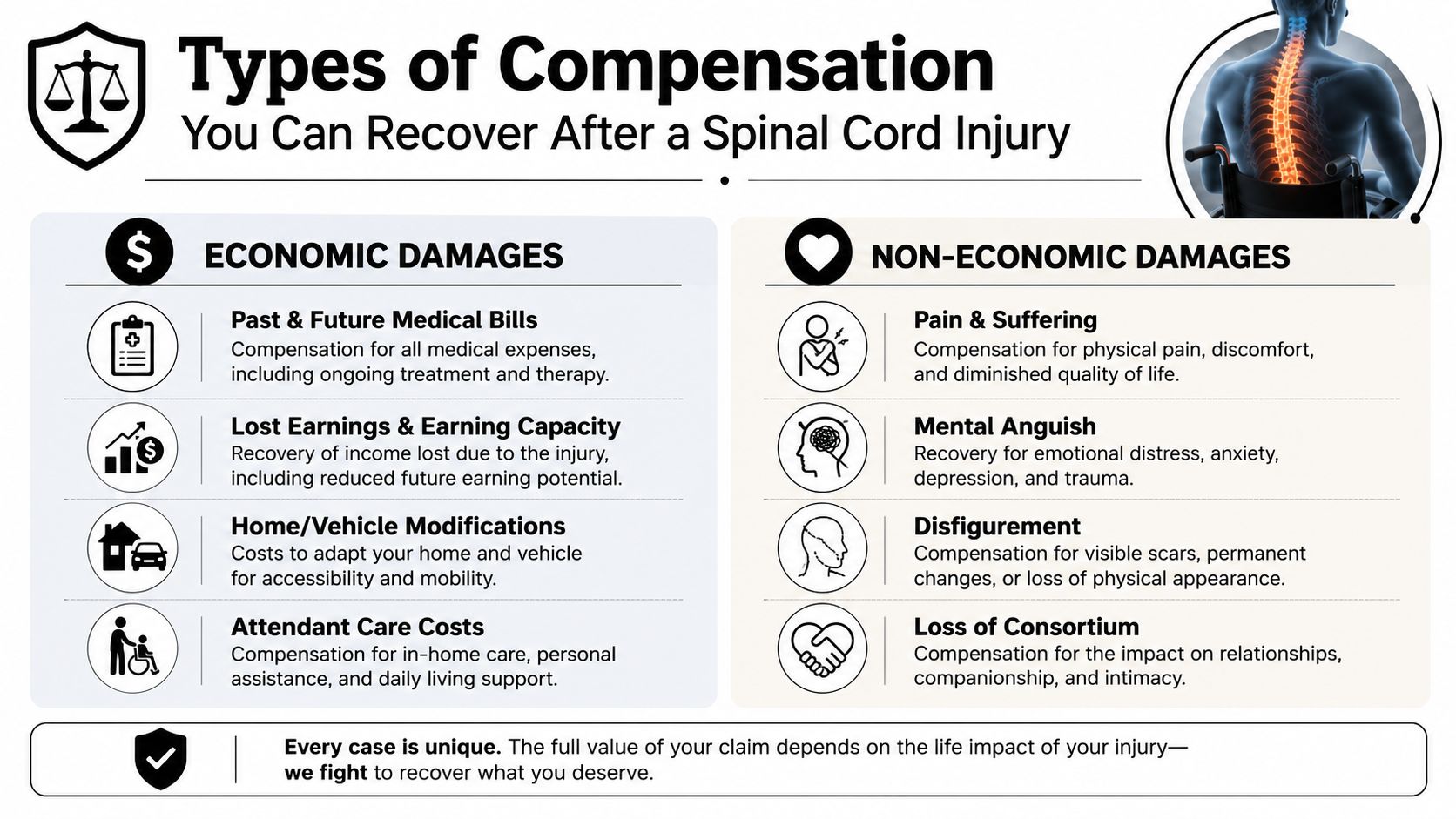
A spinal cord injury claim should account for both economic damages and non-economic damages. Economic damages are tied to financial losses. Non-economic damages address the physical and emotional effect of the injury, even when no receipt captures the full harm.
The medical side may include emergency transport, trauma care, intensive treatment, surgery, rehabilitation, specialist visits, medication, therapy, equipment, and treatment for complications. A systematic review found first-year spinal cord injury costs ranging from $32,238 to $1,156,406, with later annual costs ranging from $4,392 to $251,450. Systematic review of spinal cord injury costs
Economic losses require long-term proof
Future care often includes replacement wheelchairs and other durable medical equipment, physical and occupational therapy, physician monitoring, medication, home adaptations, vehicle modifications, and personal assistance. Some people need attendant care for daily activities, while others need less frequent support. The medical record must connect each projected need to the injury and prognosis.
Lost wages cover income already missed. Lost earning capacity addresses what the person may no longer be able to earn because of reduced function, career restrictions, or the inability to return to the same work. A vocational expert can evaluate work limitations, while an economist can analyze expected earning loss.
Non-economic harm matters too
A claim may include physical pain, mental anguish, physical impairment, disfigurement, loss of enjoyment of life, and loss of consortium for an affected spouse. These losses are personal and difficult to reduce to a formula, but Texas law recognizes that a catastrophic injury changes relationships, independence, plans, and daily life.
A life-care planner, treating physician, and economist can work together to support the claim. More detail about documenting future needs appears in this Texas catastrophic injury lifetime-care resource. Accepting an early settlement before the long-term record is developed can leave future treatment and assistance unfunded.
Steps to Protect Your Texas Spinal Cord Injury Claim
The first days after a crash can feel disorganized. Use a simple sequence, and ask a family member to help keep records if you're unable to do it yourself.
Get emergency care and follow referrals. Attend specialist appointments, rehabilitation, imaging, and therapy as directed. A gap in treatment may give an insurer an argument that the injury improved, that later symptoms came from another cause, or that future care isn't necessary.
Preserve the scene evidence. Keep photographs of the vehicles, roadway, traffic controls, visible injuries, and property damage. Save dash-camera footage, identify witnesses, request the police CR-3 crash report, and preserve relevant phone or vehicle information.
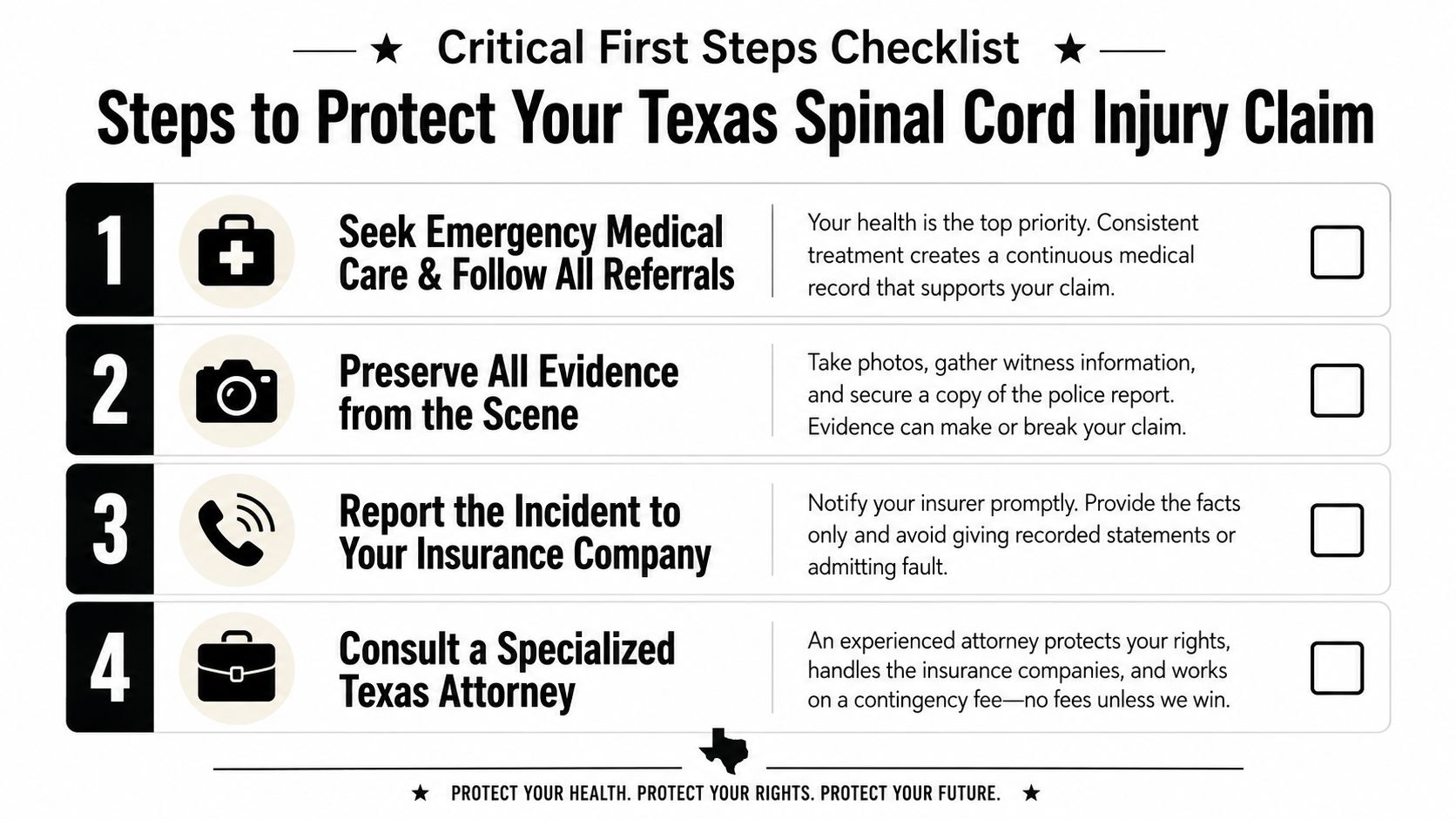
Report the crash carefully. Notify your own insurer as required by the policy, but stick to facts. Don't guess about speed, fault, prognosis, or the cause of symptoms. Commercial or work-related collisions may also require notice to an employer or carrier.
Get legal advice before resolving the claim. The Texas Personal Injury Lawyer service describes representation for injury victims across Texas on a no-fee-unless-we-win basis. A consultation can help identify responsible parties, insurance coverage, evidence to preserve, and medical documentation still needed.
Watch the filing deadline
Most Texas personal injury lawsuits must be filed within two years of the injury date under Texas Civil Practice and Remedies Code section 16.003(a). Negotiating with an insurance company doesn't stop that deadline. Claims involving governmental entities may have shorter notice requirements, so early legal review is especially important. Texas personal injury statute of limitations guide
Keep a journal of pain, sleep problems, mobility limits, bladder or bowel symptoms, therapy, missed work, and changes at home. These notes don't replace medical records, but they can help your providers and lawyer understand how the injury affects ordinary life.
Handling Insurance, Uninsured, and Underinsured Drivers in Texas
An at-fault driver's policy may not be large enough to cover a spinal cord injury. Texas law requires minimum automobile liability limits of 30/60/25, meaning coverage is structured around bodily injury and property damage limits. Those minimum limits can be inadequate when one crash causes surgery, rehabilitation, lost work, and future care.
Understanding UM and UIM coverage
Uninsured motorist coverage, often called UM, may apply when the responsible driver has no insurance or in certain hit-and-run circumstances. Underinsured motorist coverage, or UIM, may apply when the responsible driver has insurance, but the available limits don't cover the full value of the injury.
Your lawyer should review every policy connected to the household and the crash. That may include your own policy, a spouse's policy, a vehicle owned by another household member, a commercial policy, an employer policy, or an umbrella policy. Whether policies can be combined depends on policy language, named insureds, vehicles, exclusions, and Texas law. Don't assume stacking applies, and don't assume it's unavailable.
Texas has a serious uninsured-driver problem. Public-facing Texas coverage materials describe roughly 14.1% of Texas motorists as uninsured and indicate that about one in five vehicles may be uninsured. Texas Department of Insurance coverage materials That makes an early coverage investigation important after a crash involving a drunk driver, distracted driver, rideshare vehicle, or commercial truck.
| Coverage Type | Texas Minimum Limit | Typical SCI Cost |
|---|---|---|
| Bodily injury liability per person | $30,000 | Can be inadequate for hospitalization, surgery, rehabilitation, and future care |
| Bodily injury liability per accident | $60,000 | May be divided among multiple injured people |
| Property damage liability | $25,000 | Addresses vehicle and property damage, not the full injury claim |
| UM or UIM coverage | Depends on the policy | Must be reviewed against projected lifetime needs |
After a hit-and-run, report the crash to police and your insurer promptly. Don't sign a release from the at-fault carrier before your lawyer confirms that all available coverage has been identified.
Negotiating, Litigating, and How Contingency Fees Work
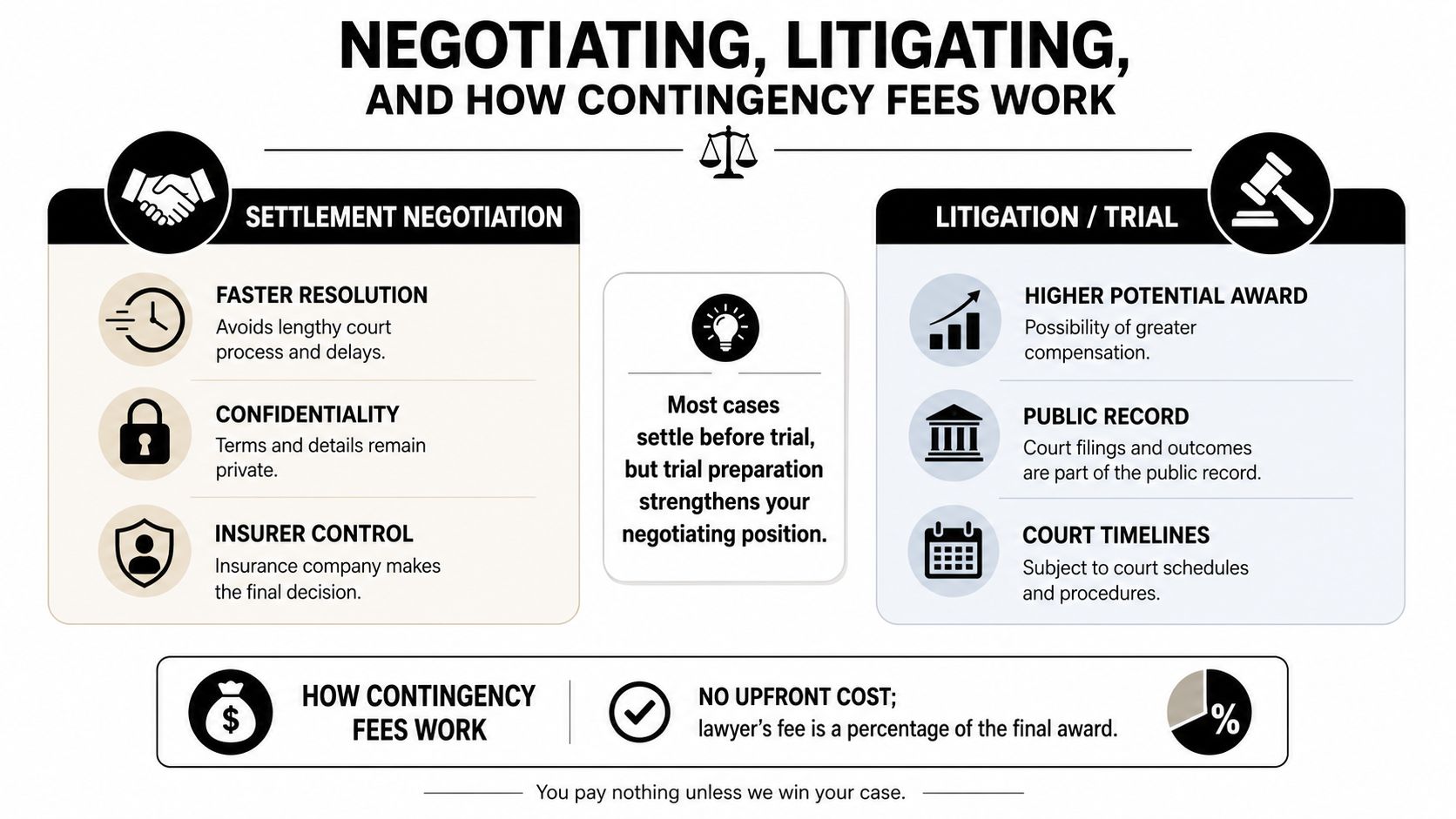
Settlement and trial are different paths, but they aren't always competing choices. A settlement may provide privacy and a faster resolution, while a lawsuit gives your legal team tools to obtain records, question witnesses, and compel evidence through discovery. Trial preparation can strengthen negotiations even when the case ultimately resolves without a verdict.
What settlement involves
Your lawyer develops the medical and financial evidence, prepares a demand, responds to defenses, negotiates with the insurer, and may participate in mediation. Settlement avoids the uncertainty of a jury decision, but the amount must cover reasonably supported future needs. Once you sign a release, you generally can't return to the same insurer for additional compensation if later care becomes more expensive.
What litigation adds
A filed lawsuit can lead to written discovery, depositions, expert testimony, motions, and trial. It takes longer and creates litigation risks, but it may be necessary when the insurer disputes fault, causation, impairment, or future damages. Your attorney should explain those risks rather than promise a particular result.
A contingency arrangement generally means you don't pay an hourly rate while the case is pending. The lawyer receives an agreed percentage of the recovery, and the written agreement should explain how case expenses are handled. Costs may include filing fees, medical records, expert depositions, accident reconstruction, life-care planning, and economic analysis.
Read the agreement carefully. Ask whether expenses are deducted before or after the attorney's fee, what happens if no recovery is made, and which decisions remain yours. This Texas contingency-fee explanation can help you prepare questions for the consultation.
Choosing the Right Spinal Cord Injury Lawyer in Texas
Look for a lawyer who understands both the collision investigation and the medical economics of spinal cord injury. A general accident practice may handle a straightforward property-damage claim differently from a case involving incomplete SCI, evolving function, future attendant care, and lost earning capacity.
Questions to ask during the consultation
- Licensing and discipline: Is the lawyer licensed by the State Bar of Texas, and can you review the attorney's disciplinary history?
- Relevant experience: Does the firm actively handle catastrophic injury, truck, car, wrongful death, and UM or UIM claims?
- Case preparation: Who investigates black-box data, dash-camera footage, driver logs, maintenance records, and crash reconstruction?
- Medical valuation: Will a life-care planner, treating physician, vocational expert, or economist help support future losses?
- Communication: How often will you receive updates, and when can you speak directly with the attorney?
- Settlement decisions: Who explains the offer, lien issues, tax considerations, risks, and projected care before you decide?
Be cautious if a lawyer guarantees a dollar amount before reviewing the evidence, pressures you to settle quickly, or can't explain who will manage the case. You should also understand how the firm handles incomplete injuries, delayed symptoms, cauda equina conditions, and bladder or bowel dysfunction.
If you're evaluating legal marketing or trying to understand how law firms present services online, this law firm SEO agency guide offers useful background on that separate issue. Your decision about counsel, however, should turn on legal experience, communication, resources, and a clear plan for proving the injury.
The Law Office of Bryan Fagan, PLLC discusses the case with the client from the initial consultation through investigation, demand negotiations, and, when necessary, trial in Harris County or the appropriate Texas venue. The firm's personal injury practice includes car, truck, catastrophic injury, wrongful death, and uninsured or underinsured motorist matters.
Your Next Step and a Free Consultation
Recovery after spinal cord injury doesn't follow a simple schedule. Some people regain function, some need long-term assistance, and some experience symptoms that become clearer only after discharge and rehabilitation. An incomplete diagnosis doesn't make the injury minor. It can make careful medical documentation even more important.
You have the right to seek economic damages for medical care, future treatment, equipment, home changes, lost wages, and diminished earning capacity. You may also seek non-economic damages for pain, mental anguish, impairment, disfigurement, loss of enjoyment, and loss of consortium when supported by the facts.
You also have the right to investigate UM and UIM coverage rather than relying only on the at-fault driver's policy. Household policies, commercial coverage, employer policies, and other sources may affect the available recovery, but the policy language must be reviewed before anyone signs a release.
Prepare for the first conversation
Bring the police report if you have it, insurance cards, hospital or rehabilitation discharge paperwork, medical provider information, photographs, witness names, and any letters from insurers. If you don't have everything, call anyway. A lawyer can explain what should be preserved and what records need to be requested.
The firm should provide a candid assessment of the known facts, possible responsible parties, likely evidence, available coverage questions, and the next steps. A contingency-fee arrangement can allow an eligible claim to be investigated without an upfront legal fee, subject to the written agreement.
Remember the deadline. Most Texas personal injury lawsuits must be filed within two years under Texas Civil Practice and Remedies Code section 16.003, and negotiations with an insurer don't pause the clock. Acting early also helps protect vehicle data, witness memories, medical records, and evidence from commercial vehicles.
The Law Office of Bryan Fagan, PLLC helps Texas families investigate spinal cord injury claims, pursue medical and future-care damages, and address uninsured or underinsured coverage disputes. Visit Law Office of Bryan Fagan, PLLC to schedule a free consultation, bring the records you have, and learn what steps can protect your claim.