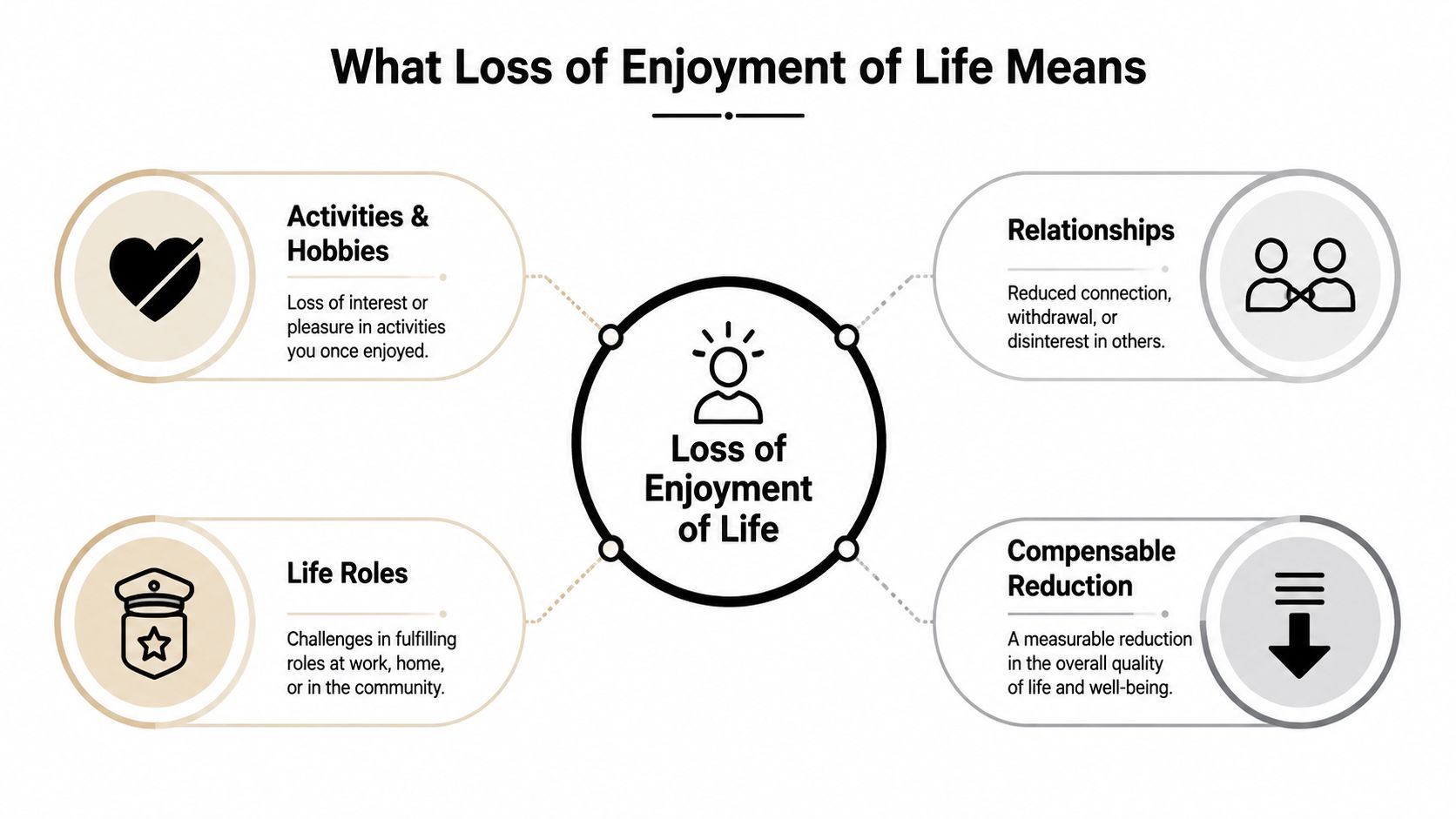
Loss of enjoyment of life means an injury has substantially reduced your ability to take part in ordinary activities, hobbies, relationships, and life roles. It's different from the physical sensations or emotional distress generally addressed through pain and suffering.
A serious accident can change your life in seconds, but you don't have to face it alone. You may be trying to understand why medical bills and lost income don't fully describe what happened. Perhaps you can no longer coach your child's team, work in the yard, travel with your family, or handle household responsibilities without help.
Those losses matter. Texas injury law can recognize the effect an injury has on the way you live, not only the treatment you receive or the wages you miss. This guide explains how to document that change, distinguish it from pain and suffering, understand Texas fault and filing rules, and decide when legal advice may protect your claim.
When an Injury Changes the Life You Once Knew
After a Houston freeway crash, a parent who once coached youth soccer may still be able to attend a child's game. But attending from the sidelines isn't the same as running drills, carrying equipment, or encouraging players on the field. If a spinal injury, fracture, or other condition prevents those activities, the loss reaches beyond physical discomfort.
The same problem can appear in quieter routines. A person who enjoyed weekend travel may now avoid long drives. Someone who cared for a garden may be unable to kneel or lift. A grandparent may still visit family but cannot pick up a grandchild. A worker may return to a job but lose the ability to volunteer, socialize, or perform ordinary tasks independently after work.
Your daily life is evidence. The question isn't only how badly you hurt. It's what you could do before the accident, what you can do now, and what medical reason explains the difference.
The human loss behind the legal claim
Loss of enjoyment of life recognizes that recovery involves more than medical bills, wage loss, and physical symptoms. The modern legal concept has roots reaching back to the 1890s, when legal scholars connected it to the industrial revolution and the growing number of accidents and long-term injuries. In the United States, the term “hedonic damages” was later used in Sherrod v. Berry in 1985, and the Seventh Circuit reviewed that award in 1987, important milestones in modern litigation involving lost life pleasures. A historical legal review from Ohio State University provides context for that development.
The idea is compassionate but practical. A claim can account for the inability to walk without pain, play sports, care for family, or enjoy familiar routines. It doesn't mean every disappointment qualifies, and it doesn't promise a particular result. It means the law may consider how an injury has narrowed the life you were living.
Small adjustments can also matter during recovery. A resource on small shifts for reproductive health may help some readers think about manageable changes while medical care continues. Those adjustments don't erase a legal loss, but they may support safer routines and a more complete recovery process.
What Loss of Enjoyment of Life Means
Before an injury, a retired teacher may have spent Saturday mornings tending a vegetable garden, preparing meals for extended family, and attending religious services without planning around pain. After a crash, limited bending, medication side effects, or a doctor's lifting restriction may make those ordinary parts of life difficult or impossible. Loss of enjoyment of life addresses that documented change in participation, relationships, routines, and personal roles.
This is generally a non-economic loss. No receipt shows the value of gardening, worshipping with a congregation, traveling, or living independently. The claim instead connects the injury to the parts of life that once gave the person purpose and satisfaction.
Pain and suffering overlaps with this harm, but the focus differs. Pain and suffering concerns physical discomfort and emotional distress caused by the injury. Loss of enjoyment concerns what the person can no longer do, or can do only with substantial difficulty. The same injury may support both categories, provided the evidence distinguishes the symptoms from their effects on daily life.
What makes the claim concrete
A credible claim usually answers four questions:
- What changed: Identify the specific activity, relationship, or role that was reduced or lost.
- Why it changed: Connect the limitation to medical findings, treatment, symptoms, or formal restrictions.
- Who saw it: Identify relatives, friends, coworkers, neighbors, or community members who observed the change firsthand.
- How long it may last: Explain whether the restriction is temporary, ongoing, or expected to remain, based on medical evidence.
These answers create a before-and-after record rather than a general statement that life feels worse. A weekly gardening routine, family meal responsibility, or regular religious practice can be more useful than broad descriptions because it shows what changed and how often the loss affected the person.
Courts and jury instructions do not handle this category uniformly. Some jurisdictions permit a separate award, while others include it within broader general damages or limit separate instructions to reduce double recovery. A PubMed review of civil jury instructions on noneconomic damages describes inconsistent treatment of pain, suffering, disability, disfigurement, and loss of enjoyment of life. Texas counsel must therefore examine the particular case and present each harm distinctly.
Insurance issues can create another source of confusion. Someone may be waiting on rental reimbursement after losing use of a vehicle. That concern may involve property damage or insurance benefits, while loss of enjoyment concerns how bodily injury changed participation in life. Separating those categories keeps the claim accurate and easier to evaluate.
Evidence That Shows How Your Life Changed
A general statement such as “I can't enjoy life anymore” expresses real pain, but it leaves important questions unanswered. Stronger proof shows what you did before the accident, what you can't do now, why you can't do it, and how long the restriction is expected to continue.
Medical records provide the foundation. They may document diagnoses, surgery, therapy, range-of-motion limits, lifting restrictions, medication effects, and a doctor's opinion about future function. The records should connect those restrictions to the accident rather than merely list symptoms.
Your own testimony adds the personal meaning. Family members may describe changes in parenting, household work, travel, or social activity. Coworkers can explain altered job duties or the loss of work-related volunteer roles. Friends and community members may remember regular sports, church activities, clubs, or hobbies that stopped after the injury.
Build a before-and-after record
Photos and videos can show activities that ordinary medical records won't capture. Calendars, travel bookings, team schedules, gardening records, award certificates, messages, and activity posts may help establish that an activity was a regular part of your life. They shouldn't be manipulated or selectively presented. Consistency matters more than dramatic presentation.
A useful evidence record may look like this:
| Evidence | What It Shows | Practical Value |
|---|---|---|
| Medical records | The injury, restrictions, treatment, and expected function | Connects the lost activity to a medical condition |
| Family or coworker testimony | Changes observed in daily life and relationships | Provides independent firsthand confirmation |
| Photos, videos, and calendars | Pre-injury activities and regular participation | Establishes a reliable baseline |
| Activity journal | Missed events, assistance needed, and changing routines | Shows the ongoing effect in specific terms |
| Employment records | Reduced duties, altered roles, or lost work participation | Separates quality-of-life effects from ordinary wage loss |
| Qualified expert opinion | How a diagnosis affects function and future participation | Translates medical restrictions into practical consequences |
A careful record also protects against exaggeration. Write down the activity, the date, what you attempted, what stopped you, and who helped. “Couldn't enjoy anything” is less useful than “could attend the family outing for a short time but couldn't walk with the group or carry the child's supplies.”
For more general guidance on documenting an injury claim, review what evidence is needed for an injury claim in Texas. An economist or another qualified expert may help when the dispute involves complex valuation, but expert analysis is only one part of the case. It can't replace your medical records or the people who observed your life.
The deadline matters while you gather proof. Most Texas injury lawsuits must be filed within two years of the injury date under Texas Civil Practice and Remedies Code § 16.003, as explained in The Two-Year Deadline for Texas Injury Claims. Don't wait until the deadline is close to begin preserving evidence.
How Attorneys Value a Lost Quality of Life
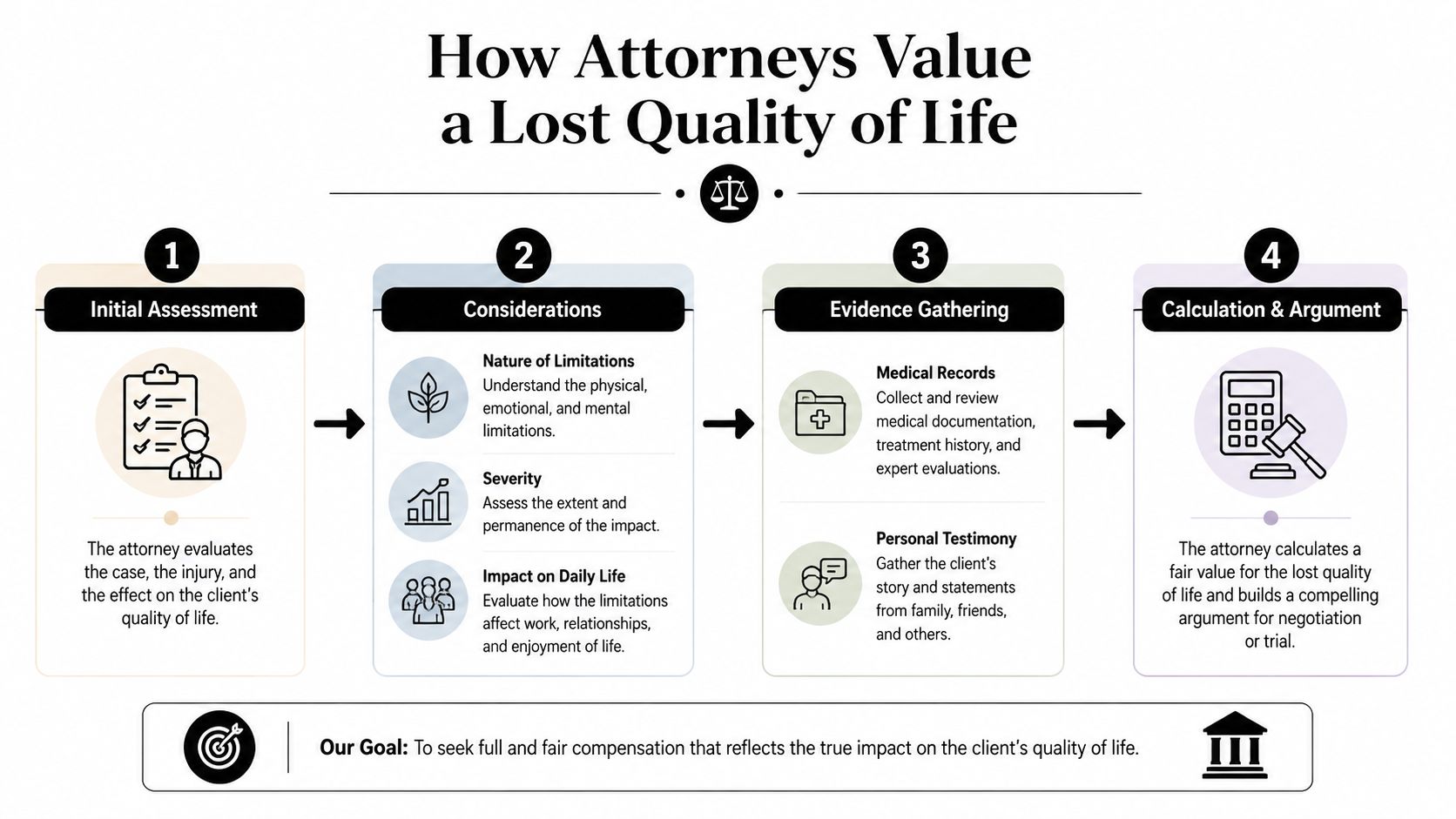
Texas doesn't provide a universal price or automatic multiplier for loss of enjoyment of life. A lawyer can't responsibly promise a settlement range from a diagnosis alone, because the value depends on the actual restrictions, the quality of the proof, the legal posture, and the full effect on the person's life.
Attorneys generally evaluate the claim through several connected questions:
- What is the injury: How serious is it, and what functions does it affect?
- What restrictions are documented: Do medical records and opinions support the claimed limitations?
- How long will the loss last: Is the impairment temporary, ongoing, or permanent?
- What parts of life changed: Did the injury affect parenting, caregiving, work, independence, recreation, or relationships?
- How consistent is the proof: Do the person's account, records, photographs, and witnesses tell the same before-and-after story?
- What future period matters: Age and life expectancy may help show how long the person may live with the restriction.
Why formulas can mislead
Some economic discussions have attempted to place a monetary value on the “bundle of things that make life enjoyable.” One widely cited estimate by economist Stanley Smith placed that bundle at $2.3 million, according to the historical discussion in the Louisiana Supreme Court's opinion concerning loss-of-enjoyment damages. That figure doesn't function as a Texas award formula, and it shouldn't be presented as a guaranteed measure of any individual's loss.
The same Louisiana history shows why courts continue to debate whether loss of enjoyment should be separated from pain and suffering. In Andrews v. Mosley Well Serv., a jury awarded $75,000 for the harm, and Louisiana appellate courts later acknowledged it as a compensable element of general damages. Those legal developments illustrate recognition of the injury, not a prediction for a Texas case.
An injury claim and a wrongful-death claim also require different analysis. An injured person may describe lost mobility, hobbies, work roles, and independence. A family in a wrongful-death case may need to prove the relationship, shared routines, caregiving, companionship, and future experiences that ended. Counsel must also avoid presenting one loss twice under different labels. A careful damages presentation identifies each harm, supports it with evidence, and explains how the categories fit together. For background on the related category of pain and suffering, readers should still keep the distinction clear.
Texas Injury and Wrongful Death Examples
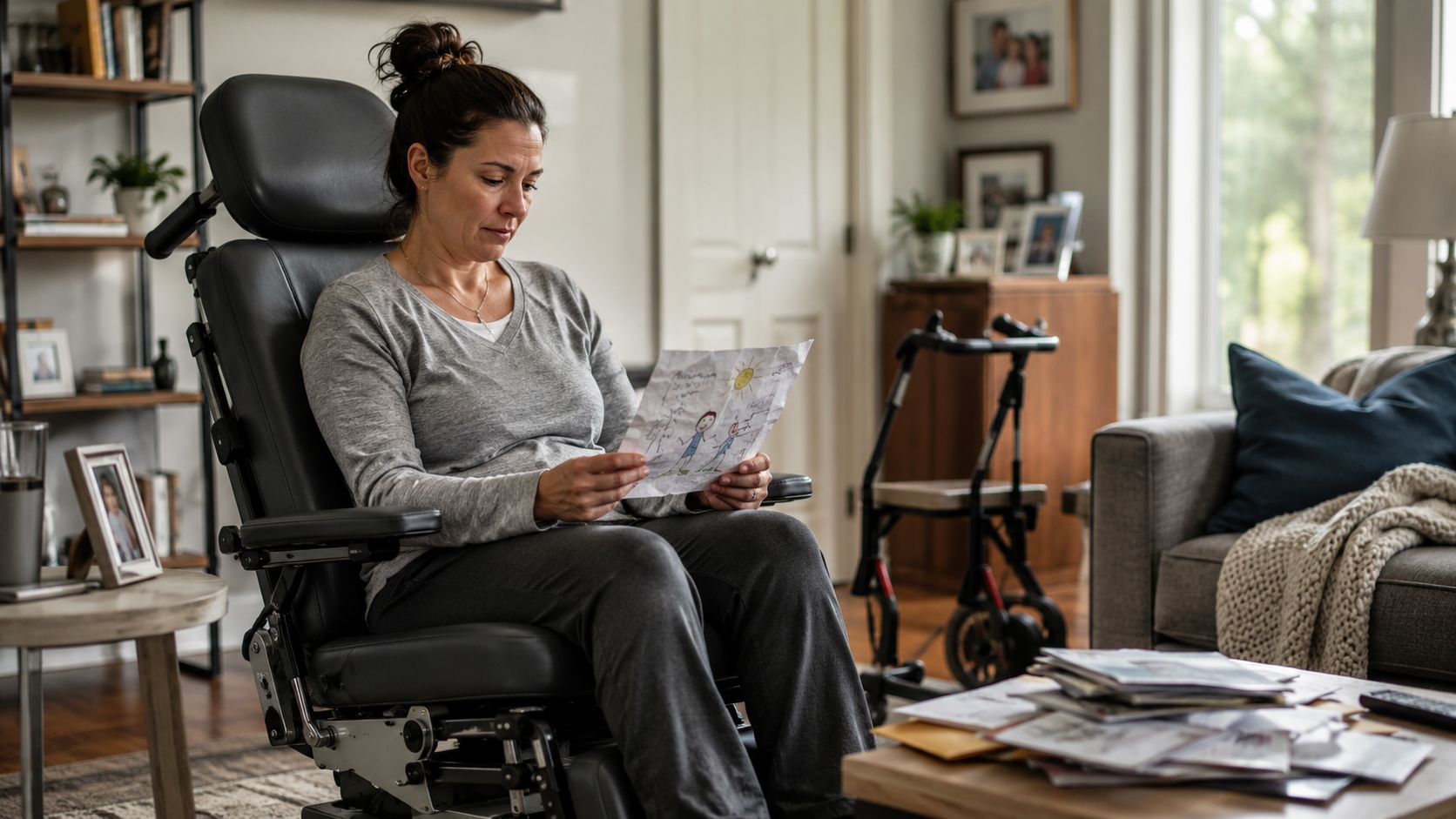
Consider a working parent after a Houston freeway crash. Before the collision, the parent lifted a young child, handled household errands, attended religious services, and joined weekly family outings. After a serious injury, medical restrictions prevent lifting, prolonged sitting, and extended walking.
The parent may still work, but ordinary job tasks take longer and require assistance. The spouse notices that the parent no longer joins outings, avoids services because sitting is painful, and watches from the car while others complete errands. Employment testimony, medical records, the spouse's observations, and photographs from earlier family activities can show the change without overstating it.
A different loss after a fatal collision
Now consider a family whose loved one dies in a truck collision. There may be no injured person who can describe living with a new restriction. Instead, family members may explain the relationship that ended, the caregiving the loved one provided, shared meals, family traditions, and experiences that will never occur.
A wrongful-death claim isn't merely an injury claim with a different defendant. It involves its own legal requirements and damages analysis, and no family should assume that a particular award is guaranteed. A car accident attorney may handle the first scenario, while a truck crash lawyer Houston families can consult may investigate commercial-driver or trucking-company issues in the second.
Families may also need a wrongful death lawyer Texas residents can contact to examine who may bring the claim and which losses the evidence supports. For life-altering injuries that involve profound, lasting limitations, catastrophic injury representation may be appropriate. These links describe different legal services, not promised outcomes.
What You Should Do After an Accident
Your first priority is medical care. Follow treatment instructions, attend follow-up appointments, and tell providers about physical limits, sleep problems, emotional changes, and trouble completing ordinary activities. Don't minimize symptoms because you're worried about appearing difficult, and don't exaggerate them either. Accurate reporting creates a trustworthy medical record.
Create a practical record
A dated journal can capture details that fade over time. Record missed activities, assistance from family, changes in responsibilities, pain during specific tasks, emotional effects, and attempts to return to old routines. Preserve photographs, videos, calendars, messages, medical bills, disability notes, and other records that show your life before and after the accident.
- List witnesses: Write down people who saw your activities before the injury and those who observe your current limitations.
- Describe facts: Ask witnesses to preserve what they personally saw, not what they heard from someone else.
- Keep original records: Don't delete posts, edit photographs, or create a dramatic presentation that could undermine credibility.
- Track restrictions: Note which medical instruction prevents an activity and whether the restriction changes over time.
Insurance companies may ask for a recorded statement, broad medical authorization, or an explanation of why you haven't resumed an activity. Don't guess, minimize symptoms, accept an early description of your injury, or sign a broad release without understanding its purpose. You can learn more about the broader categories of compensation available in a Texas injury case while discussing your individual circumstances with counsel.
Expert testimony may be useful when a doctor must explain future function or another qualified professional must address complex valuation. A lawyer should become involved early when injuries are serious, restrictions may be permanent, fault is disputed, or an insurer rejects the non-economic impact. Documenting what changed isn't greedy. It's a way to tell the truth about what the injury took.
Follow-up resources can help you understand the process, but they don't replace personalized advice. Use the information below as a starting point, then protect your records and ask questions before making significant decisions.
How Texas Fault and Deadlines Affect Your Claim
Texas negligence generally means that another person failed to use reasonable care, and that failure caused your injury. In a traffic case, the issue may involve a driver who caused a crash through unsafe conduct. Your loss-of-enjoyment claim depends on proving the responsible party's legal fault and connecting that fault to your injury and changed life.
Texas uses modified comparative responsibility. A claimant who is 50 percent or less responsible may recover damages, while a claimant who is more than 50 percent responsible is barred from recovery. A jury can assign fault in whole-number percentages to each party, then reduce damages according to the injured person's share of responsibility. This overview of Texas proportionate responsibility explains that framework.
Most Texas personal injury lawsuits must be filed within two years of the injury date under Texas Civil Practice and Remedies Code § 16.003. Texas's personal injury statute-of-limitations guidance explains why a serious injury doesn't automatically suspend that deadline. Wrongful-death claims can involve a different analysis, so families should seek prompt advice rather than assume the same filing rule applies.
Insurers may make low offers, request broad records, or suggest that a lost activity was merely optional. A focused response ties each limitation to medical proof and firsthand observations. If you need a Texas personal injury lawyer, a Houston car accident attorney, a wrongful death lawyer Texas families can consult, or a truck crash lawyer Houston clients may need, schedule a free consultation and ask about contingency-fee representation.
The Law Office of Bryan Fagan, PLLC can review how your injury changed your activities, family roles, independence, and daily routines, then help preserve the evidence supporting those losses. Visit Law Office of Bryan Fagan, PLLC to schedule a free consultation, and bring your medical records, accident information, and activity notes if you have them. Recovery is possible, and legal help is available while you take the next step.