A serious accident can change your life in seconds, but you don't have to face it alone. After a Houston-area crash, your car may come back from the body shop looking perfect while a buyer, dealer, or lender still treats it as less valuable because the collision appears in its history. If you weren't at fault, you may be asking a practical question: can you recover the value your vehicle lost after repairs?
A diminished value claim in Texas focuses on that remaining market loss. The answer often depends on two issues, which insurer is being asked to pay and whether your evidence proves a real reduction in value. This guide explains how Texas law treats the claim, how to document it, and when speaking with a Texas personal injury lawyer makes sense.
When a Repaired Car Still Costs You Money
After another driver caused a Houston freeway crash, a late-model vehicle owner might do everything expected. The car goes to a body shop, the insurer pays for repairs, and the owner picks it up looking restored. Months later, a dealer reviews the vehicle-history report and offers less because the car now carries an accident record.
That gap is the central idea behind diminished value. Texas property-damage rules generally measure loss by comparing the vehicle's market value immediately before and immediately after the injury. Texas authorities discussing the market-value measure explain why completing repairs doesn't necessarily erase a vehicle's residual loss.
Repair costs and market loss are different
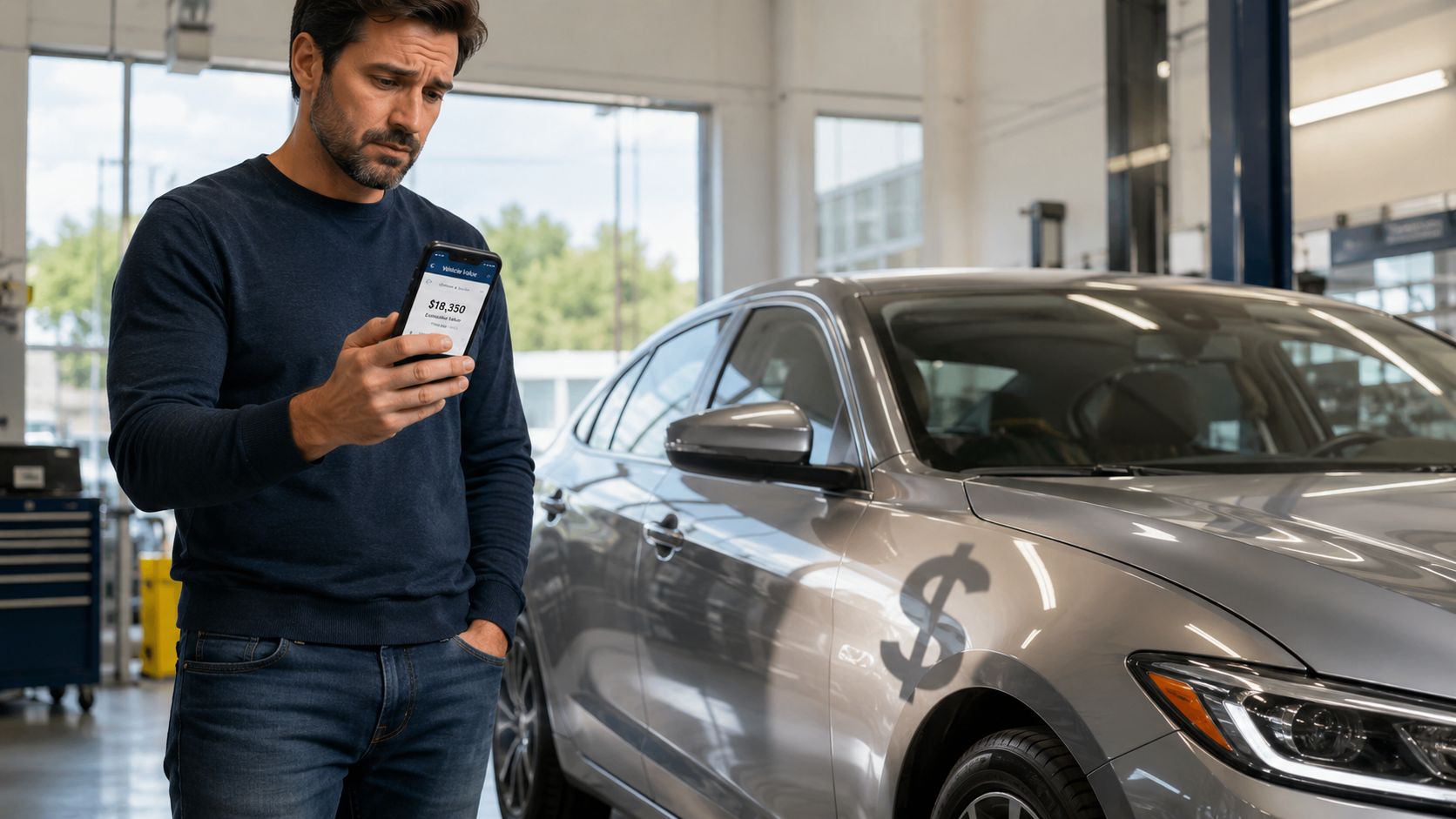
A repair invoice addresses the physical damage. Diminished value addresses what the market still discounts after the work is complete. An accident-history report, structural-damage disclosure, frame straightening, airbag deployment, or repairs to advanced safety systems can all make a vehicle harder to sell, even when it drives properly.
The claim belongs to the vehicle owner whose property lost value. A dealer's concern about resale inventory or a lender's concern about collateral is a separate issue and doesn't automatically create a claim for that business.
The insurer involved can decide the outcome
Texas treatment differs between a claim against the at-fault driver's liability insurer and a claim under your own policy. Third-party recovery may be available when another driver caused the collision, while first-party coverage depends heavily on the policy language and controlling authority.
That distinction matters in common situations. A driver without collision coverage may need to pursue the at-fault carrier directly. A driver who used collision coverage to repair the car may face a policy-based denial from their own insurer. The practical questions are whether this is a third-party or first-party claim, how the loss should be valued, and what records will prove it.
What Diminished Value Means Under Texas Law
Diminished value is the difference between what your vehicle would have been worth without the collision and what it's worth after repairs, considering the accident history and the quality of the work. Texas doesn't treat every repaired vehicle as automatically entitled to payment. You must show a specific, compensable market loss and identify the legal or policy basis for recovery.
Texas law recognizes a broader property-damage measure based on market value. Authorities citing Thomas v. Oldham, 895 S.W.2d 352, 359, and Exxon Corp. v. Middleton, 613 S.W.2d 240, describe the comparison between value before and after the injury. That framework can support a residual-value claim, but it doesn't promise a fixed result.
Three forms of loss
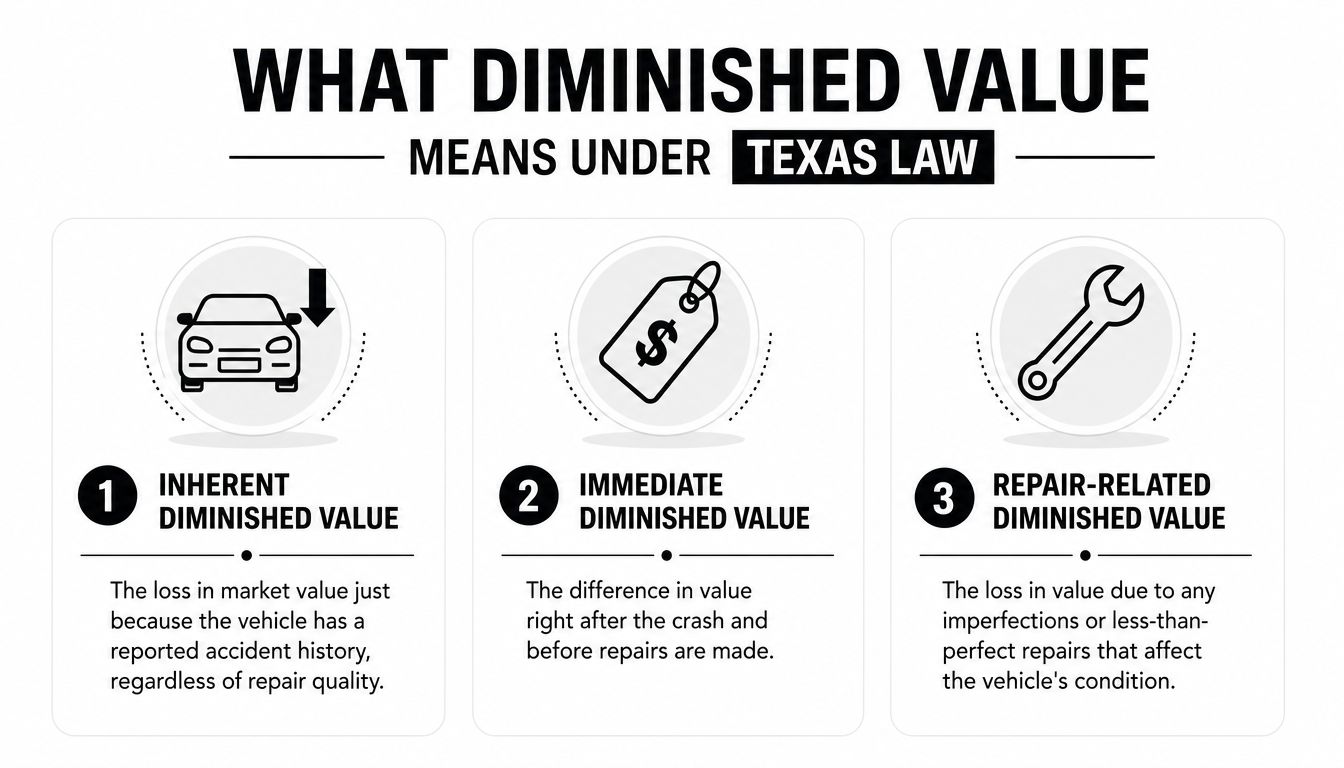
Inherent diminished value describes the market discount caused by the reported accident itself, assuming competent repairs. A buyer may pay less for a repaired car because its history is no longer clean.
Immediate diminished value concerns the difference between the vehicle's value right after the collision and its value before repairs. It's less useful for many post-repair demands because the owner usually seeks to measure what remains after restoration.
Repair-related diminished value may arise when poor workmanship, mismatched paint, non-original parts, unresolved safety-system issues, or other repair defects reduce marketability. That issue may involve the repair facility as well as the insurance claim.
What this claim does not include
Repair costs, towing, rental expenses, and loss of use are separate categories. They shouldn't be folded into a diminished-value figure merely because they happened during the same collision.
A late-model vehicle in excellent pre-crash condition, with extensive damage and documented repair concerns, may present stronger proof. An older vehicle, minor cosmetic damage, or substantial pre-existing damage can make the market loss harder to establish. The honest answer is that the evidence controls, not a formula or an assumption that every accident creates the same reduction.
How to Document and Prove the Loss After Repairs
The strongest Texas claim usually follows a market-based, post-repair appraisal. The appraiser documents the vehicle's pre-loss condition, waits until repairs are finished, and compares the repaired vehicle with comparable vehicles and market data. That approach measures residual value loss rather than repeating the repair bill.
Build the record before negotiating
Keep one organized file containing:
- Repair documents: Preserve the final repair order, itemized invoices, estimates, parts records, diagnostic reports, and photographs.
- Vehicle identity: Record the VIN, mileage, trim, options, service history, and condition before the crash.
- History evidence: Obtain the vehicle-history report showing the collision and any disclosures.
- Repair-quality evidence: Photograph paint, panel alignment, interior warnings, sensors, airbags, electronics, and any visible defects after delivery.
- Independent valuation: Request a written diminished-value appraisal that explains the method and the evidence supporting the result.
If the damage involved a frame, structural component, airbag, battery system, camera, radar sensor, or other advanced technology, ask the appraiser to address how that work affects marketability. For a Tesla, luxury vehicle, truck, or leased SUV, the report should account for the vehicle's specific class and the Texas market where it will be sold.
Use comparable vehicles carefully
A credible report compares similar year, make, model, trim, mileage, condition, and location. Comparable vehicles aren't exact substitutes, so the appraiser should adjust for accessories, title status, prior damage, service history, and other legitimate differences.
Listings can help, but a listing isn't automatically proof of a completed sale. Present the calculations clearly enough that an adjuster can follow the comparison from pre-accident value to post-repair value. If you're unsure how to separate ordinary cosmetic repair costs from a possible market loss, this guide to an estimate for car scratch repair can help clarify the repair side of the analysis.
A defective repair needs prompt attention. Get a second inspection, preserve photographs, and notify the responsible parties rather than relying only on the insurer's original estimate. In a collision involving a large commercial vehicle, understanding 18-Wheeler and Commercial Vehicle Accidents in Texas can also help identify how liability may work.
First-Party vs. Third-Party Claims in Texas
The most important coverage question is simple: whose insurer are you asking to pay?
A third-party claim is brought against the at-fault driver's liability carrier. A first-party claim is brought under your own policy, such as collision or uninsured or underinsured motorist coverage. Those claims don't receive identical treatment in Texas.
The Schaefer distinction
On October 17, 2003, the Texas Supreme Court decided American Manufacturers Mutual Insurance Company v. Schaefer, 124 S.W.3d 154. The court held that standard Texas personal auto policy language doesn't require an insurer to pay diminished value in addition to adequate repair costs under first-party coverage. The discussion of the Texas Supreme Court's diminished-value ruling explains why repair costs and residual market loss must be analyzed separately.
The Texas Department of Insurance had taken a similar position in Bulletin B-0027-00, dated April 6, 2000. The TDI bulletin on diminished value states that an insurer isn't obligated to pay first-party diminished value when the vehicle is fully repaired to pre-damage condition.
That doesn't mean every third-party claim fails. It means the policy and the identity of the responsible insurer matter.
Applying the rule after a Houston crash
If another driver caused the crash and you're pursuing that driver's liability carrier, your argument is based on the at-fault party's responsibility for the vehicle's total market loss, not merely the cost of bodywork. If you use your own collision coverage, your insurer may rely on Schaefer and the policy's language to deny a separate value payment.
Uninsured or underinsured motorist situations require careful policy review. Don't assume your own policy covers diminished value, and don't assume it excludes it without reading the relevant provisions. For additional context on claims against another party's insurer, review third-party claims in Texas.
Writing the Demand and Negotiating With the Insurer
A demand letter should make the claim easy to evaluate. Send it after repairs are complete and attach the documents that support both liability and the market loss. The goal isn't to overwhelm the adjuster. It's to show a traceable calculation that answers the likely objections.
A useful demand structure
Open with the collision date, the insured driver, the claim number, and a direct statement of the amount requested. Sample language might read:
The other driver caused the collision involving my vehicle. Although repairs are complete, the vehicle's market value remains lower because of the documented accident history and the damage reflected in the enclosed records. Based on the attached independent appraisal and comparable Texas-market vehicles, I demand payment of the documented diminished-value loss.
Follow with a concise factual background. Identify the vehicle, its pre-loss condition, the repairs performed, the history-report entry, and the appraisal's pre- and post-repair values. Cite Schaefer accurately for the first-party issue and explain why your demand is directed to the at-fault driver's liability carrier when the claim is third-party.
Attach the final repair invoice, photographs, vehicle-history report, liability evidence, and the complete appraisal. State a specific dollar demand supported by the report and provide a reasonable response deadline. Keep a copy of everything and send it through a method that confirms delivery.
For a broader demand-letter format, see this sample personal injury demand letter. Adapt it to property damage rather than copying language that doesn't fit your vehicle claim.
Responding to a low offer
An insurer may counter with a company formula, including a 17c-based calculation, or an internal adjustment that doesn't reflect local comparable vehicles. Don't respond with frustration alone. Ask the adjuster to identify the vehicles, assumptions, mileage adjustments, damage rating, and policy language used.
Then answer each weakness with evidence. If the carrier used a clean-history vehicle as its post-repair comparison, explain the mismatch. If it ignored structural work, OEM-versus-aftermarket parts, safety-system repairs, or the accident-history report, point to the relevant invoice, photograph, or appraisal page.
Settlement is a judgment call. You may decide to compromise when the carrier's evidence exposes a genuine valuation weakness, but don't split the difference just because the adjuster labels a formula “standard.” Document every call and email, including the date, speaker, offer, reason given, and your response.
An offer above the available policy limits or a claim that remains unresolved beyond 30 days should prompt a careful reassessment of strategy. That doesn't automatically prove misconduct, but it may justify attorney review before you sign a release.
Deadlines, Comparative Fault, and When to Sue
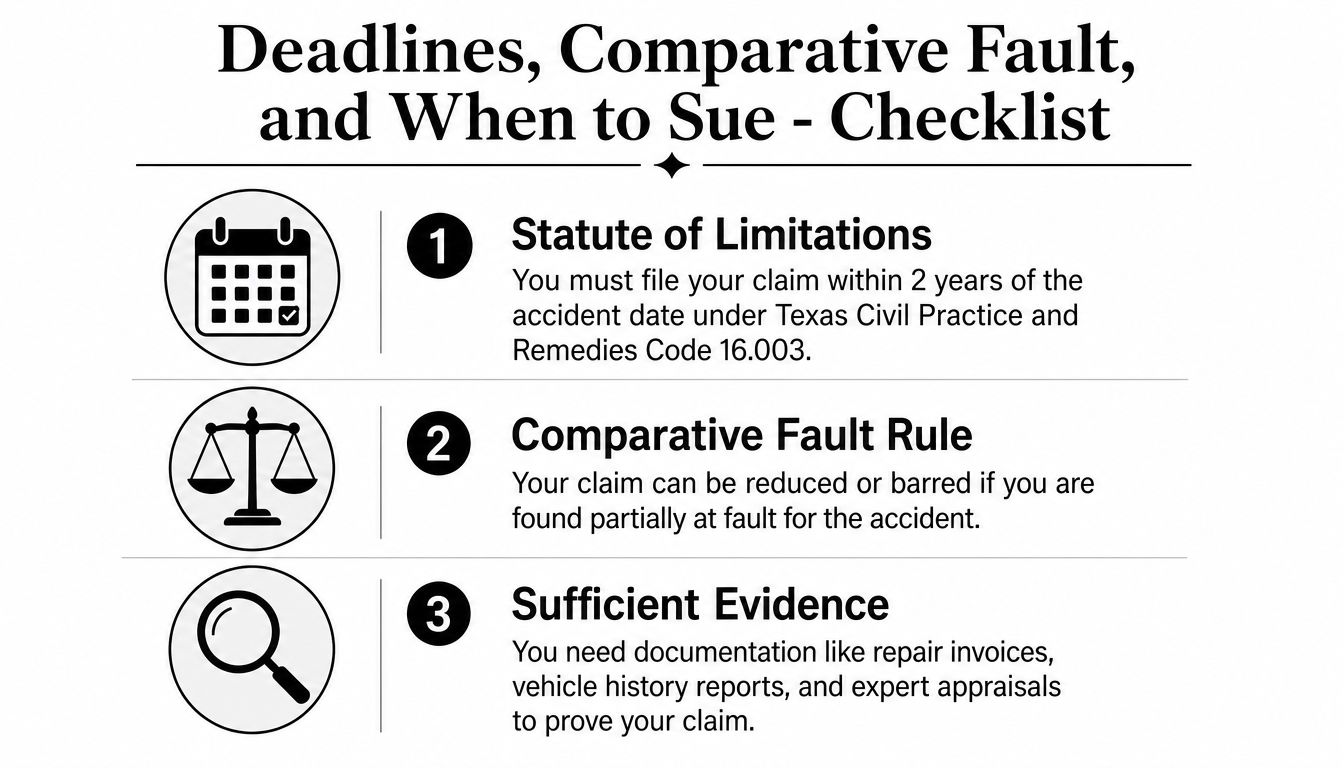
A persuasive appraisal cannot cure a late lawsuit. Texas generally gives claimants two years after a cause of action accrues to file personal injury or property-damage litigation. Texas Civil Practice and Remedies Code Section 16.003 supplies the statutory framework, and the crash date is often the practical starting point for calculating the deadline.
Later repairs usually do not restart that period. Record the accident date, calculate the filing deadline, and do not assume that an unanswered demand extends it.
Comparative responsibility
Texas follows modified comparative responsibility. Under Section 33.001, a claimant cannot recover if responsibility exceeds 50%. At 50% or less, the recoverable damages are reduced according to that responsibility. See this Texas comparative-fault explanation for a related overview.
In a crash where you were not at fault, the goal is to establish zero responsibility. If the insurer claims you contributed to the collision, preserve the crash report, photographs, witness details, traffic-camera evidence, and available vehicle data. That dispute can reduce or eliminate the broader property-damage recovery, including diminished value. This explanation of Texas's comparative-fault rule provides additional context.
Choosing the next forum
A documented demand and focused negotiation may resolve a clear third-party claim. Policy appraisal may fit a valuation dispute when the policy includes an appraisal provision, although appraisal may not decide liability or every coverage issue. Litigation becomes more realistic when the insurer denies liability, refuses to address competent market-based appraisal evidence, or delays while the filing deadline approaches.
A lawyer can assess whether county court or district court fits the amount, disputed issues, parties, and available remedies. The choice should reflect the evidence, cost, timing, and realistic ability to collect, rather than pressure from an adjuster or frustration with the claim.
Your Next Steps and When to Call a Texas Lawyer
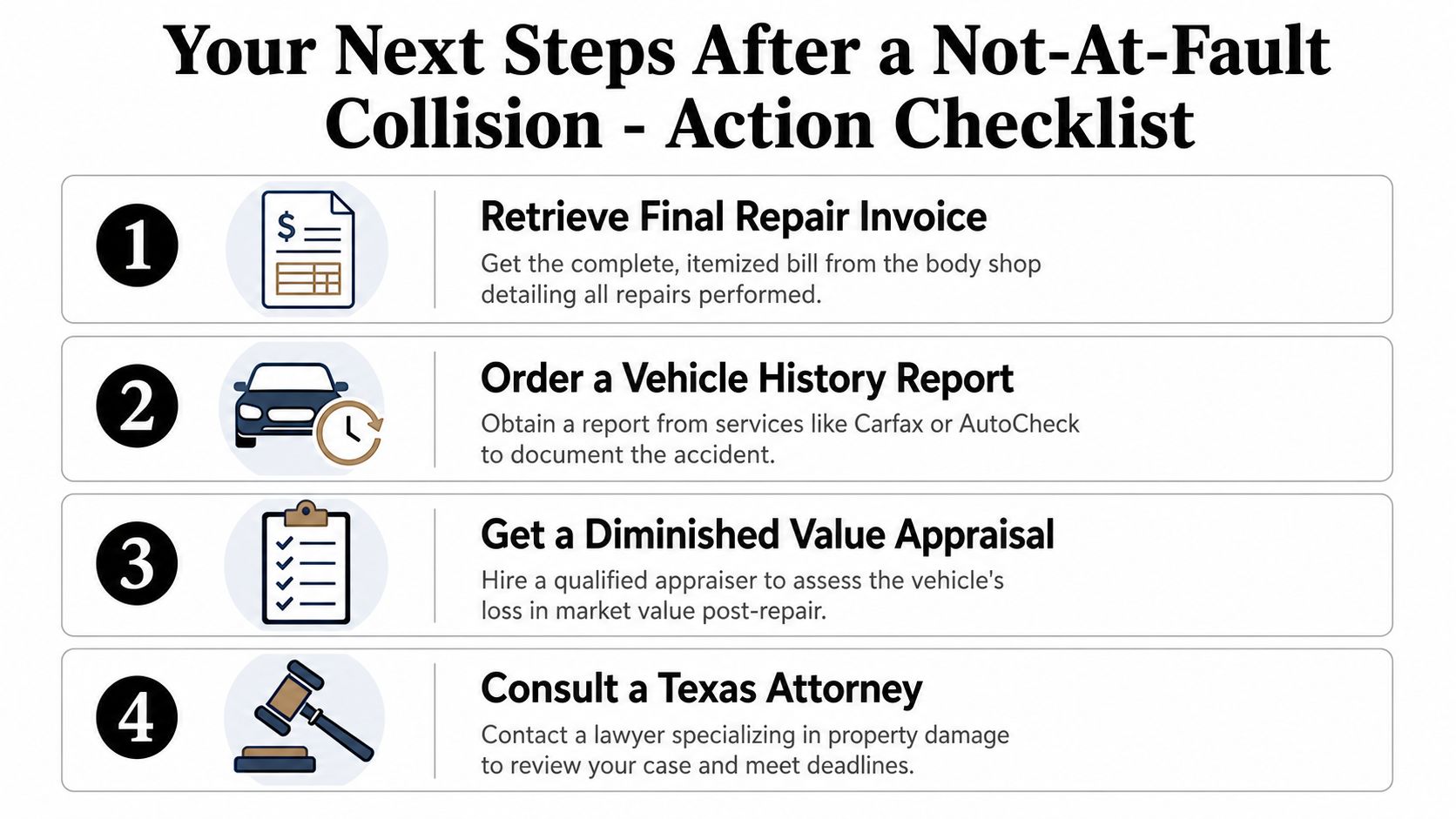
After a not-at-fault collision, use a simple file-building process. Finish the repairs, preserve the final invoice, document the vehicle's condition, and obtain a certified Carfax or AutoCheck report showing the accident history. Then secure a written diminished-value appraisal that uses comparable Texas-market vehicles and explains the adjustment process.
A practical file checklist
- Retrieve the final repair invoice. Request the complete itemized bill, including parts, labor, diagnostic work, and any safety-system procedures.
- Order the vehicle-history report. Confirm that the collision appears accurately and preserve the report in your claim file.
- Get a written appraisal. Ask for the pre-loss and post-repair values, comparable Texas vehicles, repair analysis, and stated conclusions.
- Submit the demand to the correct carrier. Send it to the at-fault driver's liability insurer unless your policy and facts point to another coverage path.
Log every adjuster communication. When the insurer makes a low counteroffer, answer with the market evidence and ask for its valuation support. Don't sign a release until you understand whether it resolves only vehicle value or all claims connected to the crash.
Warning signs that justify legal review
Call a lawyer when the insurer denies the claim based on first-party policy language, stops responding beyond 30 days, alleges responsibility over 50%, or the vehicle remains financed or leased. A lender or leasing company may have separate contractual interests, and those interests can complicate settlement and title decisions.
A Houston car accident attorney may also be appropriate when the collision caused bodily injuries, lost wages, or disputed medical expenses. A truck crash lawyer in Houston can help examine commercial-vehicle liability when a company driver or large truck caused the wreck. Families dealing with a fatal collision should speak with a wrongful death lawyer in Texas about the separate legal issues that may apply.
The Law Office of Bryan Fagan, PLLC handles motor-vehicle injury and property-damage matters, including coordination with counsel when a diminished-value dispute overlaps with a larger injury claim. The firm offers free consultations and contingency-fee representation, so you can discuss the facts and possible next steps before deciding how to proceed.
If an insurer is discounting your repaired vehicle or denying responsibility for its remaining loss, schedule a free consultation with the Law Office of Bryan Fagan, PLLC to review the policy, repair records, appraisal, and deadlines. You deserve a clear evaluation of your options, and legal help is available while you work toward recovery.