A serious accident can change your life in seconds, but you don't have to face it alone. You may be sitting at home after a Houston intersection crash, trying to understand why your head hurts, how you'll pay for treatment, or whether the driver's insurer is offering help or setting a trap. If you're searching for a bicycle accident lawyer in Texas, start with this principle: preserve evidence before you argue about fault.
Texas bicycle collisions are a recurring roadway safety problem, not isolated mishaps. State safety materials recorded 12,789 bicycle crashes from 2007 through 2012, causing 12,132 injuries and 297 fatalities (Texas bicycle crash statistics). More recent TxDOT data reported 2,761 bicycle crashes in 2024, 80 bicyclists killed, and 429 seriously injured (TxDOT vulnerable road user data). Those numbers don't determine your case, but they show why a careful investigation matters.
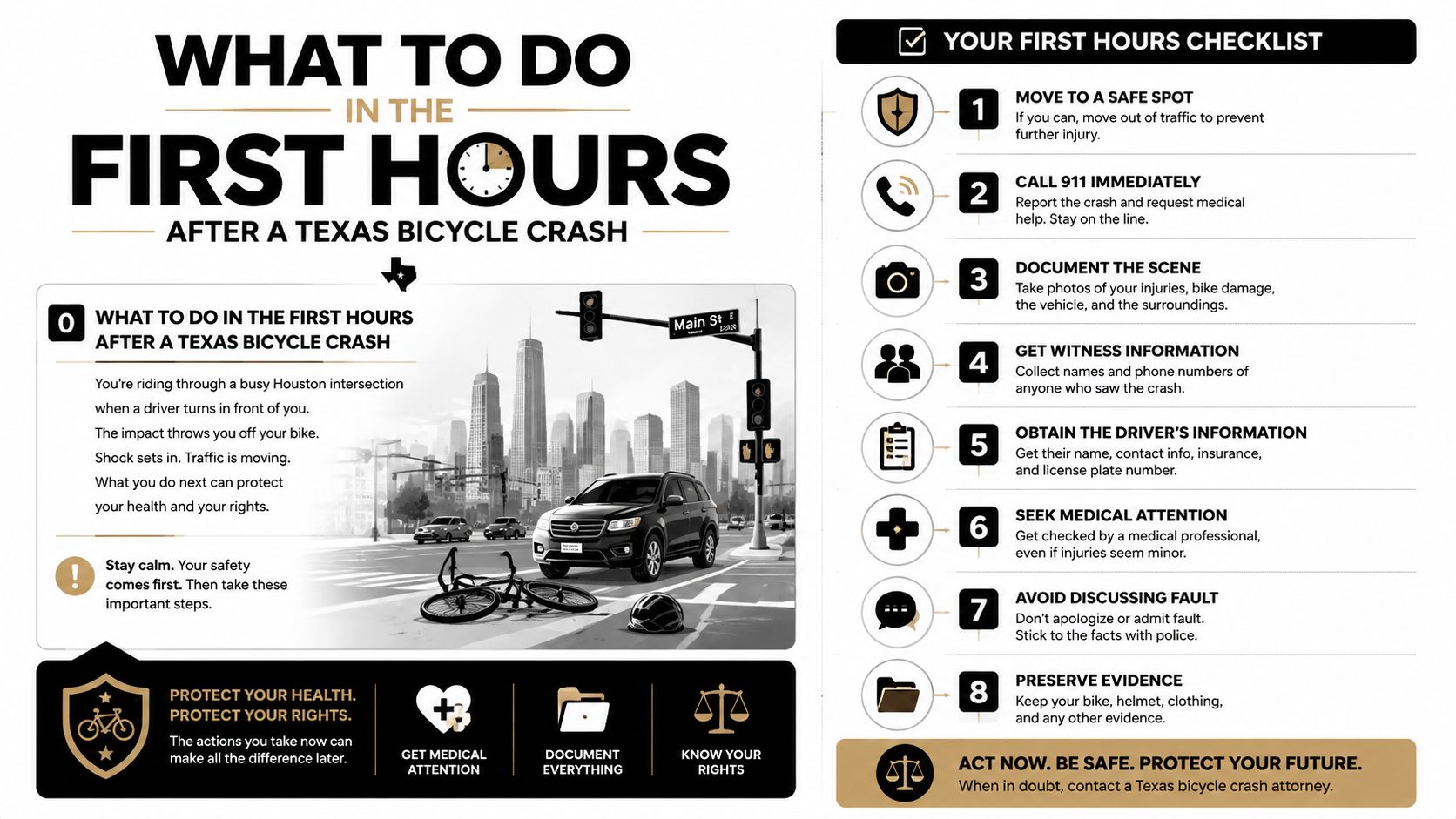
What to Do in the First Hours After a Texas Bicycle Crash
A cyclist is crossing a busy Houston intersection when an SUV turns across the bike lane. The rider hits the pavement, hears traffic rushing past, and feels embarrassed more than injured. That reaction is common. Adrenaline can hide serious harm, so treat the crash as a medical and legal emergency.
Protect your health and create a record
Move away from traffic if you can. Don't leave the scene, but get yourself out of an active lane when it's safe. Ask someone to keep vehicles away from the bicycle and damaged equipment.
Call 911. Request medical care and law enforcement. Texas law requires an officer to investigate and prepare a crash report when a collision causes injury, death, or apparent property damage of $1,000 or more under Texas Transportation Code § 550.062, as explained in this Texas police-report guidance. A report helps, but you can still pursue a claim if no report exists and other evidence supports what happened.
Describe every symptom. Tell paramedics and officers about pain, dizziness, confusion, numbness, vision changes, nausea, or difficulty remembering events. Don't say you're “fine” because you want to go home.
Exchange required information. Under Texas Transportation Code § 550.023, obtain the driver's name, contact information, insurance details, vehicle information, and license information. Don't argue with the driver or speculate about who caused the collision.
Document before the roadway changes
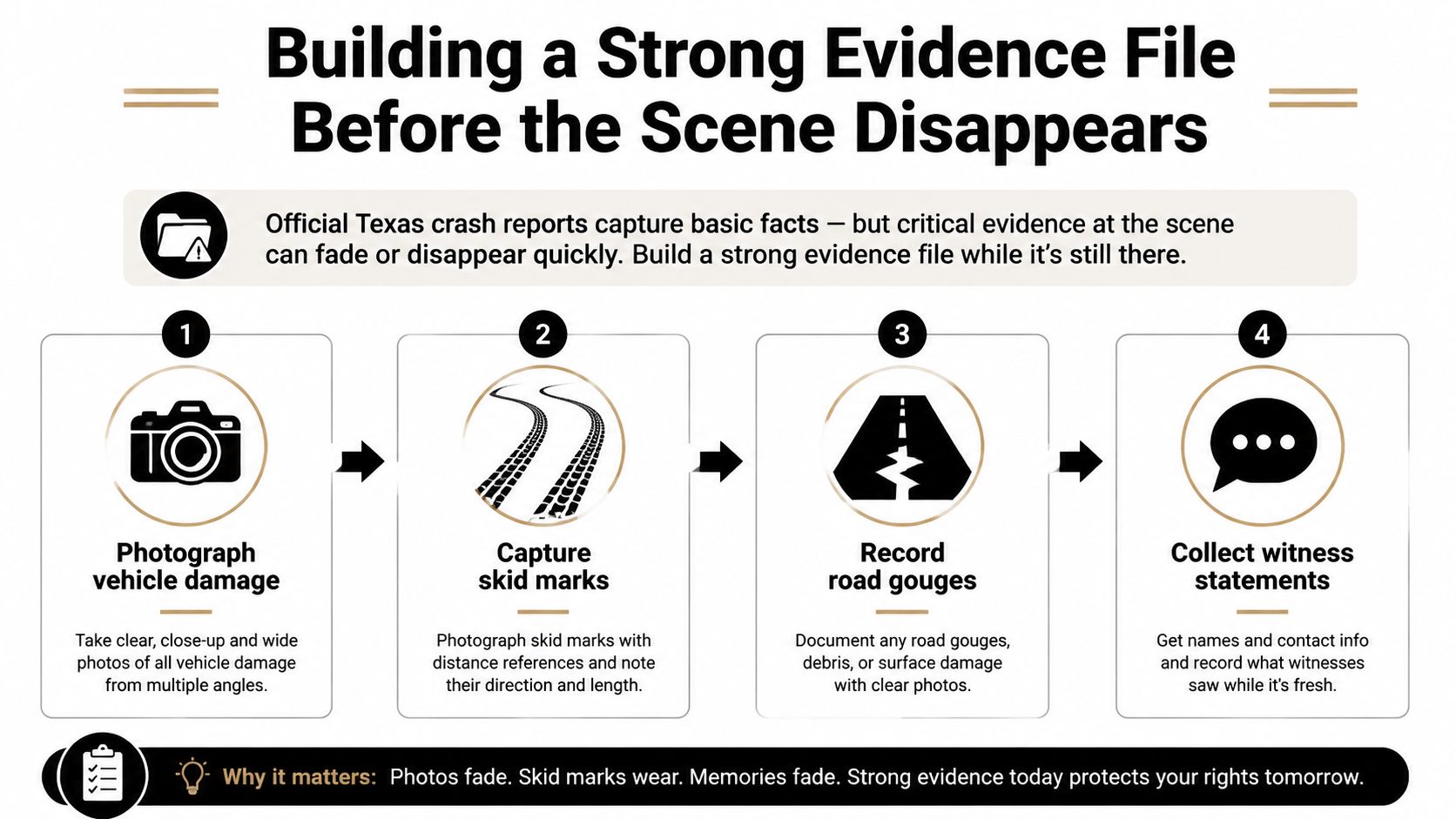
If your condition allows, photograph the intersection from several angles. Capture traffic lights, lane markings, signs, vehicle damage, skid marks, road debris, the bicycle, your helmet, torn clothing, and visible injuries. Ask witnesses for their full names and contact details, even if they believe the crash was obvious.
A cyclist's first statements often become the foundation of an insurance claim. Tell the truth, but keep it factual: “The vehicle turned left in front of me,” or “I felt pain in my shoulder after I fell.” Don't guess about speed, distance, or visibility.
For broader immediate guidance, review this Texas accident-response checklist. Then seek medical evaluation promptly, keep the bicycle and gear in their damaged condition, and avoid posting about the crash online.
Building a Strong Evidence File Before the Scene Disappears
Texas's official crash record can be incomplete. TxDOT's database captures reportable crashes based on police reports, but it doesn't capture bicycle-to-bicycle collisions or bicyclist falls, according to TxDOT's crash-data explanation. Even a reported motor-vehicle crash may contain a thin narrative that leaves out lighting, lane position, road defects, or what witnesses saw.
That gap changes your job after the collision. Don't rely on the CR-3 alone. Build a separate evidence file.
Gather physical and digital proof
Use your phone to photograph the scene before repairs, sweeping, or traffic changes the evidence. Preserve the original files so metadata remains available. At a Houston intersection, that may include the turn arrow, signal timing, bike-lane markings, nearby businesses, and the vehicle's point of impact. In Dallas, photograph road gouges and tire marks. In Austin, capture bollards, signs, protected lanes, and any obstruction that forced you into traffic.
Save more than photographs:
- Vehicle and bicycle damage: Photograph dents, paint transfer, broken spokes, bent wheels, torn bags, and helmet damage. Don't repair or discard anything before a lawyer or qualified investigator reviews it.
- Video sources: Ask nearby businesses, residents, drivers, and cyclists for doorbell, dashcam, or traffic-camera footage. Make preservation requests quickly because systems may overwrite recordings within 7 to 30 days, as reflected in the evidence guidance provided for Texas bicycle claims.
- Phone information: Preserve relevant call, text, navigation, and location records. A lawyer can request the driver's phone records when distraction is disputed.
- Emergency records: Keep 911 information, dispatch details, ambulance paperwork, and medical discharge instructions.
Lock down witnesses and official records
Write a dated account while your memory is fresh. Record where you were riding, what you observed before impact, the direction of travel, traffic conditions, lighting, and what happened immediately afterward. Don't polish the story. Accuracy matters more than certainty.
Ask witnesses for permission to contact them later, and note what each person observed. A witness who saw the driver looking down is more useful than a witness who only heard the impact.
Request the official crash report and related 911 material. If the report omits a key fact, your photographs, video, physical evidence, and witness statements can fill the gap. More practical guidance appears in this Texas injury-evidence guide.
Texas Bicycle Laws That Shape Your Claim
Texas bicycle cases usually turn on negligence. You must connect the defendant's duty, breach, causation, and damages. A driver who fails to yield, turns across a cyclist's path, drives while distracted, or opens a door into moving traffic may have breached that duty. A cyclist's legal right to use the road doesn't eliminate the need to examine the rider's conduct, but it does defeat the assumption that the cyclist didn't belong there.
Two rules deserve immediate attention: the filing deadline and comparative responsibility.
Timing and fault can reduce or erase recovery
Texas generally gives you two years from the date of injury or death to file a personal injury or wrongful-death lawsuit under Texas Civil Practice and Remedies Code § 16.003 (Texas limitations guidance). Waiting until the deadline approaches can destroy evidence and leave no time to investigate.
Texas also uses modified comparative fault. If you're 50% or less responsible, you may recover, but the award is reduced by your percentage of fault. If you're more than 50% responsible, recovery is barred (Texas bicycle-claim fault explanation).
A hypothetical makes the rule clear. If a jury valued the damages at $200,000 and assigned you 30% responsibility, the award would be reduced to $140,000. If the jury assigned you 51% responsibility, recovery would be zero. Those figures are examples of the legal math, not a prediction of case value.
Government claims require faster action. A city, county, transit agency, or government vehicle may trigger written notice requirements under the Texas Tort Claims Act, often within six months, and some city charters can impose shorter periods (government bicycle-claim deadlines). A Texas Personal Injury Lawyer may represent injury victims across Texas on a no-fee-unless-we-win basis.
| Legal Rule | Texas Standard | Effect on Your Claim |
|---|---|---|
| Personal injury or wrongful death deadline | Two years from injury or death | A late lawsuit may be barred |
| Comparative responsibility | Recovery remains possible at 50% or less fault | The award is reduced by your assigned share |
| More than 50% fault | Recovery is barred | Strong evidence becomes critical |
| Government notice | Often six months, sometimes shorter by charter | Immediate legal review may be necessary |
Working With Doctors and Insurance Adjusters the Right Way
The insurance adjuster may call while you're still sore, medicated, and unsure how serious the injuries are. Be polite, but don't treat that call as a routine conversation. The adjuster works for the insurer, not for you.
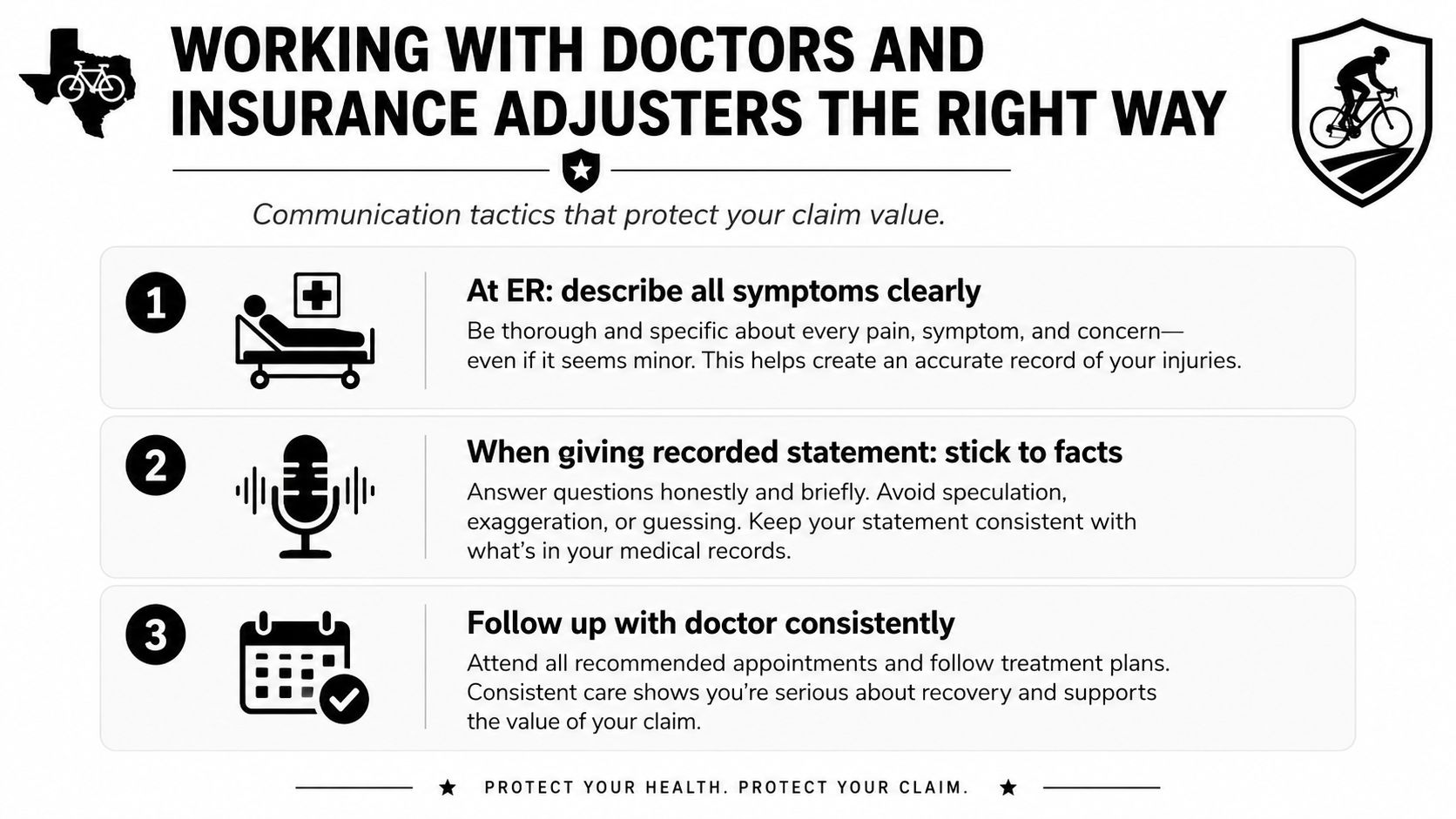
At the emergency room, describe symptoms clearly and completely. Say, “I have neck pain, dizziness, and trouble concentrating after being struck by a vehicle.” Don't minimize symptoms because you're worried about appearing dramatic. Ask the provider to document that the symptoms began after the bicycle crash.
Keep communications factual
You don't have to provide a recorded statement immediately. You can say:
“I'm receiving medical care and I'm not prepared to give a recorded statement. Please send your request in writing.”
If you do speak before hiring counsel, answer only what you know. Don't estimate your speed, declare that you “might have caused” the crash, or agree that you weren't seriously injured. “I don't know” is a proper answer when you don't know.
You should also avoid signing a broad medical release before understanding what records the insurer wants. Prior medical history may be relevant, but an unrestricted request can expose unrelated information and invite arguments about pre-existing conditions.
Follow treatment and wait for a reliable damages picture
Attend follow-up visits, take prescribed medication as directed, and explain continuing symptoms at each appointment. Gaps in care give insurers an argument that the injury improved or wasn't caused by the collision. That argument may be wrong, but consistent records make it harder to sustain.
Don't rush into a quiet settlement before doctors understand the full impact. Concussion symptoms, soft-tissue pain, emotional distress, and complications can become clearer over time. Once you sign a release, you generally can't return for additional compensation if the condition worsens.
Keep bills, receipts, mileage records, work-loss information, and correspondence in one file. This medical-records guide for Texas injury claims explains why those records matter. After you retain counsel, direct adjuster communications to your lawyer.
Negotiating a Settlement or Filing a Texas Lawsuit
A settlement can resolve a bicycle case without the expense and uncertainty of trial. A lawsuit, however, may be necessary when an insurer discounts your injuries, blames you without evidence, or refuses to account for future medical needs.
A strong demand package should tell one coherent story. It should include the crash report, scene photographs, witness information, medical records, bills, work-loss proof, bicycle damage, and a clear explanation of liability. A demand isn't just a number. It's the evidence-based argument for why the driver or another responsible party should pay.
Choose negotiation when the record is complete
Negotiation makes sense when liability is supported by independent evidence and your medical condition is sufficiently documented. After a Houston freeway crash, for example, a demand may be persuasive when the vehicle damage, lane markings, witness accounts, and medical records all point in the same direction.
Filing suit becomes more important when the insurer's offer ignores permanent impairment, future care, lost earning capacity, or wrongful-death losses. Litigation also creates formal tools that informal negotiation doesn't provide, including depositions, subpoenas, written discovery, and requests for commercial-vehicle records.
| Factor | Negotiation | Texas Lawsuit |
|---|---|---|
| Pace | Can resolve without court proceedings | Usually takes longer |
| Evidence | Voluntary exchange and investigation | Formal discovery and subpoenas |
| Driver testimony | May be limited | Depositions can test the driver's account |
| Commercial defendant | Records may be withheld | A trucking company's records can be sought through discovery |
| Mediation | May be voluntary | May be ordered under local court procedures |
| Trial risk | Avoided | Jury decides disputed issues if settlement fails |
Venue can affect how a case is presented. A Houston, Dallas, Austin, or rural-county jury may view road design, shoulder width, lighting, and cycling differently. That doesn't replace evidence, but local conditions help shape investigation and trial strategy.
Most cases resolve before trial, but preparation still matters. An insurer offers more seriously when it sees that your lawyer preserved the video, understands Texas bicycle law, and is ready to prove the case in court.
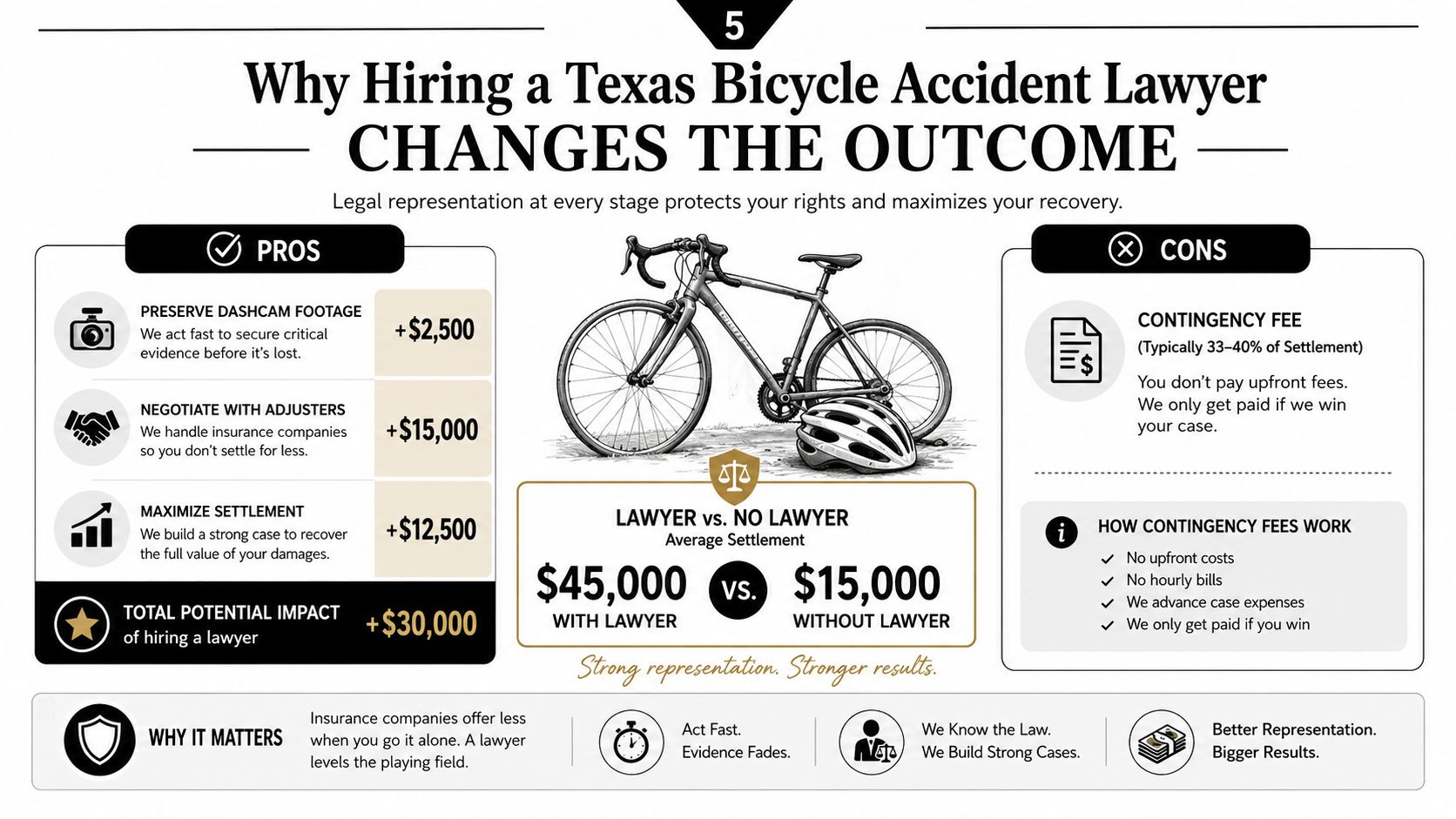
Why Hiring a Texas Bicycle Accident Lawyer Changes the Outcome
A bicycle claim is rarely just a smaller car case. The evidence can disappear quickly, the crash report may omit important details, and the defense may rely on assumptions about cyclists rather than proof. A Texas bicycle accident lawyer can focus on those issues while you focus on treatment.
A lawyer's value often appears before the first settlement discussion. Counsel can send preservation letters for dashcam, business, doorbell, and traffic-camera footage. If a commercial vehicle was involved, counsel can pursue vehicle data and company records through the proper legal process. A lawyer can also inspect the bicycle, helmet, clothing, and roadway evidence before anyone repairs or discards them.
The fee concern deserves a direct answer
Many injury firms use contingency-fee representation. That arrangement generally means you don't pay attorney fees upfront, and the fee is tied to recovery. Ask every firm to explain the percentage, case expenses, medical liens, and what happens if there's no recovery. Don't rely on a vague promise.
A lawyer also calculates damages beyond the first hospital bill. A traumatic brain injury, permanent scarring, loss of mobility, or serious fracture may affect work, household tasks, recreation, and future care. Those losses need medical and vocational documentation, not guesswork.
Practical rule: Don't let an insurer assign fault before someone has examined the scene, the records, and the physical evidence.
Texas's 50% fault threshold makes investigation especially important. A 30% fault finding can reduce an award, but it doesn't automatically eliminate recovery. The goal is to challenge unsupported fault allocation with photographs, witness testimony, reconstruction, medical records, and applicable roadway rules.
Law firms and legal-content teams can also learn from resources focused on how to measure ROI on legal content, especially when building clear educational material for accident victims. For you, the practical question is simpler: can the lawyer identify the evidence, deadlines, coverage, and damages issues your claim presents?
Your Path Forward and How Our Firm Can Help
Start today with a short, written checklist. Don't wait for the insurer to tell you what matters.
- Schedule medical follow-up: Report continuing pain, dizziness, memory problems, sleep changes, and emotional symptoms.
- Request the CR-3: Obtain the official crash report and compare it with your own account.
- Save video promptly: Ask businesses, homeowners, drivers, and transportation agencies for footage before automatic deletion.
- Write an incident memo: Date it, describe the roadway, lighting, traffic, impact, witnesses, symptoms, and treatment.
- Calendar every deadline: Mark the two-year personal-injury or wrongful-death deadline and investigate any shorter government notice requirement if a city, county, transit agency, or government vehicle is involved.
- Preserve the evidence: Keep the bicycle, helmet, clothing, phone, and damaged equipment exactly as they were after the crash.
A lawyer should turn that checklist into a managed investigation. That includes sending evidence-preservation letters, locating witnesses, reviewing the CR-3 and 911 material, coordinating with treating providers, examining available insurance, and addressing comparative-fault arguments before they become accepted facts.
The same approach applies whether you need a Houston car accident attorney for a motor-vehicle collision, a truck crash lawyer Houston families can contact after a commercial-vehicle impact, or a wrongful death lawyer Texas families need after losing someone. Severe injuries may also require guidance from a catastrophic injury attorney and families may need information about wrongful death claims. Legal education for personal-injury firms also emphasizes the importance of clear, location-specific information, as discussed in this resource by Digital Skyrocket.
The Law Office of Bryan Fagan, PLLC handles serious Texas injury claims involving cyclists, cars, trucks, wrongful death, and catastrophic harm. The firm offers free consultations and contingency-fee representation, so you can discuss your evidence and deadlines without paying an upfront legal fee.
Schedule a free consultation with the Law Office of Bryan Fagan, PLLC so a Texas personal injury lawyer can review the crash, preserve time-sensitive evidence, and identify every available source of compensation. Recovery takes time, but with prompt medical care and focused legal help, you and your family can move forward with a clear plan.