A serious accident can change your life in seconds, but you don't have to face it alone. If your child came home from daycare with a swollen head, a broken bone, a strange bruise, or a story that does not add up, trust your gut. In Texas, these cases turn on fast action, careful evidence work, and a clear understanding of who has a claim, how long they have, and what proof still exists.
When a Daycare Call Becomes a Legal Matter
The call usually comes at the worst possible time. A daycare in The Woodlands, Katy, or a Houston suburb says your toddler fell from a climbing structure while staff were changing another child, and now you need to pick them up right away. Your first reaction is fear. Your second is guilt, even though you were not there and could not have prevented it.
That kind of injury is not something families should brush off as a normal scrape. Texas has real safety problems in licensed child care settings, including 848 serious injuries in 2022 and 3 near-fatal or fatal incidents reported by the Texas Health and Human Services Commission, plus a separate 2023 report citing 651 serious injuries and 1 fatality for children age four and younger at licensed daycare centers in Texas (Stephens Law). Those numbers are not abstract. They describe real children who were hurt in places parents were told were safe.
Practical rule: if the daycare is calling about a serious injury, treat it like a legal event right away, not just a medical one.
The first hours matter because the evidence starts disappearing immediately. Staff can rewrite the story, cameras can overwrite footage, and witnesses can forget details. That's why a calm, organized response matters more than panic.
A Texas personal injury lawyer looks at what happened, but also at what the daycare should have done. In these cases, the question is not whether you are overreacting. The question is whether the facility failed to supervise, failed to keep the child safe, or failed to tell the truth fast enough for you to protect your family's rights.
What to Do in the First 48 Hours After a Daycare Injury
Start with medical care, even if the injury looks minor. A chart created on the day of the injury helps connect the harm to the event, which matters later when a daycare or insurer tries to say the injury came from somewhere else. If your child has a head bump, a limp, vomiting, unusual sleepiness, or pain that doesn't make sense, get them checked.
Do the things that protect the record
After medical care, start documenting everything. Take photos of the injury, the play area, the equipment, the clothing, and anything wet, broken, or out of place. Ask for the incident report and the sign-in or sign-out logs in writing before the daycare has time to polish its account.
A simple written request gives you an advantage because it locks in what you asked for and when. If the daycare hesitates or acts like you're being difficult, that's a sign to slow down and get help.
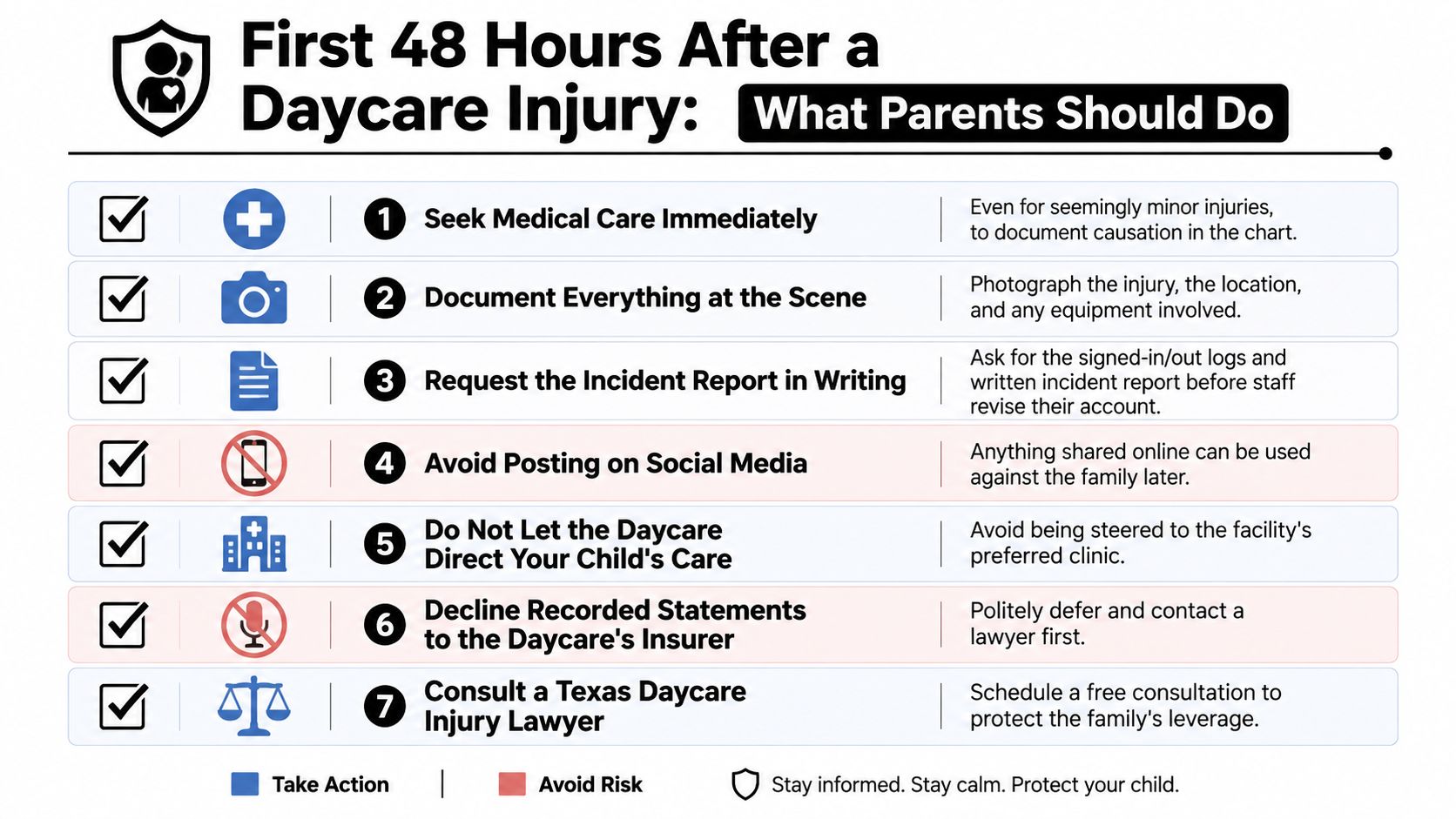
Here's the order I'd tell any parent to follow:
- Seek medical care immediately. Even a seemingly small injury deserves a chart.
- Document the scene. Use your phone to photograph the injury, the room, and any equipment involved.
- Request the report in writing. Ask for the incident report and attendance logs before anyone revises the story.
- Stay off social media. Anything posted can be used later.
- Don't let the daycare steer treatment. You choose the doctor, not the facility.
- Decline recorded statements. The insurer is collecting facts for its defense.
- Talk to a lawyer fast. A Texas Personal Injury Lawyer handles injury victims across Texas on a no-fee-unless-we-win basis.
A few mistakes hurt families over and over. Don't post updates or photos online. Don't sign broad medical authorizations just because an adjuster sounds polite. And don't let the daycare send you to its preferred clinic if your own pediatrician or emergency room is the better fit.
If the story sounds tidy too quickly, slow down. Clean narratives are often built after the fact.
How Texas Law Decides Whether the Daycare Is at Fault
A daycare case in Texas lives or dies on the four negligence elements, duty, breach, causation, and damages. Those are the building blocks a Texas daycare injury lawyer has to prove, and each one should be tied to evidence from the first day.

Duty and breach
A licensed daycare has a duty to supervise children and follow Texas child care safety rules. If the room was understaffed, if a caregiver stepped away when a toddler needed constant eyes on them, or if a climbing structure was left in a dangerous state, that can show a breach. A useful outside reference on vetting child-related workers, which also shows how seriously supervision and screening matter, is vetted childcare safeguards.
Causation and damages
Causation means the breach led to the injury. If your child was fine at drop-off, then suffered a documented head injury after a supervision lapse, the timeline matters. Damages are the losses, medical care, therapy, pain, and the ripple effects on your family.
Texas law also allows comparative responsibility, which means the defense may try to blame someone else, even the child, to reduce what it owes. That does not automatically kill a case. It just means the facts have to be clean and the proof has to be strong.
A clear example helps. After a Houston-area toddler breaks an arm on unsafe playground equipment, the case may turn on whether the daycare had a duty to watch, whether staff failed to do so, whether that failure caused the fall, and whether the child now needs treatment and follow-up. If those facts line up, the law can support compensation.
For a deeper look at how proof gets built, see how negligence is proven in Texas injury cases.
Damages Texas Families Can Recover After a Daycare Injury
The most overlooked part of a daycare injury case is that the child's claim and the parent's claim are not the same thing. That distinction matters because each one can carry different losses, different proof, and different timing.
For the child, the claim can include pain and suffering, emotional harm, future medical care, and the loss of normal childhood activities during recovery. If the injury affects development, mobility, sleep, or behavior, that future care can matter just as much as the immediate ER visit.
For parents, the claim can include out-of-pocket medical bills, missed work, and other direct expenses you paid because the daycare failed to keep your child safe. In tragic cases, the family may also have a wrongful death claim. A plain example makes this easier to see. If a Houston-area two-year-old suffers a skull fracture, the child's claim may focus on pain, follow-up care, and lasting impact, while the mother's claim may cover missed wages from taking unpaid leave to attend appointments.
The parent-versus-child issue is where families get hurt by delay. The child's claim is often tolled because of minority rules, but a parent's own claim for medical expenses or lost wages can still face its own two-year clock. If you wait because you think the child's deadline protects the whole family, you can lose part of the case value without realizing it.
Bottom line: one daycare incident can create two different timing problems, and they do not always move together.
This is why I tell parents to sort losses early, before records get mixed together. Keep the child's medical bills separate from your own wage loss paperwork. Save travel costs, therapy notes, and anything showing the day-to-day burden on the family.
Handling the Daycare's Insurance Company Without Giving Away Your Case
The daycare's insurer is not calling to help you. The adjuster's job is to protect the carrier's money, and that usually means trying to get you talking before you know the full medical picture. They may push for a recorded statement, ask for broad medical authorizations, or dangle a fast settlement before treatment is finished.
The response should be calm and short. Say, “I'm not giving a recorded statement right now. I'm focusing on my child's treatment, and I'll have my lawyer contact you.” That's enough. You do not need to explain the injury in detail, guess about fault, or promise you'll “just send over” every record in your house.
If your child is recovering, keep your attention on care and routine, not the insurer's timeline. A resource on normal development, see key milestones for preschoolers, can be useful context for parents trying to tell the difference between ordinary behavior and changes that deserve medical follow-up. If the daycare or its carrier wants a statement before you've even had a chance to understand your child's condition, that's a red flag.
The internal rule to remember is simple. Don't give the other side free information. The less they know, the less they can twist later. If the carrier is already asking questions, your position is better protected when a lawyer handles the conversation.
For a deeper warning about insurer tactics, read what not to say to an insurance adjuster in Texas.
Deadlines for Filing a Daycare Injury Claim in Texas
Texas generally gives injured people two years to file a personal injury claim under CPRC §16.003. For a child, minority tolling under CPRC §16.001 usually pauses that clock until the child turns 18, which means the child's own claim can often be filed later than an adult's claim.
That protection does not automatically save the parent's claim. If you have your own losses, such as medical bills you paid or wages you lost, your deadline can still run on the ordinary two-year schedule. That's the trap many families miss. They focus on the child, assume the whole case is protected, and later find out part of the recovery is gone.
The best way to think about this is that the family may have separate legal tracks. One track belongs to the child. Another belongs to the parent. Each track needs its own deadline analysis and its own paperwork.
For a plain reminder on timing, see how long do I have to file an injury claim in Texas.
Don't wait for the child's clock to save the whole case. Evidence, not time, is usually the first thing to disappear.
I'd rather see a family call early and learn they have time than call late and learn the parent's claim was already weakened. The injury report, video, staff schedules, and witness memory matter more than many realize. Once those pieces start to fade, the case gets harder even if the legal deadline has not arrived.
What a Texas Daycare Injury Lawyer Does for Your Family
A daycare injury lawyer does real work before anyone files a lawsuit. The first job is evidence preservation, because the proof in these cases can disappear fast. That means moving to secure surveillance footage before it gets overwritten, asking for staffing logs, collecting incident reports, and checking Texas HHS records for patterns that may support the claim.
The next job is building the medical proof. The lawyer should make sure the records tell a clear story about how the injury happened, what symptoms followed, and what care your child may need later. Insurers attack causation first, especially when a child cannot explain everything in adult detail.
Then comes valuation. A lawyer looks at the economic losses, the non-economic harm, and future care the child may need. If the daycare's commercial liability carrier lowballs the claim, the lawyer negotiates. If the insurer refuses to deal fairly, the lawyer gets the case ready for court.
Here's what I'd ask any firm before signing anything:
- Who handles the file day to day? You need to know whether you will speak with a lawyer or get passed from person to person.
- What daycare case experience do you have? Ask for specific process knowledge, not vague reassurance.
- How are medical liens handled? This affects what reaches your family at the end.
- Do you work on contingency? You should know how fees work before the case starts.
A consultation should feel like a fact-finding meeting, not a commitment. The Law Office of Bryan Fagan, PLLC handles injury claims on a contingency-fee basis, and it also serves families across Houston, Dallas–Fort Worth, Austin, San Antonio, and nearby Texas communities. That makes a free consultation a low-risk way to get answers before the daycare or insurer shapes the record for you.
The same approach applies if your family also needs help from a wrongful death lawyer Texas, a Houston car accident attorney, or a truck crash lawyer Houston because a separate crash added to the injury picture. The legal tools are different, but the first move is the same, protect the facts.
The point is simple. Recovery is possible, and legal help is available. If your child was hurt in a Texas daycare, call the Law Office of Bryan Fagan, PLLC or visit Law Office of Bryan Fagan, PLLC to schedule a free consultation and get clear next steps for your family.