A serious accident can change your life in seconds, but you don't have to face it alone. Maybe you were riding through a Houston-area neighborhood, a Texas resort, or a planned community when the cart suddenly tipped, another vehicle struck it, or a child fell from the open side. Now you're dealing with pain, medical appointments, insurance calls, and a basic question that has no simple answer: who pays when a golf cart causes serious harm?
Texas golf cart claims don't follow the same path as ordinary car crashes. The vehicle's legal classification, where it was being used, the condition of the property, available insurance policies, and each person's share of fault can all change the case. This guide explains the practical steps to protect your health and legal rights, including when a Texas personal injury lawyer can help.
What a Golf Cart Crash in Texas Really Feels Like
A quiet evening ride through a planned community can end without warning. One moment, you're traveling toward a pool or a nearby home. The next, the cart hits an uneven edge, rolls during a sharp turn, or collides with a vehicle at an intersection. Your wrist may be fractured, your head may have struck the frame, and everyone around you may be asking different questions about what happened.
Golf carts feel slow, but riders remain exposed. Open sides, limited restraints, and unfamiliar paths can turn a short trip into a serious medical event. A national emergency-room study found 156,040 golf cart-related injuries treated from 2007 through 2017, an average of roughly 14,185 injuries per year. The study also found that injuries among seniors increased 67.6%, from 4.81 per 100,000 seniors in 2007 to 8.06 per 100,000 seniors in 2017. Those findings are discussed with the underlying study reference at golf cart injury data and safety information.
Why low speed doesn't mean low risk
A separate academic review of U.S. emergency-room surveillance identified 147,696 nonfatal golf cart injuries from 1990 to 2006. Children under 17 represented 31.2% of cases, hospitalization occurred in 7.8%, and falling from the cart accounted for 38.3% of injuries. More than 70% of injuries occurred at sports facilities, according to the review available through academic golf cart injury research.
The numbers matter, but your own evidence matters more. A medical record showing a fracture, concussion, spinal injury, or lasting limitation can connect the crash to the harm you're experiencing. Photos, witness accounts, cart records, and the location of the crash can help identify whether the driver, a property owner, a rental operator, or another party bears responsibility.
Your first job isn't to solve the legal case at the scene. It's to protect your health and preserve the facts before they disappear.
What to Do in the First Hours After the Crash
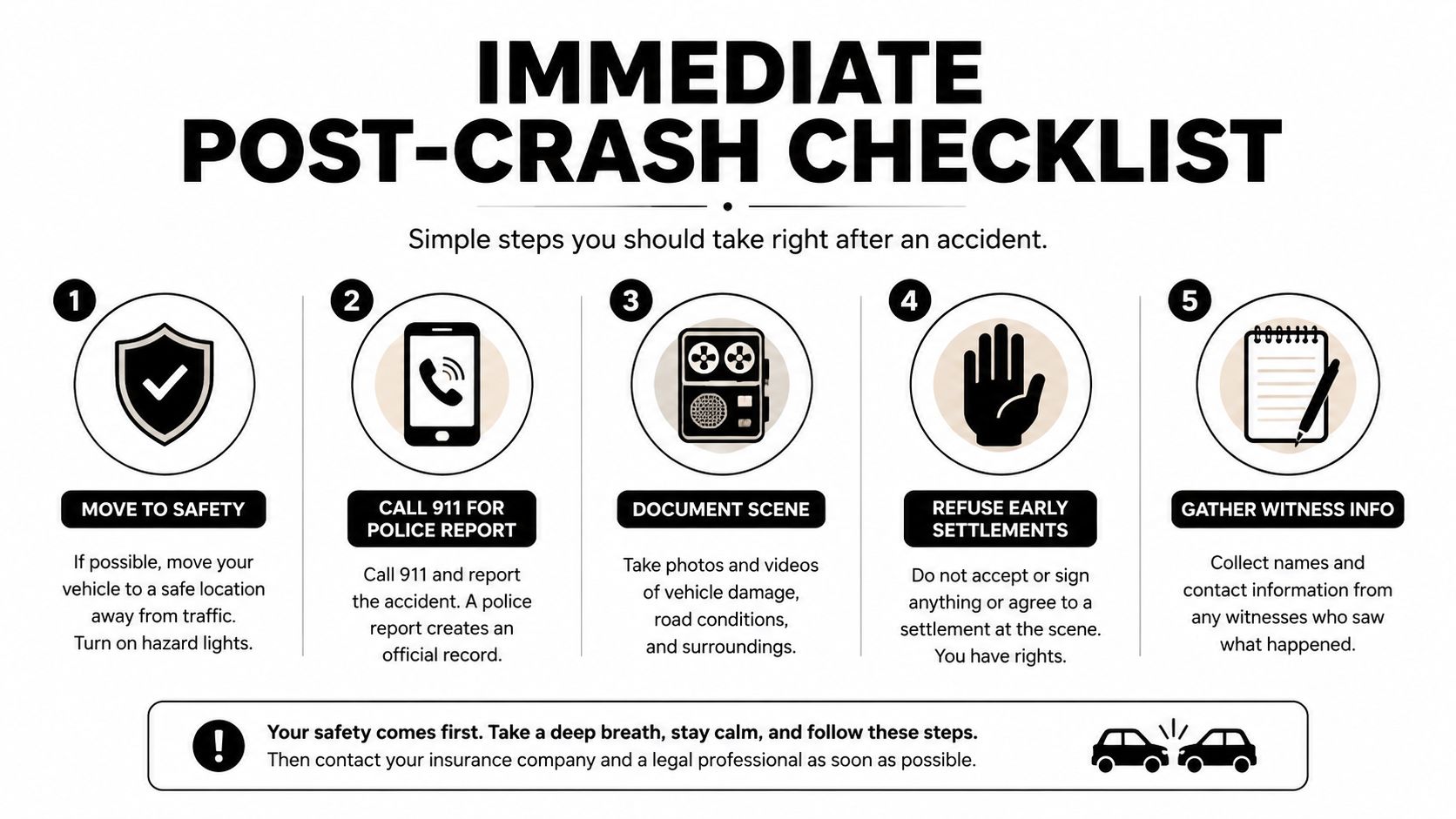
Move away from traffic, slopes, damaged carts, or any other immediate danger if you can do so safely. Call 911 and request police, sheriff, or emergency medical assistance. A formal report can preserve basic facts while the event is still fresh, and emergency responders can identify injuries that aren't obvious in the first minutes.
Don't apologize, speculate, or say that the crash was your fault. Tell responders what you remember, but avoid guessing about speed, distance, or why another person acted as they did. After a Texas car accident step-by-step guide, the same core principle applies here: report the event, obtain care, and preserve evidence.
Get medical care and document the scene
Seek medical evaluation even if your pain seems manageable. Adrenaline can mask symptoms, and a delayed examination may give an insurer an argument that your injury came from something else. Keep discharge papers, imaging reports, prescriptions, bills, work records, and notes about how the injury affects sleep, movement, childcare, and daily tasks.
Use your phone to photograph the cart, its seats and restraints, visible damage, the roadway or path, lighting, signs, curbs, tire marks, nearby vehicles, and your injuries. Ask witnesses for their names and contact information. If a business, homeowners association, campground, resort, or rental company controls the location, notify that entity promptly and request that it preserve video, incident reports, inspection records, and maintenance documents.
Protect your claim from early insurance pressure
Don't post photographs, opinions, or updates about the crash on social media. Don't give a recorded statement or sign a release before a lawyer reviews the facts and policy language. Adjusters may ask questions that sound routine but can later be used to argue that you accepted blame or recovered faster than you did.
For practical information about how insurers try to reduce payouts and how to protect your claim, see Dealing With Insurance Companies After a Texas Accident. A prompt consultation is especially important when a child, older adult, or seriously injured passenger is involved.
How Texas Law Treats Golf Carts and Insurance
Texas law treats a golf cart as a specific class of vehicle. The Transportation Code defines it as a motor vehicle designed by the manufacturer primarily for use on a golf course. In 2019, Texas codified detailed operating rules, including authority for counties and municipalities to prohibit golf cart use on highways when safety requires it. The legal framework and its effect on accident claims are summarized in Texas golf cart accident law information.
Classification affects where the cart could lawfully travel, what equipment or restrictions may apply, and which negligence arguments deserve investigation. A traditional course cart, a permitted neighborhood cart, and a low-speed vehicle shouldn't automatically be treated as the same thing. Identify the cart, the road or property, and the purpose of the trip before assuming an ordinary auto policy will respond.
The insurance path depends on the facts
Many victims ask whether the cart itself is insured. That question is too narrow. The core issue is which person or entity controlled the risk and which policy covers that conduct.
A Texas Supreme Court decision held that a golf cart wasn't an “auto” under a school district's auto liability policy. Coverage summaries also note that golf carts are generally exempt from Texas financial-responsibility rules unless treated as low-speed vehicles. That can leave recovery dependent on a homeowner's policy, commercial coverage, premises liability insurance, a driver's separate liability policy, or an umbrella policy. The coverage issue is discussed in Texas golf cart insurance coverage analysis.
| Cart Type | Texas Classification | Typical Insurance Path |
|---|---|---|
| Traditional course cart | Motor vehicle designed primarily for golf-course use | Course or rental company commercial liability, property coverage, or applicable homeowner coverage |
| Neighborhood golf cart | Golf cart subject to Texas and local operating restrictions | Owner's golf cart coverage, homeowner endorsement, umbrella policy, or other applicable liability coverage |
| Low-speed vehicle or street-legal cart | A separate vehicle category with different roadway and insurance questions | Auto policy, dedicated low-speed vehicle coverage, or commercial policy |
| Rented cart | Cart controlled or supplied by a rental operation | Rental company commercial liability, maintenance-related coverage, and the operator's applicable policy |
If you own or operate an electric cart, reviewing insurance for your EV cart can help you understand why dedicated coverage and policy exclusions matter. After a crash, notify potentially applicable carriers, but don't provide a detailed recorded statement until you understand the liability picture. A broader explanation of policy issues is available through Texas liability insurance information.
Legal Claims That May Apply to Your Case
A golf cart case may involve more than one legal theory. The correct theory follows the facts, not the label placed on the vehicle.
Negligence is the usual starting point when an operator drives carelessly, looks away, operates while impaired, carries passengers unsafely, or ignores a roadway restriction. The evidence may include the police report, witness statements, phone records where legally obtainable, photographs, video, and reconstruction of the crash.
Premises liability becomes important when a community, resort, campground, course, rental track, or event property allowed a dangerous condition to remain. A damaged path, missing warning, blind curve, poor lighting, steep grade, or uncontrolled access point may support a claim if the responsible party knew or should have known about the hazard.
Product liability may apply when a defect in braking, steering, throttle control, stability, battery systems, or safety equipment caused the crash or made the injuries worse. Preserve the cart. Don't allow repairs, modifications, or disposal before an attorney and qualified experts can inspect it.
Wrongful death applies when a crash takes a family member's life. A family may need a wrongful death lawyer in Texas to investigate the crash, identify statutory beneficiaries, and pursue damages under the separate rules that govern fatal injury claims.
| Legal Theory | Typical Fact Pattern | Key Evidence Needed |
|---|---|---|
| Negligence | A driver strikes a pedestrian, passenger, or another cart through careless operation | Police report, witnesses, video, medical records, scene photographs |
| Premises liability | An unsafe path, missing warning, or property hazard contributes to a rollover or collision | Inspection records, maintenance logs, property rules, photographs, prior notice |
| Product liability | A defective brake, steering component, throttle, or design worsens the event | Preserved cart, maintenance history, expert inspection, purchase and repair records |
| Wrongful death | The crash causes a family member's death | Medical and death records, crash evidence, family relationship records, financial and personal-loss proof |
Texas law also recognizes a specific crosswalk concern. When criminal negligence by a driver causes bodily injury to a pedestrian, bicyclist, or golf-cart occupant in a crosswalk, that offense can provide important evidence for a civil claim when supported by police and medical records. The Texas courts material addressing this issue is available through Texas crosswalk and golf cart legal guidance.
How Damages Are Calculated and How Fault Affects Them
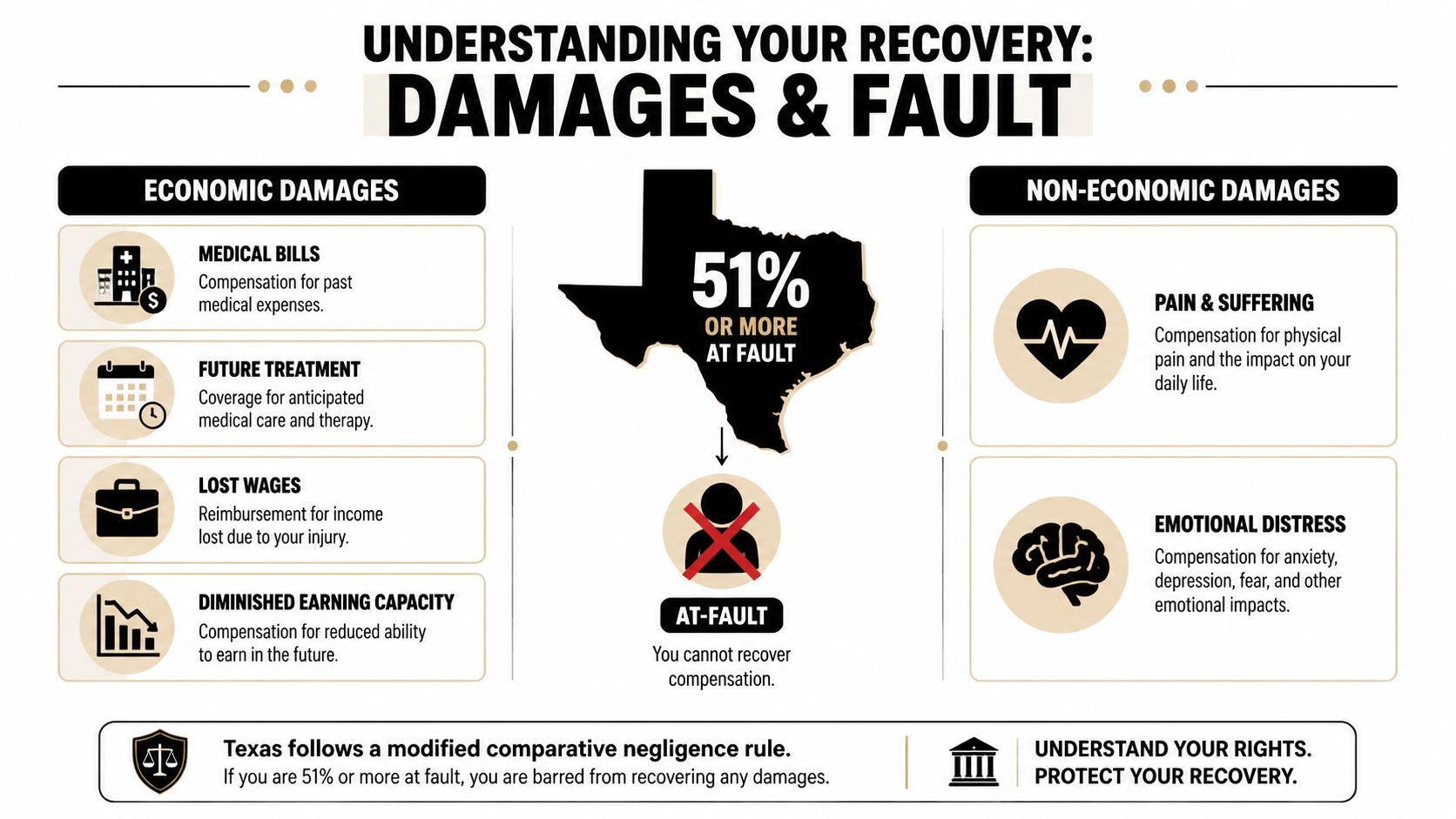
Your damages should reflect both the bills you can document and the life you've lost or changed. Economic damages may include emergency care, hospital treatment, surgery, rehabilitation, future medical care, lost wages, reduced earning capacity, transportation, home assistance, and other out-of-pocket costs tied to the injury.
Non-economic damages address the human consequences. They can include pain, mental anguish, disfigurement, loss of enjoyment of life, physical limitations, and the effect of a serious injury on family relationships and ordinary activities. A person who can no longer work, drive, sleep normally, or care for a child may have losses that don't appear on a billing statement.
How comparative responsibility changes recovery
Texas follows modified comparative negligence under Civil Practice and Remedies Code Chapter 33. If you're found 50% or less at fault, your damages are reduced by your percentage of responsibility. If you're found more than 50% at fault, you recover nothing under the 51% bar rule. The rule's operation is explained in Texas comparative negligence research.
For example, assume the evidence supports a gross recovery of $400,000 and a jury finds you 25% at fault because you failed to use a working seatbelt. Your recovery would be reduced by that share, leaving $300,000. That example doesn't predict a result. It shows why insurers focus on passenger conduct, speed, distraction, and safety equipment.
Fault isn't an all-or-nothing question until the evidence makes it one. Preserve the facts that show what each person did, what each person controlled, and what each person could have prevented.
Punitive damages require a separate analysis and generally depend on proof beyond ordinary carelessness. Wrongful death damages also follow their own rules. A lawyer should evaluate those issues alongside medical costs, lost income, future needs, and the effect of the injury on your daily life.
When and How to Hire a Texas Golf Cart Accident Lawyer
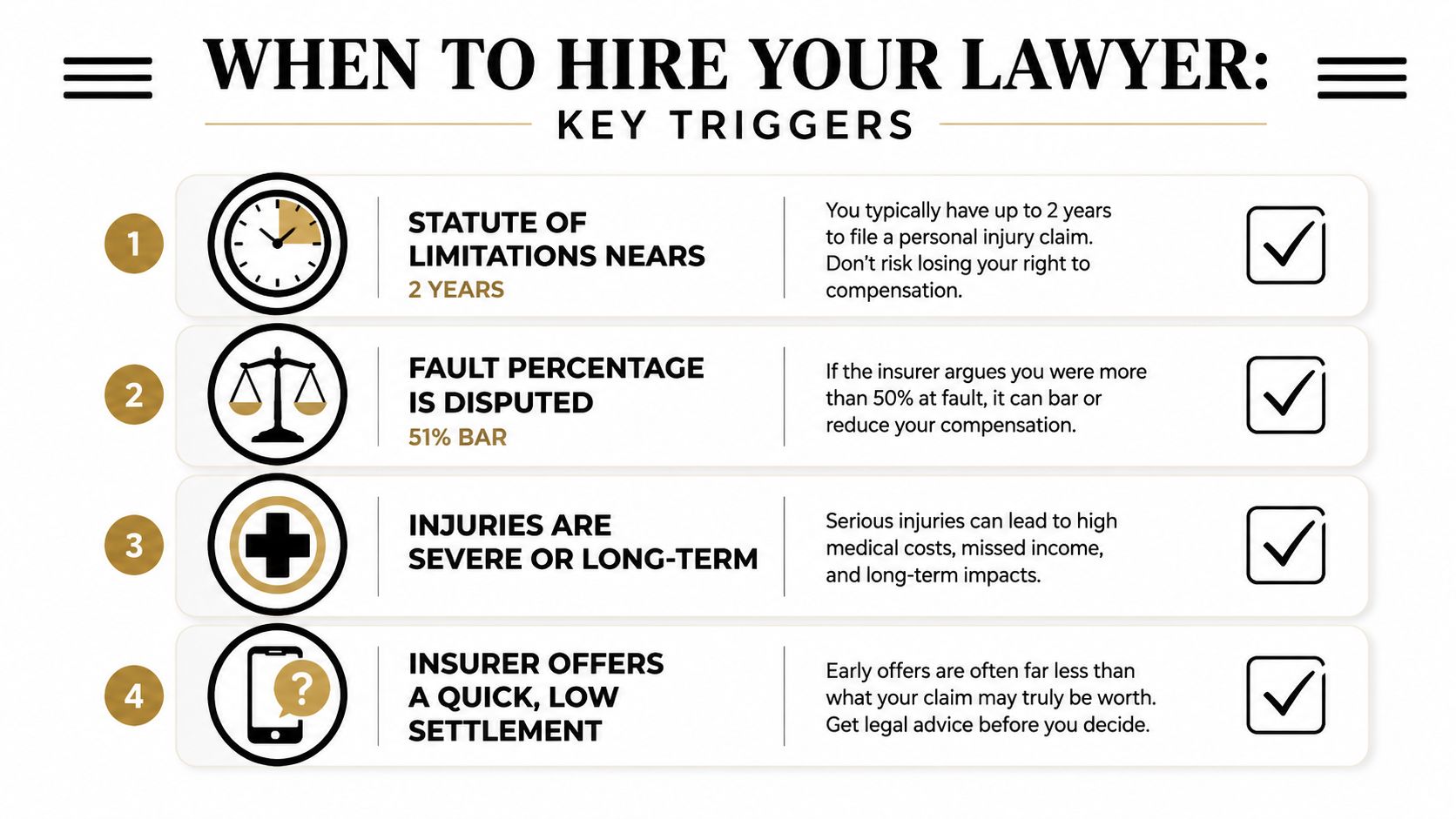
Contact a lawyer early when the injuries are serious, the fault is disputed, a child is involved, the cart may have a defect, or a business or government entity controlled the location. A golf cart accident lawyer Texas families hire should investigate before the cart is repaired, surveillance is overwritten, maintenance records disappear, or witnesses forget key details.
Texas personal injury claims generally have a two-year statute of limitations under Texas Civil Practice and Remedies Code § 16.003. Most injured people must file suit within two years of the injury date or lose the right to seek court-ordered compensation. The deadline and its practical consequences are explained in the Texas two-year deadline for injury claims.
What to look for in a lawyer
Ask whether the attorney handles personal injury cases involving negligence, premises liability, defective products, wrongful death, and disputed insurance coverage. Ask who will investigate the cart, scene, maintenance history, roadway rules, and medical evidence. A serious case may require accident reconstruction, engineering, medical, or vocational professionals.
A contingency-fee agreement generally means the firm's fee is paid from a recovery rather than charged upfront, but the written agreement should explain the percentage, case expenses, and what happens if there is no recovery. Don't sign anything you don't understand.
Red flags during a consultation
Be cautious if a lawyer guarantees an outcome, pressures you to settle immediately, refuses to explain the fee arrangement, or treats a child's injury as a routine claim. You deserve direct answers about evidence, deadlines, possible defendants, insurance policies, and the risks of litigation.
A free consultation can help you decide whether you need representation now. Don't wait for an adjuster's deadline or a serious diagnosis to force the decision.
What to Expect From the Claims and Litigation Process
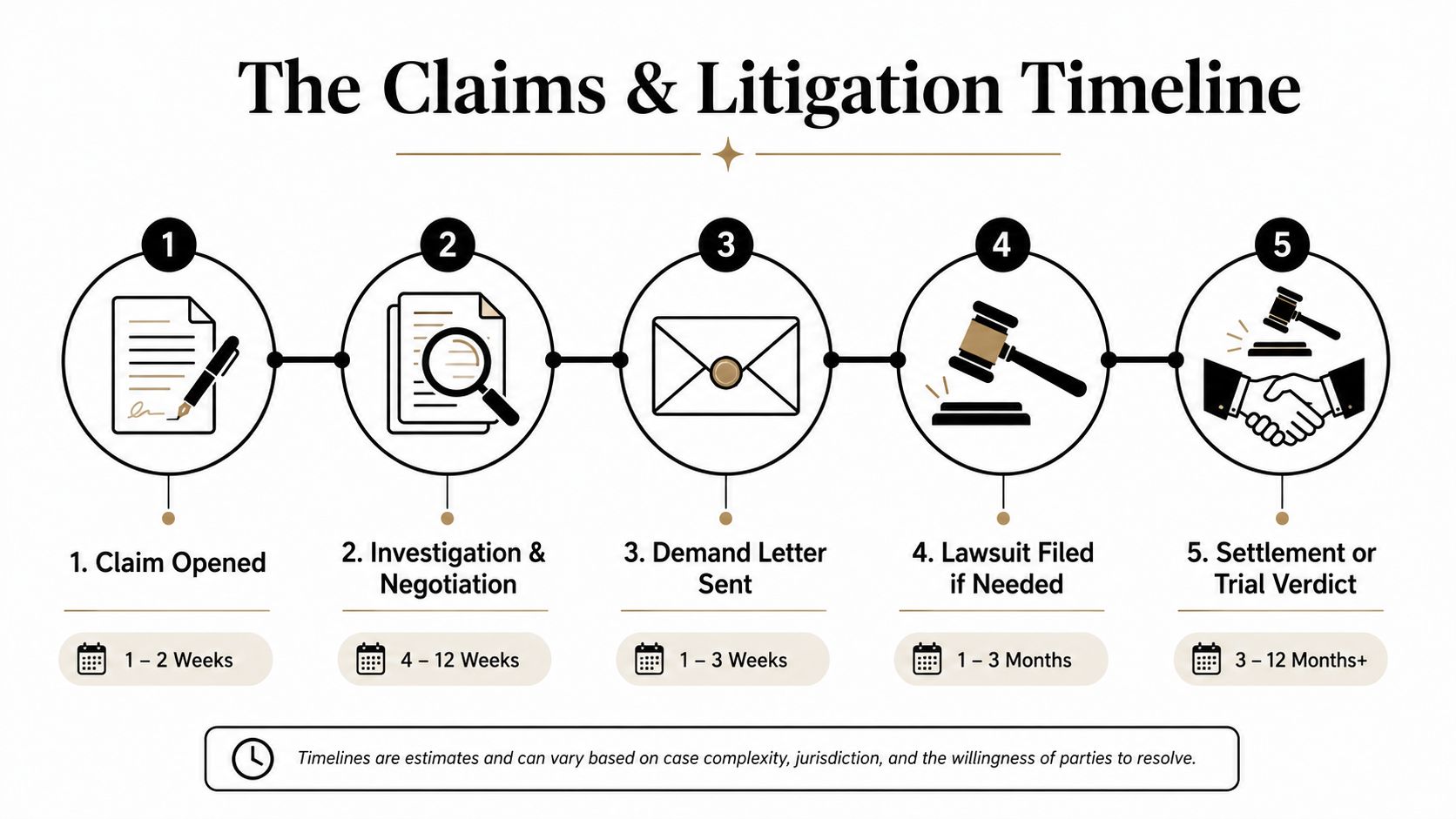
A claim usually begins with investigation. Your lawyer gathers the crash report, medical records, photographs, witness information, property records, cart ownership and maintenance documents, and available insurance policies. The firm may then prepare a demand package that explains liability, treatment, current losses, future needs, and the amount requested.
The insurer may investigate independently, question the extent of your injuries, argue that you share fault, or offer less than the evidence supports. Don't treat an early offer as the value of the case. It may arrive before doctors know whether you need additional treatment or whether your limitations will last.
When negotiation doesn't resolve the claim
Many cases resolve through negotiation. If the parties can't reach a fair agreement, your attorney may file a petition in the appropriate Texas court. The case can then involve written discovery, document requests, depositions, expert work, and mediation before a jury trial.
A straightforward property-damage dispute may move faster than a serious injury claim. A wrongful death or defective product case that proceeds to trial can take 18 to 30 months, while an uncontested property-damage settlement may take a few months, depending on the evidence and disputes. Those time ranges are practical descriptions, not guarantees.
For a fuller explanation of the stages, review the Texas personal injury claim process. You can also watch this related educational video:
If your case involves a vehicle collision, the same investigation may connect you with a Houston car accident attorney, a truck crash lawyer in Houston, or counsel experienced in catastrophic injury claims. The firm also handles catastrophic injury cases and related motor-vehicle matters when the harm extends far beyond a temporary injury.
The Law Office of Bryan Fagan, PLLC offers free consultations and contingency-fee representation for Texas golf cart injury, wrongful death, and serious motor-vehicle claims, so you can discuss your options before making an insurance decision. Visit Law Office of Bryan Fagan, PLLC to schedule a confidential case review, preserve evidence, and get clear guidance about your deadline and potential sources of recovery. Recovery is possible, and legal help is available when you're ready to take the next step.