A serious accident can change your life in seconds, but you don't have to face it alone. You may be juggling medical appointments, missed paychecks, and calls from an adjuster who suggests you caused part of the crash. Understanding how a jury assigns responsibility can help you make informed choices before you accept a settlement or go to trial.
What CPRC 33.003 Asks the Jury to Decide
Say you're changing lanes on I-10 in Houston during rush hour when a pickup clips your car. You're injured, but the pickup driver says you moved without checking your mirror. You want to know whether the jury can blame you, too.
Yes, the jury can consider your conduct alongside everyone else's. The jury charge is the judge's written set of questions and instructions. Jurors answer responsibility questions on designated lines, based on admitted evidence rather than guesses about who probably caused the crash.
Who Can Receive a Percentage Under Section 33.003
| Party | Who This Is | Houston Freeway Example | Can Receive a Percentage? |
|---|---|---|---|
| Claimant | The injured person suing for damages | The driver accused of changing lanes without checking the mirror | Yes; responsibility above the recovery threshold bars recovery |
| Defendant | The party being sued | The pickup driver who struck the car | Yes; ordinarily responsible for its allocated share, subject to other liability rules |
| Settling person | Someone who settled before trial | A trucking company whose insurer paid a pretrial settlement | Yes, when supported by evidence; settlement doesn't automatically remove the company |
| Designated responsible third party | A non-party formally designated through a motion | An absent vehicle owner accused of failing to service the brakes | Yes, but only with a proper designation and supporting evidence |
The 51-percent bar generally prevents recovery when your responsibility exceeds 50 percent; at 50 percent or less, your damages are reduced by your share, as the Texas Supreme Court's explanation of Chapter 33 describes.
For a hypothetical verdict finding $100,000 in damages and assigning you 20 percent responsibility, the remaining award would be $80,000, assuming the defendant bears the rest and no other adjustment applies. These are illustrative figures, not an estimate of your case's value.
Negligence means failing to use reasonable care, causing legally compensable harm. Proportionate responsibility, sometimes called comparative responsibility, compares the supported conduct of the people involved. An insurer's accusation isn't itself proof.
The jury assigns whole-number percentages separately for each applicable cause of action. Your attorney must connect the names, claims, and evidence before the judge decides which questions belong in the charge.
How to Request and Submit Percentage Questions to the Jury
Percentage questions are built months before trial, through pleadings, discovery, and decisions about which people or companies belong in the case. Every choice during that period, from which records your lawyer requests to which names appear in the proposed charge, moves the numbers the jury will eventually write down.
The controlling safeguard appears in Texas Civil Practice and Remedies Code §33.003: a responsibility question cannot be submitted about a person without sufficient supporting evidence. The statute requires whole-number allocations for each cause of action and reaches negligent conduct, defective products, and other violations of applicable legal standards.
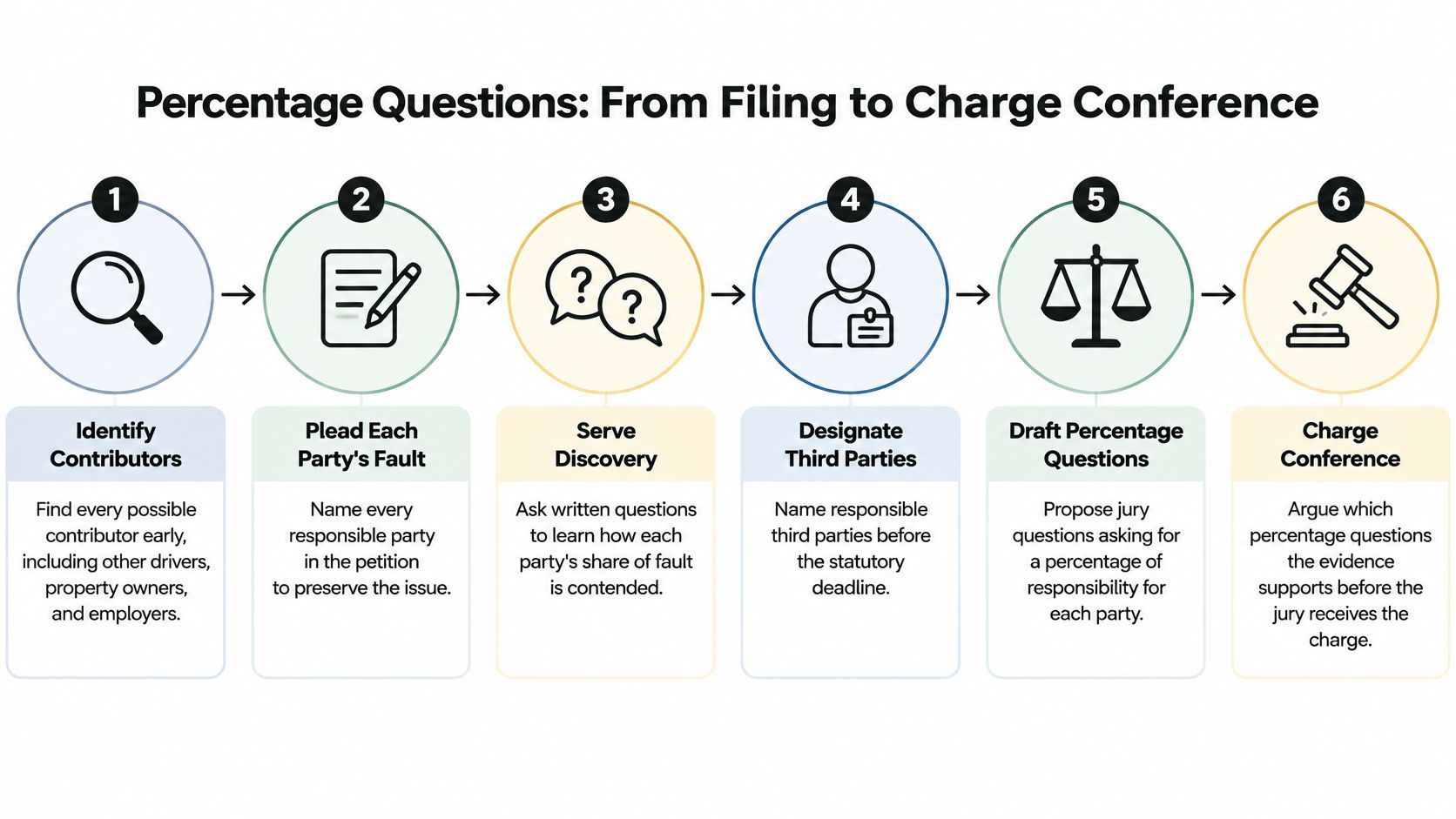
Build the Submission From the Beginning
Identify possible contributors early. Your lawyer should evaluate other drivers, employers, vehicle owners, maintenance contractors, and manufacturers when the facts support doing so. Naming a possible contributor is only the first step; the evidence still has to connect that person's conduct to the harm.
Address non-party designations promptly. Texas Civil Practice and Remedies Code §33.004 generally requires a defendant to move to designate a responsible third party at least 60 days before trial, unless the court permits a later motion for good cause. Designating someone and suing them are separate steps, and the firm's guide to responsible third-party designation in Texas walks through that distinction.
Tie each proposed name to specific conduct. A maintenance record showing neglected brakes may support an allegation that a vehicle owner contributed to the injury. Title documents standing alone carry far less weight, because the question is what that person did or failed to do.
Match the questions to the actual claims. Counsel should request the allocations required for each applicable cause of action. Gross negligence and exemplary damages require their own careful charge analysis, not an automatic duplicate percentage question.
Check settling parties against the evidence. Your attorney should confirm whether each settling person belongs in the allocation. The correct name is the person or company whose conduct contributed to the harm; an insurer that issued payment does not belong on the list by itself.
Tender a written proposed charge. Counsel should submit substantially correct questions, instructions, and verdict lines by the court's deadline. Under Texas Rule of Civil Procedure 278, the pleadings and evidence determine what questions the court must submit.
Make specific objections on the record. At the charge conference, your lawyer should identify the challenged language, explain the legal or evidentiary problem, and obtain a ruling. A written charge on file preserves some complaints, while oral objections tailored to the court's exact wording protect others.
The process connects early investigation with the questions jurors eventually receive.
Keep Settlement and Trial Preparation Connected
The Texas Personal Injury Settlement Process explains what to expect from demand through settlement or trial. Settlement discussions and charge preparation often overlap, so counsel should evaluate a proposed release before deciding how it affects the remaining case.
Practical rule: A proposed percentage needs more than a name on paper. It needs a legally proper submission supported by evidence.
A judge won't add an unsupported person just because an attorney mentions that person during closing argument. The paperwork and proof must support the requested allocation.
Sample Verdict Form Language for Percentage Questions
A verdict form splits the jury's work into separate jobs. One question asks who was negligent and whether that negligence caused the occurrence. Another asks for percentages. A third asks for the dollar value of the harm.
That separation keeps jurors from choosing percentages merely to reach a preferred payout. The wording below is an educational illustration, not an approved Texas pattern charge, and your trial attorney must use legally correct language suited to the claims and evidence.
Read Each Question for Its Separate Job
"Did the negligence of each person named below proceed from a cause of the occurrence? Answer Yes or No for each."
This proposed wording attempts to combine negligence and causation, but "proceed from a cause" is not a reliable substitute for proper proximate-cause wording. Counsel should adapt the applicable Texas pattern question asking whether each person's negligence proximately caused the occurrence or injury.
"What percentage of responsibility for the occurrence do you assign to each of the following persons? Answer in whole numbers. The total must equal 100 percent."
This question allocates responsibility among the people the charge makes eligible, and the court's instructions control which names appear. Those names reflect fights already won or lost: each line on the form is a percentage someone argued for or against long before deliberations began. A responsible-third-party line doesn't, by itself, order that non-party to pay you.
Building Blocks of a Percentage Verdict Form
| Question | Sample Wording | Purpose |
|---|---|---|
| Liability question | Did the negligence of each person named below proceed from a cause of the occurrence? Answer Yes or No for each. | Intended to address negligence and causation; requires correction before courtroom use |
| Percentage question | What percentage of responsibility for the occurrence do you assign to each of the following persons? Answer in whole numbers. The total must equal 100 percent. | Sets the allocation required by the statute |
| Allocation lines | Claimant ___ percent; Defendant ___ percent; Settling Person [name] ___ percent; Designated Responsible Third Party [name] ___ percent | Gives jurors one blank for each person the charge makes eligible, including a supported pretrial settler |
| Damages question | What sum of money would fairly compensate the claimant for each element of damages? | Determines damages separately from responsibility |
"What sum of money would fairly compensate the claimant for each element of damages?"
Jurors determine supported damages without making their own responsibility deduction. The court later applies the governing reductions and credits.
Proper instructions also direct jurors to consider eligible conduct that caused or contributed to the harm, without using the damages amount to choose responsibility percentages. In a hypothetical Austin motorcycle case, a road-maintenance contractor might receive a line only after the necessary procedural and evidentiary requirements are met.
Wording failures surface as contradictions inside the verdict itself. Under the misworded liability question above, a juror who believes the defendant was careless but not a proximate cause has no clean answer. That juror might answer No to the combined question and still write a percentage beside the defendant's name, producing a form that says the defendant caused nothing and yet bears part of the responsibility. Separated negligence and causation questions give that juror a coherent path and keep a supported verdict from collapsing on review.
Objections and Evidence That Protect Your Claim
An alleged trailer brake failure sits at the center of a San Antonio I-35 collision case. At the charge conference, the defense asks jurors to assign responsibility to an absent trailer owner, yet the record holds no maintenance records, no testimony, and no expert analysis connecting that owner's conduct to the failure. Your attorney objects and explains the missing causal link. If the judge agrees, the unsupported line comes off the verdict form.
The record decides that fight. Absence from court alone does not disqualify a party, because a trailer owner whose conduct was properly pleaded and supported could still take a percentage line without ever appearing. What removes the line is the gap between the allegation and the proof, and closing that gap starts long before trial.
Preservation work should begin while you are still receiving medical care, not when trial approaches. Within days of the crash, counsel should consider preservation letters to the other driver, employer, insurer, and anyone controlling relevant records or vehicles. Your attorney should obtain the official crash report and seek access to the vehicle's event data recorder before repair or salvage destroys useful information. Dashcam footage, scene photographs, witness names, relevant phone records, and medical records can establish both how the collision happened and how it injured you.
Match the Evidence to the Allegation
A preservation letter identifies material that should not be destroyed. It does not automatically obtain that material or guarantee access, so your attorney may need discovery requests, an inspection agreement, or court intervention.
Each piece of proof has to land on a specific name on the verdict form. In the I-35 case, a supported trailer-owner line would have required the same categories of evidence the defense lacked: records, testimony, or expert analysis tying the owner's conduct to the brake failure. When that support exists, a settling or absent party can absorb part of the allocation. When it does not, the percentage stays with the people whose conduct the evidence actually reaches.
Objections and When to Raise Them
Objections do not end when the jury retires. Two later windows still protect the allocation.
| Objection | Raise It When | What It Protects |
|---|---|---|
| Conflicting jury answers | Before the jury is discharged | Preserves the opportunity to seek clarification or further deliberation |
| Insufficient evidence after verdict | Appropriate post-verdict motion, including a motion for new trial or judgment notwithstanding the verdict | Preserves applicable sufficiency complaints for review |
Specificity matters at every stage. Saying that a question is unfair doesn't identify the legal defect. Counsel should explain which name, instruction, or missing element creates the problem and obtain a ruling.
An objection the court never hears usually cannot protect you in the same way as a timely, specific objection on the record.
Post-verdict remedies also differ. Factual-sufficiency complaints generally require a motion for new trial, while legal-sufficiency challenges may support a judgment notwithstanding the verdict when properly preserved. Counsel must select the procedure that matches the alleged error.
By the time jurors see the percentage question, much of the allocation is already shaped. Each preserved record, each timely objection, and each removed line determines whose conduct the jury gets to weigh.
How Percentages Change Your Damages
A $500,000 verdict produces very different recoveries depending on one percentage. Hold the damages figure constant and move only the responsibility allocation, and the math shows why proof of fault matters as much as proof of medical bills.
The Texas Supreme Court's April 2025 Werner Enterprises decision reinforces the breadth of conduct contributing "in any way" to the harm. Supported conduct may enter the comparison even when it wasn't the immediate cause of the collision.
Recovery From the Defendant on a $500,000 Verdict
These are illustrative calculations, assuming one defendant, no additional liable party, and no settlement-credit reduction except where settlement is discussed.
| Claimant Share | Defendant Share | Settling Person Share | Recoverable From Defendant |
|---|---|---|---|
| 0% | 100% | 0% | $500,000 |
| 20% | 80% | 0% | $400,000 |
| 49% | 51% | 0% | $255,000 |
| 51% | 49% | 0% | $0, claimant barred |
| 10% | 60% | 30% | $300,000 as the defendant's allocated share, not necessarily the final judgment |
The first four rows isolate your share of the harm. The final row adds a settling person, and that scenario runs through a credit calculation before any judgment is entered.
The firm's explanation of the Texas fifty-one-percent bar and proportionate responsibility addresses why a small change near the recovery threshold can have a substantial effect.
A Settlement Requires a Separate Calculation
Work the final row step by step. The jury's $500,000 drops first by your 10 percent share, leaving $450,000 in recoverable damages. The settling person's 30 percent then generates a credit under CPRC §33.012: the nonsettling defendant receives a credit equal to the greater of the dollar amount paid in settlement or the settling person's percentage applied to the damages. Thirty percent of $500,000 is $150,000, so if the settlement paid $150,000 or less, the percentage credit controls. Subtracting it leaves $300,000, the figure in the table's last column. A settlement that paid more than $150,000 would shrink that number further.
Under CPRC §33.013, a defendant assigned more than 50 percent responsibility can generally face joint and several liability for recoverable damages. Joint and several liability still leaves your own share of fault on your side of the ledger, and statutory exceptions can also matter.
Ask for the judgment calculation, not just the percentage calculation. A responsibility table is a planning tool; the judgment is what a defendant can actually be ordered to pay.
Percentages are built long before the verdict. Each evidence choice, designation decision, expert disclosure, and charge objection pushes the allocation in one direction or the other, which is why the same $500,000 finding produces $500,000 at zero percent claimant responsibility, $255,000 at 49, and nothing at 51.
Your lawyer should model these allocations alongside insurance limits, collectability, settlement offers, and causation proof. A large damages finding can still yield limited recovery when coverage is thin or the proof supports a damaging allocation, and a clear model shows whether an offer fairly accounts for those risks.
What Your Attorney Should Do and What to Expect
Your attorney should give you a clear plan, explain who handles each task, and identify the deadlines that affect your rights. You should not have to understand court procedure before asking for help.
A consultation is also a chance to discuss your treatment, work restrictions, and concerns about the insurance process. Ask how the evidence gathered in the first weeks could move the responsibility number. On a large claim, a shift from 49 to 51 percent claimant responsibility is the difference between a reduced recovery and none.
What Your Lawyer Should Handle
During the first 30 days, a useful planning checklist includes confirming preservation efforts, reviewing coverage, evaluating possible contributors, and calendaring filing and designation deadlines. Treat that window as a management target, since some investigations take longer.
Counsel should examine liability coverage and any uninsured or underinsured motorist coverage, rather than assuming the other driver's policy is the only potential source of payment. If you are in Houston, a local car accident attorney can explain when trucking logs, employment records, and company policies may affect the case.
Texas personal injury claims generally have a two-year filing deadline under CPRC §16.003, though exceptions and different claim requirements can change the analysis. The statute of limitations sets the deadline for filing suit. Reporting the crash to an insurer does not satisfy it, and settlement negotiations generally do not pause it.
Ask your lawyer to identify your actual deadline in writing. A wrongful-death claim, government-related claim, or case involving unusual circumstances needs individualized review.
What You Can Do While the Case Progresses
A few steady habits protect both your credibility and your claim:
- Handle adjuster calls carefully. Before giving the opposing insurer a recorded statement, ask counsel whether it's necessary and how to respond truthfully without guessing.
- Keep a simple journal. Record pain, missed work, treatment appointments, and activities you can't perform.
- Save receipts and notices. Keep medical invoices, transportation expenses, wage records, and insurance correspondence together.
- Review releases before signing. A release can end claims you didn't realize you were resolving.
For planning purposes, investigation and early demands may take one to three months, litigation may take a year or more, and jury deliberations may last days. Treat those as rough scheduling ranges, not predictions about your case.
The charge conference ordinarily occurs after the evidence closes and before closing arguments. That is where your attorney objects to how the responsibility question is worded, and those objections can shape which percentage the jury writes next to your name. The firm's guide to what happens when a Texas injury case goes to trial explains the broader courtroom sequence.
The video below follows that same sequence, showing where the charge conference and the verdict form fit within a trial.
Each of these steps feeds the same verdict form. The preservation letter sent in week one and the objection raised at the charge conference both help decide the percentage that controls your recovery.
When to Call a Texas Personal Injury Lawyer
Call before responsibility becomes a disputed line on the verdict form. If an adjuster says you were partly at fault, you deserve an explanation of what evidence supports that accusation and what evidence may answer it.
You should also seek advice when a party offers to settle while others remain involved. A release can affect the remaining claims, and the offered amount may not reflect your future medical needs.
Signs That You Need Individual Advice
- A company vehicle was involved. Employment relationships and business records may identify additional claims or coverage.
- A loved one died. Families searching for a wrongful death lawyer Texas residents can consult need guidance about eligible claimants, losses, and deadlines.
- Your injuries require long-term care. A catastrophic injury claim requires careful attention to future treatment, assistance, and earning capacity.
- The insurer disputes coverage. Uninsured or underinsured motorist issues may require a separate policy analysis.
Managing Attorney Bryan Fagan leads a team serving Houston, Dallas–Fort Worth, Austin, San Antonio, and surrounding communities. Through the firm's personal injury website, you can request information about car accidents, truck crashes, wrongful death, catastrophic injuries, and representation by a Texas personal injury lawyer.
A first consultation can address how the crash happened, your treatment, available coverage, disputed fault, and approaching deadlines. Consultations are free, and the firm offers contingency-fee representation, meaning no attorney's fees unless it wins; your written agreement should explain expenses and other terms.
You don't need a complete evidence file before calling. Bring what you have, explain what worries you, and ask what needs attention first.
Law Office of Bryan Fagan, PLLC offers free consultations and contingency-fee representation to help injured people understand disputed responsibility and its effect on compensation. Visit Law Office of Bryan Fagan, PLLC to schedule a free consultation through the website's form and discuss your evidence, deadlines, and next steps. Recovery is possible, and legal help is available, even when fault is disputed.