Skip to content

Moderate whiplash cases in Texas often settle between $15,000 and $50,000, but there isn't one official average for every claim. Your result depends heavily on things you can influence, especially how quickly you get treatment, how well you document your injury, and how effectively you push back against insurance company tactics.
An Accident Can Change Your Life But You Are Not Alone
A serious accident can change your life in seconds, but you don't have to face it alone.
After a Houston freeway crash, many people walk away thinking they're lucky. The cars can still move. The airbags may not deploy. You tell the officer you feel shaken up, but mostly fine. Then the next morning hits. Your neck is stiff, your lower back is burning, and turning your head to check a blind spot suddenly feels impossible.
That's where soft tissue claims get difficult. The injury feels real because it is real, but the insurance company often treats it like a small inconvenience instead of a serious disruption to your life. Meanwhile, medical bills start arriving, work gets harder, and the adjuster sounds friendly while building a case to pay you less.
What many victims are dealing with right now
You may be in that spot today:
- Pain that got worse later: Whiplash, back strain, shoulder strain, and deep bruising often become more obvious after the adrenaline wears off.
- Pressure from insurance: An adjuster may ask for a recorded statement before you even understand your diagnosis.
- Confusion about value: You want to know what a fair soft tissue injury settlement in Texas looks like, but every website seems to give a different answer.
- Worry about fault: You may wonder whether one small mistake on your part could ruin the claim.
Soft tissue cases are often won or lost by what happens in the first days and weeks after the crash, not just by how badly you were hurt.
Texas personal injury law gives you a path to recover damages when another driver's negligence caused your injury. That includes claims involving cars, commercial vehicles, and fatal wrecks that may require a wrongful death lawyer Texas families can trust. Whether you need a car accident lawyer, support after a commercial collision that may call for a truck crash lawyer Houston families turn to, or help after a devastating loss, the first step is understanding how the system works and how insurers try to control it.
What Is a Soft Tissue Injury and Why Is It Hard to Value
A soft tissue injury affects the body's muscles, ligaments, and tendons rather than the bones. In car crashes, common examples include whiplash, neck strain, back strain, and deep bruising. These injuries can cause major pain and limited movement even when an X-ray looks normal.

Why insurers challenge these claims
Insurance companies prefer injuries they can point to on a scan. A fracture is easy to show. A torn or inflamed soft tissue structure often isn't. That gap gives adjusters room to argue that you're exaggerating, that your treatment was unnecessary, or that the pain came from something else.
That doesn't mean the law is against you. Texas law explicitly allows compensation for soft tissue injuries without requiring fractures or surgery, focusing instead on whether negligence caused measurable damages including economic losses and non-economic losses (soft tissue injury compensation under Texas law).
What actually helps prove the claim
The strongest soft tissue case is usually the best-documented one. If you tell a doctor right away where it hurts, return for follow-up care, and keep a clear timeline of symptoms, you make it harder for an insurer to dismiss the injury as vague or unrelated.
A few practical records matter more than people realize:
- Doctor notes and diagnoses: These connect the crash to your symptoms.
- Treatment plans: Physical therapy, medication, and follow-up visits show the injury required real care.
- Photos: Bruising, swelling, and visible limitations can help.
- A daily journal: Write down pain levels, sleep disruption, missed activities, and work limitations.
- Organized records: If you want a simple way to keep your paperwork readable, resources that simplify medical report formats can make it easier to track visits, diagnoses, and restrictions.
The insurance company doesn't experience your pain. It evaluates your file. If your file is thin, the offer usually is too.
Fault and negligence still matter
Texas follows a fault-based system. That means you must show another party's negligence caused the crash and your injury. In plain English, negligence usually means a driver failed to act with reasonable care, such as following too closely, speeding, or driving distracted.
That's why the injury itself is only part of the claim. The other half is proving how the collision happened and tying your physical limitations back to that event.
How Texas Calculates Your Soft Tissue Injury Settlement
Texas insurers usually start with a simple question after a crash: what can they point to on paper, and what can they argue down? That is why settlement value is rarely just about the diagnosis. It is about how well the claim is built from day one, and how effectively you answer the insurer's pushback.

Economic damages come first
The first layer is economic damages. These are the financial losses tied to the collision, and they usually set the floor for settlement talks.
They can include:
- Medical expenses: ER visits, urgent care, follow-up appointments, physical therapy, prescriptions, and related treatment
- Lost wages: Income you missed because the injury kept you from working
- Property damage: Vehicle repairs or replacement costs tied to the crash
This part sounds straightforward. In practice, insurers still look for openings. Missing bills, incomplete work records, and unclear treatment dates give the adjuster room to say the losses are overstated or unrelated. A claim gets stronger when every charge, missed shift, and out-of-pocket cost is collected early and organized before negotiations begin.
Non-economic damages are where the real fight usually happens
Non-economic damages cover pain, mental anguish, and physical impairment. In soft tissue cases, this is often the most disputed part of the claim because there may be no cast, no surgery, and no dramatic scan for the adjuster to wave around.
Texas claims often use a per diem approach or a multiplier approach to estimate these losses. One published Texas source notes that insurers often apply a low multiplier in soft tissue cases and frequently begin with modest offers, especially when they believe they can characterize the injury as minor (Texas soft tissue settlement valuation and lowball offers).
The practical issue is not the formula by itself. It is who controls the story behind the formula.
If the file shows steady treatment, medical restrictions, missed work, and daily limitations, the claim supports a higher value. If the file shows treatment gaps, mixed statements, or an early release from care, the insurer will use that to push the number down. In many Texas whiplash injury settlement claims, that dispute becomes the center of the case.
A short explainer can help:
How the insurance playbook affects the math
After a rear-end crash or a freeway collision, adjusters often use the same pressure points. They may argue the property damage was minor, suggest your treatment lasted too long, or say your pain complaints are too subjective to justify more money. Those arguments are designed to reduce both the medical portion of the claim and the pain-and-suffering value.
Good cases answer those arguments with proof.
- Consistent treatment: Following the treatment plan shows the injury required real care.
- Clear functional limits: Notes about trouble sleeping, driving, lifting, working, or caring for your children make the loss concrete.
- Medical support: Doctor opinions, therapy records, and restrictions help connect the crash to your ongoing symptoms.
- Strong liability evidence: Police reports, photos, witness statements, and crash details leave less room for blame-shifting.
A few mistakes can lower value fast:
- Long gaps in treatment
- Downplaying symptoms to doctors or adjusters
- Giving a recorded statement too early
- Accepting a quick offer before the recovery picture is clear
I tell clients the same thing all the time. Insurance companies do not pay more because an injury sounds painful. They pay more when the records, timeline, and daily impact make it hard to deny what the crash cost you.
That is how Texas calculates these cases in practice. Part arithmetic, part persuasion, and often a direct response to the insurer's attempt to minimize the claim.
Typical Settlement Ranges for Texas Soft Tissue Injuries
There's no fixed average that applies to every person. The more useful question is where your injury falls on the severity spectrum and whether your records support that category.
Published Texas guidance states that moderate whiplash cases requiring several weeks of physical therapy typically settle between $15,000 and $50,000, while minor neck strains healing with rest may settle for $2,500 to $10,000, and severe back strains or herniated discs with long-term effects can reach $100,000 or more (Texas soft tissue settlement ranges by severity).
Sample Texas Soft Tissue Injury Settlement Ranges
| Injury Severity | Description | Typical Settlement Range |
|---|---|---|
| Minor | Neck strain or similar injury that improves with rest and limited care | $2,500 to $10,000 |
| Moderate | Whiplash with ongoing symptoms and several weeks of physical therapy | $15,000 to $50,000 |
| Severe | Serious back strain or herniated disc with long-term effects | $100,000 or more |
Why two similar injuries can settle differently
A range is not a promise. One person with whiplash may recover steadily and return to work quickly. Another may need extended therapy, struggle to sleep, and lose income. Those are not the same cases, even if both started with rear-end collisions.
Don't measure your claim by the label alone. Measure it by the treatment required, the disruption to your life, and the quality of the proof.
If your injuries involve neck trauma, this overview of a whiplash injury settlement can help you compare your situation to the kinds of issues that often affect claim value.
Key Factors That Change Your Settlement Amount
A rear-end crash can leave two drivers with the same whiplash diagnosis and very different settlement results. One has prompt treatment, clear records, and a steady recovery plan. The other waits three weeks, misses therapy, and gives the adjuster broad statements over the phone. Insurance companies use those differences to argue that one claim is worth far less.
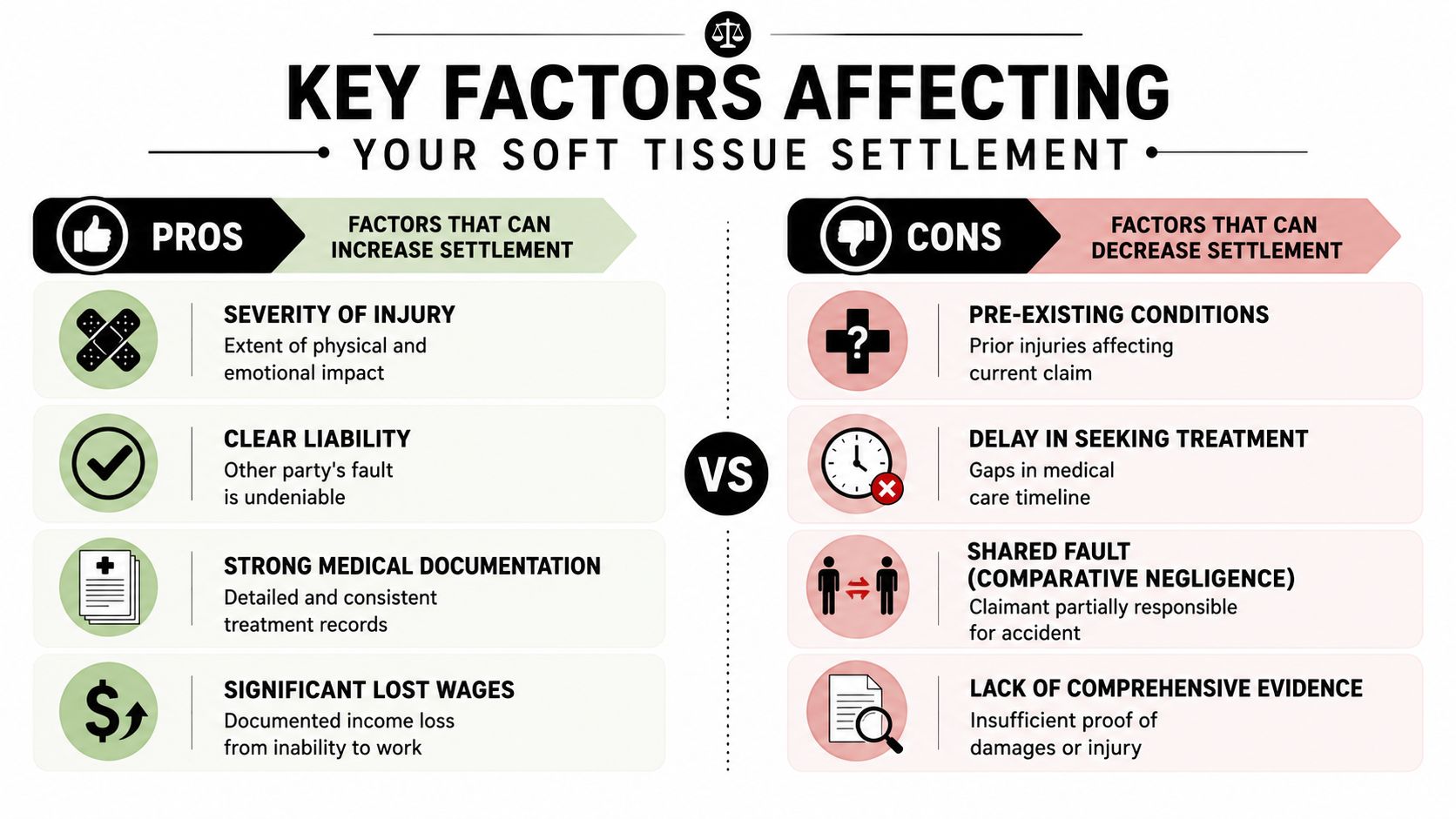
The biggest value drivers are not mysterious. They are proof, consistency, and how much room the insurer has to question causation, severity, or fault.
What helps your claim and what hurts it
Insurance adjusters look for gaps they can use. Start closing those gaps on day one.
- Get medical care quickly: Early treatment ties your symptoms to the wreck and makes it harder for the carrier to argue that something else caused your pain.
- Follow the treatment plan: If a doctor recommends imaging, medication, or therapy, follow through unless another doctor changes the plan. Gaps in care often become a centerpiece of the insurer's defense.
- Report symptoms in plain detail: Tell your providers what movements hurt, how the pain affects sleep, driving, work, lifting, or caring for your kids. Those details often matter more than the diagnosis label.
- Keep records organized: Save visit summaries, prescriptions, work notes, receipts, and mileage to appointments. A well-documented file gives the adjuster less room to minimize the claim.
- Stay cautious with social media: A single photo from a family outing can be used out of context to argue that you are fully recovered.
- Be careful with recorded statements: Adjusters are trained to ask questions that pin you down early, before the full injury picture is clear.
Treatment choices matter too. Physical therapy often does more than help you recover. It can also show that the injury required ongoing care and limited your daily function. This explanation of how physical therapy can affect an injury settlement gives a useful example.
Fault disputes can shrink a good case
Texas follows a proportionate responsibility rule. If the defense can convince a jury that you carry too much of the blame, your recovery can be reduced or barred entirely. That is why adjusters so often push early on speed, following distance, lane changes, distraction, or whether you "could have avoided" the collision. The Texas Civil Practice and Remedies Code explains how percentage fault affects recovery in personal injury cases under Chapter 33 (Texas proportionate responsibility law).
This shows up in small moments. "I looked down for a second." "I may have stopped short." "I felt okay at first." Innocent comments can later be framed as admissions that you caused the crash or exaggerated the injury.
Policy limits, medical records, and credibility all matter
Sometimes the main limit on a settlement is not the injury. It is the insurance available to pay it. Texas drivers must carry minimum liability coverage for bodily injury and property damage, and those limits can cap the first source of recovery unless other policies apply, according to the Texas Department of Insurance (Texas minimum auto liability coverage requirements).
Credibility matters just as much.
If your records show consistent complaints, your treatment matches your symptoms, and your daily life reflects the restrictions you report, your case becomes harder to discount. If your story changes, appointments are missed, or your activities seem inconsistent with your claimed limits, the insurer will press that point.
A strong soft tissue claim is built, not assumed. The people who do best are usually the ones who treat early, document carefully, and get legal help before the insurance company defines the case for them.
Your Legal Deadlines and First Steps to Take
Time matters in every injury case, but it matters even more when the injury is easy for insurers to downplay.
Texas law imposes a strict two-year statute of limitations for car accident injury claims, which means you must settle your claim or file a lawsuit within two years of the accident date to preserve your right to compensation (Texas two-year filing deadline for injury claims).
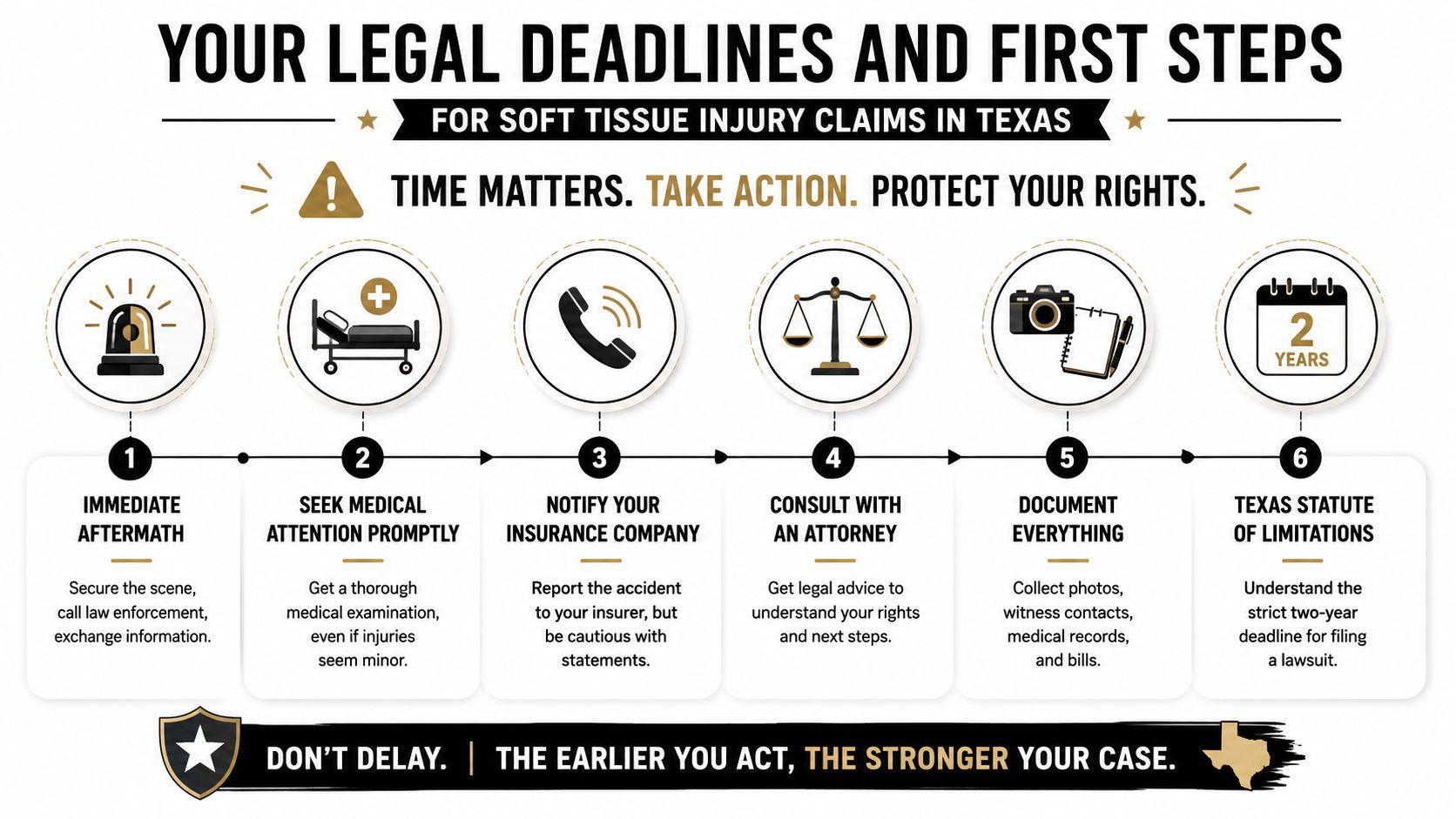
What to do in the first hours and days
After an Austin intersection crash or a San Antonio rear-end collision, the right steps can protect both your health and your case.
- Get medical care quickly. Even if the pain seems minor, early evaluation creates a record.
- Report the crash. A police report helps preserve the basic facts.
- Take photos if you can. Vehicle damage, bruising, swelling, and the scene can all matter later.
- Collect contact information. Witnesses can help if fault becomes disputed.
- Notify your insurer carefully. Give the basics, but don't guess about injuries or accept blame.
What not to do
Just as important, avoid the mistakes insurers count on.
- Don't give a recorded statement to the other driver's insurer before you understand your injuries.
- Don't minimize symptoms because you want to sound reasonable.
- Don't stop treatment early just because the adjuster suggests you should be feeling better by now.
- Don't throw away receipts, discharge papers, or prescription records.
Start a pain journal the same week as the crash. Small daily notes often become powerful evidence months later.
If you're unsure how the deadline applies in your situation, tools that help you find injury claim filing dates can provide general context, but Texas-specific legal advice matters when the facts are close or the insurer is delaying.
Why You Should Speak with a Texas Personal Injury Lawyer
A week after a crash, many injured Texans get the same call. The adjuster sounds friendly, asks for a recorded statement, and suggests the injury should have resolved by now because the vehicle damage looks minor. That is often the point when a soft tissue claim starts slipping off course.
A Texas personal injury lawyer helps stop that early. Soft tissue cases are often disputed because the injury does not show up on an X-ray, symptoms can worsen over time, and insurers know many people settle before they understand the full cost of treatment. A lawyer's job is to protect the claim before the insurance company defines it for you.
That work is practical. Your attorney can gather treatment records, line up photos and witness statements, organize wage-loss proof, and deal with the adjuster so you do not get boxed into a statement that hurts your case later. Just as important, a lawyer can identify the pressure tactics insurers use in these claims, such as arguing that you waited too long for care, had a preexisting condition, or should have stopped treatment sooner.
You should consider calling a lawyer if any of these problems show up:
- The insurer says your injury is minor or unrelated to the crash
- You are being blamed for causing part of the collision
- Your treatment is ongoing and you still do not know the full extent of your recovery
- The settlement offer covers bills but ignores pain, missed work, or daily limitations
- There are multiple vehicles, a company vehicle, or serious injuries involved
Good legal help also means making decisions at the right time. In some cases, settling quickly gets money in hand sooner but leaves unpaid treatment on the table. In others, waiting too long without a clear plan gives the insurer more room to argue that something else caused your symptoms. A lawyer helps you weigh those trade-offs with the facts of your case, not the insurance company's script.
Cost is often less intimidating than people expect. Many Texas injury lawyers work on a contingency fee, which means the fee is usually paid from the recovery rather than upfront. Ask direct questions before signing anything. Who pays case costs, how medical liens are handled, and what happens if the case settles early are all fair questions.
If you are still unsure about timing, general tools that help you find injury claim filing dates can give basic context, but a Texas lawyer can apply those rules to the facts of your crash and tell you what delay could cost you.
The Law Office of Bryan Fagan, PLLC offers free consultations for injured Texans and families who need clear answers about their rights, next steps, and options for pursuing compensation. Recovery is possible, and legal help can make it much harder for an insurer to undervalue what this crash has taken from you.