Skip to content

A serious accident can change your life in seconds, but you don't have to face it alone. A dog bite can leave you shaken, embarrassed, and unsure whether the wound is “bad enough” to matter legally. In Texas, the answer often turns on details that aren't obvious at first, like who knew the dog was dangerous, what records you kept in the first few days, and how quickly you reported the attack.
If you're searching for dog bite settlement Texas information right now, you probably want straight answers, not legal jargon. A settlement is built from proof, timing, and the facts of the attack, not just the size of the bite. The right paperwork, medical follow-up, and early reporting can make a real difference in how an insurer values your claim.
Facing a Dog Bite in Texas
A neighbor's dog lunges as you're walking past a driveway, and in a few seconds you're on the ground, trying to understand what just happened. Your clothes are torn, your hand is bleeding, and the owner keeps saying the dog has “never done that before.” That kind of moment leaves people confused, and it's common to feel pressured to brush it off or accept a quick apology.
What you do next is more significant than commonly understood. Texas dog bite claims turn on fault, documentation, and deadlines, so your first job is to protect your health and the paper trail at the same time. That means getting medical care, saving evidence, and learning how Texas law treats responsibility for the attack.
A claim is not just about pain. It's about whether the owner knew the dog was dangerous, whether the owner used reasonable care, and whether your injuries can be tied to the attack with medical proof. When those pieces come together, settlement discussions become much more serious.
If you're also dealing with a wider injury matter, a Texas personal injury lawyer can help you sort out whether your case belongs with a dog bite claim, a premises issue, or another injury claim. In some situations, people also need help with related accident work, like a car crash case or a broader injury review.
Practical rule: Treat the first day after a bite like evidence collection day, not just pain management day.
Texas Dog Bite Liability Standards
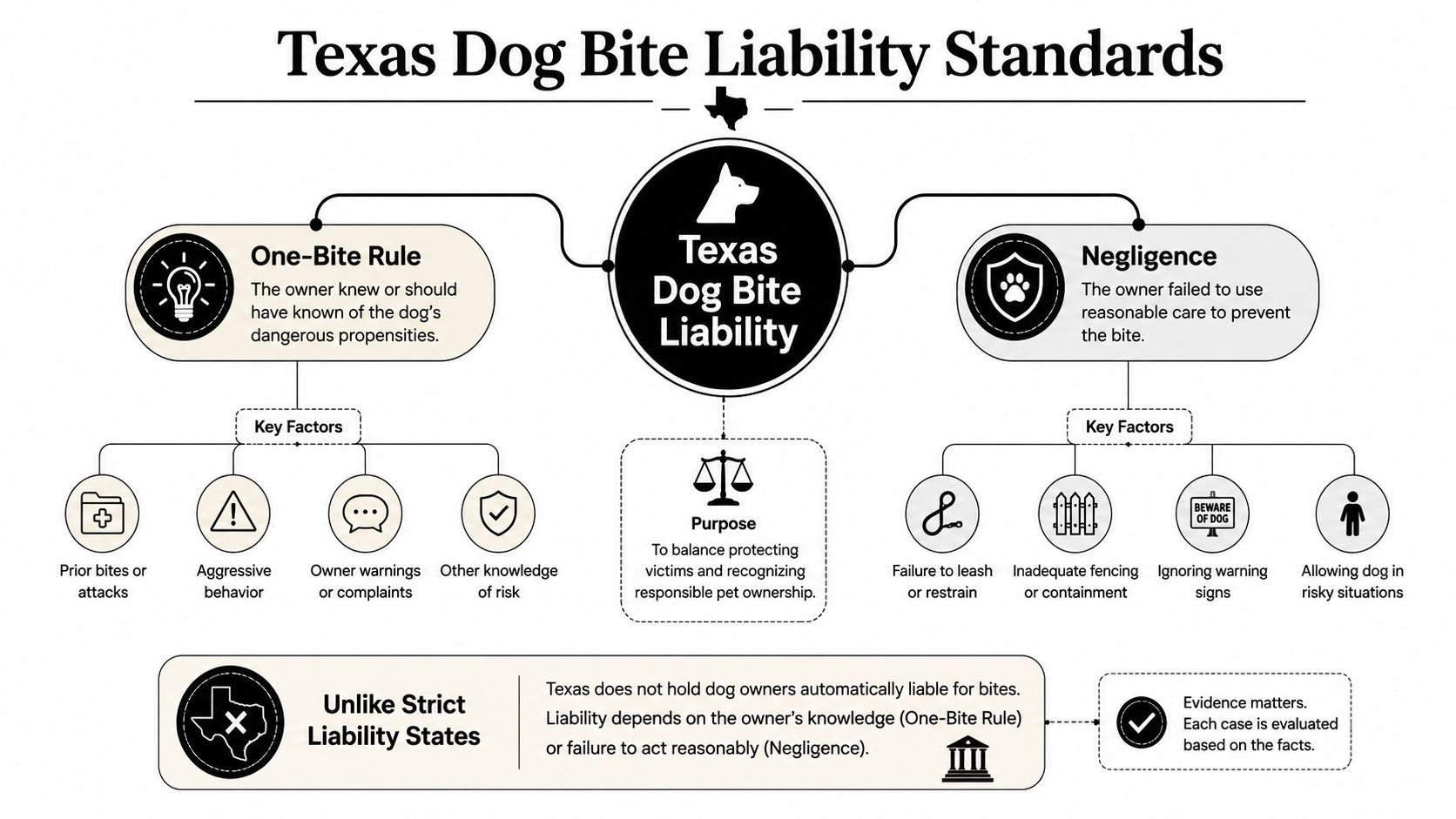
Texas dog bite cases usually turn on negligence and the state's one-bite rule, so the legal question is often whether the owner knew, or should have known, the dog posed a danger. That is a different path from strict-liability states, where the fact of the bite can carry much more weight by itself. Simmons and Fletcher summarizes this Texas approach well, because the focus stays on warning signs, owner control, and whether reasonable care was used.
The first 72 hours matter because liability is built from facts, not guesses. Get medical care, take photos of injuries and torn clothing, save the names of witnesses, and report the bite to the right local authority if that is available in your area. A claim often develops like a file on a desk, if one page is missing, the insurance company will use that gap to question the whole story.
What liability really means
Liability is the legal bridge between the bite and compensation. If the owner had prior warning signs, such as aggressive behavior or an earlier incident, that evidence can support the claim. If the owner failed to leash, confine, or supervise the dog in a reasonable way, negligence may still support recovery even when there is no formal prior bite history.
Texas also uses modified comparative negligence, which matters if the insurer tries to place part of the blame on you. A person found 50% or more at fault cannot recover, while a person found less than 50% at fault can still recover damages reduced by that share of fault. That makes details like where you were standing, whether you ignored a warning, and whether you provoked the dog part of the legal analysis.
Property and location questions can also matter, especially if the bite happened on someone else's land or near a business entrance. For a broader explanation of how property conditions affect injury claims, see Texas premises liability law.
Texas injury claims also have a filing deadline, and that deadline starts with the bite itself in the usual case. If the injured person is a child, the limitations period is generally treated differently until adulthood, which means the age of the victim can change the timing analysis. The settlement discussion can also be affected by whether medical care is delayed because the victim is trying to cut medical costs for the uninsured, since gaps in treatment often become part of the insurer's argument.
Settlement Ranges and Damages Calculation
Texas settlement value usually tracks injury severity, not a simple formula. One Texas legal source places typical ranges at about $30,000 to $50,000 for minor bites, $50,000 to $100,000 for moderate injuries, $100,000 to $500,000+ for severe disfigurement, and $500,000 to $1 million+ for catastrophic injury or death, with similar severity bands reported by Texas Legal Group. Those bands help you think about value, but they don't replace the facts of your case.
What goes into the number
Medical bills are usually the easiest part to prove. Lost wages matter too, especially if you missed work for doctor visits, infection treatment, or surgery. Pain and suffering, mental distress, and lasting scarring can move a case far beyond the bill total.
Here's a simple way to think about it. A bite that heals with routine treatment sits in one range. A bite that needs plastic surgery, counseling, or future revision work sits in a different one entirely.
| Injury Severity | Typical Settlement Range |
|---|---|
| Minor bite | $30,000 to $50,000 |
| Moderate injury | $50,000 to $100,000 |
| Severe disfigurement | $100,000 to $500,000+ |
| Catastrophic injury or death | $500,000 to $1 million+ |
If you're trying to reduce medical bills while you wait on a claim, it can help to cut medical costs for the uninsured so the debt doesn't grow faster than the case. That's a practical step, not a substitute for legal recovery.
A case review with Texas Personal Injury Lawyer may be useful if you need representation for injury victims across Texas on a no-fee-unless-we-win basis. That can be especially important when injuries are serious and the insurance company pushes a low early offer.
Evidence and Documentation Checklist
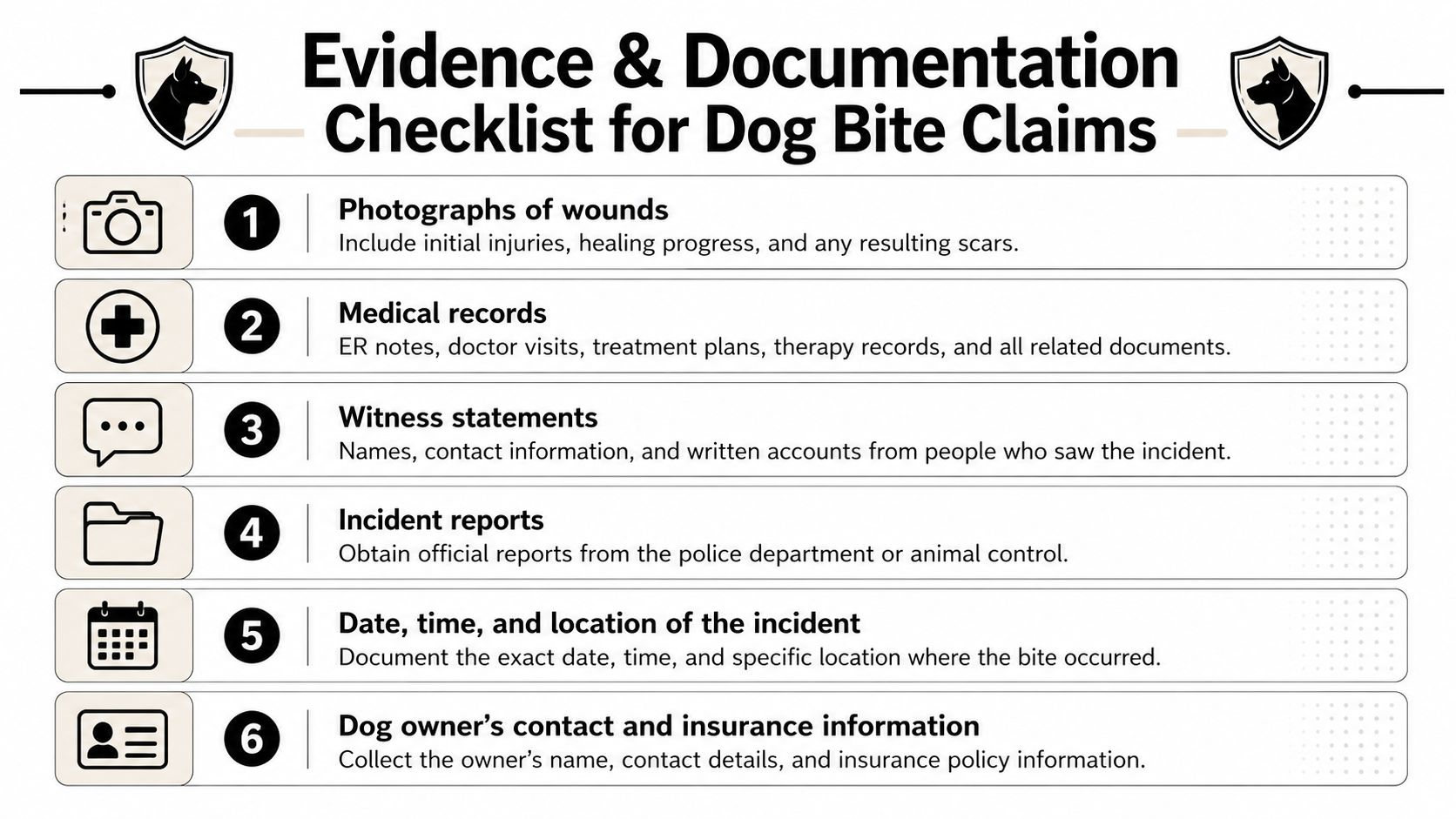
The strongest dog bite claims usually look orderly on paper. That doesn't happen by accident. It happens when someone saves records, photographs injuries at different stages, and keeps the story of the bite consistent from the hospital through the insurance claim.
What to gather first
Start with the wound itself. Take clear photos of the bite as soon as you can, then keep taking photos as it heals. Initial swelling, stitches, scabs, infection signs, and later scarring all help show the full impact of the injury.
Next, keep every medical record in one place. ER notes, urgent care records, prescriptions, therapy visits, and plastic-surgery consults all help create the injury-to-treatment chain that Texas lawyers use to prove value. That point matters because high-value Texas claims depend on documented prior aggression, a clear treatment trail, and objective proof like ER records, lost-wage statements, and scar photos, as discussed by the Texas Bar.
Then collect the human evidence. Witness names, phone numbers, and short written statements can confirm what happened before memories fade. If animal control or police made a report, keep a copy of that too.
Keep your records like a file a doctor, insurer, and lawyer could all understand without extra explanations.
For families trying to stay organized, Family Folder for medical records is a useful reference for building a simple document system. It's easier to negotiate from a complete file than from a stack of loose papers.
If you want a visual reminder of what to save, the short video below is a helpful supplement to the checklist above.
Dealing with Insurance and Fault Defenses
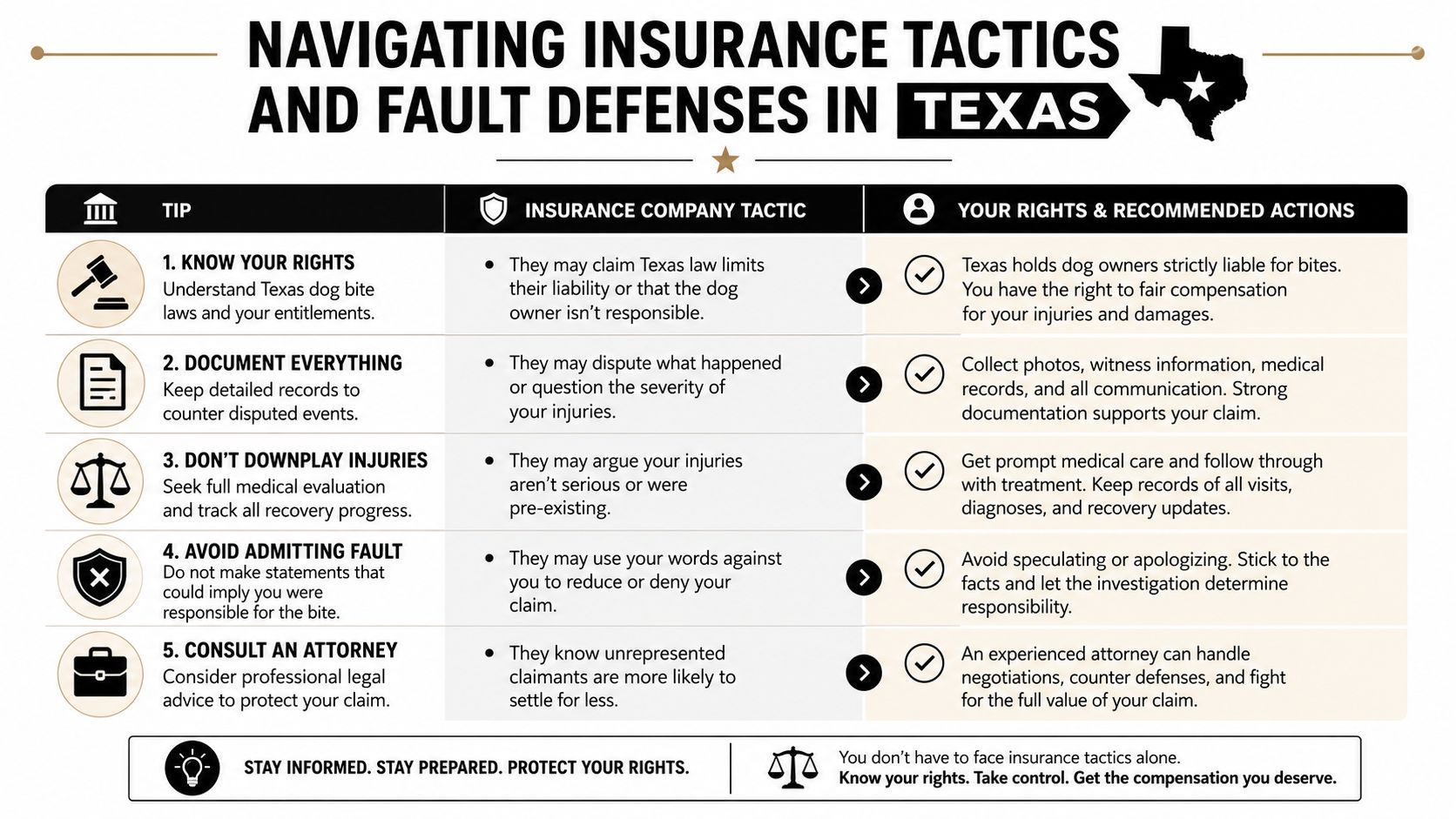
An insurance adjuster may contact you quickly after a dog bite. The first call can sound routine, but it often serves a clear purpose, to narrow the claim before you have the chance to gather your records. The adjuster may ask for a recorded statement, suggest the injury is minor, or imply that you caused the dog to react.
The safest response is steady and factual. Do not guess about what happened, do not exaggerate, and do not minimize the wound just to sound tough. If the insurer wants details, give them through medical records, photographs, and a written summary of the incident instead of a casual phone conversation that can be taken out of context later.
What insurers may argue
One common defense is to dispute the facts. An adjuster may question where the bite happened, whether the dog was restrained, or whether you provoked it in some way. Another common defense is to minimize the injury, especially when the wound looked small at first but later became infected or required more treatment. Both tactics try to reduce the amount the insurer believes it must pay.
Texas comparative fault law makes those tactics matter. Under the modified negligence rule, a person found 50% or more at fault cannot recover, while a lower share of fault reduces the award by that percentage, according to TexaCreek. A small statement can carry real weight, the way a loose brick can weaken an entire wall.
Insurance rule of thumb: If a question sounds designed to get you to accept blame, pause and get legal advice before you answer.
If the bite happened at a rental home, apartment complex, or business property, the facts may also involve a landlord, property owner, or another party with separate responsibilities. That kind of overlap makes early review important, because each person or company may point to someone else and try to avoid responsibility. Clear records and careful wording help keep the focus on what happened, not on an insurer's preferred version of events.
The first 72 hours matter here. Save photos, text messages, witness names, clothing, and medical receipts right away, before memory fades and the scene changes. For a fuller explanation of why timing controls a case, the statute of limitations for personal injury resource explains how deadline rules affect Texas injury claims.
Key Deadlines and Statute Limitation Rules
A dog bite claim can lose its footing if the deadline passes. In Texas, the main filing deadline for a personal injury case is generally controlled by the rules explained in the statute of limitations for personal injury resource, and for minors that clock is generally paused until the child turns 18. That timing rule matters because a case is like a train with a departure time. If you miss it, the station closes even if the facts are strong.
A practical timeline
The first 24 hours should focus on health and reporting. Get medical attention quickly, and make sure the bite is reported to animal control and documented by a treating professional, because Texas guidance says both local animal control and medical professionals have reporting duties, as noted by FindLaw. That report is more than paperwork. It helps protect the public and creates the first layer of your legal record.
The first 72 hours should focus on preservation. Save photos, text messages, witness names, clothing, and medical receipts. In a legal claim, those items work like the first pieces of a puzzle. Once memory fades and the wound starts to heal, the picture gets harder to complete.
If you want a clearer sense of why deadline control matters in Texas injury claims, the statute of limitations for personal injury guide explains how filing windows protect the right to pursue a claim. The rule sounds technical, but its purpose is simple. It keeps the claim alive long enough for the injured person to be heard.
A demand letter usually comes after the medical picture is developed enough to support a settlement figure. Sent too early, it can leave out future treatment and understate the case. Sent too late, the insurer may already be dug in and harder to move.
When to Hire a Lawyer and Next Steps
A lawyer matters earlier than many injured people expect. If the bite left permanent scarring, caused an infection, kept you out of work, involved disputed fault, or injured a child's face, the claim has moved into territory where settlement value depends on careful proof and negotiation. The same concern arises when an insurer urges you to settle before the full medical picture is clear.
Signs it's time to call
- Serious medical treatment: ER visits, stitches, surgery, or follow-up care can make the claim more complex.
- Unclear liability: If the dog owner denies fault or says the dog had never acted aggressively, the legal fight gets harder.
- Children or facial injuries: These often raise future-care questions and long-term emotional harm.
- Insurance pressure: Early low offers usually leave out future treatment and non-economic damages.
The first 72 hours still matter here, even if you are already thinking about a lawyer. Preserve the wound photos, medical instructions, animal-control report, witness names, clothing, and every insurer message, because those items form the paper trail that a settlement lawyer will later use to measure the case. A claim is a little like building a file cabinet, if the early folders are empty, later proof has nowhere to go.
An experienced Texas personal injury attorney can organize the evidence, speak with the insurer, and value the claim with the future in mind. In a broader injury practice, firms may also handle truck crashes, wrongful death claims, and catastrophic injury cases, which is useful when a dog bite overlaps with another serious injury problem, such as a truck crash lawyer Houston matter or a wrongful death lawyer Texas search. You should not have to sort through those issues alone.
If you meet with a lawyer, bring your photos, medical bills, witness names, insurance letters, and any report you filed in those first few days. Ask who will handle communication, how treatment affects settlement value, and what facts could weaken the claim. If the case is suitable, the right firm can move it forward without making you pay upfront.
Hope and Legal Help for Dog Bite Victims
You've already done the hardest part by learning how Texas treats fault, deadlines, proof, and insurance tactics. Recovery is still possible, even when the wound, the bills, and the worry feel overwhelming. The right next step is to put the facts in the hands of a legal team that knows how to value the harm and protect your claim.
The Law Office of Bryan Fagan, PLLC offers free consultations, and a careful review can help you understand whether your settlement should account for medical expenses, lost wages, pain and suffering, future care, or scarring. If you're ready to talk, reach out now. Help is available, and you don't have to figure this out by yourself.
A CTA for Law Office of Bryan Fagan, PLLC.